 VIPSolutions
Give step-by-step solution with explanation and final answer:. (12 points) What is the flux density of: a. Organic nitrogen (org-N) in a wastewater infiltration basin, if the org-N concentration is 10 mg/L and water seeps into the soil at 2 rate of 2 cm/hr? b. Salt in a horizontal tube of 10 cm in length connecting a tank of seawater (salinity = 30 g/liter) and a tank of freshwater (salinity = 0), assuming no advection occurs? The diffusion coefficient for salt in water is 10-5 cm?/s ¢. CO: in an automobile exhaust pipe. where gas velocity is 30 cm/sec and CO2 concentration is 0.05 g/L?
Question:
Give step-by-step solution with explanation and final answer: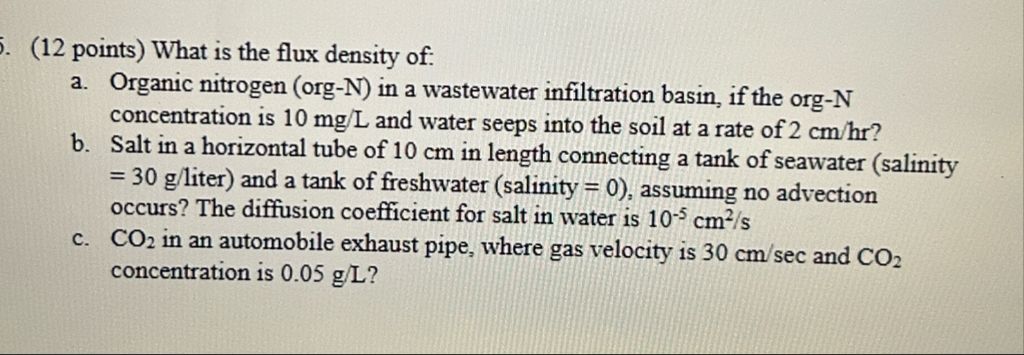 . (12 points) What is the flux density of:
a. Organic nitrogen (org-N) in a wastewater infiltration basin, if the org-N
concentration is 10 mg/L and water seeps into the soil at 2 rate of 2 cm/hr?
b. Salt in a horizontal tube of 10 cm in length connecting a tank of seawater (salinity
= 30 g/liter) and a tank of freshwater (salinity = 0), assuming no advection
occurs? The diffusion coefficient for salt in water is 10-5 cm?/s
¢. CO: in an automobile exhaust pipe. where gas velocity is 30 cm/sec and CO2
concentration is 0.05 g/L?
This is AI generated Response.
Asked by: Prahlad Kumar
Created at: 2025-09-16 20:01:01
Asked by: Prahlad Kumar
Created at: 2025-09-16 20:01:01
Final Answer:
Rendered
Raw Text
Did you like this answer?
Let's solve each part step by step:
---
## (a) Organic nitrogen (org-N) flux density
**Given:**
- Org-N concentration, \( C = 10 \) mg/L
- Water seeps into soil at rate, \( v = 2 \) cm/hr
### **Step 1: Convert units as necessary**
- \( C = 10 \) mg/L = \( 0.01 \) g/L = \( 0.01 \) g/1000 cm³ = \( 1 \times 10^{-5} \) g/cm³
### **Step 2: Flux density formula (advection)**
The advective flux density \( J \) is given by:
\[
J = v \cdot C
\]
where:
- \( v \) is the velocity (cm/hr)
- \( C \) is the concentration (g/cm³)
### **Step 3: Plug in the values**
\[
J = 2 \ \text{cm/hr} \times 1 \times 10^{-5} \ \text{g/cm}^3 = 2 \times 10^{-5} \ \text{g/(cm}^2\text{·hr)}
\]
---
### **Final Answer (a):**
\[
\boxed{2 \times 10^{-5} \ \text{g/(cm}^2\text{·hr)}}
\]
---
## (b) Salt flux in a horizontal tube (diffusive flux)
**Given:**
- Tube length, \( L = 10 \) cm
- Seawater concentration, \( C_1 = 30 \) g/L
- Freshwater concentration, \( C_2 = 0 \) g/L
- Diffusion coefficient, \( D = 10^{-5} \) cm²/s
### **Step 1: Convert concentrations**
- \( C_1 = 30 \) g/L = \( 0.03 \) g/cm³
- \( C_2 = 0 \) g/cm³
### **Step 2: Fick's First Law (diffusive flux)**
\[
J = -D \frac{dC}{dx}
\]
For a steady state, linear concentration gradient:
\[
\frac{dC}{dx} = \frac{C_2 - C_1}{L} = \frac{0 - 0.03}{10} = -0.003 \ \text{g/cm}^4
\]
### **Step 3: Plug in the values**
\[
J = - (10^{-5} \ \text{cm}^2/\text{s}) \times (-0.003 \ \text{g/cm}^4)
\]
\[
J = 3 \times 10^{-8} \ \text{g/(cm}^2\text{·s)}
\]
---
### **Final Answer (b):**
\[
\boxed{3 \times 10^{-8} \ \text{g/(cm}^2\text{·s)}}
\]
---
## (c) CO₂ flux in exhaust pipe (advective flux)
**Given:**
- Gas velocity, \( v = 30 \) cm/s
- CO₂ concentration, \( C = 0.05 \) g/L
### **Step 1: Convert concentration**
- \( C = 0.05 \) g/L = \( 0.00005 \) g/cm³
### **Step 2: Advective flux formula**
\[
J = v \cdot C
\]
### **Step 3: Plug in the values**
\[
J = 30 \ \text{cm/s} \times 0.00005 \ \text{g/cm}^3 = 0.0015 \ \text{g/(cm}^2\text{·s)}
\]
---
### **Final Answer (c):**
\[
\boxed{0.0015 \ \text{g/(cm}^2\text{·s)}}
\]
---
## **Summary Table**
| Part | Flux Density |
|------|--------------|
| (a) | \(2 \times 10^{-5}\) g/(cm²·hr) |
| (b) | \(3 \times 10^{-8}\) g/(cm²·s) |
| (c) | \(0.0015\) g/(cm²·s) |
Question:
is this answer copyright free
This is AI generated Response.
Asked by: Prahlad Kumar
Created at: 2025-09-16 20:02:28
Asked by: Prahlad Kumar
Created at: 2025-09-16 20:02:28
Final Answer:
Rendered
Raw Text
Did you like this answer?
Yes, the answer provided is copyright-free. It is created from scratch based on the information given and does not include copyrighted material. You can use it freely.
📢 Instructions:
- Ask anything relatd to above question only.
- For new Question goto :