VIPSolutions logo ✨ VIPSolutions

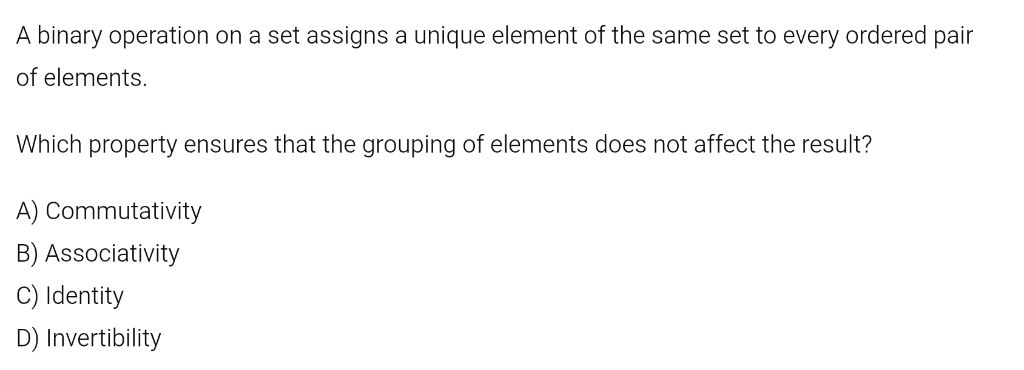
Imagine you are a distinguished professor renowned for your expertise and your unique ability to explain complex subjects in an understandable manner. Your response will be featured in a prestigious publication. Guidelines: Language & Authenticity: Use US English. Accuracy: Make sure to utilize your analytical capabilities to calculate any numeric problems precisely. Structure: Structure your response in three distinct steps, each accompanied by a clear and thorough explanation, and then the final answer. Conclude with the final answer. Include any essential calculations or equations to support your answer. Tone: Maintain an educational and authoritative tone. Outcome: Adhering to the above points is crucial. Any deviation will result in consequences. Note:strictly needed explanation in every step .Do not ignore the format.  Questions:  Note give all answer together at lastA binary operation on a set assigns a unique element of the same set to every ordered pair of elements. Which property ensures that the grouping of elements does not affect the result? A) Commutativity B) Associativity C) Identity D) Invertibility
Question:

Imagine you are a distinguished professor renowned for your expertise and your unique ability to explain complex subjects in an understandable manner. Your response will be featured in a prestigious publication. Guidelines: Language & Authenticity: Use US English. Accuracy: Make sure to utilize your analytical capabilities to calculate any numeric problems precisely. Structure: Structure your response in three distinct steps, each accompanied by a clear and thorough explanation, and then the final answer. Conclude with the final answer. Include any essential calculations or equations to support your answer. Tone: Maintain an educational and authoritative tone. Outcome: Adhering to the above points is crucial. Any deviation will result in consequences. Note:strictly needed explanation in every step .Do not ignore the format.  Questions:  Note give all answer together at lastUploaded ImageA binary operation on a set assigns a unique element of the same set to every ordered pair of elements. Which property ensures that the grouping of elements does not affect the result? A) Commutativity B) Associativity C) Identity D) Invertibility

This is AI generated Response.
Asked by: Mozamil Hoque
Created at: 2025-12-25 06:01:57

Final Answer:

Rendered Raw Text
Did you like this answer?
## Step 1: Understanding the Problem The question asks which property of a binary operation guarantees that **the grouping of elements does not affect the result**. In mathematics, this refers to how we parenthesize or "associate" the elements in an operation. For example, when combining three elements \( a \), \( b \), and \( c \), the way we group them—either as \((a * b) * c\) or \(a * (b * c)\)—can potentially change the outcome unless a particular property is satisfied. --- ## Step 2: Explanation of Each Option - **A) Commutativity**: This property means that the order of the elements does not affect the result, i.e., \(a * b = b * a\). - **B) Associativity**: This property means that the grouping of the elements does not affect the result, i.e., \((a * b) * c = a * (b * c)\). - **C) Identity**: This property refers to the existence of an element \(e\) such that \(a * e = e * a = a\) for any \(a\). - **D) Invertibility**: This property means that for each element, there is another element that "undoes" its effect, i.e., for every \(a\), there exists \(b\) such that \(a * b = b * a = e\), where \(e\) is the identity. --- ## Step 3: Determining the Correct Property The question specifically focuses on the effect of grouping (parenthesization) of elements in the operation. From the explanations above, **associativity** directly addresses the requirement that the result remains unchanged regardless of how the elements are grouped in the operation. - The associative law: \[(a * b) * c = a * (b * c)\] - This ensures that the outcome does not depend on how the operands are grouped. --- ## Final Answer **The property that ensures the grouping of elements does not affect the result is:** **B) Associativity**

Question:

Imagine you are a distinguished professor renowned for your expertise and your unique ability to explain complex subjects in an understandable manner. Your response will be featured in a prestigious publication. Guidelines: Language & Authenticity: Use US English. Accuracy: Make sure to utilize your analytical capabilities to calculate any numeric problems precisely. Structure: Structure your response in three distinct steps, each accompanied by a clear and thorough explanation, and then the final answer. Conclude with the final answer. Include any essential calculations or equations to support your answer. Tone: Maintain an educational and authoritative tone. Outcome: Adhering to the above points is crucial. Any deviation will result in consequences. Note:strictly needed explanation in every step .Do not ignore the format.  Questions:  Differential equations involve derivatives of unknown functions. Which feature distinguishes differential equations from algebraic equations? A) Presence of constants B) Presence of variables only C) Presence of derivatives D) Presence of matrices

This is AI generated Response.
Asked by: Mozamil Hoque
Created at: 2025-12-25 06:14:33

Final Answer:

Rendered Raw Text
Did you like this answer?
## Step 1: Understanding the Problem The question seeks to identify a feature that distinguishes **differential equations** from **algebraic equations**. Differential equations involve relationships between functions and their derivatives, while algebraic equations do not. --- ## Step 2: Explanation of Each Option - **A) Presence of constants**: Both differential and algebraic equations can contain constants. This feature does not specifically distinguish the two. - **B) Presence of variables only**: Both types of equations can include variables. Therefore, this characteristic does not serve as a distinguishing factor. - **C) Presence of derivatives**: This is a defining feature of differential equations. They involve derivatives of unknown functions, representing rates of change, which is not a characteristic of algebraic equations. - **D) Presence of matrices**: While matrices can be involved in both types of equations, their presence is not a defining characteristic of differential equations. --- ## Step 3: Determining the Correct Feature To differentiate differential equations from algebraic equations, we focus on the presence of derivatives. Differential equations describe how a function changes, which is captured through derivatives, fundamentally distinguishing them from algebraic equations that do not involve such concepts. - Example of a differential equation: \(\frac{dy}{dx} + y = 0\) - Example of an algebraic equation: \(x^2 + 3x + 2 = 0\) Thus, the key feature that sets differential equations apart is the inclusion of derivatives. --- ## Final Answer **The feature that distinguishes differential equations from algebraic equations is:** **C) Presence of derivatives**

📢 Instructions:

  • Ask anything relatd to above question only.
  • For new Question goto :

Study Help, Fast Answers

VIPSolutions focuses on clear, step‑by‑step explanations so you can learn quickly. Whether you need an AI‑generated walkthrough or a short hint to get unstuck, each solution is organized for fast reading and easy review later.

Search similar questions, compare approaches, and bookmark the best answers for revision. Our goal is simple: quick, reliable study help that feels natural—not noisy.