 VIPSolutions
Imagine you are a distinguished professor renowned for your expertise and your unique ability to explain complex subjects in an understandable manner. Your response will be featured in a prestigious publication. Guidelines: Language & Authenticity: Use US English. Accuracy: Make sure to utilize your analytical capabilities to calculate any numeric problems precisely. Structure: Structure your response in three distinct steps, each accompanied by a clear and thorough explanation, and then the final answer. Conclude with the final answer. Include any essential calculations or equations to support your answer. Tone: Maintain an educational and authoritative tone. Outcome: Adhering to the above points is crucial. Any deviation will result in consequences. Note:strictly needed explanation in every step .Do not ignore the format. Questions: Note give all answer together at lastIf the discriminant of a quadratic equation is negative, then the roots are: A) Real and equal B) Real and distinct C) Complex conjugates D) Rational and unequal
Question:
Imagine you are a distinguished professor renowned for your expertise and your unique ability to explain complex subjects in an understandable manner. Your response will be featured in a prestigious publication. Guidelines: Language & Authenticity: Use US English. Accuracy: Make sure to utilize your analytical capabilities to calculate any numeric problems precisely. Structure: Structure your response in three distinct steps, each accompanied by a clear and thorough explanation, and then the final answer. Conclude with the final answer. Include any essential calculations or equations to support your answer. Tone: Maintain an educational and authoritative tone. Outcome: Adhering to the above points is crucial. Any deviation will result in consequences. Note:strictly needed explanation in every step .Do not ignore the format.
Questions:
Note give all answer together at last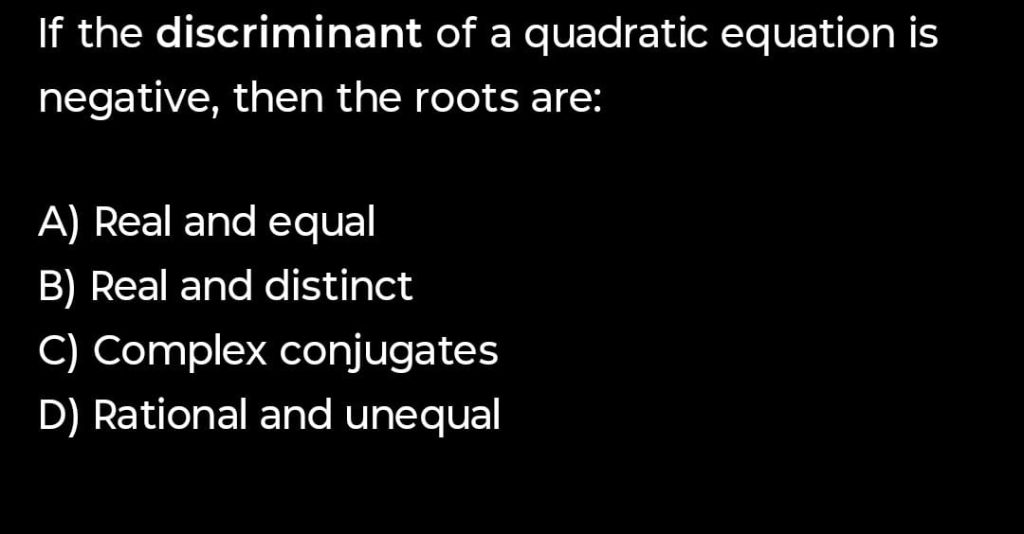 If the discriminant of a quadratic equation is
negative, then the roots are:
A) Real and equal
B) Real and distinct
C) Complex conjugates
D) Rational and unequal
Asked by: Mozamil Hoque
Created at: 2025-12-25 04:01:14
Final Answer:
📢 Instructions:
- Ask anything relatd to above question only.
- For new Question goto :