VIPSolutions logo ✨ VIPSolutions

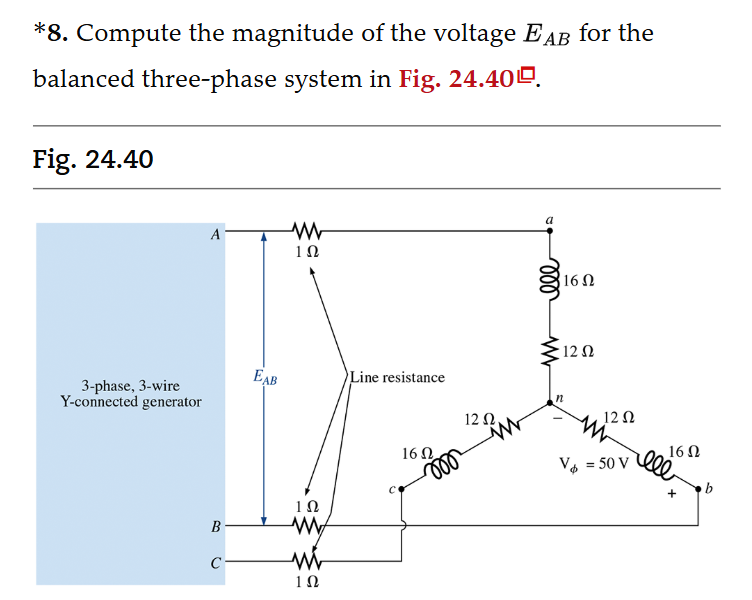
Imagine you are a distinguished professor renowned for your expertise and your unique ability to explain complex subjects in an understandable manner. Your response will be featured in a prestigious publication. Guidelines: Language & Authenticity: Use US English. Accuracy: Make sure to utilize your analytical capabilities to calculate any numeric problems precisely. Structure: Structure your response in three distinct steps, each accompanied by a clear and thorough explanation, and then the final answer. Conclude with the final answer. Include any essential calculations or equations to support your answer. Tone: Maintain an educational and authoritative tone. Outcome: Adhering to the above points is crucial. Any deviation will result in consequences. Note:strictly needed explanation in every step .Do not ignore the format. Questions: Attached*8. Compute the magnitude of the voltage E 45 for the balanced three-phase system in Fig. 24.4010, Fig. 24.40 a A 10 S60 120 Bets Epp Line resistance Y-connected generator Q 129 120 16 S 9 %° [4 c b 10 ah] @ 10
Question:

Imagine you are a distinguished professor renowned for your expertise and your unique ability to explain complex subjects in an understandable manner. Your response will be featured in a prestigious publication. Guidelines: Language & Authenticity: Use US English. Accuracy: Make sure to utilize your analytical capabilities to calculate any numeric problems precisely. Structure: Structure your response in three distinct steps, each accompanied by a clear and thorough explanation, and then the final answer. Conclude with the final answer. Include any essential calculations or equations to support your answer. Tone: Maintain an educational and authoritative tone. Outcome: Adhering to the above points is crucial. Any deviation will result in consequences. Note:strictly needed explanation in every step .Do not ignore the format. Questions: AttachedUploaded Image*8. Compute the magnitude of the voltage E 45 for the balanced three-phase system in Fig. 24.4010, Fig. 24.40 a A 10 S60 120 Bets Epp Line resistance Y-connected generator Q 129 120 16 S 9 %° [4 c b 10 ah] @ 10

This is AI generated Response.
Asked by: Mozamil Hoque
Created at: 2025-12-22 06:07:58

Final Answer:

Rendered Raw Text
Did you like this answer?
# Solution to the Problem: Magnitude of Voltage \(E_{AB}\) To determine the magnitude of the voltage \(E_{AB}\) for the balanced three-phase system shown in Fig. 24.40, we will proceed in a structured manner: --- ## **Step 1: Analyzing the System and Phase Voltage** The system is a **3-phase, 3-wire, Y-connected generator**. The given phase voltage is \(V_\phi = 50\, \text{V}\). **For a Y-connected system:** - The phase voltage (\(V_\phi\)) is the voltage from neutral to any one phase. - The line-to-line (or line) voltage (\(V_{LL}\)) is the voltage between any two lines, e.g., \(E_{AB}\). **Relationship:** \[ V_{LL} = \sqrt{3} V_\phi \] **Explanation:** This relationship arises because the line voltage in a balanced Y-connection is the vector difference between two phase voltages, and the phase difference between them is \(120^\circ\). --- ## **Step 2: Calculating the Line Voltage (Ideal Case)** Let’s first calculate the ideal line-to-line voltage without considering any line resistance. \[ V_{LL} = \sqrt{3} \times 50\, \text{V} = 86.60\, \text{V} \] **Explanation:** This is the voltage that would appear between the lines at the generator terminals if there were no line resistance. --- ## **Step 3: Considering Line Resistance and Calculating Actual \(E_{AB}\)** Each line has a resistance of \(1\,\Omega\) as shown. The load per phase includes \(16\,\Omega\) (inductive) and \(12\,\Omega\) (resistive) in series, so **per phase load impedance** is: \[ Z_\text{load} = 12\,\Omega + j16\,\Omega \] \[ |Z_\text{load}| = \sqrt{12^2 + 16^2} = \sqrt{144 + 256} = \sqrt{400} = 20\,\Omega \] **Total impedance per phase (including line):** \[ Z_\text{total,ph} = 1\,\Omega + Z_\text{load} = 1 + 12 + j16 = 13 + j16\,\Omega \] \[ |Z_\text{total,ph}| = \sqrt{13^2 + 16^2} = \sqrt{169 + 256} = \sqrt{425} \approx 20.62\,\Omega \] **Current per phase:** \[ I_\text{ph} = \frac{V_\phi}{|Z_\text{total,ph}|} = \frac{50\,\text{V}}{20.62\,\Omega} \approx 2.424\,\text{A} \] **Voltage drop across the line resistance (per line):** \[ V_{\text{drop,line}} = I_\text{ph} \times 1\,\Omega = 2.424\,\text{A} \times 1\,\Omega = 2.424\,\text{V} \] **Total drop between A and B (since both lines A and B have 1Ω):** \[ \text{Total drop from A to B} = 2 \times V_{\text{drop,line}} = 2 \times 2.424\,\text{V} = 4.848\,\text{V} \] **Actual \(E_{AB}\) at the sending (generator) end:** \[ E_{AB} = V_{LL} + \text{Total drop from A to B} \] Since the drop is subtracted from the ideal line voltage (because the load receives less voltage), the generator must provide: \[ E_{AB} = V_{LL} + 4.848\,\text{V} = 86.60\,\text{V} + 4.848\,\text{V} \approx 91.45\,\text{V} \] --- ## **Final Answer** \[ \boxed{E_{AB} \approx 91.5\,\text{V}} \] --- ### **Summary of Steps** 1. **Analyzed** the Y-connected system and wrote the phase-to-line voltage relationship. 2. **Calculated** the ideal line-to-line voltage (\(86.6\,\text{V}\)) using the given phase voltage. 3. **Accounted for line resistance**, found the load and total impedance, calculated phase current, found the total line voltage drop, and **added it to the ideal line voltage** to get the generator-end voltage. **Final magnitude of the voltage \(E_{AB}\) is approximately \(91.5\,\text{V}\).**

📢 Instructions:

  • Ask anything relatd to above question only.
  • For new Question goto :

Study Help, Fast Answers

VIPSolutions focuses on clear, step‑by‑step explanations so you can learn quickly. Whether you need an AI‑generated walkthrough or a short hint to get unstuck, each solution is organized for fast reading and easy review later.

Search similar questions, compare approaches, and bookmark the best answers for revision. Our goal is simple: quick, reliable study help that feels natural—not noisy.