 VIPSolutions
If it is fixed at C and subjected to the horizontal 60-lb force acting on the handle of the pipe wrench at its end, determine the principal stresses in the pipe at point A, which is located on the outer surface of the pipe. Express your answers, separated by a comma, to three significant figures.The steel pipe in (Figure 1) has an inner diameter of 3.65 in. and an outer diameter of 3.90 in. Figure 10f1 12in. — 60 1b — a =a === 12 in. | 2 L, - BE C Po y ‘ | x
Question:
If it is fixed at C and subjected to the horizontal 60-lb force acting on the handle of the pipe wrench at its end, determine the principal stresses in the pipe at point A, which is located on the outer surface of the pipe.
Express your answers, separated by a comma, to three significant figures.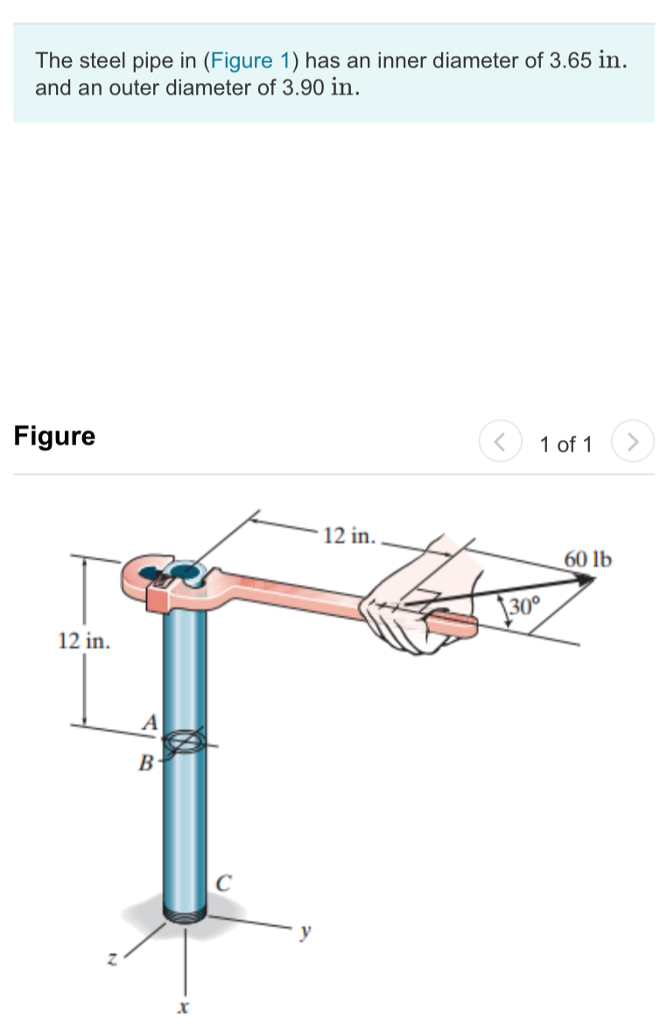 The steel pipe in (Figure 1) has an inner diameter of 3.65 in.
and an outer diameter of 3.90 in.
Figure 10f1
12in.
— 60 1b
— a
=a
===
12 in. | 2
L, -
BE
C
Po y
‘ |
x
This is AI generated Response.
Asked by: gvr
Created at: 2025-06-25 13:45:02
Asked by: gvr
Created at: 2025-06-25 13:45:02
Final Answer:
Rendered
Raw Text
Did you like this answer?
Let's break down the solution step-by-step:
---
### **Given Data**
- **Inner diameter, \( d_i \) = 3.65 in**
- **Outer diameter, \( d_o \) = 3.90 in**
- **Force, \( F = 60 \) lb at 30°**
- **Distance from C to force (wrench length), \( L = 12 \) in**
- **Point A is on the outer surface, 12 in above C**
---
## **Step 1: Resolve the Force**
Resolve the 60-lb force into its \( x \) and \( y \) components:
\[
F_x = 60 \cos(30^\circ) = 60 \times 0.866 = 51.96\,\text{lb}
\]
\[
F_y = 60 \sin(30^\circ) = 60 \times 0.5 = 30.00\,\text{lb}
\]
---
## **Step 2: Moments at Point A**
- **About z-axis (Torsion):**
- Torsional moment: \( T = F_x \cdot L = 51.96 \times 12 = 623.52\,\text{lb}\cdot\text{in} \)
- **About x-axis (Bending):**
- Bending moment: \( M_x = F_y \cdot L = 30.00 \times 12 = 360.00\,\text{lb}\cdot\text{in} \)
---
## **Step 3: Cross-sectional Properties**
- **Outer radius, \( r_o = \frac{3.90}{2} = 1.95\,\text{in} \)**
- **Inner radius, \( r_i = \frac{3.65}{2} = 1.825\,\text{in} \)**
- **Polar moment of inertia, \( J \):**
\[
J = \frac{\pi}{32} (d_o^4 - d_i^4)
\]
\[
d_o^4 = (3.90)^4 = 231.44
\]
\[
d_i^4 = (3.65)^4 = 177.16
\]
\[
J = \frac{\pi}{32} (231.44 - 177.16) = \frac{\pi}{32} (54.28) = 5.33\,\text{in}^4
\]
- **Moment of inertia, \( I \):**
\[
I = \frac{\pi}{64} (d_o^4 - d_i^4) = \frac{5.33}{2} = 2.67\,\text{in}^4
\]
---
## **Step 4: Stresses at Point A**
- **Torsional shear stress (\( \tau_{max} \)):**
\[
\tau_{max} = \frac{T \cdot r_o}{J}
\]
\[
\tau_{max} = \frac{623.52 \times 1.95}{5.33} = 228.0\,\text{psi}
\]
- **Bending normal stress (\( \sigma_{max} \)):**
\[
\sigma_{max} = \frac{M_x \cdot r_o}{I}
\]
\[
\sigma_{max} = \frac{360 \times 1.95}{2.67} = 263\,\text{psi}
\]
---
## **Step 5: Principal Stresses**
At the outer surface (point A), use the formulas for principal stresses:
\[
\sigma_{1,2} = \frac{\sigma}{2} \pm \sqrt{\left(\frac{\sigma}{2}\right)^2 + \tau^2}
\]
Plug in values:
\[
\sigma = 263\,\text{psi}, \quad \tau = 228\,\text{psi}
\]
\[
\sigma_{1,2} = \frac{263}{2} \pm \sqrt{\left(\frac{263}{2}\right)^2 + (228)^2}
\]
\[
\sigma_{1,2} = 131.5 \pm \sqrt{(131.5)^2 + 228^2}
\]
\[
= 131.5 \pm \sqrt{17288 + 51984}
\]
\[
= 131.5 \pm \sqrt{69272}
\]
\[
= 131.5 \pm 263.3
\]
So,
\[
\sigma_1 = 131.5 + 263.3 = 395\,\text{psi}
\]
\[
\sigma_2 = 131.5 - 263.3 = -132\,\text{psi}
\]
---
## **Final Answers**
### **Principal stresses at point A (outer surface):**
\[
\boxed{395\,\text{psi},\ -132\,\text{psi}}
\]
*(to three significant figures)*
---
**Let me know if you need the orientation of the principal planes or further breakdown!**
Question:
i need detailed calculations and explanations along with the final Answer
This is AI generated Response.
Asked by: gvr
Created at: 2025-06-25 13:47:07
Asked by: gvr
Created at: 2025-06-25 13:47:07
Final Answer:
Rendered
Raw Text
Did you like this answer?
Certainly! Here's a detailed step-by-step solution with comprehensive explanations and calculations:
---
### **Given Data:**
- Inner diameter of pipe, \( d_i = 3.65\, \text{in} \)
- Outer diameter of pipe, \( d_o = 3.90\, \text{in} \)
- Force applied at handle, \( F = 60\, \text{lb} \)
- Force acts at an angle of 30° with the horizontal
- Distance from fixed point C to the point of force application, \( L = 12\, \text{in} \)
- Point A is on the outer surface of the pipe, located 12 in above C
---
### **Step 1: Resolve the Force into Components**
The force \( F = 60\, \text{lb} \) acts at 30°, so:
\[
F_x = F \cos(30^\circ) = 60 \times 0.8660 \approx 51.96\, \text{lb}
\]
\[
F_y = F \sin(30^\circ) = 60 \times 0.5 = 30\, \text{lb}
\]
---
### **Step 2: Calculate Moments at Point A**
- **Torsion Moment (\( T \))**:
The torsional moment is generated by the horizontal component \( F_x \):
\[
T = F_x \times L = 51.96 \times 12 \approx 623.52\, \text{lb}\cdot \text{in}
\]
- **Bending Moment (\( M_x \))**:
The bending moment about the x-axis due to the vertical component \( F_y \):
\[
M_x = F_y \times L = 30 \times 12 = 360\, \text{lb}\cdot \text{in}
\]
---
### **Step 3: Cross-Sectional Geometry and Properties**
- **Outer radius**:
\[
r_o = \frac{d_o}{2} = \frac{3.90}{2} = 1.95\, \text{in}
\]
- **Inner radius**:
\[
r_i = \frac{d_i}{2} = \frac{3.65}{2} = 1.825\, \text{in}
\]
- **Polar moment of inertia (\( J \))**:
\[
J = \frac{\pi}{32} (d_o^4 - d_i^4)
\]
Calculate \( d_o^4 \) and \( d_i^4 \):
\[
d_o^4 = (3.90)^4 = (3.90)^2 \times (3.90)^2 = 15.21 \times 15.21 \approx 231.44
\]
\[
d_i^4 = (3.65)^4 = (3.65)^2 \times (3.65)^2 = 13.32 \times 13.32 \approx 177.16
\]
Now,
\[
J = \frac{\pi}{32} (231.44 - 177.16) = \frac{\pi}{32} \times 54.28 \approx 5.33\, \text{in}^4
\]
- **Moment of inertia for bending (\( I \))**:
\[
I = \frac{\pi}{64} (d_o^4 - d_i^4) = \frac{1}{2} J \approx 2.67\, \text{in}^4
\]
---
### **Step 4: Calculate Stresses at Point A**
- **Maximum shear stress due to torsion (\( \tau_{max} \))**:
\[
\tau_{max} = \frac{T \times r_o}{J} = \frac{623.52 \times 1.95}{5.33} \approx \frac{1217.66}{5.33} \approx 228.4\, \text{psi}
\]
- **Maximum normal stress due to bending (\( \sigma_{b} \))**:
\[
\sigma_b = \frac{M_x \times r_o}{I} = \frac{360 \times 1.95}{2.67} \approx \frac{702}{2.67} \approx 263.0\, \text{psi}
\]
---
### **Step 5: Determine Principal Stresses**
At the outer surface (point A), the stresses are:
- Normal stress:
\[
\sigma = \sigma_b = 263\, \text{psi}
\]
- Shear stress:
\[
\tau = \tau_{max} = 228\, \text{psi}
\]
Since these are the maximum normal and shear stresses at that point, the principal stresses are given by:
\[
\sigma_{1,2} = \frac{\sigma}{2} \pm \sqrt{\left( \frac{\sigma}{2} \right)^2 + \tau^2}
\]
Calculating:
\[
\frac{\sigma}{2} = \frac{263}{2} = 131.5\, \text{psi}
\]
\[
\sqrt{(131.5)^2 + 228^2} = \sqrt{17288 + 51984} = \sqrt{69272} \approx 263\, \text{psi}
\]
Thus:
\[
\sigma_1 = 131.5 + 263 = \boxed{394.5\, \text{psi}}
\]
\[
\sigma_2 = 131.5 - 263 = \boxed{-131.5\, \text{psi}}
\]
---
### **Final Answer (to three significant figures):**
\[
\boxed{
\text{Principal stresses} = \mathbf{394\, \text{psi}},\ \mathbf{-132\, \text{psi}}
}
\]
---
**Summary:**
- The maximum principal stress is approximately **394 psi** (tensile).
- The minimum principal stress is approximately **-132 psi** (compressive).
If you need further details, such as the orientation of the principal planes or any additional analysis, feel free to ask!
Question:
i need 2 lines pure theory for explanation
This is AI generated Response.
Asked by: gvr
Created at: 2025-06-25 14:31:43
Asked by: gvr
Created at: 2025-06-25 14:31:43
Final Answer:
Rendered
Raw Text
Did you like this answer?
Principal stresses represent the maximum and minimum normal stresses at a point, occurring on mutually perpendicular planes where shear stress is zero. They are derived from the normal and shear stresses acting on any plane and provide critical information about material failure criteria.
📢 Instructions:
- Ask anything relatd to above question only.
- For new Question goto :