 VIPSolutions
give answer in 2 step with explanation at the end of each step and final answer at the end:What is your interpretation of the initial-boundary-value problem? u(0,)) = 0 BCs 0.9) 0
Question:
give answer in 2 step with explanation at the end of each step and final answer at the end: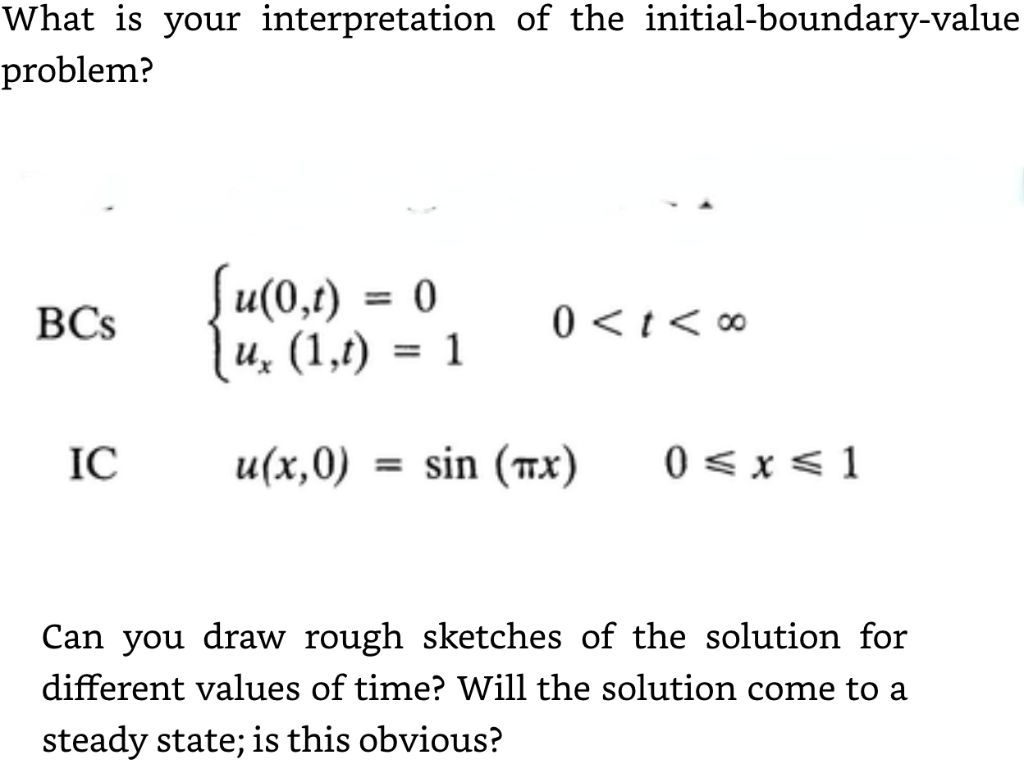 What is your interpretation of the initial-boundary-value
problem?
u(0,)) = 0
BCs 0.9) 0
This is AI generated Response.
Asked by: Pagal
Created at: 2025-09-02 02:42:32
Asked by: Pagal
Created at: 2025-09-02 02:42:32
Final Answer:
Rendered
Raw Text
Did you like this answer?
### **Step 1: Interpreting the Problem**
- **Boundary Conditions (BCs):**
- \( u(0, t) = 0 \): The solution is fixed at 0 at \( x = 0 \) for all time.
- \( u_x(1, t) = 1 \): The spatial derivative (slope) at \( x = 1 \) is always 1 for all time.
- **Initial Condition (IC):**
- \( u(x, 0) = \sin(\pi x) \): The initial profile at \( t = 0 \) is a sine wave, starting at 0 (at \( x = 0 \)), peaking at \( x = 0.5 \), and returning to 0 at \( x = 1 \).
- **Physical Interpretation:**
- This is likely a diffusion or heat equation problem (though the PDE isn't stated, usually these are parabolic PDEs).
- At \( t = 0 \), the system starts with the initial profile.
- The left end is always at 0, while the right end's slope is always fixed at 1.
**Explanation:**
The system starts with a sine-shaped profile and is then influenced by the boundaries: one end is fixed, and the other end's slope is fixed. Over time, the profile will adjust to these constraints.
---
### **Step 2: Long-Term Behavior and Sketches**
- **Sketch for \( t = 0 \):**
- The curve is \( \sin(\pi x) \), peaking in the middle and zero at both ends.
- **Sketch for \( t > 0 \):**
- The solution will begin to change, especially near \( x = 1 \), where the slope must become 1.
- Over time, the initial sine shape will fade, and the solution will transition to a shape that satisfies the boundary conditions for all \( t \).
- **Steady-State Solution:**
- At steady state, \( u(x, t) \to u_s(x) \) as \( t \to \infty \).
- The steady-state must satisfy:
- \( u_s(0) = 0 \)
- \( u_s'(1) = 1 \)
- For a typical diffusion equation (\( u_t = u_{xx} \)), the steady-state is a linear function with a slope of 1:
- \( u_s(x) = x \)
- This satisfies both BCs: \( u_s(0) = 0 \), \( u_s'(1) = 1 \).
**Explanation:**
The initial profile will decay (due to diffusion), and the solution will approach a steady-state linear profile \( u_s(x) = x \). This is because, at steady state, the system only needs to satisfy the boundary conditions, not the initial shape.
---
### **Final Answer**
- The initial-boundary-value problem describes a process where an initial sine-shaped profile evolves over time, with one boundary fixed at zero and the other boundary's slope fixed at one.
- **The solution will come to a steady state, which is the linear function \( u(x) = x \).**
- This is obvious because the boundary conditions uniquely determine the steady-state solution, and the system will lose memory of its initial shape as time progresses.
Question:
IC u(x, 0) = sin(pi x) 0
This is AI generated Response.
Asked by: Pagal
Created at: 2025-09-02 02:43:31
Asked by: Pagal
Created at: 2025-09-02 02:43:31
Final Answer:
Rendered
Raw Text
Did you like this answer?
### **Step 1: Interpretation of the Initial-Boundary-Value Problem**
- **Given conditions:**
- Initial condition: \( u(x, 0) = \sin(\pi x) \) for \( 0 \leq x \leq 1 \).
- Boundary conditions:
- At \( x=0 \): \( u(0, t) = 0 \).
- At \( x=1 \): \( u_x(1, t) = 1 \) (the derivative with respect to \( x \) is fixed at 1).
- **Physical/Mathematical context:**
- Likely a diffusion or heat equation problem (e.g., \( u_t = u_{xx} \)), although the PDE isn't explicitly provided.
- The initial profile is a sine wave, starting at zero, peaking in the middle, then decreasing back to zero at \( x=1 \).
- Boundary conditions fix the value at \( x=0 \) and the slope at \( x=1 \), which influences how the initial wave evolves over time.
- **Summary:**
- The problem models how an initial sine-shaped profile diffuses or evolves under these boundary constraints.
- The boundary conditions suggest the solution will adjust over time to satisfy both the fixed value at the left boundary and the fixed slope at the right boundary.
**Explanation:**
This initial-boundary-value problem describes a system starting with a sine wave, with fixed boundary conditions that will cause the solution to change over time toward a steady state that respects these constraints.
---
### **Step 2: Sketching the Solution and Its Long-Term Behavior**
- **Initial profile at \( t=0 \):**
\( u(x, 0) = \sin(\pi x) \), which starts at 0 at \( x=0 \), peaks at \( x=0.5 \), and returns to 0 at \( x=1 \).
- **Evolution over time:**
- The solution will smooth out and change shape, especially near the boundaries.
- At \( x=0 \), \( u=0 \) remains fixed.
- At \( x=1 \), the slope \( u_x \) is fixed at 1, implying the solution near \( x=1 \) will tend toward a linear function with slope 1.
- **Steady-state solution:**
- At long times, the solution approaches a steady state \( u_s(x) \).
- The steady-state must satisfy:
- \( u_s(0) = 0 \),
- \( u_s'(1) = 1 \).
- A linear function satisfying these conditions is:
\[
u_s(x) = x,
\]
which has:
- \( u_s(0) = 0 \),
- \( u_s'(x) = 1 \),
- \( u_s'(1) = 1 \).
- **Sketches:**
- At \( t=0 \): a sine wave starting at zero and peaking at \( x=0.5 \).
- For \( t>0 \): the profile smooths out, gradually approaching the line \( u(x) = x \).
- The solution will "flatten" the initial wave, especially near \( x=0 \), and develop a slope of 1 at \( x=1 \).
**Will the solution come to a steady state?**
Yes, because the boundary conditions are fixed and the PDE (assumed to be diffusive) leads to a smoothing process that stabilizes over time. The limiting shape is the linear function \( u(x) = x \).
---
### **Final Answer:**
The initial-boundary-value problem models the evolution of a sine-shaped initial profile under fixed boundary conditions: zero at \( x=0 \) and slope 1 at \( x=1 \). Over time, the solution smooths out and approaches the steady state \( u(x) = x \). The solution sketches would show the initial sine wave gradually flattening into the linear function, confirming that the solution indeed approaches this steady state as \( t \to \infty \).
📢 Instructions:
- Ask anything relatd to above question only.
- For new Question goto :