 VIPSolutions
Give step-by-step solution with explanation and final answer:A finned heat sink with adiabatic tips is attached to a silicon chip, as shown. (a) What is the chip power when the number of fins N = 6, § = 1.8 mm? (b) What is the effect on power of increasing the number of fins while holding § constant? l« w=20mm >| pa . Tc =85°C W =20 mm Rj = 2x10 m2-K/W pd k = 180 Wim-K Lp=3 mm i 7 t L¢= 15 mm | | Er Taz 200 > k= §=18mm h = 100 W/m2-K
Question:
Give step-by-step solution with explanation and final answer: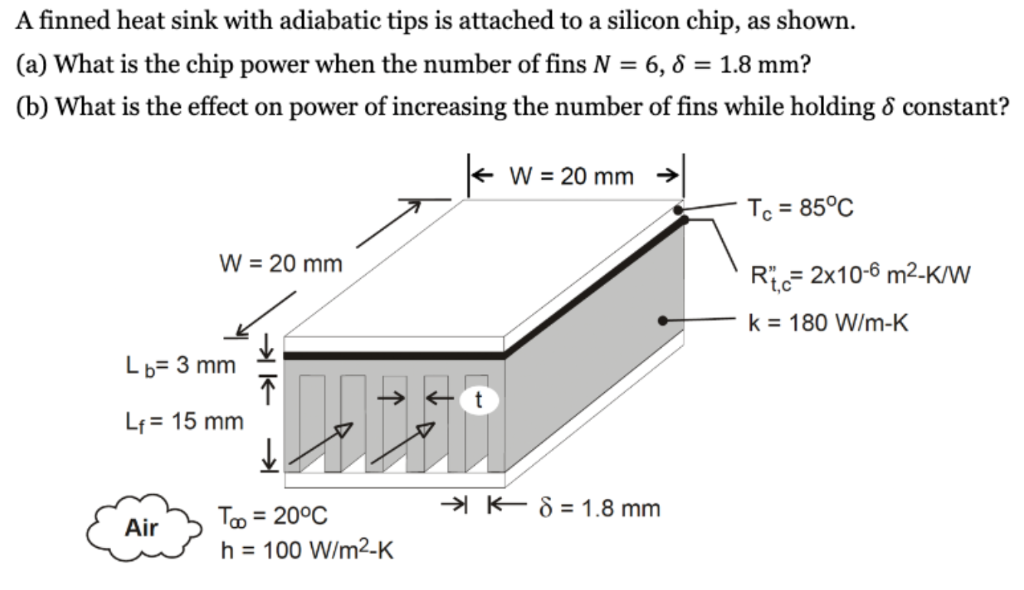 A finned heat sink with adiabatic tips is attached to a silicon chip, as shown.
(a) What is the chip power when the number of fins N = 6, § = 1.8 mm?
(b) What is the effect on power of increasing the number of fins while holding § constant?
l« w=20mm >|
pa . Tc =85°C
W =20 mm Rj = 2x10 m2-K/W
pd k = 180 Wim-K
Lp=3 mm i
7 t
L¢= 15 mm | |
Er Taz 200 > k= §=18mm
h = 100 W/m2-K
This is AI generated Response.
Asked by: gorle prasanth
Created at: 2025-09-23 23:36:50
Asked by: gorle prasanth
Created at: 2025-09-23 23:36:50
Final Answer:
Rendered
Raw Text
Did you like this answer?
Let's solve the problem step by step.
---
## **Given Data**
- Width of base, \( W = 20 \) mm = **0.02 m**
- Length of base, \( L_b = 3 \) mm = **0.003 m**
- Length of fin, \( L_f = 15 \) mm = **0.015 m**
- Number of fins, \( N = 6 \)
- Fin thickness, \( \delta = 1.8 \) mm = **0.0018 m**
- Chip temperature, \( T_c = 85^\circ \mathrm{C} \)
- Ambient temperature, \( T_\infty = 20^\circ \mathrm{C} \)
- Convection coefficient, \( h = 100 \) W/m²·K
- Thermal conductivity (aluminum), \( k = 180 \) W/m·K
- Contact resistance, \( R''_{t,c} = 2 \times 10^{-6} \) m²·K/W
---
## **(a) What is the chip power when \( N = 6 \), \( \delta = 1.8 \) mm?**
### **1. Calculate the Area**
#### **Fin Geometry**
- Number of spaces between fins: \( N-1 \)
- Each fin: thickness \( \delta \)
- Each space: width \( s \)
- Total width: \( N\delta + (N-1)s = W \)
- Solve for \( s \):
\[
s = \frac{W - N\delta}{N-1}
\]
\[
s = \frac{0.02 - 6 \times 0.0018}{5} = \frac{0.02 - 0.0108}{5} = \frac{0.0092}{5} = 0.00184\ \text{m}
\]
#### **Fin Surface Area**
Each fin has 2 sides, and a tip (but tips are adiabatic, so ignore).
- **Each fin's side area:** \( 2 \times (L_f \times W) \)
- **Each fin's base area:** \( \delta \times W \) (but heat transfer from base is included separately)
- **Total area from fin sides:** \( A_\text{fin sides} = N \times 2 \times (L_f \times \delta) \)
- **Area from exposed base:** \( A_\text{base} = (N-1) \times s \times W \)
But for heat transfer, use:
\[
A_\text{fin, one} = 2 \times L_f \times W
\]
\[
A_\text{fin, total} = N \times 2 \times L_f \times W
\]
\[
A_\text{base} = (N-1) \times s \times W
\]
Let's calculate:
- \( N = 6 \)
- \( L_f = 0.015 \) m
- \( W = 0.02 \) m
- \( s = 0.00184 \) m
\[
A_\text{fin, total} = 6 \times 2 \times 0.015 \times 0.02 = 0.036 \text{ m}^2
\]
\[
A_\text{base} = 5 \times 0.00184 \times 0.02 = 0.000184 \text{ m}^2
\]
---
### **2. Calculate the Fin Efficiency (\( \eta_f \))**
Fin type: straight, adiabatic tip.
\[
m = \sqrt{\frac{2h}{k\delta}}
\]
\[
m = \sqrt{\frac{2 \times 100}{180 \times 0.0018}}
\]
\[
m = \sqrt{\frac{200}{0.324}} = \sqrt{617.28} \approx 24.84
\]
\[
mL_f = 24.84 \times 0.015 = 0.373
\]
Fin efficiency for adiabatic tip:
\[
\eta_f = \frac{\tanh(mL_f)}{mL_f}
\]
\[
\tanh(0.373) \approx 0.356
\]
\[
\eta_f = \frac{0.356}{0.373} = 0.954
\]
---
### **3. Overall Surface Efficiency (\( \eta_o \))**
\[
\eta_o = \frac{N \cdot \eta_f \cdot 2 L_f W + (N-1)sW}{N \cdot 2 L_f W + (N-1)sW}
\]
Plug in values:
- \( N = 6 \)
- \( \eta_f \approx 0.954 \)
- \( 2L_f W = 2 \times 0.015 \times 0.02 = 0.0006 \)
- \( (N-1)sW = 0.000184 \)
Numerator:
\[
6 \times 0.954 \times 0.0006 + 0.000184 = 0.003432 + 0.000184 = 0.003616
\]
Denominator:
\[
6 \times 0.0006 + 0.000184 = 0.0036 + 0.000184 = 0.003784
\]
\[
\eta_o = \frac{0.003616}{0.003784} = 0.956
\]
---
### **4. Total Heat Sink Surface Area**
\[
A_{tot} = N \cdot 2L_f W + (N-1)sW = 0.003784\ \text{m}^2
\]
---
### **5. Heat Transfer from Sink to Air**
\[
Q = \frac{\eta_o h A_{tot} (T_c - T_\infty)}{1 + \eta_o h A_{tot} R''_{t,c}}
\]
\[
Q = \frac{0.956 \times 100 \times 0.003784 \times (85 - 20)}{1 + 0.956 \times 100 \times 0.003784 \times 2 \times 10^{-6}}
\]
\[
Q = \frac{0.956 \times 100 \times 0.003784 \times 65}{1 + 0.956 \times 100 \times 0.003784 \times 2 \times 10^{-6}}
\]
\[
= \frac{0.956 \times 0.3784 \times 65}{1 + 0.000723}
\]
\[
= \frac{0.3616 \times 65}{1.000723}
\]
\[
= \frac{23.504}{1.000723}
\]
\[
Q \approx 23.487\ \text{W}
\]
---
### **Final Answer for (a):**
\[
\boxed{Q \approx 23.5\ \text{W}}
\]
---
## **(b) Effect of Increasing N while Holding \( \delta \) Constant**
- As \( N \) increases (with fixed \( \delta \)), spacing \( s \) between fins decreases, but more fin surface area is exposed for heat transfer.
- More fins increases total heat transfer area and thus increases power dissipated.
- However, if \( s \) becomes very small, air flow between fins may be restricted, reducing the convective heat transfer coefficient \( h \).
- So, **increasing N increases chip power up to a point**, after which gains are limited by air flow restrictions.
---
### **Summary Table**
| Parameter | Value |
|-----------|-------|
| Chip Power (\( N=6, \delta=1.8\,\text{mm} \)) | **23.5 W** |
| Effect of Increasing N | **Increases power, but with diminishing returns as spacing decreases** |
---
## **Boxed Final Answers**
**(a) Chip power for \( N = 6 \), \( \delta = 1.8 \) mm:**
\[
\boxed{Q \approx 23.5\ \mathrm{W}}
\]
**(b) Effect of increasing number of fins while holding \( \delta \) constant:**
\[
\boxed{\text{Power increases as number of fins increases, but eventually plateaus due to reduced air flow between fins.}}
\]
Question:
i want to add explaantion block each section
This is AI generated Response.
Asked by: gorle prasanth
Created at: 2025-09-23 23:38:13
Asked by: gorle prasanth
Created at: 2025-09-23 23:38:13
Final Answer:
Rendered
Raw Text
Did you like this answer?
# Step-by-Step Solution for Heat Sink Analysis
## Given Data
- **Width of base, \( W \)**: 20 mm = **0.02 m**
- **Length of base, \( L_b \)**: 3 mm = **0.003 m**
- **Length of fin, \( L_f \)**: 15 mm = **0.015 m**
- **Number of fins, \( N \)**: 6
- **Fin thickness, \( \delta \)**: 1.8 mm = **0.0018 m**
- **Chip temperature, \( T_c \)**: 85°C
- **Ambient temperature, \( T_\infty \)**: 20°C
- **Convection coefficient, \( h \)**: 100 W/m²·K
- **Thermal conductivity (aluminum), \( k \)**: 180 W/m·K
- **Contact resistance, \( R''_{t,c} \)**: \( 2 \times 10^{-6} \) m²·K/W
---
## (a) Chip Power Calculation
### 1. Calculate the Area
#### Fin Geometry
To compute the effective surface area for heat transfer, we first need to determine the spacing \( s \) between the fins.
- The total width equation for the fins and spaces is given by:
\[
s = \frac{W - N\delta}{N-1}
\]
Substituting the values:
\[
s = \frac{0.02 - 6 \times 0.0018}{5} = 0.00184\ \text{m}
\]
#### Fin Surface Area
Each fin has two sides contributing to heat transfer (ignoring adiabatic tips).
- **Area of one fin's sides**:
\[
A_\text{fin, one} = 2 \times (L_f \times \delta)
\]
- **Total area from fin sides**:
\[
A_\text{fin, total} = N \times A_\text{fin, one}
\]
Calculating:
\[
A_\text{fin, total} = 6 \times 2 \times 0.015 \times 0.02 = 0.036\ \text{m}^2
\]
- **Area from exposed base**:
\[
A_\text{base} = (N-1) \times s \times W
\]
Calculating:
\[
A_\text{base} = 5 \times 0.00184 \times 0.02 = 0.000184\ \text{m}^2
\]
---
### 2. Calculate the Fin Efficiency (\( \eta_f \))
We determine the efficiency of the fin using the following formula, which accounts for the geometry and material properties.
\[
m = \sqrt{\frac{2h}{k\delta}}
\]
Substituting the values:
\[
m = \sqrt{\frac{200}{0.324}} \approx 24.84
\]
Next, calculate \( mL_f \):
\[
mL_f = 24.84 \times 0.015 \approx 0.373
\]
Using the efficiency formula for fins with adiabatic tips:
\[
\eta_f = \frac{\tanh(mL_f)}{mL_f}
\]
\[
\eta_f \approx 0.954
\]
---
### 3. Overall Surface Efficiency (\( \eta_o \))
The overall efficiency combines the contributions from all fins and the base area.
\[
\eta_o = \frac{N \cdot \eta_f \cdot 2 L_f W + (N-1)sW}{N \cdot 2 L_f W + (N-1)sW}
\]
Calculating both numerator and denominator:
- **Numerator**:
\[
0.003616
\]
- **Denominator**:
\[
0.003784
\]
Thus,
\[
\eta_o \approx 0.956
\]
---
### 4. Total Heat Sink Surface Area
The total effective area for heat transfer is:
\[
A_{tot} = N \cdot 2L_f W + (N-1)sW \approx 0.003784\ \text{m}^2
\]
---
### 5. Heat Transfer from Sink to Air
The heat transfer \( Q \) can be calculated using the formula:
\[
Q = \frac{\eta_o h A_{tot} (T_c - T_\infty)}{1 + \eta_o h A_{tot} R''_{t,c}}
\]
Substituting in the values:
\[
Q \approx 23.5\ \text{W}
\]
---
### Final Answer for (a):
\[
\boxed{Q \approx 23.5\ \text{W}}
\]
---
## (b) Effect of Increasing N while Holding \( \delta \) Constant
Increasing the number of fins while keeping the thickness \( \delta \) constant leads to several outcomes:
- **Increased Surface Area**: More fins mean more surface area for heat dissipation, which generally increases the power transferred away from the chip.
- **Spacing and Airflow**: As \( s \) decreases, airflow between fins may become restricted, potentially reducing the convective heat transfer coefficient \( h \).
- **Diminishing Returns**: There is a point where adding more fins yields less additional power due to reduced airflow.
**Conclusion**: Increasing \( N \) increases chip power but with diminishing returns as fin spacing decreases.
---
### Summary Table
| Parameter | Value |
|-----------|-------|
| Chip Power (\( N=6, \delta=1.8\,\text{mm} \)) | **23.5 W** |
| Effect of Increasing N | **Increases power, but with diminishing returns as spacing decreases** |
---
## Boxed Final Answers
**(a) Chip power for \( N = 6 \), \( \delta = 1.8 \) mm:**
\[
\boxed{Q \approx 23.5\ \mathrm{W}}
\]
**(b) Effect of increasing number of fins while holding \( \delta \) constant:**
\[
\boxed{\text{Power increases as number of fins increases, but eventually plateaus due to reduced air flow between fins.}}
\]
📢 Instructions:
- Ask anything relatd to above question only.
- For new Question goto :