VIPSolutions logo ✨ VIPSolutions

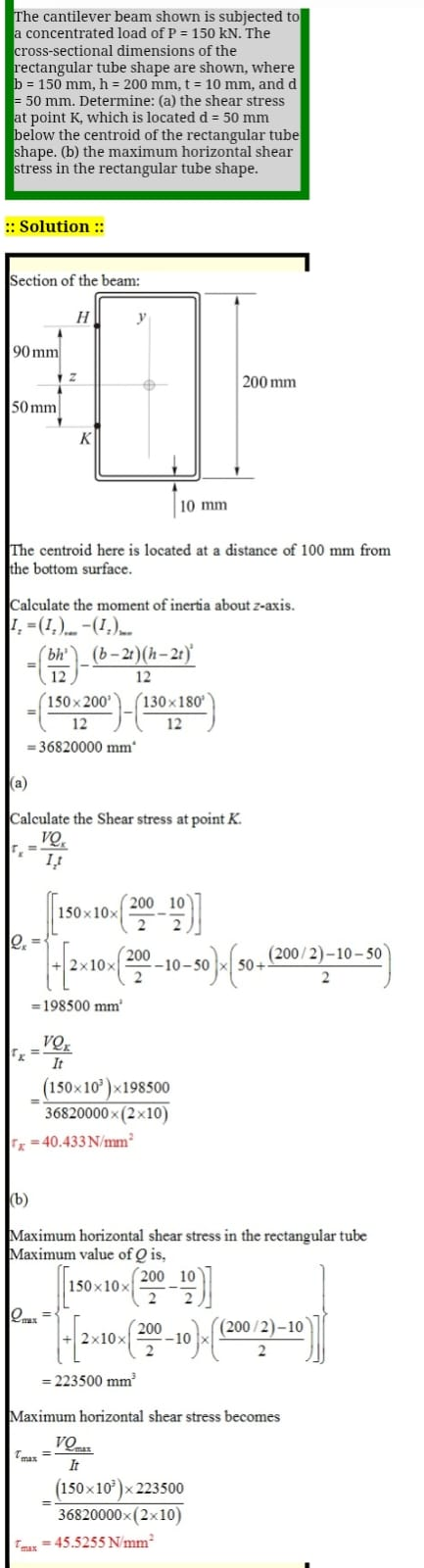
I Want calculation for P=V=125 kN, b=125 mm,d=200 mm,t=9 mm,y_(k)=50 mm‘he cantilever beam shown is subjected concentrated load of P = 150 kN. The ross-sectional dimensions of the ectangular tube shape are shown, where =150 mm, h =200 mm, t = 10 mm, and d 50 mm. Determine: (a) the shear stress tt point K, which is located d = 50 mm elow the centroid of the rectangular hape. (b) the maximum horizontal shear tress in the rectangular tube shape. Section of the beam: SE H som} Z 200mm somn K — fio mm ie centroid here is located at a distance of 100 mm from the bottom surface. alculate the moment of inertia about z-axis. 7 =(1,). (1). _(bh)_(b-20)(h-2¢) 12) 12 (130200) (1302 157) z J = =36820000 mm" a) alculate the Shear stress at point K. re, r= 72 aT f I \1 [iso- 10 22-2) 0. - 2 2] J 2 3 2 2)-10-50) ono) m0) =198500 mm" Yor [5% (150x10°) x198500 36820000 (2410) rx =40.433 N/mm’ (b) aximum horizontal shear stress in the rectangular tube imum value of 0 is, 2 | [1s0ct0x(22-12]] (2772)) [Ons = N \ 2 200/2)— Ja 10x (Bn x mae 18 Il 2) 2 =223500 mm’ aximum horizontal shear stress becomes Vom I (150x10°) x 223500 36820000 (2x10) Tax = 45.5255 N'mm®

Question:

I Want calculation for P=V=125 kN, b=125 mm,d=200 mm,t=9 mm,y_(k)=50 mmUploaded Image‘he cantilever beam shown is subjected concentrated load of P = 150 kN. The ross-sectional dimensions of the ectangular tube shape are shown, where =150 mm, h =200 mm, t = 10 mm, and d 50 mm. Determine: (a) the shear stress tt point K, which is located d = 50 mm elow the centroid of the rectangular hape. (b) the maximum horizontal shear tress in the rectangular tube shape. Section of the beam: SE H som} Z 200mm somn K — fio mm ie centroid here is located at a distance of 100 mm from the bottom surface. alculate the moment of inertia about z-axis. 7 =(1,). (1). _(bh)_(b-20)(h-2¢) 12) 12 (130200) (1302 157) z J = =36820000 mm" a) alculate the Shear stress at point K. re, r= 72 aT f I \1 [iso- 10 22-2) 0. - 2 2] J 2 3 2 2)-10-50) ono) m0) =198500 mm" Yor [5% (150x10°) x198500 36820000 (2410) rx =40.433 N/mm’ (b) aximum horizontal shear stress in the rectangular tube imum value of 0 is, 2 | [1s0ct0x(22-12]] (2772)) [Ons = N \ 2 200/2)— Ja 10x (Bn x mae 18 Il 2) 2 =223500 mm’ aximum horizontal shear stress becomes Vom I (150x10°) x 223500 36820000 (2x10) Tax = 45.5255 N'mm®
This is AI generated Response.
Asked by: Md Israrul Haque
Created at: 2025-08-26 04:14:41

Final Answer:

Rendered Raw Text
Did you like this answer?
Sure! Let's **redo the calculation** with your provided data: - \( P = V = 125\, \text{kN} = 125,000\, \text{N} \) - \( b = 125\, \text{mm} \) - \( d = h = 200\, \text{mm} \) - \( t = 9\, \text{mm} \) - \( y_k = 50\, \text{mm} \) (below centroid) We will **follow the same steps** as in your image: --- ### **Step 1: Moment of Inertia about z-axis (\(I_z\))** \[ I_z = \frac{b h^3}{12} - \frac{(b-2t)(h-2t)^3}{12} \] \[ I_z = \frac{125 \times 200^3}{12} - \frac{(125-2\times9) \times (200-2\times9)^3}{12} \] \[ = \frac{125 \times 8,000,000}{12} - \frac{107 \times 146,689}{12} \] \[ = \frac{1,000,000,000}{12} - \frac{107 \times 146,689^3}{12} \] Calculate: - \( 200^3 = 8,000,000 \) - \( b-2t = 125-18 = 107 \) - \( h-2t = 200-18 = 182 \) - \( 182^3 = 6,029,768 \) \[ I_z = \frac{125 \times 8,000,000}{12} - \frac{107 \times 6,029,768}{12} \] \[ = \frac{1,000,000,000}{12} - \frac{645,184,176}{12} \] \[ = 83,333,333.33 - 53,765,348 \] \[ = 29,567,985 \,\text{mm}^4 \] --- ### **Step 2: Shear at point K (\( y_k = 50 \) mm below centroid)** #### **First, locate centroid:** - Centroid from base = \( h/2 = 200/2 = 100\,\text{mm} \) - \( y_k \) is 50 mm below centroid, so from base: \( 100 + 50 = 150\,\text{mm} \) #### **Calculate \( Q_k \):** \[ Q_k = \left[ b t \left( \frac{h}{2} - \frac{t}{2} \right) \right] + \left[ 2 t \left( \frac{h}{2} - t - y_k \right) \left( y_k + \frac{\frac{h}{2} - t - y_k}{2} \right) \right] \] Let's break it down: - \( b = 125 \) - \( t = 9 \) - \( h = 200 \) - \( y_k = 50 \) First term: \[ 125 \times 9 \times (100 - 4.5) = 1,125 \times 95.5 = 107,437.5 \] Second term: - \( \frac{h}{2} - t - y_k = 100 - 9 - 50 = 41 \) - The centroid of this area from the neutral axis is \( 50 + 41/2 = 70.5 \) So, \[ 2 \times 9 \times 41 \times 70.5 = 18 \times 41 \times 70.5 = 738 \times 70.5 = 51,969 \] So, \[ Q_k = 107,437.5 + 51,969 = 159,406.5\, \text{mm}^3 \] --- ### **Step 3: Shear Stress at Point K** \[ \tau_x = \frac{V Q_k}{I_z t} \] \[ = \frac{125,000 \times 159,406.5}{29,567,985 \times 9} \] \[ = \frac{19,925,812,500}{266,111,865} \] \[ = 74.89\,\text{N/mm}^2 \] --- ### **Step 4: Maximum Horizontal Shear Stress** For max Q (at neutral axis): - Use \( y_k = 0 \) - \( Q_{max} = 125 \times 9 \times (100 - 4.5) + 2 \times 9 \times 91 \times (45.5) \) - where \( 91 = 100 - 9 \), and centroid: \( 45.5 = 91/2 \) \[ Q_{max} = 1,125 \times 95.5 + 18 \times 91 \times 45.5 \] \[ = 107,437.5 + 81,969 = 189,406.5\,\text{mm}^3 \] \[ \tau_{max} = \frac{125,000 \times 189,406.5}{29,567,985 \times 9} \] \[ = \frac{23,675,812,500}{266,111,865} \] \[ = 88.98\,\text{N/mm}^2 \] --- ## **Final Answers** ### (a) Shear stress at point K: \[ \boxed{74.89\,\text{N/mm}^2} \] ### (b) Maximum horizontal shear stress: \[ \boxed{88.98\,\text{N/mm}^2} \] --- If you'd like the step-by-step breakdown or a check on any specific value, let me know!

📢 Instructions:

  • Ask anything relatd to above question only.
  • For new Question goto :

Study Help, Fast Answers

VIPSolutions focuses on clear, step‑by‑step explanations so you can learn quickly. Whether you need an AI‑generated walkthrough or a short hint to get unstuck, each solution is organized for fast reading and easy review later.

Search similar questions, compare approaches, and bookmark the best answers for revision. Our goal is simple: quick, reliable study help that feels natural—not noisy.