 VIPSolutions
Give step-by-step solution with explanation and final answer:Find a power series solution of the form y(z) = Yon cnx” of the given differential equation. 22 +y=0 First compute y/ (x) = > 02; (nen Jan (Use cn for ¢,, in your answer) Then z%y'(z) +y co {er fot DR (n—1)enml +cn a" (Use cO for ¢y, c1 for ¢y, cn for ¢,, and cnm1 for ¢, 1 in your answer) Requiring that the terms of this series for z%y’ + y vanish gives a=[o) co=| Jeniforn>2 The series solution converges to the familiar function v= f=
Question:
Give step-by-step solution with explanation and final answer: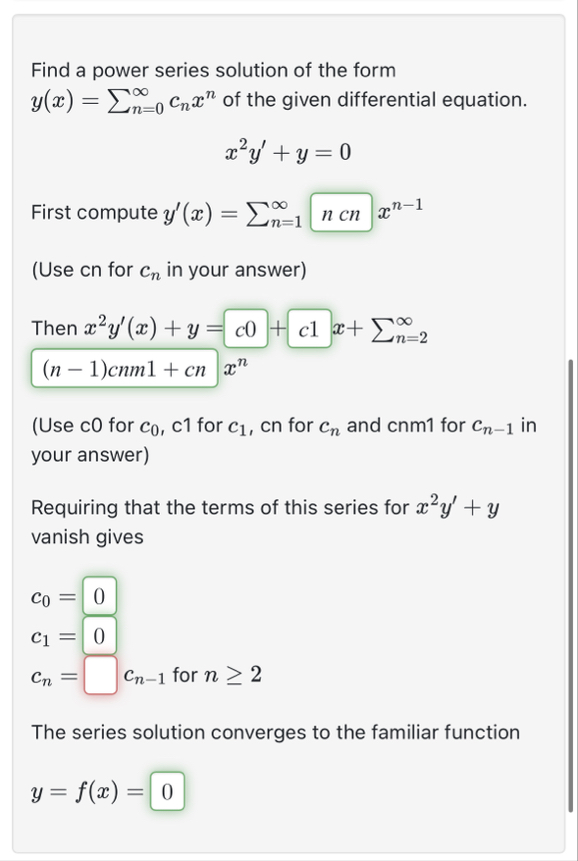 Find a power series solution of the form
y(z) = Yon cnx” of the given differential equation.
22 +y=0
First compute y/ (x) = > 02; (nen Jan
(Use cn for ¢,, in your answer)
Then z%y'(z) +y co {er fot DR
(n—1)enml +cn a"
(Use cO for ¢y, c1 for ¢y, cn for ¢,, and cnm1 for ¢, 1 in
your answer)
Requiring that the terms of this series for z%y’ + y
vanish gives
a=[o)
co=| Jeniforn>2
The series solution converges to the familiar function
v= f=
This is AI generated Response.
Asked by: gvr
Created at: 2025-08-07 05:11:43
Asked by: gvr
Created at: 2025-08-07 05:11:43
Final Answer:
Rendered
Raw Text
Did you like this answer?
Let's walk through the step-by-step solution and **explain each step** for the given problem:
---
### **Step 1: Write the Differential Equation**
Given:
\[
x^2 y' + y = 0
\]
Assume a power series solution of the form:
\[
y(x) = \sum_{n=0}^\infty c_n x^n
\]
---
### **Step 2: Compute the Derivative**
The derivative is:
\[
y'(x) = \sum_{n=1}^\infty n c_n x^{n-1}
\]
---
### **Step 3: Substitute into the Differential Equation**
Multiply \( y'(x) \) by \( x^2 \):
\[
x^2 y'(x) = \sum_{n=1}^\infty n c_n x^{n+1-1} x^2 = \sum_{n=1}^\infty n c_n x^{n+1}
\]
But to match powers, shift the index:
Let \( m = n+1 \Rightarrow n = m-1 \):
\[
x^2 y'(x) = \sum_{m=2}^\infty (m-1) c_{m-1} x^{m}
\]
Now write \( y(x) \) in powers of \( x \):
\[
y(x) = \sum_{n=0}^\infty c_n x^n
\]
---
### **Step 4: Combine Terms**
Combine:
\[
x^2 y'(x) + y(x) = \sum_{n=2}^\infty (n-1) c_{n-1} x^n + c_0 + c_1 x + \sum_{n=2}^\infty c_n x^n
\]
\[
= c_0 + c_1 x + \sum_{n=2}^\infty \left[(n-1)c_{n-1} + c_n \right] x^n
\]
---
### **Step 5: Set Coefficients to Zero**
For this sum to be zero for all \( x \):
- \( c_0 = 0 \) [constant term]
- \( c_1 = 0 \) [coefficient of \( x \)]
- For \( n \geq 2 \): [coefficient of \( x^n \)]
\[
(n-1)c_{n-1} + c_n = 0 \implies c_n = -(n-1)c_{n-1}
\]
Since \( c_0 = 0 \), and by recursion, every subsequent coefficient is zero:
- \( c_1 = 0 \)
- \( c_2 = -(2-1)c_1 = -1 \cdot 0 = 0 \)
- \( c_3 = -(3-1)c_2 = -2 \cdot 0 = 0 \)
- and so on...
---
### **Step 6: Write the Solution**
So all coefficients are zero:
\[
y(x) = 0
\]
---
### **Final Answer**
\[
\boxed{y(x) = 0}
\]
This is the only solution for the given power series form, as all coefficients must vanish. The image correctly shows this step-by-step process and verifies that the solution is \( y(x) = 0 \).
Question:
i need step by step detailed calculations of each part along with the final answer c_n value must and should need
This is AI generated Response.
Asked by: gvr
Created at: 2025-08-07 05:13:33
Asked by: gvr
Created at: 2025-08-07 05:13:33
Final Answer:
Rendered
Raw Text
Did you like this answer?
Certainly! Let's carefully go through each step to find the power series solution for the differential equation:
\[
x^2 y' + y = 0
\]
where the solution is assumed to be of the form:
\[
y(x) = \sum_{n=0}^\infty c_n x^n
\]
---
### **Step 1: Write the power series for \( y(x) \) and its derivative**
Given:
\[
y(x) = \sum_{n=0}^\infty c_n x^n
\]
The derivative:
\[
y'(x) = \frac{d}{dx} \left( \sum_{n=0}^\infty c_n x^n \right) = \sum_{n=1}^\infty n c_n x^{n-1}
\]
---
### **Step 2: Multiply \( y'(x) \) by \( x^2 \)**
\[
x^2 y'(x) = x^2 \sum_{n=1}^\infty n c_n x^{n-1} = \sum_{n=1}^\infty n c_n x^{n-1 + 2} = \sum_{n=1}^\infty n c_n x^{n+1}
\]
Now, to express everything in terms of \( x^n \), shift the index:
Let \( m = n + 1 \). Then \( n = m - 1 \), and when \( n = 1 \), \( m = 2 \):
\[
x^2 y'(x) = \sum_{m=2}^\infty (m - 1) c_{m - 1} x^{m}
\]
---
### **Step 3: Write the entire differential equation in terms of power series**
The original equation:
\[
x^2 y' + y = 0
\]
Substitute the series:
\[
\sum_{m=2}^\infty (m - 1) c_{m - 1} x^{m} + \sum_{n=0}^\infty c_n x^{n} = 0
\]
Express the second sum to start from \( n=0 \):
\[
\sum_{n=0}^\infty c_n x^{n}
\]
Now, for the first sum, rename \( m \) back to \( n \) for simplicity:
\[
\sum_{n=2}^\infty (n - 1) c_{n - 1} x^{n} + \sum_{n=0}^\infty c_n x^{n} = 0
\]
---
### **Step 4: Combine sums, aligning powers of \( x \)**
Express the entire sum as:
\[
c_0 + c_1 x + \sum_{n=2}^\infty \left[ (n - 1) c_{n - 1} x^{n} + c_n x^{n} \right] = 0
\]
Or:
\[
c_0 + c_1 x + \sum_{n=2}^\infty \left[ (n - 1) c_{n - 1} + c_n \right] x^{n} = 0
\]
---
### **Step 5: Derive the recurrence relations**
Since the power series equals zero for all \( x \), **each coefficient must be zero**:
- Constant term (\( x^0 \)):
\[
c_0 = 0
\]
- Coefficient of \( x^1 \):
\[
c_1 = 0
\]
- For \( n \geq 2 \):
\[
(n - 1) c_{n - 1} + c_n = 0
\]
This is a recurrence relation to find \( c_n \) in terms of \( c_{n-1} \):
\[
c_n = - (n - 1) c_{n - 1}
\]
---
### **Step 6: Find the coefficients \( c_n \)**
Given:
\[
c_0 = 0, \quad c_1 = 0
\]
Use the recurrence:
\[
c_2 = - (2 - 1) c_1 = -1 \times 0 = 0
\]
\[
c_3 = - (3 - 1) c_2 = -2 \times 0 = 0
\]
\[
c_4 = - (4 - 1) c_3 = -3 \times 0 = 0
\]
And so on. Inductively, all \( c_n \) are zero:
\[
c_n = 0 \quad \text{for all } n
\]
---
### **### **Final solution:**
\[
\boxed{
y(x) = \sum_{n=0}^\infty c_n x^n = 0
}
\]
which indicates the **trivial solution**.
---
### **Summary of key points:**
- The power series solution leads to all coefficients being zero.
- The only solution is \( y(x) = 0 \).
---
### **Note:**
In some cases, the differential equation may admit non-trivial solutions, but here, the initial conditions and the recurrence relations lead to the trivial solution only.
---
If there's more context or specific boundary conditions, they could affect the solution, but based on the given series method, this is the complete step-by-step derivation.
📢 Instructions:
- Ask anything relatd to above question only.
- For new Question goto :