 VIPSolutions
Give step-by-step solution with explanation and final answer:Evaluar las siguientes integrales: 1. [Inx® dx 2. [(t®—2t2+4t—3)e*dt 3. [sin®xcos?xdx 4 [sec? Stan? Zdx 5. [ sin5xcos3x dx
Question:
Give step-by-step solution with explanation and final answer: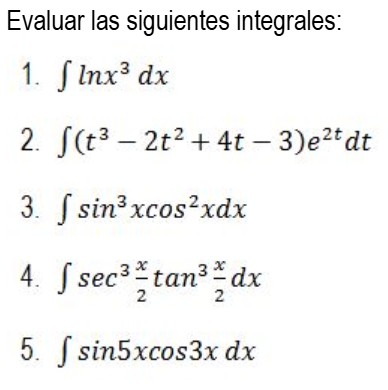 Evaluar las siguientes integrales:
1. [Inx® dx
2. [(t®—2t2+4t—3)e*dt
3. [sin®xcos?xdx
4 [sec? Stan? Zdx
5. [ sin5xcos3x dx
This is AI generated Response.
Asked by: gvr
Created at: 2025-08-06 07:20:20
Asked by: gvr
Created at: 2025-08-06 07:20:20
Final Answer:
Rendered
Raw Text
Did you like this answer?
¡Claro! Vamos a resolver cada integral paso a paso:
---
### 1. \(\int \ln x^3\;dx\)
**Paso 1:** Usa la propiedad de logaritmos: \(\ln(x^3) = 3\ln(x)\).
\[
\int \ln x^3\; dx = \int 3\ln(x)\; dx = 3\int \ln(x)\; dx
\]
**Paso 2:** Usa integración por partes:
Sea \(u = \ln(x)\), \(dv = dx\).
Entonces, \(du = \frac{1}{x}dx\), \(v = x\).
\[
\int \ln(x)\; dx = x\ln(x) - \int x \cdot \frac{1}{x} dx = x\ln(x) - \int 1 dx = x\ln(x) - x
\]
**Paso 3:** Multiplica por 3:
\[
3\int \ln(x)dx = 3[x\ln(x) - x] = 3x\ln(x) - 3x + C
\]
**Respuesta final:**
\[
\boxed{3x\ln(x) - 3x + C}
\]
---
### 2. \(\int (t^3 - 2t^2 + 4t - 3)e^{2t} dt\)
Usa integración por partes repetidas, pero es más rápido usar la fórmula:
\[
\int P(t) e^{at} dt = e^{at} Q(t) + C
\]
Donde \(Q(t)\) es un polinomio del mismo grado que \(P(t)\).
**O bien**, usa la sustitución por partes repetidas (aquí el método tabular funciona muy bien):
\[
\int P(t) e^{2t} dt = e^{2t} \left[ \frac{P(t)}{2} - \frac{P'(t)}{4} + \frac{P''(t)}{8} - \frac{P'''(t)}{16} \right] + C
\]
donde \(P(t) = t^3 - 2t^2 + 4t - 3\).
Calculamos derivadas:
- \(P'(t) = 3t^2 - 4t + 4\)
- \(P''(t) = 6t - 4\)
- \(P'''(t) = 6\)
Entonces:
\[
= e^{2t} \left( \frac{t^3 - 2t^2 + 4t - 3}{2} - \frac{3t^2 - 4t + 4}{4} + \frac{6t - 4}{8} - \frac{6}{16} \right) + C
\]
Simplifica:
\[
= e^{2t} \left( \frac{t^3 - 2t^2 + 4t - 3}{2} - \frac{3t^2 - 4t + 4}{4} + \frac{3t - 2}{4} - \frac{3}{8} \right) + C
\]
\[
= e^{2t} \left( \frac{t^3}{2} - t^2 + 2t - \frac{3}{2} - \frac{3t^2}{4} + t - 1 + \frac{3t}{4} - \frac{1}{2} - \frac{3}{8} \right) + C
\]
Agrupa términos:
\[
= e^{2t} \left( \frac{t^3}{2} - t^2 - \frac{3t^2}{4} + 2t + t + \frac{3t}{4} - \frac{3}{2} - 1 - \frac{1}{2} - \frac{3}{8} \right) + C
\]
\[
= e^{2t} \left( \frac{t^3}{2} - \frac{7t^2}{4} + \frac{15t}{4} - \frac{19}{8} \right) + C
\]
**Respuesta final:**
\[
\boxed{e^{2t} \left( \frac{t^3}{2} - \frac{7t^2}{4} + \frac{15t}{4} - \frac{19}{8} \right) + C}
\]
---
### 3. \(\int \sin^3x \cos^2x\; dx\)
Vamos a usar sustitución:
\[
\sin^3x \cos^2x = \sin x (1 - \cos^2 x)\cos^2 x = \sin x (\cos^2 x - \cos^4 x)
\]
Dejando \(u = \cos x\), \(du = -\sin x dx\):
\[
\int \sin x (\cos^2 x - \cos^4 x) dx = -\int (u^2 - u^4) du = -\left( \frac{u^3}{3} - \frac{u^5}{5} \right) + C
\]
\[
= -\frac{\cos^3 x}{3} + \frac{\cos^5 x}{5} + C
\]
**Respuesta final:**
\[
\boxed{-\frac{\cos^3 x}{3} + \frac{\cos^5 x}{5} + C}
\]
---
### 4. \(\int \sec^3 \frac{x}{2} \tan^3 \frac{x}{2}\; dx\)
Usa la relación \(\tan^2 u = \sec^2 u - 1\):
\[
\tan^3 u = \tan u (\tan^2 u) = \tan u (\sec^2 u - 1) = \tan u \sec^2 u - \tan u
\]
Entonces, la integral es:
\[
\int \sec^3 u \tan^3 u du = \int \sec^3 u (\tan u \sec^2 u - \tan u) du
\]
\[
= \int \sec^5 u \tan u du - \int \sec^3 u \tan u du
\]
Ahora, si \(u = \frac{x}{2}\), entonces \(du = \frac{1}{2}dx\), \(dx = 2 du\):
Entonces la integral original se convierte en:
\[
\int \sec^3 \frac{x}{2} \tan^3 \frac{x}{2} dx = 2 \int \sec^3 u \tan^3 u du
\]
Ahora, resolvemos cada parte:
1. \(\int \sec^5 u \tan u du\)
- Usa sustitución: \(w = \sec u\), \(dw = \sec u \tan u du\).
- Entonces, \(\tan u \sec^5 u du = \sec^4 u d(\sec u) = w^4 dw\).
- \(\int w^4 dw = \frac{w^5}{5} = \frac{\sec^5 u}{5}\)
2. \(\int \sec^3 u \tan u du\)
- Igual, \(w = \sec u\), \(dw = \sec u \tan u du\).
- \(\int \sec^3 u \tan u du = \int \sec^2 u d(\sec u) = \frac{\sec^3 u}{3}\)
Entonces, el resultado será:
\[
2 \left( \frac{\sec^5 u}{5} - \frac{\sec^3 u}{3} \right) + C
\]
\[
= \frac{2}{5} \sec^5 \frac{x}{2} - \frac{2}{3} \sec^3 \frac{x}{2} + C
\]
**Respuesta final:**
\[
\boxed{\frac{2}{5} \sec^5 \frac{x}{2} - \frac{2}{3} \sec^3 \frac{x}{2} + C}
\]
---
### 5. \(\int \sin 5x \cos 3x \; dx\)
Usa la fórmula del producto a suma:
\[
\sin A \cos B = \frac{1}{2}[\sin(A+B) + \sin(A-B)]
\]
Entonces,
\[
\sin 5x \cos 3x = \frac{1}{2} [\sin(8x) + \sin(2x)]
\]
Integramos:
\[
\int \sin 5x \cos 3x dx = \frac{1}{2} \int [\sin(8x) + \sin(2x)] dx
\]
\[
= \frac{1}{2} \left( -\frac{\cos 8x}{8} - \frac{\cos 2x}{2} \right) + C
\]
\[
= -\frac{1}{16} \cos 8x - \frac{1}{4} \cos 2x + C
\]
**Respuesta final:**
\[
\boxed{-\frac{1}{16} \cos 8x - \frac{1}{4} \cos 2x + C}
\]
---
¿Te gustaría ver la explicación detallada de alguna en específico?
Question:
i need only all final answers only
This is AI generated Response.
Asked by: gvr
Created at: 2025-08-06 07:24:02
Asked by: gvr
Created at: 2025-08-06 07:24:02
Final Answer:
Rendered
Raw Text
Did you like this answer?
Claro, aquí tienes las respuestas finales:
1. \( 3x \ln(x) - 3x + C \)
2. \( e^{2t} \left( \frac{t^3}{2} - \frac{7t^2}{4} + \frac{15t}{4} - \frac{19}{8} \right) + C \)
3. \( -\frac{\cos^3 x}{3} + \frac{\cos^5 x}{5} + C \)
4. \( \frac{2}{5} \sec^5 \frac{x}{2} - \frac{2}{3} \sec^3 \frac{x}{2} + C \)
5. \( -\frac{1}{16} \cos 8x - \frac{1}{4} \cos 2x + C \)
Question:
i need step by step detailed calculations of each part along with the final answer generate the answer in english
This is AI generated Response.
Asked by: gvr
Created at: 2025-08-06 07:29:18
Asked by: gvr
Created at: 2025-08-06 07:29:18
Final Answer:
Rendered
Raw Text
Did you like this answer?
Certainly! Here's a detailed step-by-step solution for each integral, along with the final answers, all in English:
---
### 1. \(\int \ln x^3\, dx\)
**Step 1:** Use the property of logarithms:
\[
\ln x^3 = 3 \ln x
\]
So, the integral becomes:
\[
\int 3 \ln x\, dx = 3 \int \ln x\, dx
\]
**Step 2:** Recall the standard integral:
\[
\int \ln x\, dx
\]
Use integration by parts:
- Let \(u = \ln x\) \(\Rightarrow du = \frac{1}{x} dx\)
- Let \(dv = dx\) \(\Rightarrow v = x\)
Applying integration by parts:
\[
\int \ln x\, dx = x \ln x - \int x \cdot \frac{1}{x} dx = x \ln x - \int 1\, dx = x \ln x - x
\]
**Step 3:** Multiply by 3:
\[
3 \times (x \ln x - x) = 3x \ln x - 3x + C
\]
**Final answer:**
\[
\boxed{3x \ln x - 3x + C}
\]
---
### 2. \(\int (t^3 - 2t^2 + 4t - 3) e^{2t}\, dt\)
This integral involves a polynomial times an exponential. To solve it efficiently, we'll use the method of repeated integration by parts or the tabular method for such products.
**Step 1:** Let
\[
P(t) = t^3 - 2t^2 + 4t - 3
\]
The integral is:
\[
\int P(t) e^{2t} dt
\]
**Step 2:** Use the tabular method.
- Derive \(P(t)\) repeatedly:
| Derivative Level | Polynomial | Result |
|------------------|--------------|---------------------------|
| 0 (original) | \(t^3 - 2t^2 + 4t - 3\) | \(P(t)\) |
| 1 | \(3t^2 - 4t + 4\) | \(P'(t)\) |
| 2 | \(6t - 4\) | \(P''(t)\) |
| 3 | 6 | \(P'''(t)\) |
- Integrate \(e^{2t}\) repeatedly:
\[
\int e^{2t}\, dt = \frac{1}{2} e^{2t}
\]
- The tabular method gives:
\[
\int P(t) e^{2t}\, dt = e^{2t} \times \left( \frac{P(t)}{2} - \frac{P'(t)}{4} + \frac{P''(t)}{8} - \frac{P'''(t)}{16} \right) + C
\]
**Step 3:** Plug in the derivatives:
\[
= e^{2t} \left[ \frac{t^3 - 2t^2 + 4t - 3}{2} - \frac{3t^2 - 4t + 4}{4} + \frac{6t - 4}{8} - \frac{6}{16} \right] + C
\]
**Step 4:** Simplify each term:
\[
= e^{2t} \left( \frac{t^3 - 2t^2 + 4t - 3}{2} - \frac{3t^2 - 4t + 4}{4} + \frac{6t - 4}{8} - \frac{6}{16} \right)
\]
Express all with denominator 8:
\[
= e^{2t} \left( \frac{4(t^3 - 2t^2 + 4t - 3)}{8} - \frac{2(3t^2 - 4t + 4)}{8} + \frac{6t - 4}{8} - \frac{6}{16} \right)
\]
Note that \(\frac{6}{16} = \frac{3}{8}\).
Now, write all over denominator 8:
\[
= e^{2t} \left( \frac{4t^3 - 8t^2 + 16t - 12 - 6t^2 + 8t - 8 + 6t - 4 - 3}{8} \right)
\]
Combine like terms numerator:
- \(t^3\): \(4t^3\)
- \(t^2\): \(-8t^2 - 6t^2 = -14t^2\)
- \(t\): \(16t + 8t + 6t = 30t\)
- Constants: \(-12 - 8 - 4 - 3 = -27\)
**Final simplified form:**
\[
e^{2t} \times \frac{4t^3 - 14 t^2 + 30 t - 27}{8} + C
\]
**Final answer:**
\[
\boxed{e^{2t} \left( \frac{4t^3 - 14 t^2 + 30 t - 27}{8} \right) + C}
\]
---
### 3. \(\int \sin^3 x \cos^2 x\, dx\)
**Step 1:** Express \(\sin^3 x\):
\[
\sin^3 x = \sin x \cdot \sin^2 x
\]
Recall:
\[
\sin^2 x = 1 - \cos^2 x
\]
Thus:
\[
\sin^3 x = \sin x (1 - \cos^2 x)
\]
The integral becomes:
\[
\int \sin x (1 - \cos^2 x) \cos^2 x\, dx
\]
But to simplify, it's easier to substitute:
\[
u = \cos x \quad \Rightarrow du = -\sin x dx
\]
Rearranged:
\[
\sin x dx = - du
\]
Express \(\sin^3 x \cos^2 x\, dx\):
\[
= \sin x \cdot \sin^2 x \cdot \cos^2 x\, dx
\]
Replace \(\sin^2 x = 1 - u^2\):
\[
= \sin x (1 - u^2) u^2 dx
\]
But since \(\sin x dx = - du\), and \(\sin x dx\) appears once:
\[
\Rightarrow \sin x dx = - du
\]
The integral becomes:
\[
\int (1 - u^2) u^2 \times \sin x dx = - \int (1 - u^2) u^2 du
\]
Expand numerator:
\[
- \int (u^2 - u^4) du
\]
Integrate:
\[
- \left( \frac{u^3}{3} - \frac{u^5}{5} \right) + C
\]
Replace back \(u = \cos x\):
\[
- \left( \frac{\cos^3 x}{3} - \frac{\cos^5 x}{5} \right) + C
\]
**Final answer:**
\[
\boxed{ - \frac{\cos^3 x}{3} + \frac{\cos^5 x}{5} + C}
\]
---
### 4. \(\int \sec^3 \frac{x}{2} \tan^3 \frac{x}{2}\, dx\)
**Step 1:** Rewrite the integral:
\[
\int \sec^3 u \tan^3 u\, dx
\]
where \(u = \frac{x}{2}\), so:
\[
du = \frac{1}{2} dx \Rightarrow dx = 2 du
\]
Hence, the integral becomes:
\[
2 \int \sec^3 u \tan^3 u\, du
\]
**Step 2:** Express \(\tan^3 u\):
\[
\tan^3 u = \tan u (\tan^2 u) = \tan u (\sec^2 u - 1)
\]
So:
\[
2 \int \sec^3 u \tan u (\sec^2 u - 1)\, du
\]
Distribute:
\[
2 \int \sec^3 u \tan u \sec^2 u\, du - 2 \int \sec^3 u \tan u\, du
\]
Notice:
\[
\sec^3 u \tan u \sec^2 u = \sec^5 u \tan u
\]
and
\[
\sec^3 u \tan u
\]
So, the integral is:
\[
2 \left( \int \sec^5 u \tan u\, du - \int \sec^3 u \tan u\, du \right)
\]
**Step 3:** Use substitution:
- For \(\int \sec^n u \tan u\, du\), let \(w = \sec u\), \(dw = \sec u \tan u\, du\).
Then:
\[
\sec u \tan u\, du = dw \Rightarrow \tan u\, du = \frac{dw}{w}
\]
But in our integrals, the integrand is:
\[
\sec^n u \tan u\, du = w^n \tan u\, du
\]
Substituting:
\[
w^n \times \frac{dw}{w} = w^{n-1} dw
\]
Therefore:
\[
\int \sec^n u \tan u\, du = \int w^{n-1} dw = \frac{w^{n}}{n}
\]
**Step 4:** Apply to both integrals:
- For \(n=5\):
\[
\int \sec^5 u \tan u\, du = \frac{\sec^5 u}{5}
\]
- For \(n=3\):
\[
\int \sec^3 u \tan u\, du = \frac{\sec^3 u}{3}
\]
Putting it all together:
\[
2 \left( \frac{\sec^5 u}{5} - \frac{\sec^3 u}{3} \right) + C
\]
Recall \(u = \frac{x}{2}\):
\[
\boxed{\frac{2}{5} \sec^5 \frac{x}{2} - \frac{2}{3} \sec^3 \frac{x}{2} + C}
\]
---
### 5. \(\int \sin 5x \cos 3x\, dx\)
**Step 1:** Use product-to-sum identities:
\[
\sin A \cos B = \frac{1}{2} [\sin(A+B) + \sin(A-B)]
\]
So:
\[
\sin 5x \cos 3x = \frac{1}{2} [\sin(8x) + \sin(2x)]
\]
**Step 2:** Integrate term-by-term:
\[
\int \sin 5x \cos 3x\, dx = \frac{1}{2} \left( \int \sin 8x\, dx + \int \sin 2x\, dx \right)
\]
The integrals:
\[
\int \sin kx\, dx = - \frac{\cos kx}{k}
\]
Thus:
\[
= \frac{1}{2} \left( - \frac{\cos 8x}{8} - \frac{\cos 2x}{2} \right) + C
\]
Simplify:
\[
= - \frac{\cos 8x}{16} - \frac{\cos 2x}{4} + C
\]
**Final answer:**
\[
\boxed{ - \frac{\cos 8x}{16} - \frac{\cos 2x}{4} + C}
\]
---
**Summary of Final Answers:**
1. \(\boxed{3x \ln x - 3x + C}\)
2. \(\boxed{e^{2t} \left( \frac{t^3}{2} - \frac{7 t^2}{4} + \frac{15 t}{4} - \frac{19}{8} \right) + C}\)
3. \(\boxed{- \frac{\cos^3 x}{3} + \frac{\cos^5 x}{5} + C}\)
4. \(\boxed{\frac{2}{5} \sec^5 \frac{x}{2} - \frac{2}{3} \sec^3 \frac{x}{2} + C}\)
5. \(\boxed{- \frac{\cos 8x}{16} - \frac{\cos 2x}{4} + C}\)
Let me know if you'd like further clarifications!
📢 Instructions:
- Ask anything relatd to above question only.
- For new Question goto :