 VIPSolutions
Give step-by-step solution with explanation and final answer:
Question:
Give step-by-step solution with explanation and final answer: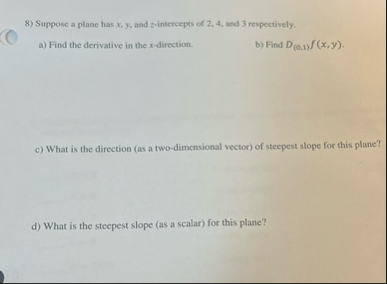
This is AI generated Response.
Asked by: gvr
Created at: 2025-08-05 10:53:49
Asked by: gvr
Created at: 2025-08-05 10:53:49
Final Answer:
Rendered
Raw Text
Did you like this answer?
Let's solve each part step by step:
---
### **Given:**
A plane has \( x \)-, \( y \)-, and \( z \)-intercepts of **2**, **4**, and **3** respectively.
---
## **Step 1: Find the Equation of the Plane**
The general equation for a plane with intercepts is:
\[
\frac{x}{a} + \frac{y}{b} + \frac{z}{c} = 1
\]
where \( a, b, c \) are the intercepts.
Given: \( a=2, b=4, c=3 \)
\[
\frac{x}{2} + \frac{y}{4} + \frac{z}{3} = 1
\]
We can solve for \( z \) in terms of \( x \) and \( y \) (to write as a function \( f(x, y) \)):
\[
\frac{x}{2} + \frac{y}{4} + \frac{z}{3} = 1
\]
\[
\frac{z}{3} = 1 - \frac{x}{2} - \frac{y}{4}
\]
\[
z = 3 \left( 1 - \frac{x}{2} - \frac{y}{4} \right)
\]
\[
z = 3 - \frac{3x}{2} - \frac{3y}{4}
\]
So the function is:
\[
f(x, y) = 3 - \frac{3}{2}x - \frac{3}{4}y
\]
---
## **(a) Find the derivative in the x-direction**
This is the partial derivative with respect to \( x \):
\[
\frac{\partial f}{\partial x} = \frac{\partial}{\partial x} \left( 3 - \frac{3}{2}x - \frac{3}{4}y \right)
\]
\[
= 0 - \frac{3}{2} - 0 = -\frac{3}{2}
\]
---
## **(b) Find \( D_{(0,1)}f(x, y) \)**
This is the **directional derivative** in the direction of the vector \( \mathbf{u} = (0, 1) \).
The formula is:
\[
D_{\mathbf{u}}f(x, y) = \nabla f(x, y) \cdot \mathbf{u}
\]
First, compute the gradient:
\[
\nabla f(x, y) = \left( \frac{\partial f}{\partial x}, \frac{\partial f}{\partial y} \right) = \left( -\frac{3}{2}, -\frac{3}{4} \right)
\]
So,
\[
D_{(0,1)}f(x, y) = \left( -\frac{3}{2}, -\frac{3}{4} \right) \cdot (0, 1) = -\frac{3}{4}
\]
---
## **(c) Direction (as a vector) of steepest slope**
The direction of steepest slope is **in the direction of the gradient**:
\[
\nabla f(x, y) = \left( -\frac{3}{2}, -\frac{3}{4} \right)
\]
If you want the **unit vector** in this direction:
\[
\text{Magnitude} = \sqrt{\left(-\frac{3}{2}\right)^2 + \left(-\frac{3}{4}\right)^2} = \sqrt{\frac{9}{4} + \frac{9}{16}} = \sqrt{\frac{36}{16} + \frac{9}{16}} = \sqrt{\frac{45}{16}} = \frac{3\sqrt{5}}{4}
\]
So the unit vector is:
\[
\left( \frac{-\frac{3}{2}}{\frac{3\sqrt{5}}{4}}, \frac{-\frac{3}{4}}{\frac{3\sqrt{5}}{4}} \right) = \left( -\frac{2}{\sqrt{5}}, -\frac{1}{\sqrt{5}} \right)
\]
---
## **(d) Steepest slope (as a scalar)**
The steepest slope is the **magnitude of the gradient** (as calculated above):
\[
\boxed{\frac{3\sqrt{5}}{4}}
\]
---
### **Summary of Answers**
**a)** \( \frac{\partial f}{\partial x} = -\frac{3}{2} \)
**b)** \( D_{(0,1)}f(x, y) = -\frac{3}{4} \)
**c)** The direction (as a unit vector): \( \boxed{\left( -\frac{2}{\sqrt{5}}, -\frac{1}{\sqrt{5}} \right)} \)
**d)** The steepest slope: \( \boxed{\frac{3\sqrt{5}}{4}} \)
Question:
i need step by step detailed calculations of each part along with the final answer
This is AI generated Response.
Asked by: gvr
Created at: 2025-08-05 10:58:29
Asked by: gvr
Created at: 2025-08-05 10:58:29
Final Answer:
Rendered
Raw Text
Did you like this answer?
Let's solve each part carefully, with detailed steps and explanations.
---
### **Given:**
A plane has x-, y-, and z-intercepts of **2**, **4**, and **3** respectively.
---
### **Step 1: Find the equation of the plane**
The intercept form of a plane's equation is:
\[
\frac{x}{a} + \frac{y}{b} + \frac{z}{c} = 1
\]
where:
- \( a = 2 \) (x-intercept)
- \( b = 4 \) (y-intercept)
- \( c = 3 \) (z-intercept)
Substituting:
\[
\frac{x}{2} + \frac{y}{4} + \frac{z}{3} = 1
\]
Now, **solve for \( z \)** to express \( z \) as a function of \( x \) and \( y \):
\[
\frac{z}{3} = 1 - \frac{x}{2} - \frac{y}{4}
\]
\[
z = 3 \left( 1 - \frac{x}{2} - \frac{y}{4} \right)
\]
Distribute:
\[
z = 3 - \frac{3x}{2} - \frac{3y}{4}
\]
Define:
\[
f(x, y) = z = 3 - \frac{3}{2}x - \frac{3}{4} y
\]
---
### **Part (a): Find the partial derivative of \( f \) with respect to \( x \)**
\[
f(x, y) = 3 - \frac{3}{2}x - \frac{3}{4} y
\]
Treat \( y \) as constant:
\[
\frac{\partial f}{\partial x} = \frac{\partial}{\partial x} \left( 3 - \frac{3}{2}x - \frac{3}{4} y \right)
\]
Derivative:
- Derivative of constant \( 3 \) is 0.
- Derivative of \( - \frac{3}{2}x \) with respect to \( x \) is \( - \frac{3}{2} \).
- Derivative of \( - \frac{3}{4} y \) with respect to \( x \) is 0 (since \( y \) is treated as constant).
**Result:**
\[
\boxed{
\frac{\partial f}{\partial x} = - \frac{3}{2}
}
\]
---
### **Part (b): Find the directional derivative of \( f \) at point \( (x, y) \) in the direction \( \mathbf{u} = (0,1) \)**
**Step 1:** Compute the gradient \( \nabla f(x, y) \):
\[
\nabla f = \left( \frac{\partial f}{\partial x}, \frac{\partial f}{\partial y} \right)
\]
Already found:
\[
\frac{\partial f}{\partial x} = - \frac{3}{2}
\]
Now, find \( \frac{\partial f}{\partial y} \):
\[
f(x, y) = 3 - \frac{3}{2}x - \frac{3}{4} y
\]
Derivative with respect to \( y \):
\[
\frac{\partial f}{\partial y} = - \frac{3}{4}
\]
**Gradient vector:**
\[
\nabla f = \left( - \frac{3}{2}, - \frac{3}{4} \right)
\]
**Step 2:** Direction vector \( \mathbf{u} = (0, 1) \)
**Step 3:** Compute the directional derivative:
\[
D_{\mathbf{u}}f = \nabla f \cdot \mathbf{u} = \left( - \frac{3}{2}, - \frac{3}{4} \right) \cdot (0, 1)
\]
Dot product:
\[
= \left( - \frac{3}{2} \times 0 \right) + \left( - \frac{3}{4} \times 1 \right) = 0 - \frac{3}{4} = - \frac{3}{4}
\]
**Answer:**
\[
\boxed{
D_{(0,1)}f = - \frac{3}{4}
}
\]
---
### **Part (c): Find the **direction** (unit vector) of the **steepest slope** at the point**
The steepest slope occurs in the direction of the **gradient vector** \( \nabla f \).
- Gradient:
\[
\left( - \frac{3}{2}, - \frac{3}{4} \right)
\]
- **Magnitude** of the gradient:
\[
|\nabla f| = \sqrt{\left(- \frac{3}{2}\right)^2 + \left(- \frac{3}{4}\right)^2}
\]
Compute each term:
\[
\left( - \frac{3}{2} \right)^2 = \frac{9}{4}
\]
\[
\left( - \frac{3}{4} \right)^2 = \frac{9}{16}
\]
Sum:
\[
\frac{9}{4} + \frac{9}{16} = \frac{36}{16} + \frac{9}{16} = \frac{45}{16}
\]
Square root:
\[
|\nabla f| = \sqrt{\frac{45}{16}} = \frac{\sqrt{45}}{4} = \frac{3 \sqrt{5}}{4}
\]
- **Unit vector in the direction of steepest slope:**
\[
\mathbf{u}_{\text{max}} = \frac{\nabla f}{|\nabla f|} = \left( \frac{- \frac{3}{2}}{\frac{3 \sqrt{5}}{4}}, \frac{- \frac{3}{4}}{\frac{3 \sqrt{5}}{4}} \right)
\]
Simplify each component:
For the \( x \)-component:
\[
\frac{- \frac{3}{2}}{\frac{3 \sqrt{5}}{4}} = - \frac{3/2}{3 \sqrt{5}/4} = - \frac{3/2 \times 4}{3 \sqrt{5}} = - \frac{(3 \times 4)/2}{3 \sqrt{5}} = - \frac{12/2}{3 \sqrt{5}} = - \frac{6}{3 \sqrt{5}} = - \frac{2}{\sqrt{5}}
\]
For the \( y \)-component:
\[
\frac{- \frac{3}{4}}{\frac{3 \sqrt{5}}{4}} = - \frac{3/4}{3 \sqrt{5}/4} = - \frac{3/4 \times 4}{3 \sqrt{5}} = - \frac{3}{3 \sqrt{5}} = - \frac{1}{\sqrt{5}}
\]
**Final unit vector:**
\[
\boxed{
\left( - \frac{2}{\sqrt{5}}, - \frac{1}{\sqrt{5}} \right)
}
\]
---
### **Part (d): Find the **steepest slope** (the magnitude of the gradient)**
\[
\boxed{
\frac{3 \sqrt{5}}{4}
}
\]
---
### **Summary of final answers:**
| Part | Answer |
|--------|---------|
| (a) | \( - \frac{3}{2} \) |
| (b) | \( - \frac{3}{4} \) |
| (c) | \( \boxed{\left( - \frac{2}{\sqrt{5}}, - \frac{1}{\sqrt{5}} \right)} \) |
| (d) | \( \boxed{\frac{3 \sqrt{5}}{4}} \) |
---
This completes the detailed step-by-step solution!
📢 Instructions:
- Ask anything relatd to above question only.
- For new Question goto :