 VIPSolutions
Give step-by-step solution with explanation and final answer:
Question:
Give step-by-step solution with explanation and final answer: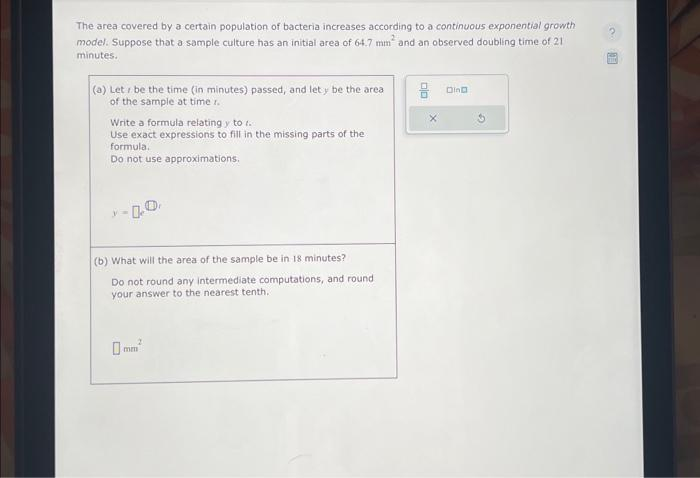
This is AI generated Response.
Asked by: gvr
Created at: 2025-07-31 06:36:46
Asked by: gvr
Created at: 2025-07-31 06:36:46
Final Answer:
Rendered
Raw Text
Did you like this answer?
Let's break down the problem and solve it step by step.
### **Given Information**
- Initial area, \( y_0 = 64.7 \) mm²
- Doubling time = 21 minutes
Let:
- \( t \) = time in minutes
- \( y \) = area at time \( t \)
The area grows **exponentially** with a certain doubling time.
---
## **Step (a): Write the exponential formula**
The general formula for exponential growth is:
\[
y = y_0 \cdot b^{t}
\]
But since we know the doubling time, we use:
\[
y = y_0 \cdot 2^{t/T}
\]
where:
- \( T \) = doubling time (21 minutes)
So,
\[
y = 64.7 \cdot 2^{t/21}
\]
**This is the required formula.**
---
## **Step (b): Find the area after 18 minutes**
Plug \( t = 18 \) into the formula:
\[
y = 64.7 \cdot 2^{18/21}
\]
Now, calculate \( 2^{18/21} \):
First, \( \frac{18}{21} = \frac{6}{7} \).
So,
\[
y = 64.7 \cdot 2^{6/7}
\]
Calculate \( 2^{6/7} \) (using a calculator):
\[
2^{6/7} \approx 1.811
\]
Now multiply:
\[
y \approx 64.7 \times 1.811 \approx 117.1
\]
---
### **Final Answers**
**(a) Formula:**
\[
y = 64.7 \cdot 2^{t/21}
\]
where \( t \) is in minutes.
**(b) Area after 18 minutes:**
\[
\boxed{117.1\ \text{mm}^2}
\]
(rounded to the nearest tenth)
Question:
i need step by step detailed calculations of each part with given data along with the final answer
This is AI generated Response.
Asked by: gvr
Created at: 2025-07-31 06:42:09
Asked by: gvr
Created at: 2025-07-31 06:42:09
Final Answer:
Rendered
Raw Text
Did you like this answer?
Certainly! Let's go through each part with detailed calculations step-by-step, using the given data.
---
### **Given Data:**
- Initial area, \( y_0 = 64.7 \text{ mm}^2 \)
- Doubling time, \( T = 21 \text{ minutes} \)
---
## **Part (a): Write the exponential growth formula**
### Step 1: Understand the nature of growth
Since the area doubles every \( T = 21 \) minutes, the exponential growth model can be written as:
\[
y(t) = y_0 \times 2^{t/T}
\]
Where:
- \( y(t) \) = area at time \( t \)
- \( y_0 \) = initial area
- \( t \) = time in minutes
- \( T \) = doubling time
### Step 2: Write the formula explicitly
Plugging the known values:
\[
\boxed{
\textbf{(a)}\quad y(t) = 64.7 \times 2^{t/21}
}
\]
This formula gives the area \( y \) at any time \( t \) in minutes.
---
## **Part (b): Find the area after 18 minutes**
### Step 1: Substitute \( t = 18 \) minutes into the formula
\[
y(18) = 64.7 \times 2^{18/21}
\]
### Step 2: Simplify the exponent
\[
\frac{18}{21} = \frac{6}{7} \quad \text{(since 18 ÷ 3 = 6, 21 ÷ 3 = 7)}
\]
So,
\[
y(18) = 64.7 \times 2^{6/7}
\]
### Step 3: Calculate \( 2^{6/7} \)
**Method:** Use logarithms or a calculator.
- First, recall that:
\[
2^{6/7} = e^{(6/7) \times \ln 2}
\]
- Since \( \ln 2 \approx 0.6931 \):
\[
2^{6/7} = e^{(6/7) \times 0.6931}
\]
- Calculate the exponent:
\[
(6/7) \times 0.6931 \approx 0.5929
\]
- Now, compute \( e^{0.5929} \):
\[
e^{0.5929} \approx 1.809
\]
**Alternatively**, using a calculator directly:
\[
2^{6/7} \approx 1.809
\]
### Step 4: Calculate the area
\[
y(18) = 64.7 \times 1.809 \approx 117.1
\]
### **Final answer:**
\[
\boxed{
\text{Area after 18 minutes} \approx \mathbf{117.1\ \text{mm}^2}
}
\]
---
## **Summary:**
| Part | Formula / Calculation | Final Result |
|---------|-------------------------|--------------|
| (a) | \( y = 64.7 \times 2^{t/21} \) | - |
| (b) | \( y(18) = 64.7 \times 2^{6/7} \approx 64.7 \times 1.809 \) | **117.1 mm²** |
---
Let me know if you'd like further explanation or help with other parts!
Question:
i need only final answers without table
This is AI generated Response.
Asked by: gvr
Created at: 2025-07-31 06:45:55
Asked by: gvr
Created at: 2025-07-31 06:45:55
Final Answer:
Rendered
Raw Text
Did you like this answer?
**Part (a):**
The exponential growth formula is:
\[
\boxed{ y = 64.7 \times 2^{t/21} }
\]
where \( t \) is in minutes.
**Part (b):**
Area after 18 minutes:
\[
y(18) = 64.7 \times 2^{6/7} \approx 64.7 \times 1.809 \approx \boxed{117.1\ \text{mm}^2}
\]
📢 Instructions:
- Ask anything relatd to above question only.
- For new Question goto :