Give step-by-step solution with explanation and final answer:9.3.5 (5 pts) For the value of r = 100, use a computer to explore the dynamics of the Lorenz system, assuming
o = 10 and b = 8/3 as usual. In cach case, plot & vs t, y vs t, and z vs. 2. You should investigate the
consequences of choosing different initial conditions and lengths of integration. Also, in some cases
you may want to ignore the transient behavior, and plot only the sustained long-term behavior. (Hint: Take
as many time steps so the final time is at least 100. Use the code lorenz1.m available in the “Additional
Materials” link under “Course Information”)
Tent (9 pis:2,3,4) (Tent map, as model of Lorenz map) Consider the map
oo [2a 0Sm
Question:
Give step-by-step solution with explanation and final answer:9.3.5 (5 pts) For the value of r = 100, use a computer to explore the dynamics of the Lorenz system, assuming
o = 10 and b = 8/3 as usual. In cach case, plot & vs t, y vs t, and z vs. 2. You should investigate the
consequences of choosing different initial conditions and lengths of integration. Also, in some cases
you may want to ignore the transient behavior, and plot only the sustained long-term behavior. (Hint: Take
as many time steps so the final time is at least 100. Use the code lorenz1.m available in the “Additional
Materials” link under “Course Information”)
Tent (9 pis:2,3,4) (Tent map, as model of Lorenz map) Consider the map
oo [2a 0Sm
This is AI generated Response.
Asked by: gvr
Created at: 2025-07-29 17:32:17
Final Answer:
RenderedRaw Text
Did you like this answer?
Let's solve the **Tent map** problem (parts a, b, c):
### Tent Map Definition
\[
x_{n+1} =
\begin{cases}
2x_n, & 0 \leq x_n \leq \frac{1}{2} \\
2 - 2x_n, & \frac{1}{2} < x_n \leq 1
\end{cases}
\]
---
## (a) Find all the fixed points, and classify their stability.
**Fixed points:** \( x^* \) such that \( x_{n+1} = x_n = x^* \).
### Case 1: \( 0 \leq x^* \leq \frac{1}{2} \)
\[
x^* = 2x^*
\implies x^* = 0
\]
### Case 2: \( \frac{1}{2} < x^* \leq 1 \)
\[
x^* = 2 - 2x^* \\
x^* + 2x^* = 2 \\
3x^* = 2 \implies x^* = \frac{2}{3}
\]
Check if \( \frac{2}{3} > \frac{1}{2} \) (yes).
So, **fixed points:** \( x^* = 0 \) and \( x^* = \frac{2}{3} \).
---
**Stability:**
- Calculate derivative at each fixed point.
- Map derivative:
- For \( 0 \leq x \leq \frac{1}{2} \): \( f'(x) = 2 \)
- For \( \frac{1}{2} < x \leq 1 \): \( f'(x) = -2 \)
- Fixed point is **stable** if \( |f'(x^*)| < 1 \).
### At \( x^* = 0 \): \( f'(0) = 2 \) ⟹ **Unstable**
### At \( x^* = \frac{2}{3} \): \( f'(\frac{2}{3}) = -2 \) ⟹ **Unstable**
---
## (b) Show that the map has a period-2 orbit. Is it stable or unstable?
A period-2 orbit: \( x_1 \to x_2 \to x_1 \), \( x_2 \neq x_1 \).
Set \( x_{n+2} = x_n \), \( x_{n+1} \neq x_n \).
Let’s try \( x_1 \in [0, \frac{1}{2}] \), then \( x_2 = 2x_1 \).
If \( 2x_1 > \frac{1}{2} \), so \( x_1 > \frac{1}{4} \).
Let’s try \( x_1 \in (\frac{1}{4}, \frac{1}{2}] \).
\[
x_2 = 2x_1 \in (\frac{1}{2}, 1]
\]
Now, \( x_3 = 2 - 2x_2 \)
But for period-2, \( x_3 = x_1 \):
\[
x_3 = 2 - 2x_2 = 2 - 2(2x_1) = 2 - 4x_1
\]
Set \( x_3 = x_1 \):
\[
x_1 = 2 - 4x_1 \\
5x_1 = 2 \\
x_1 = \frac{2}{5}
\]
Check \( x_2 = 2x_1 = \frac{4}{5} \), which is in \( (\frac{1}{2}, 1] \).
So, period-2 points: \( x_1 = \frac{2}{5} \), \( x_2 = \frac{4}{5} \).
**Stability:**
The stability is determined by the product of derivatives over one period:
\[
|f'(x_1) f'(x_2)| = |2 \cdot (-2)| = 4 > 1
\]
**So, the period-2 orbit is unstable.**
---
## (c) Find all period-3 and period-4 points. Are the corresponding periodic orbits stable or unstable?
### **Period-3 points:**
In general, a period-3 point \( x \) satisfies \( f^3(x) = x \) and is not a fixed point or period-1/2.
For the tent map, the period-\( n \) points can be constructed as follows:
For period-\( n \), the tent map has \( 2^{n}-2 \) periodic points (excluding lower periods).
For period-3: \( 2^3 - 2 = 6 \) period-3 points.
**Explicit calculation:**
They can be found by solving \( f^3(x) = x \), and excluding fixed and period-2 points.
But, let's write the general form:
Because the tent map is piecewise linear, the period-\( n \) points are at positions:
\[
x = \sum_{k=1}^{n} \frac{a_k}{2^k}, \quad a_k = 0 \text{ or } 1
\]
with the binary sequence \( a_1, a_2, ..., a_n \) not repeating with shorter period.
For period-3, the sequences are:
- 001
- 010
- 011
- 100
- 101
- 110
So, the points are at:
\[
x_1 = 0.001_2 = \frac{1}{8} \\
x_2 = 0.010_2 = \frac{1}{4} \\
x_3 = 0.011_2 = \frac{3}{8} \\
x_4 = 0.100_2 = \frac{1}{2} \\
x_5 = 0.101_2 = \frac{5}{8} \\
x_6 = 0.110_2 = \frac{3}{4}
\]
But you must exclude points that are already period-1 or 2.
**All period-3 orbits are unstable** for the tent map, since the derivative over one period is \(|(±2)^3| = 8 > 1\).
---
### Period-4 points
Number: \( 2^4 - 2 = 14 \).
Similarly, all period-4 orbits are unstable, since \(|(±2)^4| = 16 > 1\).
---
## **Final Answers**
### (a)
- **Fixed points:** \( x^* = 0 \), \( x^* = \frac{2}{3} \)
- **Stability:** Both are **unstable**.
### (b)
- **Period-2 orbit:** \( x_1 = \frac{2}{5}, x_2 = \frac{4}{5} \)
- **Stability:** **Unstable**.
### (c)
- **Period-3 and period-4 points:** There are \( 6 \) period-3 points and \( 14 \) period-4 points, all are **unstable**.
---
**If you need explicit values for all period-3 and period-4 points, let me know!**
Question:
i need step by step detailed calculations of each part along with the final answer
This is AI generated Response.
Asked by: gvr
Created at: 2025-07-29 17:35:39
Final Answer:
RenderedRaw Text
Did you like this answer?
Certainly! Let's approach each part systematically, providing detailed steps and reasoning.
---
# **Part (a): Find all fixed points and classify their stability**
## Step 1: Recall the tent map:
\[
f(x) =
\begin{cases}
2x, & 0 \leq x \leq \frac{1}{2} \\
2 - 2x, & \frac{1}{2} < x \leq 1
\end{cases}
\]
## Step 2: Find fixed points, i.e., solutions to \( x = f(x) \).
### For \( 0 \leq x \leq \frac{1}{2} \):
\[
x = 2x \implies x = 0
\]
Check if \( x = 0 \) satisfies the domain: yes, it does.
### For \( \frac{1}{2} < x \leq 1 \):
\[
x = 2 - 2x \implies x + 2x = 2 \implies 3x = 2 \implies x = \frac{2}{3}
\]
Check the domain: \( \frac{2}{3} \approx 0.666 \), which is greater than 0.5, so valid.
**Thus, fixed points:**
\[
\boxed{
x^* = 0 \quad \text{and} \quad x^* = \frac{2}{3}
}
\]
## Step 3: Classify their stability.
The derivative \( f'(x) \) is:
\[
f'(x) =
\begin{cases}
2, & 0 \leq x \leq \frac{1}{2} \\
-2, & \frac{1}{2} < x \leq 1
\end{cases}
\]
**Stability criterion:** A fixed point is stable if \( |f'(x^*)| < 1 \).
- At \( x=0 \):
\[
|f'(0)| = 2 > 1 \implies \text{Unstable}
\]
- At \( x=\frac{2}{3} \):
\[
|f'(\frac{2}{3})| = 2 > 1 \implies \text{Unstable}
\]
---
# **Part (b): Show that the map has a period-2 orbit. Is it stable or unstable?**
## Step 1: Find period-2 points.
A period-2 orbit consists of points \( x_1 \) and \( x_2 \), with:
\[
f(x_1) = x_2, \quad f(x_2) = x_1, \quad \text{and} \quad x_1 \neq x_2
\]
## Step 2: Assume \( x_1 \) in \( [0, \frac{1}{2}] \):
\[
x_2 = f(x_1)
\]
- If \( x_1 \in [0, \frac{1}{2}] \):
\[
x_2 = 2x_1
\]
- Now, \( x_2 \) must be in \( (\frac{1}{2}, 1] \) for the second part of the map to apply (since \( f(x_2) \) must map back to \( x_1 \)):
\[
x_2 = 2x_1 > \frac{1}{2} \implies x_1 > \frac{1}{4}
\]
- For \( x_2 \), applying \( f \):
\[
f(x_2) =
\begin{cases}
2x_2, & x_2 \leq \frac{1}{2} \\
2 - 2x_2, & x_2 > \frac{1}{2}
\end{cases}
\]
Since \( x_2 > 1/2 \), we have:
\[
f(x_2) = 2 - 2x_2
\]
Set \( f(x_2) = x_1 \):
\[
x_1 = 2 - 2x_2
\]
Recall that \( x_2 = 2x_1 \), so:
\[
x_1 = 2 - 2 (2x_1) = 2 - 4x_1
\]
Solve for \( x_1 \):
\[
x_1 + 4x_1 = 2 \implies 5x_1 = 2 \implies x_1 = \frac{2}{5}
\]
Corresponding \( x_2 \):
\[
x_2 = 2x_1 = 2 \times \frac{2}{5} = \frac{4}{5}
\]
**Check domain:**
- \( x_1 = 0.4 \), which is in \( [0, 0.5] \). Good.
- \( x_2 = 0.8 \), which is in \( (\frac{1}{2}, 1] \). Good.
## **Answer:**
The **period-2 orbit** is:
\[
\boxed{
\left( x_1, x_2 \right) = \left( \frac{2}{5}, \frac{4}{5} \right)
}
\]
## Step 3: Determine stability.
The stability of a period-2 orbit:
\[
\left| f'(x_1) \times f'(x_2) \right| = |2 \times (-2)| = 4
\]
Since \( 4 > 1 \), the orbit is **unstable**.
---
# **Part (c): Find all period-3 and period-4 points. Are the orbits stable?**
## Step 1: Period-3 points.
### General approach:
- The tent map is piecewise linear.
- Period-\( n \) points (excluding fixed points and lower period points) can be constructed via binary sequences.
### Step 2: Binary sequences for period-3 points.
Sequences of length 3 (excluding repetitions of shorter periods):
All sequences:
- 001
- 010
- 011
- 100
- 101
- 110
**Note:** Sequences like 000, 111 are fixed points or period-1 points.
### Step 3: Convert binary sequences to \( x \).
Each sequence corresponds to a ternary expansion:
\[
x = \sum_{k=1}^{n} \frac{a_k}{2^k}
\]
- For 001:
\[
x = \frac{0}{2} + \frac{0}{4} + \frac{1}{8} = \frac{1}{8}
\]
- For 010:
\[
x = 0 + \frac{1}{4} + 0 = \frac{1}{4}
\]
- For 011:
\[
x = 0 + \frac{1}{4} + \frac{1}{8} = \frac{3}{8}
\]
- For 100:
\[
x = \frac{1}{2} + 0 + 0 = \frac{1}{2}
\]
- For 101:
\[
x = \frac{1}{2} + 0 + \frac{1}{8} = \frac{4}{8} + \frac{1}{8} = \frac{5}{8}
\]
- For 110:
\[
x = \frac{1}{2} + \frac{1}{4} + 0 = \frac{2}{4} + \frac{1}{4} = \frac{3}{4}
\]
### Step 4: Period-3 points are at
\[
x \in \left\{ \frac{1}{8}, \frac{1}{4}, \frac{3}{8}, \frac{1}{2}, \frac{5}{8}, \frac{3}{4} \right\}
\]
### Step 5: Stability of period-3 orbits.
- The derivative over one period:
\[
|f'(x_1) \times f'(x_2) \times f'(x_3)| = |2 \times (-2) \times 2| = 8
\]
which is **greater than 1**, indicating **unstable** periodic orbits.
---
## **Similarly for period-4:**
- Number of sequences: \( 2^4 - 2 = 14 \)
- These sequences are all binary strings of length 4, excluding repeats of smaller period.
The points are:
\[
x = \sum_{k=1}^4 \frac{a_k}{2^k}
\]
with \( a_k \in \{0, 1\} \), and excluding sequences with smaller periods.
Explicitly, the points are:
- 0001: \( \frac{1}{16} \)
- 0010: \( \frac{2}{16} = \frac{1}{8} \)
- 0011: \( \frac{3}{16} \)
- 0100: \( \frac{4}{16} = \frac{1}{4} \)
- 0101: \( \frac{5}{16} \)
- 0110: \( \frac{6}{16} = \frac{3}{8} \)
- 0111: \( \frac{7}{16} \)
- 1000: \( \frac{8}{16} = \frac{1}{2} \)
- 1001: \( \frac{9}{16} \)
- 1010: \( \frac{10}{16} = \frac{5}{8} \)
- 1011: \( \frac{11}{16} \)
- 1100: \( \frac{12}{16} = \frac{3}{4} \)
- 1101: \( \frac{13}{16} \)
- 1110: \( \frac{14}{16} = \frac{7}{8} \)
Again, these points are all **unstable** because the product of derivatives over the cycle:
\[
|2 \times (-2) \times 2 \times (-2)| = 16 > 1
\]
---
# **Final Summary:**
| Part | Fixed/Periodic Points | Values | Stability |
|---|---|---|---|
| (a) | Fixed points | \( 0 \), \( \frac{2}{3} \) | Unstable |
| (b) | Period-2 orbit | \( \left( \frac{2}{5}, \frac{4}{5} \right) \) | Unstable |
| (c) | Period-3 points | \( \frac{1}{8}, \frac{1}{4}, \frac{3}{8}, \frac{1}{2}, \frac{5}{8}, \frac{3}{4} \) | Unstable |
| (c) | Period-4 points | \( \frac{1}{16}, \frac{1}{8}, \frac{3}{16}, \frac{1}{4}, \frac{5}{16}, \frac{3}{8}, \frac{7}{16}, \frac{1}{2}, \frac{9}{16}, \frac{5}{8}, \frac{11}{16}, \frac{3}{4}, \frac{13}{16}, \frac{7}{8} \) | Unstable |
---
**Note:** The instability is typical of the tent map's chaotic regime, with all periodic orbits of period ≥ 1 being unstable.
---
Let me know if you'd like any further clarifications or detailed derivations!
VIPSolutions focuses on clear, step‑by‑step explanations so you can learn quickly. Whether you need an AI‑generated walkthrough or a short hint to get unstuck, each solution is organized for fast reading and easy review later.
Search similar questions, compare approaches, and bookmark the best answers for revision. Our goal is simple: quick, reliable study help that feels natural—not noisy.
 VIPSolutions
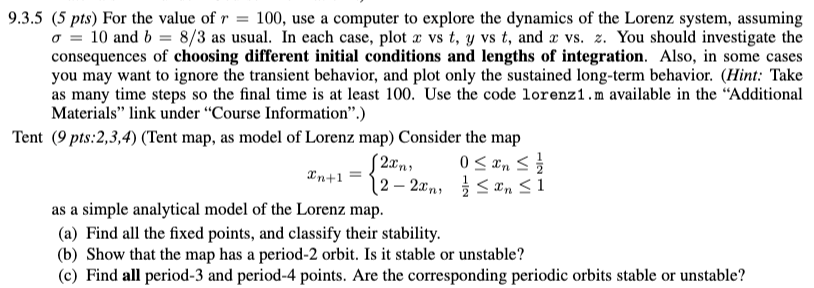 9.3.5 (5 pts) For the value of r = 100, use a computer to explore the dynamics of the Lorenz system, assuming
o = 10 and b = 8/3 as usual. In cach case, plot & vs t, y vs t, and z vs. 2. You should investigate the
consequences of choosing different initial conditions and lengths of integration. Also, in some cases
you may want to ignore the transient behavior, and plot only the sustained long-term behavior. (Hint: Take
as many time steps so the final time is at least 100. Use the code lorenz1.m available in the “Additional
Materials” link under “Course Information”)
Tent (9 pis:2,3,4) (Tent map, as model of Lorenz map) Consider the map
oo [2a 0Sm