 VIPSolutions
Give step-by-step solution with explanation and final answer:2.Find the frequency spectra of the signals shown in Figure 2s 0 IES
Question:
Give step-by-step solution with explanation and final answer: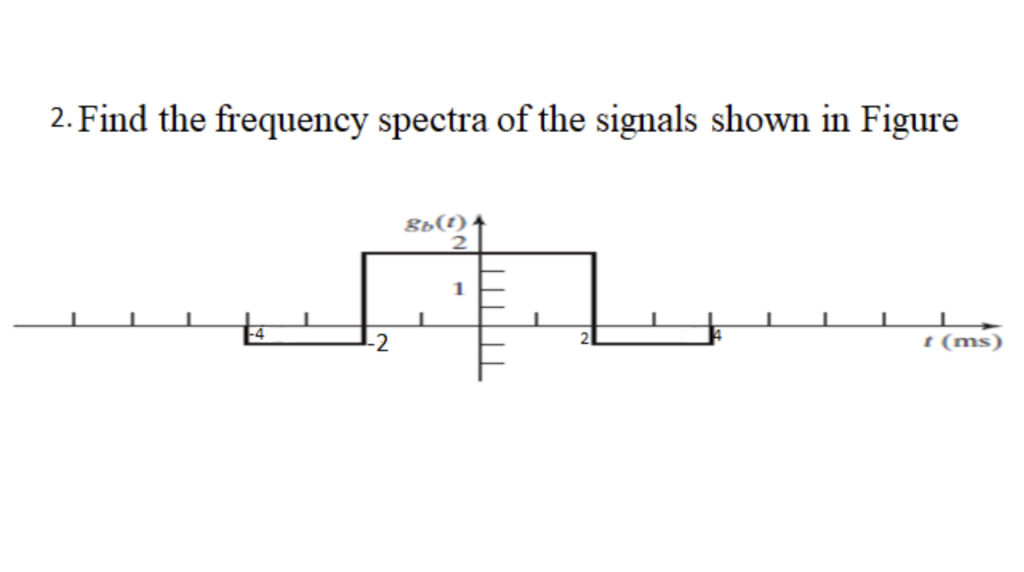 2.Find the frequency spectra of the signals shown in Figure
2s 0
IES
This is AI generated Response.
Asked by: gvr
Created at: 2025-07-28 05:10:29
Asked by: gvr
Created at: 2025-07-28 05:10:29
Final Answer:
Rendered
Raw Text
Did you like this answer?
Let's solve the problem step by step.
### **Step 1: Analyze the Signal**
From the figure, the signal \( g_b(t) \):
- Is a rectangular pulse.
- Amplitude = 2 from \( t = -2 \) ms to \( t = 2 \) ms.
- Amplitude = 0 otherwise.
So,
\[
g_b(t) =
\begin{cases}
2, & -2 \leq t \leq 2 \\
0, & \text{otherwise}
\end{cases}
\]
### **Step 2: Express the Signal Mathematically**
This is a rectangular pulse centered at \( t = 0 \) with width \( T = 4 \) ms and height 2.
We can write:
\[
g_b(t) = 2 \cdot \text{rect}\left(\frac{t}{4}\right)
\]
Where:
\[
\text{rect}\left(\frac{t}{T}\right) =
\begin{cases}
1, & |t| \leq \frac{T}{2} \\
0, & \text{otherwise}
\end{cases}
\]
### **Step 3: Find the Fourier Transform**
The Fourier Transform of \( \text{rect}\left(\frac{t}{T}\right) \) is \( T \cdot \text{sinc}(fT) \), where:
\[
\text{sinc}(x) = \frac{\sin(\pi x)}{\pi x}
\]
So, for our signal:
- Amplitude = 2
- Width \( T = 4 \) ms = 0.004 s
The Fourier Transform is:
\[
G_b(f) = 2 \cdot 4 \cdot \text{sinc}(4f)
\]
\[
G_b(f) = 8 \cdot \text{sinc}(4f)
\]
But since the width is in milliseconds,
\[
T = 4~\text{ms} = 0.004~\text{s}
\]
So, the correct argument for the sinc function is \( fT \) in Hz and seconds:
\[
G_b(f) = 2 \times 0.004 \cdot \text{sinc}(0.004f)
\]
\[
G_b(f) = 0.008 \cdot \text{sinc}(0.004f)
\]
### **Step 4: Final Answer**
**The frequency spectrum of \( g_b(t) \) is:**
\[
\boxed{
G_b(f) = 0.008 \cdot \text{sinc}(0.004f)
}
\]
where
\[
\text{sinc}(x) = \frac{\sin(\pi x)}{\pi x}
\]
---
#### **Explanation**
- The spectrum is a sinc function because the time-domain signal is a rectangular pulse.
- The width and amplitude of the pulse determine the scaling of the sinc function.
- The main lobe width is inversely proportional to the pulse width.
If you want the frequency in kHz, just substitute \( f \) with \( f \) in kHz accordingly.
Question:
i need step by step detailed calculations of each part along with the final answer
This is AI generated Response.
Asked by: gvr
Created at: 2025-07-28 05:15:06
Asked by: gvr
Created at: 2025-07-28 05:15:06
Final Answer:
Rendered
Raw Text
Did you like this answer?
Certainly! Let's go through the detailed, step-by-step solution to find the frequency spectrum of the given rectangular pulse signal.
---
### **Step 1: Understand the given signal**
From the figure, the signal \( g_b(t) \):
- Is a rectangular pulse centered at \( t = 0 \).
- Has amplitude = 2.
- Duration (width) = 4 ms, i.e., from \( t = -2 \) ms to \( t = 2 \) ms.
- Zero outside this interval.
**Mathematically:**
\[
g_b(t) =
\begin{cases}
2, & -2\, \text{ms} \leq t \leq 2\, \text{ms} \\
0, & \text{otherwise}
\end{cases}
\]
---
### **Step 2: Express the signal using the rectangular function**
The rectangular pulse can be expressed using the rectangular function:
\[
g_b(t) = 2 \cdot \text{rect}\left( \frac{t}{T} \right)
\]
where:
- \( T = 4\, \text{ms} = 0.004\, \text{s} \),
- \( \text{rect}\left( \frac{t}{T} \right) = 1 \) for \( |t| \leq T/2 \), 0 otherwise.
**Note:** The rectangular function is defined as:
\[
\text{rect}\left( \frac{t}{T} \right) =
\begin{cases}
1, & |t| \leq \frac{T}{2} \\
0, & \text{otherwise}
\end{cases}
\]
---
### **Step 3: Recall the Fourier Transform of a rectangular pulse**
The Fourier Transform of a rectangular pulse of amplitude \( A \), width \( T \), centered at zero, is well-known:
\[
\mathcal{F}\left\{A \cdot \text{rect}\left( \frac{t}{T} \right) \right\} = A T \cdot \text{sinc}(f T)
\]
Where:
\[
\text{sinc}(x) = \frac{\sin(\pi x)}{\pi x}
\]
This formula assumes the Fourier Transform convention:
\[
G(f) = \int_{-\infty}^{\infty} g(t) e^{-j 2 \pi f t} dt
\]
---
### **Step 4: Apply the Fourier Transform to our signal**
Our signal:
\[
g_b(t) = 2 \cdot \text{rect}\left( \frac{t}{T} \right)
\]
with \( T = 0.004\, \text{s} \).
Using the formula:
\[
G_b(f) = \text{FT}\{g_b(t)\} = 2 \times T \times \text{sinc}(f T)
\]
Substitute \( T = 0.004 \):
\[
G_b(f) = 2 \times 0.004 \times \text{sinc}(f \times 0.004)
\]
Calculate the coefficient:
\[
2 \times 0.004 = 0.008
\]
So,
\[
\boxed{
G_b(f) = 0.008 \cdot \text{sinc}(0.004 f)
}
\]
where:
\[
\text{sinc}(x) = \frac{\sin(\pi x)}{\pi x}
\]
---
### **Step 5: Final expression for the frequency spectrum**
**Final answer:**
\[
\boxed{
\boxed{
G_b(f) = 0.008 \cdot \frac{\sin(\pi \times 0.004 f)}{\pi \times 0.004 f}
}
}
\]
or equivalently,
\[
G_b(f) = 0.008 \cdot \text{sinc}(0.004 f)
\]
---
### **Summary:**
| Parameter | Value | Explanation |
|------------|---------|--------------|
| Pulse amplitude | 2 | From the figure |
| Pulse duration \( T \) | 4 ms = 0.004 s | Width of the pulse |
| Fourier transform | \( G_b(f) = 0.008 \cdot \text{sinc}(0.004 f) \) | Based on properties of rectangular pulse |
---
### **Additional notes:**
- The spectrum's main lobe width is inversely proportional to the pulse duration.
- The sinc function determines the shape of the spectrum.
- The maximum magnitude occurs at \( f = 0 \):
\[
G_b(0) = 0.008 \times \text{sinc}(0) = 0.008 \times 1 = 0.008
\]
---
**This completes the detailed step-by-step derivation of the frequency spectrum of the given rectangular pulse signal.**
📢 Instructions:
- Ask anything relatd to above question only.
- For new Question goto :