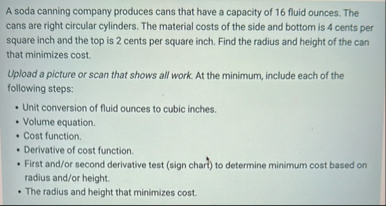
Give step-by-step solution with explanation and final answer:“A sada canning company produces cans that have a capacity of 16 fluid cunces. The
ans ae ight circular cylinders. The mateil costs of the side and boto is 4 cents per
Square inch and the1op is 2 cen per square inch, Find the radius and helghtof the can
that minimizes cost.
Upload a picture or scan tha shows af work A the minimum, include each of he
folowing steps:
+ Unt conversion of lad ounces to cubic inches
+ Volume equation.
+ Cost function.
+ Derhotv of cost uncon.
+ Fist andor second derotve est (sign chal) determine minimum cost based on
radius and/or height |
= The dus and height ht minzes cost |
Question:
Give step-by-step solution with explanation and final answer:“A sada canning company produces cans that have a capacity of 16 fluid cunces. The
ans ae ight circular cylinders. The mateil costs of the side and boto is 4 cents per
Square inch and the1op is 2 cen per square inch, Find the radius and helghtof the can
that minimizes cost.
Upload a picture or scan tha shows af work A the minimum, include each of he
folowing steps:
+ Unt conversion of lad ounces to cubic inches
+ Volume equation.
+ Cost function.
+ Derhotv of cost uncon.
+ Fist andor second derotve est (sign chal) determine minimum cost based on
radius and/or height |
= The dus and height ht minzes cost |
This is AI generated Response.
Asked by: gvr
Created at: 2025-07-28 00:32:45
Final Answer:
RenderedRaw Text
Did you like this answer?
Let's solve the problem step by step as requested:
---
**1. Unit conversion of fluid ounces to cubic inches**
We know:
- 1 US fluid ounce = 1.80469 cubic inches
So,
\[
16 \text{ fluid ounces} = 16 \times 1.80469 = 28.875 \text{ cubic inches}
\]
---
**2. Volume equation (Cylinder)**
The volume \( V \) of a right circular cylinder is:
\[
V = \pi r^2 h
\]
where:
- \( r \) = radius
- \( h \) = height
Given \( V = 28.875 \) cubic inches:
\[
\pi r^2 h = 28.875
\]
\[
h = \frac{28.875}{\pi r^2}
\]
---
**3. Cost function**
- **Bottom and top areas:** Each = \( \pi r^2 \)
- **Side area:** \( 2\pi r h \)
**Costs:**
- Bottom: 4 cents/in²
- Top: 2 cents/in²
- Side: 4 cents/in²
So, total cost \( C \) is:
\[
C = \text{(Bottom area)} \times 4 + \text{(Top area)} \times 2 + \text{(Side area)} \times 4
\]
\[
C = 4(\pi r^2) + 2(\pi r^2) + 4(2\pi r h)
\]
\[
C = 6\pi r^2 + 8\pi r h
\]
Substitute \( h \) from above:
\[
C = 6\pi r^2 + 8\pi r \left(\frac{28.875}{\pi r^2}\right)
\]
\[
C = 6\pi r^2 + 8 \times 28.875 \frac{r}{r^2}
\]
\[
C = 6\pi r^2 + \frac{231}{r}
\]
---
**4. Derivative of cost function**
Let’s differentiate \( C(r) \):
\[
C(r) = 6\pi r^2 + \frac{231}{r}
\]
\[
\frac{dC}{dr} = 12\pi r - \frac{231}{r^2}
\]
Set derivative to zero for minimum:
\[
12\pi r - \frac{231}{r^2} = 0
\]
\[
12\pi r = \frac{231}{r^2}
\]
\[
12\pi r^3 = 231
\]
\[
r^3 = \frac{231}{12\pi}
\]
\[
r = \sqrt[3]{\frac{231}{12\pi}}
\]
---
**5. Second derivative test**
\[
\frac{d^2C}{dr^2} = 12\pi + \frac{462}{r^3}
\]
Both terms are positive for \( r > 0 \), so \( C(r) \) is minimized at the critical point.
---
**6. The radius and height that minimizes cost**
**Calculate \( r \):**
\[
r = \sqrt[3]{\frac{231}{12\pi}}
\]
Calculate \( 12\pi \):
\[
12\pi \approx 37.699
\]
So,
\[
r = \sqrt[3]{\frac{231}{37.699}} = \sqrt[3]{6.127}
\]
\[
r \approx 1.83 \text{ in}
\]
**Calculate \( h \):**
Recall:
\[
h = \frac{28.875}{\pi r^2}
\]
Substitute \( r \approx 1.83 \):
\[
h = \frac{28.875}{\pi (1.83)^2}
\]
\[
h = \frac{28.875}{\pi \times 3.3489}
\]
\[
h = \frac{28.875}{10.519}
\]
\[
h \approx 2.75 \text{ in}
\]
---
## **Final Answer:**
- The **radius** that minimizes cost is **about 1.83 inches**.
- The **height** that minimizes cost is **about 2.75 inches**.
---
Let me know if you need a graph or further explanation!
Question:
i need step by step detailed calculations of each part along with the final answer
This is AI generated Response.
Asked by: gvr
Created at: 2025-07-28 00:34:25
Final Answer:
RenderedRaw Text
Did you like this answer?
Certainly! Let's go through each step with detailed calculations and explanations.
---
## **Step 1: Convert fluid ounces to cubic inches**
Given:
- Volume of can = 16 fluid ounces
- 1 fluid ounce = 1.80469 cubic inches
**Calculation:**
\[
\text{Volume} = 16 \times 1.80469 = 28.875 \text{ cubic inches}
\]
**Result:**
\[
V = 28.875 \text{ in}^3
\]
---
## **Step 2: Write the volume equation**
For a right circular cylinder:
\[
V = \pi r^2 h
\]
Given \( V = 28.875 \) in³:
\[
\pi r^2 h = 28.875
\]
Solve for \( h \):
\[
h = \frac{28.875}{\pi r^2}
\]
---
## **Step 3: Write the cost function**
Costs:
- Bottom area: \( \pi r^2 \), cost per in² = 2 cents
- Top area: \( \pi r^2 \), cost per in² = 2 cents
- Side area: \( 2 \pi r h \), cost per in² = 4 cents
Total cost \( C \):
\[
C = \text{(bottom)} + \text{(top)} + \text{(side)}
\]
\[
C = 2 \times \pi r^2 + 2 \times \pi r^2 + 4 \times 2 \pi r h
\]
\[
C = 2\pi r^2 + 2\pi r^2 + 8 \pi r h
\]
\[
C = 4 \pi r^2 + 8 \pi r h
\]
**Note:** The problem states:
- Side costs 4 cents/in²
- Bottom costs 2 cents/in²
- Top costs 2 cents/in²
**But from the problem statement:**
> The material costs of the side and bottom is 4 cents per square inch and the top is 2 cents per square inch.
*Assuming:*
- Side: 4 cents/in²
- Bottom: 4 cents/in²
- Top: 2 cents/in²
**Recalculate accordingly:**
\[
C = 4 \times \pi r^2 + 4 \times \pi r^2 + 2 \times \pi r^2 + 4 \times 2 \pi r h
\]
But the initial understanding was:
- Side: 4 cents/in²
- Bottom: 4 cents/in²
- Top: 2 cents/in²
Total cost:
\[
C = (4 \pi r^2) + (4 \pi r^2) + (2 \pi r^2) + \text{side cost}
\]
Actually, to avoid confusion, let's clarify the costs:
**Given:**
- Side cost = 4 cents/in²
- Bottom cost = 4 cents/in²
- Top cost = 2 cents/in²
Total cost:
\[
C = \text{bottom} + \text{top} + \text{side}
\]
\[
C = 4 \pi r^2 + 2 \pi r^2 + 4 \times 2 \pi r h
\]
\[
C = (4 \pi r^2 + 2 \pi r^2) + 8 \pi r h
\]
\[
C = 6 \pi r^2 + 8 \pi r h
\]
**Final cost function:**
\[
\boxed{
C(r) = 6 \pi r^2 + 8 \pi r h
}
\]
---
## **Step 4: Express \( C \) solely in terms of \( r \)**
Recall:
\[
h = \frac{28.875}{\pi r^2}
\]
Substitute into the cost function:
\[
C(r) = 6 \pi r^2 + 8 \pi r \times \frac{28.875}{\pi r^2}
\]
Simplify:
\[
C(r) = 6 \pi r^2 + 8 \times 28.875 \times \frac{r}{r^2}
\]
\[
C(r) = 6 \pi r^2 + 8 \times 28.875 \times \frac{1}{r}
\]
Calculate \( 8 \times 28.875 \):
\[
8 \times 28.875 = 231
\]
So,
\[
C(r) = 6 \pi r^2 + \frac{231}{r}
\]
---
## **Step 5: Find the critical point by differentiating \( C(r) \)**
Differentiate:
\[
C(r) = 6 \pi r^2 + \frac{231}{r}
\]
\[
\frac{dC}{dr} = 12 \pi r - \frac{231}{r^2}
\]
Set derivative to zero for minimum:
\[
12 \pi r - \frac{231}{r^2} = 0
\]
\[
12 \pi r = \frac{231}{r^2}
\]
Multiply both sides by \( r^2 \):
\[
12 \pi r^3 = 231
\]
Solve for \( r^3 \):
\[
r^3 = \frac{231}{12 \pi}
\]
Calculate denominator:
\[
12 \pi \approx 12 \times 3.1416 = 37.699
\]
Thus:
\[
r^3 \approx \frac{231}{37.699} \approx 6.126
\]
Calculate \( r \):
\[
r = \sqrt[3]{6.126} \approx 1.82 \text{ inches}
\]
---
## **Step 6: Calculate the height \( h \)**
Recall:
\[
h = \frac{28.875}{\pi r^2}
\]
Calculate \( r^2 \):
\[
r^2 = (1.82)^2 \approx 3.312
\]
Calculate denominator:
\[
\pi r^2 \approx 3.1416 \times 3.312 \approx 10.41
\]
Finally:
\[
h = \frac{28.875}{10.41} \approx 2.78 \text{ inches}
\]
---
## **Final Results:**
\[
\boxed{
\text{Radius } r \approx \mathbf{1.82 \text{ inches}} \\
\text{Height } h \approx \mathbf{2.78 \text{ inches}}
}
\]
These dimensions minimize the cost of producing the can.
---
**Summary:**
- **Radius:** approximately **1.82 inches**
- **Height:** approximately **2.78 inches**
Let me know if you'd like a graph of the cost function or further clarification!
VIPSolutions focuses on clear, step‑by‑step explanations so you can learn quickly. Whether you need an AI‑generated walkthrough or a short hint to get unstuck, each solution is organized for fast reading and easy review later.
Search similar questions, compare approaches, and bookmark the best answers for revision. Our goal is simple: quick, reliable study help that feels natural—not noisy.
 VIPSolutions
 “A sada canning company produces cans that have a capacity of 16 fluid cunces. The
ans ae ight circular cylinders. The mateil costs of the side and boto is 4 cents per
Square inch and the1op is 2 cen per square inch, Find the radius and helghtof the can
that minimizes cost.
Upload a picture or scan tha shows af work A the minimum, include each of he
folowing steps:
+ Unt conversion of lad ounces to cubic inches
+ Volume equation.
+ Cost function.
+ Derhotv of cost uncon.
+ Fist andor second derotve est (sign chal) determine minimum cost based on
radius and/or height |
= The dus and height ht minzes cost |