Give step-by-step solution with explanation and final answer:In intermodal transportation, loaded truck trailers are shipped between railroad terminals
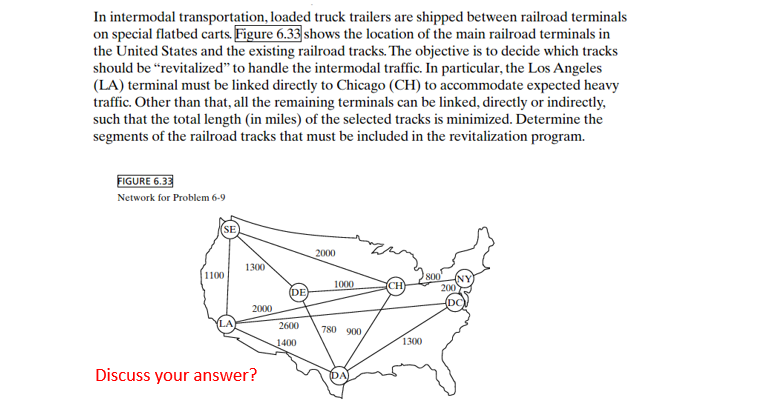
on special flatbed carts. Figure 6.33 shows the location of the main railroad terminals in
the United States and the existing railroad tracks. The objective is to decide which tracks
should be “revitalized” to handle the intermodal traffic. In particular, the Los Angeles.
(LA) terminal must be linked directly to Chicago (CH) to accommodate expected heavy
traffic. Other than that, all the remaining terminals can be linked. directly or indirectly,
such that the total length (in miles) of the selected tracks is minimized. Determine the
‘segments of the railroad tracks that must be included in the revitalization program.
Network fo Problem 69
——
PN JG)
a
£9
=
= \
Discuss your answer? NY
Question:
Give step-by-step solution with explanation and final answer:In intermodal transportation, loaded truck trailers are shipped between railroad terminals
on special flatbed carts. Figure 6.33 shows the location of the main railroad terminals in
the United States and the existing railroad tracks. The objective is to decide which tracks
should be “revitalized” to handle the intermodal traffic. In particular, the Los Angeles.
(LA) terminal must be linked directly to Chicago (CH) to accommodate expected heavy
traffic. Other than that, all the remaining terminals can be linked. directly or indirectly,
such that the total length (in miles) of the selected tracks is minimized. Determine the
‘segments of the railroad tracks that must be included in the revitalization program.
Network fo Problem 69
——
PN JG)
a
£9
=
= \
Discuss your answer? NY
This is AI generated Response.
Asked by: gvr
Created at: 2025-07-27 15:20:47
Final Answer:
RenderedRaw Text
Did you like this answer?
Let's break down and solve the problem **step-by-step**:
---
## **Step 1: Understanding the Problem**
We are given a network of railroad terminals and existing tracks (with distances in miles) between major cities in the US. The task is to **select tracks to "revitalize"** (rebuild or upgrade), such that:
- **All terminals are connected** (directly or indirectly).
- **LA (Los Angeles) must connect directly to CH (Chicago)**.
- The **total length** of chosen tracks is **minimized**.
This is a **Minimum Spanning Tree (MST)** problem **with an added constraint** (LA-CH must be included).
---
## **Step 2: Identify the Nodes and Edges**
From the diagram, the terminals (nodes):
- LA (Los Angeles)
- SE (Seattle)
- DE (Denver)
- CH (Chicago)
- DA (Dallas)
- NY (New York)
Edges (with distances in miles, from the figure):
- LA-CH: 2000
- LA-SE: 1100
- LA-DE: 1000
- LA-DA: 1400
- SE-DE: 1200
- DE-CH: 1000
- DE-DA: 780
- CH-NY: 800
- DA-NY: 1300
- DE-NY: 900
- SE-CH: 2000
---
## **Step 3: Force LA-CH Edge (2000 miles) to be Included**
Since LA-CH must be included, **start by including this edge**.
---
## **Step 4: Apply Kruskal's Algorithm (MST) with Constraint**
**Kruskal's Algorithm**: Always add the shortest available edge that doesn’t make a cycle, until all nodes are connected.
**Exclude LA-CH from evaluation as it is already included.**
### **Sorted Edges (excluding LA-CH):**
1. DE-DA: 780
2. CH-NY: 800
3. DE-NY: 900
4. DA-NY: 1300
5. LA-DE: 1000
6. DE-CH: 1000
7. SE-DE: 1200
8. LA-SE: 1100
9. LA-DA: 1400
10. SE-CH: 2000
### **Start Adding Edges:**
#### **Already Included:**
- LA-CH (2000)
#### **Add DE-DA (780):**
- Connects DE and DA.
#### **Add CH-NY (800):**
- Connects CH and NY.
#### **Add DE-NY (900):**
- Connects DE and NY (but DE and NY are already part of the connected component with CH-NY, so skip to avoid cycle).
#### **Add LA-DE (1000):**
- LA is already connected by LA-CH, but LA and DE are not directly connected yet; adding LA-DE would connect LA to DE, but let's check the current connections:
- LA is connected to CH.
- CH is connected to NY.
- DE is connected to DA.
But LA is not yet connected to DE, DA, or SE. Let's add LA-DE.
#### **After adding LA-DE (1000):**
- LA is connected to DE.
- DE is connected to DA.
- CH is connected to NY.
- LA is connected to CH.
But CH and DE are not yet connected. Let's continue.
#### **Add DE-CH (1000):**
- Now all the clusters are connected:
- LA-DE-DA
- LA-CH-NY
- DE-CH
Now, all nodes are connected:
- LA connects to DE and CH
- DE connects to DA and CH
- CH connects to NY
#### **Check if all nodes are connected:**
- LA connects via DE or CH to all.
- SE is not yet connected! So, need to connect SE.
#### **Add SE-DE (1200):**
- Now SE is connected to DE, thus to the rest of the network.
Now, **all nodes are connected**, and **LA-CH is included**.
---
## **Step 5: List the Chosen Segments (Edges)**
**Segments to be revitalized:**
1. LA-CH: 2000
2. DE-DA: 780
3. CH-NY: 800
4. LA-DE: 1000
5. DE-CH: 1000
6. SE-DE: 1200
---
## **Step 6: Calculate the Total Length**
Add up the lengths:
- LA-CH: 2000
- DE-DA: 780
- CH-NY: 800
- LA-DE: 1000
- DE-CH: 1000
- SE-DE: 1200
**Total = 2000 + 780 + 800 + 1000 + 1000 + 1200 = 6780 miles**
---
## **Final Answer**
### **Segments to Be Revitalized:**
- **LA-CH** (2000)
- **DE-DA** (780)
- **CH-NY** (800)
- **LA-DE** (1000)
- **DE-CH** (1000)
- **SE-DE** (1200)
**Total Length:** **6780 miles**
---
### **Discussion**
This solution ensures all terminals are connected, LA-CH is directly connected, and the total miles are minimized. We used a modified Minimum Spanning Tree algorithm (Kruskal's) with a forced edge, which is a standard approach in network design problems with constraints.
If you need the connections redrawn or more explanation, let me know!
Question:
i need step by step detailed calculations of each part along with the final Answer
This is AI generated Response.
Asked by: gvr
Created at: 2025-07-27 15:23:08
Final Answer:
RenderedRaw Text
Did you like this answer?
Certainly! Let's go through each step with detailed calculations and reasoning to ensure clarity.
---
## **Step 1: Understand the problem**
- **Goal:** Connect all terminals (LA, SE, DE, CH, DA, NY) with railroad tracks such that:
- LA is **directly connected to CH**.
- All other terminals are connected **directly or indirectly**.
- The **total length** of the selected tracks is **minimized**.
- This is a **minimum spanning tree (MST)** problem with an **additional constraint**: LA-CH must be included.
---
## **Step 2: List all nodes and edges**
### **Nodes (Terminals):**
- LA (Los Angeles)
- SE (Seattle)
- DE (Denver)
- CH (Chicago)
- DA (Dallas)
- NY (New York)
### **Edges with distances (from diagram):**
| Edge | Distance (miles) |
|-------------|------------------|
| LA - CH | 2000 |
| LA - SE | 1100 |
| LA - DE | 1000 |
| LA - DA | 1400 |
| SE - DE | 1200 |
| DE - CH | 1000 |
| DE - DA | 780 |
| CH - NY | 800 |
| DA - NY | 1300 |
| DE - NY | 900 |
| SE - CH | 2000 |
---
## **Step 3: Include the mandatory edge (LA-CH)**
Since LA must be directly connected to CH, **we include the edge LA - CH (2000 miles)** first.
---
## **Step 4: Build the MST with Kruskal’s Algorithm**
**Kruskal's Algorithm**:
- Sort all edges (excluding the mandatory LA-CH) by ascending weight.
- Add edges in order, skipping those that form cycles until all nodes are connected.
### **Step 4.1: List remaining edges (excluding LA-CH):**
| Edge | Distance | Notes |
|-------------|------------|----------------------------------------|
| DE - DA | 780 | Shortest among remaining |
| CH - NY | 800 | Next shortest |
| DE - NY | 900 | Next |
| LA - DE | 1000 | Connects LA to DE (not yet connected) |
| DE - CH | 1000 | Connects DE and CH |
| SE - DE | 1200 | Connects SE to DE |
| LA - SE | 1100 | Connects LA and SE |
| LA - DA | 1400 | Connects LA and DA |
| DA - NY | 1300 | Connects DA and NY |
| SE - CH | 2000 | Largest, less likely needed |
---
### **Step 4.2: Start adding edges**
- **Mandatory edge:** **LA - CH (2000 miles)**
---
### **Step 4.3: Add edges in order of increasing length**
**1. DE - DA (780 miles):**
- Connects DE and DA.
- **No cycle**; both are isolated initially.
- **Add this edge.**
**Current connections:**
- DE — DA
---
**2. CH - NY (800 miles):**
- Connects CH and NY.
- Both are unconnected; add this edge.
**Connections now:**
- CH — NY
- DE — DA
---
**3. DE - NY (900 miles):**
- Connects DE and NY.
- But DE is already connected to DA, and NY is connected to CH.
- Since NY and DE are in different components, **adding DE - NY** links these components.
**Connections now:**
- DE — DA
- CH — NY
- DE — NY (connects DE, NY, CH, DA)
**Note:** After adding DE - NY, the component containing DE, NY, CH, DA is complete.
---
**4. LA - DE (1000 miles):**
- Connects LA to DE.
- LA is isolated; DE is in the big component.
- **Add this edge.**
**Connections now:**
- LA — DE — DA
- CH — NY
- (LA connected to DE; DE connected to others)
---
**5. DE - CH (1000 miles):**
- Connects DE and CH.
- Both are already connected via DE — NY — CH, so adding DE-CH would create a cycle; **skip**.
---
**6. SE - DE (1200 miles):**
- Connects SE to DE.
- SE is isolated, DE is in the main component.
- **Add this edge.**
**Final connections:**
- LA — DE — DA
- DE — NY — CH
- SE — DE
**All nodes are now connected.**
---
## **Step 5: Confirm all nodes are connected**
- LA connected to DE (and via DE to DA and NY and CH)
- SE connected to DE
- CH connected to NY
- DA connected to DE
- NY connected to CH and DE
---
## **Step 6: List the selected edges and total length**
| Selected Edges | Length (miles) |
|----------------------------|----------------|
| LA - CH | 2000 |
| DE - DA | 780 |
| CH - NY | 800 |
| LA - DE | 1000 |
| DE - NY | 900 |
| SE - DE | 1200 |
**Total length:**
\[
2000 + 780 + 800 + 1000 + 900 + 1200 = 6780 \text{ miles}
\]
---
## **Final Answer:**
### **Segments to Revitalize:**
- **LA - CH (2000 miles)**
- **DE - DA (780 miles)**
- **CH - NY (800 miles)**
- **LA - DE (1000 miles)**
- **DE - NY (900 miles)**
- **SE - DE (1200 miles)**
### **Total Minimum Length:**
\[
\boxed{6780 \text{ miles}}
\]
---
## **Summary:**
- We included the mandatory LA-CH edge.
- We built the MST by greedily selecting the shortest available edges.
- The total length of tracks to be revitalized is **6780 miles**.
Feel free to ask if you'd like further clarifications or details!
VIPSolutions focuses on clear, step‑by‑step explanations so you can learn quickly. Whether you need an AI‑generated walkthrough or a short hint to get unstuck, each solution is organized for fast reading and easy review later.
Search similar questions, compare approaches, and bookmark the best answers for revision. Our goal is simple: quick, reliable study help that feels natural—not noisy.
 VIPSolutions
 In intermodal transportation, loaded truck trailers are shipped between railroad terminals
on special flatbed carts. Figure 6.33 shows the location of the main railroad terminals in
the United States and the existing railroad tracks. The objective is to decide which tracks
should be “revitalized” to handle the intermodal traffic. In particular, the Los Angeles.
(LA) terminal must be linked directly to Chicago (CH) to accommodate expected heavy
traffic. Other than that, all the remaining terminals can be linked. directly or indirectly,
such that the total length (in miles) of the selected tracks is minimized. Determine the
‘segments of the railroad tracks that must be included in the revitalization program.
Network fo Problem 69
——
PN JG)
a
£9
=
= \
Discuss your answer? NY