 VIPSolutions
Give step-by-step solution with explanation and final answer:° 4 Compute the integral using the Residue Theorem | en) 4, ox” +2x +2
Question:
Give step-by-step solution with explanation and final answer: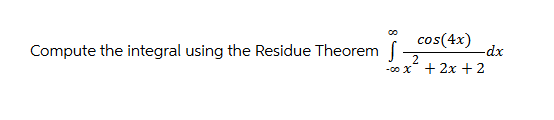 ° 4
Compute the integral using the Residue Theorem | en) 4,
ox” +2x +2
This is AI generated Response.
Asked by: gvr
Created at: 2025-07-26 22:30:42
Asked by: gvr
Created at: 2025-07-26 22:30:42
Final Answer:
Rendered
Raw Text
Did you like this answer?
Let's compute the integral using the **Residue Theorem**:
\[
I = \int_{-\infty}^{\infty} \frac{\cos(4x)}{x^2 + 2x + 2} \, dx
\]
---
### **Step 1: Express Cosine as Exponential**
Recall:
\[
\cos(4x) = \text{Re}(e^{i4x})
\]
So,
\[
I = \text{Re} \left\{ \int_{-\infty}^{\infty} \frac{e^{i4x}}{x^2 + 2x + 2} \, dx \right\}
\]
---
### **Step 2: Identify the Poles**
Factor denominator:
\[
x^2 + 2x + 2 = (x+1)^2 + 1
\]
Set denominator to zero:
\[
(x+1)^2 + 1 = 0 \implies (x+1)^2 = -1 \implies x+1 = \pm i \implies x = -1 \pm i
\]
Poles: **\( x_1 = -1 + i \), \( x_2 = -1 - i \)**
---
### **Step 3: Choose a Contour**
Since \(e^{i4x}\) decays in the upper half-plane for large \(x\), close the contour in the **upper half-plane**.
Among the poles, only \(x_1 = -1 + i\) is in the upper half-plane.
---
### **Step 4: Compute the Residue at \(x_1\)**
For a simple pole:
\[
\text{Res}_{x = x_1} \, f(x) = \lim_{x \to x_1} (x - x_1) \frac{e^{i4x}}{(x - x_1)(x - x_2)}
= \frac{e^{i4x_1}}{x_1 - x_2}
\]
Compute \(x_1 - x_2\):
\[
x_1 - x_2 = (-1 + i) - (-1 - i) = 2i
\]
So,
\[
\text{Res}_{x = x_1} \, f(x) = \frac{e^{i4x_1}}{2i}
\]
---
### **Step 5: Apply the Residue Theorem**
\[
\int_{-\infty}^\infty \frac{e^{i4x}}{x^2 + 2x + 2} dx = 2\pi i \cdot \left(\text{Residue at } x_1\right)
= 2\pi i \cdot \frac{e^{i4x_1}}{2i}
= \pi e^{i4x_1}
\]
---
### **Step 6: Take the Real Part**
Recall \(I = \text{Re}(\pi e^{i4x_1})\).
Compute \(e^{i4x_1}\):
\[
x_1 = -1 + i \implies e^{i4x_1} = e^{i4(-1 + i)} = e^{-i4} \cdot e^{-4}
\]
So,
\[
I = \text{Re}(\pi e^{-i4} e^{-4}) = \pi e^{-4} \cos(4)
\]
---
## **Final Answer**
\[
\boxed{
\int_{-\infty}^{\infty} \frac{\cos(4x)}{x^2 + 2x + 2} \, dx = \pi e^{-4} \cos(4)
}
\]
Question:
I NEED STEP BY STEP DETAILED CALCULATIONS OF EACH PART ALONG WITH THE FINAL aNSWER
This is AI generated Response.
Asked by: gvr
Created at: 2025-07-26 22:32:23
Asked by: gvr
Created at: 2025-07-26 22:32:23
Final Answer:
Rendered
Raw Text
Did you like this answer?
Let's carefully compute the integral:
\[
I = \int_{-\infty}^{\infty} \frac{\cos(4x)}{x^2 + 2x + 2} \, dx
\]
using the **Residue Theorem**. Here's a detailed step-by-step process:
---
### **Step 1: Express \(\cos(4x)\) as the real part of an exponential**
Recall Euler's formula:
\[
\cos(4x) = \Re \left( e^{i4x} \right)
\]
Thus,
\[
I = \Re \left( \int_{-\infty}^{\infty} \frac{e^{i4x}}{x^2 + 2x + 2} \, dx \right)
\]
Define:
\[
J = \int_{-\infty}^{\infty} \frac{e^{i4x}}{x^2 + 2x + 2} \, dx
\]
so that
\[
I = \Re(J)
\]
---
### **Step 2: Simplify the denominator**
Complete the square:
\[
x^2 + 2x + 2 = (x + 1)^2 + 1
\]
The poles are where the denominator is zero:
\[
(x + 1)^2 + 1 = 0 \implies (x + 1)^2 = -1 \implies x + 1 = \pm i
\]
So,
\[
x = -1 \pm i
\]
The **poles** are at:
\[
x_1 = -1 + i \quad \text{(upper half-plane)} \\
x_2 = -1 - i \quad \text{(lower half-plane)}
\]
---
### **Step 3: Choose the contour**
Because the integrand involves \(e^{i4x}\), which decays in the **upper half-plane** for large \(\Im(x)\), we close the contour in the **upper half-plane**.
Only the pole at:
\[
x_1 = -1 + i
\]
lies inside this contour.
---
### **Step 4: Compute the residue at \(x_1 = -1 + i\)**
The integrand:
\[
f(x) = \frac{e^{i4x}}{(x+1)^2 + 1}
\]
has simple poles at \(x = -1 \pm i\). The residue at \(x_1\) is:
\[
\operatorname{Res}_{x = x_1} f(x) = \lim_{x \to x_1} (x - x_1) f(x)
\]
Since the denominator factors as:
\[
(x+1)^2 + 1 = (x - x_1)(x - x_2)
\]
the residue simplifies to:
\[
\operatorname{Res}_{x = x_1} f(x) = \frac{e^{i4x_1}}{(x_1 - x_2)}
\]
because at \(x = x_1\):
\[
\lim_{x \to x_1} (x - x_1) \frac{e^{i4x}}{(x - x_1)(x - x_2)} = \frac{e^{i4x_1}}{x_1 - x_2}
\]
Now, compute \(x_1 - x_2\):
\[
x_1 - x_2 = (-1 + i) - (-1 - i) = 2i
\]
Thus,
\[
\operatorname{Res}_{x = x_1} f(x) = \frac{e^{i4x_1}}{2i}
\]
---
### **Step 5: Use the Residue Theorem**
The integral over the real axis (with the chosen contour) equals:
\[
J = 2\pi i \times \text{sum of residues inside the contour}
\]
since only the pole at \(x_1\) is enclosed,
\[
J = 2 \pi i \times \frac{e^{i4x_1}}{2i} = \pi e^{i4x_1}
\]
---
### **Step 6: Re-express \(e^{i4x_1}\)**
Recall:
\[
x_1 = -1 + i
\]
Then,
\[
e^{i4x_1} = e^{i4(-1 + i)} = e^{-i4} \times e^{i4 \times i} = e^{-i4} \times e^{-4}
\]
because:
\[
i \times i = -1 \quad \Rightarrow \quad i4 \times i = -4
\]
So,
\[
e^{i4x_1} = e^{-i4} \times e^{-4}
\]
---
### **Step 7: Write the integral \(J\) in terms of real functions**
\[
J = \pi e^{i4x_1} = \pi e^{-4} e^{-i4}
\]
Recall that:
\[
e^{-i4} = \cos(4) - i \sin(4)
\]
Therefore,
\[
J = \pi e^{-4} (\cos 4 - i \sin 4)
\]
The original integral \(I\) is the **real part** of \(J\):
\[
I = \Re(J) = \pi e^{-4} \cos 4
\]
---
### **### **Final Answer:**
\[
\boxed{
\int_{-\infty}^{\infty} \frac{\cos(4x)}{x^2 + 2x + 2} \, dx = \pi e^{-4} \cos 4
}
\]
This completes the detailed step-by-step solution!
📢 Instructions:
- Ask anything relatd to above question only.
- For new Question goto :