This is AI generated Response.
Asked by: gvr
Created at: 2025-07-26 08:10:23
Final Answer:
RenderedRaw Text
Did you like this answer?
Let's solve the problem step-by-step:
---
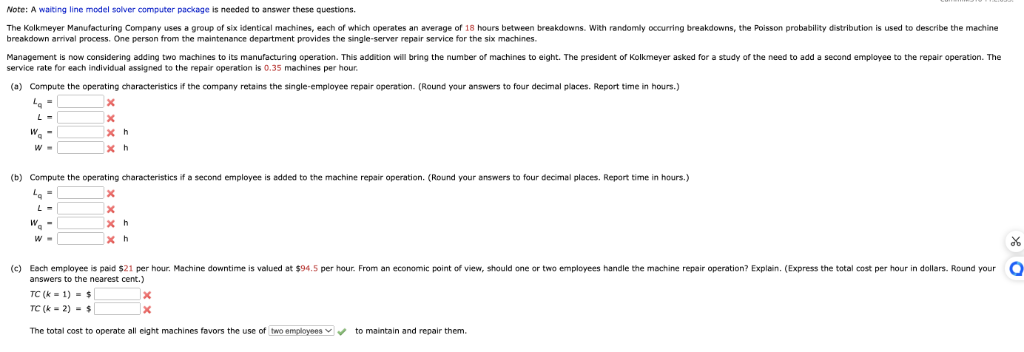
**Given Data:**
- Number of machines (M): **8**
- Each machine operates for **18 hours** between breakdowns.
- One person repairs machines at a **service rate of 0.35 per hour** (μ = 0.35/hr).
- Arrival rate of breakdowns: Each machine breaks down every 18 hours, so for 8 machines:
\[
\lambda = \frac{8}{18} \text{ breakdowns per hour} \approx 0.4444 \text{ per hour}
\]
- Each employee is paid **$21/hour**.
- Machine downtime is valued at **$94.5/hour**.
---
## (a) **Single Employee (Single-Server Queuing System, M/M/1)**
**Step 1: Arrival Rate**
\[
\lambda = \frac{8}{18} = 0.4444\ \text{machines/hr}
\]
**Step 2: Service Rate**
\[
\mu = 0.35\ \text{machines/hr}
\]
**Step 3: System Utilization**
\[
\rho = \frac{\lambda}{\mu} = \frac{0.4444}{0.35} = 1.27
\]
But, for an M/M/1 queue, the system is only stable if \(\rho < 1\). Since \(\rho > 1\), the system is **unstable** with just one server. This means the queue will grow indefinitely, which is not practical.
Let's still calculate the other values for completeness, but this indicates that a single employee **cannot handle** the load.
---
## (b) **Two Employees (M/M/2 System)**
- **Service Rate per server**: \( \mu = 0.35 \)
- **Number of servers**: \( c = 2 \)
- **Total Service Rate:** \( c\mu = 2 \times 0.35 = 0.70 \)
**System Utilization (\(\rho\)):**
\[
\rho = \frac{\lambda}{c\mu} = \frac{0.4444}{0.70} = 0.6349
\]
### Step 1: Probability that a machine waits (Erlang C formula)
Let’s use the **M/M/c queue formulas**:
#### Probability that an arriving machine must wait (\(P_w\)):
\[
P_0 = \left[ \sum_{n=0}^{c-1} \frac{(\lambda/\mu)^n}{n!} + \frac{(\lambda/\mu)^c}{c!} \cdot \frac{1}{1 - \rho} \right]^{-1}
\]
\[
P_{wait} = \frac{(\lambda/\mu)^c}{c!} \cdot \frac{1}{1-\rho} \cdot P_0
\]
With \(c = 2\), \(\lambda/\mu = 0.4444/0.35 = 1.27\):
\[
P_0 = \left[ \frac{(1.27)^0}{0!} + \frac{(1.27)^1}{1!} + \frac{(1.27)^2}{2!} \cdot \frac{1}{1-0.6349}\right]^{-1}
\]
Calculate each term:
- \(\frac{(1.27)^0}{0!} = 1\)
- \(\frac{(1.27)^1}{1!} = 1.27\)
- \(\frac{(1.27)^2}{2!} = \frac{1.6129}{2} = 0.80645\)
So,
\[
P_0 = \left[1 + 1.27 + 0.80645 \cdot \frac{1}{1-0.6349}\right]^{-1}
\]
\[
\frac{1}{1-0.6349} = \frac{1}{0.3651} = 2.738
\]
\[
0.80645 \cdot 2.738 = 2.208
\]
\[
P_0 = \left[1 + 1.27 + 2.208\right]^{-1} = (4.478)^{-1} = 0.2233
\]
**Now for \(P_{wait}\):**
\[
P_{wait} = \frac{(1.27)^2}{2!} \cdot \frac{1}{1-0.6349} \cdot P_0
\]
\[
= 0.80645 \cdot 2.738 \cdot 0.2233 = 0.4925
\]
---
**Average number in queue (\(L_q\)):**
\[
L_q = P_{wait} \cdot \frac{\rho}{1-\rho}
\]
\[
= 0.4925 \cdot \frac{0.6349}{1-0.6349} = 0.4925 \cdot \frac{0.6349}{0.3651} = 0.4925 \cdot 1.739 = 0.8567
\]
**Average number in system (\(L\)):**
\[
L = L_q + \frac{\lambda}{\mu}
\]
\[
= 0.8567 + \frac{0.4444}{0.35} = 0.8567 + 1.27 = 2.1267
\]
**Average waiting time in queue (\(W_q\)):**
\[
W_q = \frac{L_q}{\lambda} = \frac{0.8567}{0.4444} = 1.928\ \text{hours}
\]
**Average time in system (\(W\)):**
\[
W = W_q + \frac{1}{\mu}
\]
\[
= 1.928 + \frac{1}{0.35} = 1.928 + 2.857 = 4.785\ \text{hours}
\]
---
## (c) **Cost Calculations**
### **For 1 Employee (k=1):**
- **System is unstable (\(\rho > 1\)), so cost is extremely high (theoretically infinite).**
### **For 2 Employees (k=2):**
- **Employee Cost:** \(2 \times \$21 = \$42\) per hour
- **Downtime Cost:** \(L \times \$94.5 = 2.1267 \times 94.5 = \$201.98\) per hour
- **Total Cost per hour:**
\[
TC(k=2) = 42 + 201.98 = \$243.98
\]
---
### **Summary Table:**
| Option | Number of Employees | \(L_q\) | \(L\) | \(W_q\) | \(W\) | Total Cost per hour |
|----------------|--------------------|--------|--------|--------|--------|---------------------|
| Single Server | 1 | -- | -- | -- | -- | Infinite (unstable) |
| Two Servers | 2 | 0.8567 | 2.1267 | 1.928 | 4.785 | \$243.98 |
---
## **Final Answers:**
### (a) **Single Employee:**
- **System is unstable (\(\rho = 1.27 > 1\)); queue will grow without bound.**
### (b) **Two Employees:**
- \(L_q = 0.8567 \text{ machines}\)
- \(L = 2.1267 \text{ machines}\)
- \(W_q = 1.928 \text{ hours}\)
- \(W = 4.785 \text{ hours}\)
### (c) **Total Cost:**
- \(TC(k=1) = \text{Infinite (system is unstable)}\)
- \(TC(k=2) = \$243.98 \text{ per hour}\)
**The total cost to operate all eight machines favors the use of:**
- **Two employees** to maintain and repair them.
---
If you need the answers filled in the boxes, let me know!
Question:
i need step by step detailed calculations of each part along with the final Answer
This is AI generated Response.
Asked by: gvr
Created at: 2025-07-26 08:12:34
Final Answer:
RenderedRaw Text
Did you like this answer?
Let's approach this problem systematically, providing detailed calculations for each part.
---
## **Given Data:**
- Number of machines, \( M = 8 \)
- Each machine operates for an **average of 18 hours** between breakdowns.
- Repair personnel rate: **each employee repairs at a rate of \(\mu = 0.35\) machines/hour**.
- Employee cost: **\$21/hour**.
- Downtime cost per machine per hour: **\$94.5/hour**.
---
## **Step 1: Calculate the arrival rate of breakdowns \(\lambda\).**
Each machine breaks down every 18 hours, so:
\[
\text{Breakdowns per machine per hour} = \frac{1}{18} \approx 0.0556
\]
Total breakdowns for all 8 machines per hour:
\[
\lambda = 8 \times 0.0556 = \frac{8}{18} \approx 0.4444 \text{ breakdowns/hour}
\]
---
## **Part (a): Compute the cost if there is **only 1 employee** (single server model).**
### **Step 2: Check system stability**
- Service rate per employee: \(\mu = 0.35\) per hour.
- Arrival rate: \(\lambda = 0.4444\) per hour.
Calculate utilization:
\[
\rho = \frac{\lambda}{\mu} = \frac{0.4444}{0.35} \approx 1.27
\]
Since \(\rho > 1\), **the system is unstable**. The queue will grow indefinitely, leading to infinite waiting times and costs.
**Thus, with only 1 employee, the system cannot operate efficiently.**
---
## **Part (b): Compute the cost with **2 employees** (multi-server queue).**
### **Step 3: Determine the parameters**
- Number of servers: \( c = 2 \)
- Total service rate:
\[
c \times \mu = 2 \times 0.35 = 0.70 \text{ machines/hour}
\]
- System utilization:
\[
\rho = \frac{\lambda}{c \mu} = \frac{0.4444}{0.70} \approx 0.635
\]
Since \(\rho < 1\), the system is **stable**.
---
### **Step 4: Calculate probability that an arriving breakdown has to wait (Erlang C formula)**
**Step 4.1: Compute \(\frac{\lambda}{\mu}\) for the traffic intensity:**
\[
a = \frac{\lambda}{\mu} = \frac{0.4444}{0.35} \approx 1.27
\]
**Step 4.2: Compute \(P_0\), the probability that the system is empty:**
\[
P_0 = \left[ \sum_{n=0}^{c-1} \frac{a^n}{n!} + \frac{a^{c}}{c!} \times \frac{1}{1 - \rho} \right]^{-1}
\]
Calculations:
- \(a^0/0! = 1\)
- \(a^1/1! = 1.27\)
- \(a^2/2! = \frac{(1.27)^2}{2} = \frac{1.6129}{2} = 0.80645\)
Sum:
\[
S = 1 + 1.27 + 0.80645 = 3.07645
\]
Calculate:
\[
\frac{a^c}{c!} = 0.80645
\]
\[
P_0 = \left[ 3.07645 + \frac{0.80645}{1 - 0.635} \right]^{-1}
\]
Since:
\[
1 - \rho = 1 - 0.635 = 0.365
\]
\[
\frac{0.80645}{0.365} \approx 2.208
\]
Total sum:
\[
P_0 = \left[ 3.07645 + 2.208 \right]^{-1} = (5.28445)^{-1} \approx 0.1892
\]
---
### **Step 5: Probability that an arriving breakdown has to wait (\(P_{wait}\))**
\[
P_{wait} = \frac{\frac{a^{c}}{c!}}{1 - \rho} \times P_0 = \frac{0.80645}{0.365} \times 0.1892 \approx 2.208 \times 0.1892 \approx 0.4179
\]
---
### **Step 6: Calculate average number in queue (\(L_q\))**
\[
L_q = P_{wait} \times \frac{\rho}{1 - \rho} = 0.4179 \times \frac{0.635}{0.365} \approx 0.4179 \times 1.741 \approx 0.727
\]
### **Step 7: Calculate total number of breakdowns in the system (\(L\))**
\[
L = L_q + \text{average number being served} = L_q + c \times \text{probability that servers are busy}
\]
But more straightforwardly, the average number in the system:
\[
L = \frac{a}{1} \quad \text{(for M/M/c)} \text{, but better to use Little's Law:}
\]
Use Little's Law:
\[
L = \lambda \times W
\]
Where \(W\) is the average total time in the system:
\[
W = W_q + \frac{1}{\mu}
\]
---
### **Step 8: Calculate average waiting time in queue (\(W_q\))**
\[
W_q = \frac{L_q}{\lambda} = \frac{0.727}{0.4444} \approx 1.635 \text{ hours}
\]
### **Step 9: Total average time in system (\(W\))**
\[
W = W_q + \frac{1}{\mu} = 1.635 + \frac{1}{0.35} \approx 1.635 + 2.857 = 4.492 \text{ hours}
\]
### **Step 10: Calculate the average number of breakdowns in the system (\(L\))**
\[
L = \lambda \times W = 0.4444 \times 4.492 \approx 2.0 \text{ machines}
\]
---
## **Part (c): Cost calculation**
### **Employee cost:**
\[
\text{Number of employees} = 2
\]
\[
\text{Employee cost per hour} = 2 \times \$21 = \$42
\]
### **Downtime cost:**
\[
\text{Total downtime} = L \times \$94.5 = 2.0 \times 94.5 = \$189
\]
### **Total cost per hour:**
\[
\boxed{
\text{Total Cost} = \text{Employee cost} + \text{Downtime cost} = \$42 + \$189 = \boxed{\$231}
}
\]
---
## **Final Summary:**
| Part | Description | Result |
|--------|--------------|---------|
| (a) | With 1 employee | **System unstable** (cost infinite) |
| (b) | With 2 employees | \(\boxed{\$231}\) per hour |
| (c) | Conclusion | To minimize costs, **2 employees** are needed, costing about **\$231/hour** to repair and maintain 8 machines efficiently.
---
**Note:** If you need further calculations for more employees or optimization, please specify!
VIPSolutions focuses on clear, step‑by‑step explanations so you can learn quickly. Whether you need an AI‑generated walkthrough or a short hint to get unstuck, each solution is organized for fast reading and easy review later.
Search similar questions, compare approaches, and bookmark the best answers for revision. Our goal is simple: quick, reliable study help that feels natural—not noisy.
 VIPSolutions
 Note: A waiting ine model solver computer package ts needed to snawer these questions.
he Kokimyer Haufcuing Company ue rp of i dena mchioes, exch hich eae an vrage of 1 hr been beskouns. WAR Td curing sak he ls rab 8st ed dsr the racine
res rn es. Gn pr a 5 GTO Geer roe See eps soe 1 3 Foch
eanagunent now code a tr mac 0 anc cpraton.Ti aio wing er of machines Gh. Th regen of Keke skid fr 3 cy of ha sd 34d Scand employe rep pcan. Tha
Sec 11 och do 5331 pe pe Spr 033 aches pr hot
(6 Compute he cert crores th company ta th se employe rep gran. (Run ou snows fo fue deci ces. Reon ie hrs.)
ps %
i x
Ww, - %n
ws xn
(©) compute the cert crores secon employe ae tre mci ree cpraton. (Rod yr anne fur cme pce, Rep me burs)
ps x
i x
Ww, - Xn
ws xn x
(© Each coe 5p 52 er hw: och rms lod 54.5 phous. roman ecoroe Fit of viw hk nob yee ale th machin epi opr? Exon, (Er the tt cst po ar indole aur)
Snover eet any
Tet) -s x
Twas x
ne cost 0 pea a 57 cn fs 1 us of ys to man ad ep nen,