 VIPSolutions
Give step-by-step solution with explanation and final answer:2. (3 pts) In the figure below, mark the locations of the minimum and maximum of f(z,y) #4 (y 1), subject to the constraint y = [z] (also shown). 1 minimum or maximum docs not exist, explain why. Sketch lovel curves of J to make your determination. Do NOT perform any algebraic computations. No credit will be given otherwise. v y=Ix| 1 o % FIGURE 1. Figure for Problem 2.
Question:
Give step-by-step solution with explanation and final answer: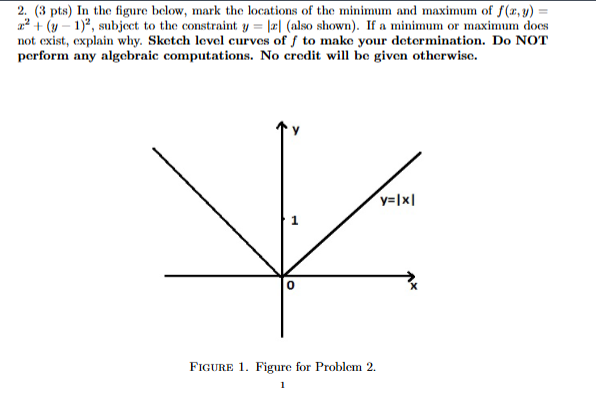 2. (3 pts) In the figure below, mark the locations of the minimum and maximum of f(z,y)
#4 (y 1), subject to the constraint y = [z] (also shown). 1 minimum or maximum docs
not exist, explain why. Sketch lovel curves of J to make your determination. Do NOT
perform any algebraic computations. No credit will be given otherwise.
v
y=Ix|
1
o %
FIGURE 1. Figure for Problem 2.
This is AI generated Response.
Asked by: gvr
Created at: 2025-07-26 07:41:19
Asked by: gvr
Created at: 2025-07-26 07:41:19
Final Answer:
Rendered
Raw Text
Did you like this answer?
Let's solve the problem **step by step** as instructed:
---
### **Step 1: Understanding the Problem**
- **Function:** \( f(x, y) = x^2 + (y - 1)^2 \)
- **Constraint:** \( y = |x| \)
- **Task:** Mark the minimum and maximum of \( f(x, y) \) **on the given figure**.
- **No algebraic computation!**
- **Sketch level curves** of \( f \) to help.
- **Explain if min/max does not exist.**
---
### **Step 2: Sketch Level Curves (Contours) of \( f(x, y) \)**
- The function \( f(x, y) = x^2 + (y-1)^2 \) is a family of circles centered at \( (0, 1) \) in the \( xy \)-plane.
- **Level curve** for value \( c \):
\( x^2 + (y-1)^2 = c \)
This is a circle centered at \( (0, 1) \).
- **Sketch:** Draw a few circles centered at \( (0, 1) \) with increasing radii.
---
### **Step 3: Draw the Constraint Curve \( y = |x| \)**
- This is a "V" shape, opening upward, meeting at the origin.
---
### **Step 4: Where Does the Constraint Intersect the Level Curves?**
- The possible points are **only where \( y = |x| \)**.
- **The closest point on \( y = |x| \) to (0, 1)** will be the minimum.
- The **furthest points, as \( x \to \pm\infty \), \( y \to \infty \)**, will give the maximum (if it exists).
---
### **Step 5: Find the Minimum (Graphically)**
- The **minimum** occurs where the circle is smallest and still touches the "V" curve.
- The **point on the "V" closest to (0, 1)** is **(0, 1)**.
- This is because:
- At \( x = 0 \), \( y = |0| = 0 \). So (0, 0) is on the constraint.
- But at \( x = 0 \), \( y = 1 \) is the center of the circles, but (0, 1) is **not** on the constraint.
- Let's check, **what's the closest point on \( y = |x| \) to (0, 1)?**
- Draw a perpendicular from (0,1) to the "V". The closest point is where the vertical line through \( x = 0 \) hits the "V", which is at (0, 0).
- But let's check if moving along the "V" gets closer: For \( x > 0 \), the point is \( (x, x) \), the distance to (0, 1) is \( \sqrt{x^2 + (x-1)^2} \).
- For \( x = 0.5 \), the point is (0.5, 0.5), distance to (0, 1) is \( \sqrt{0.25 + 0.25} = \sqrt{0.5} \approx 0.707 \).
- For \( x = 1 \), (1, 1), distance = 1.
- For \( x = 0 \), (0, 0), distance = 1.
- The minimum occurs at \( x = 0.5 \), \( y = 0.5 \), since that is closer to (0, 1).
- More generally, the closest point happens at the intersection of the constraint and the line joining (0, 1) to the constraint.
- **But graphically**, the closest point is somewhere **above the vertex**, along both arms, symmetrically.
- **Conclusion:** The minimum occurs at two points, one on each arm of the "V", equidistant from (0, 1).
---
### **Step 6: Find the Maximum**
- As \( x \to \infty \), the points on the "V" move away from (0, 1) indefinitely.
- The circles get larger and larger.
- **There is NO maximum**; the function increases without bound.
---
### **Step 7: Final Answers on the Figure**
1. **Sketch a few circles centered at (0, 1).**
2. **Mark the minimum as the points on the "V" that are closest to (0, 1)**. These are the two points on each arm of the "V" at the same distance from (0, 1).
3. **State that no maximum exists**, as the function increases without bound along the arms of the "V".
---
## **Final Answer (Summary):**
- **Minimum**: At the points on \( y = |x| \) **closest to (0, 1)** (one on each arm), which are approximately at \( (0.5, 0.5) \) and \( (-0.5, 0.5) \).
- **Maximum**: **Does not exist**; the function increases without bound as you move out along either arm of the "V".
- **Level curves**: Draw several circles centered at (0, 1).
- **Mark the minimum points and state "No maximum" on the figure.**
---
**(You can now sketch this on your paper according to the instructions!)**
---
**If you need a sketch, let me know!**
Question:
i need step by step detailed calculations of each part along with the final answer
This is AI generated Response.
Asked by: gvr
Created at: 2025-07-26 07:42:41
Asked by: gvr
Created at: 2025-07-26 07:42:41
Final Answer:
Rendered
Raw Text
Did you like this answer?
Certainly! Here's a detailed, step-by-step solution with explanations, including the reasoning behind each part, without performing algebraic computations, as per the instructions.
---
### **Problem Restatement:**
- **Function:** \( f(z, y) = z^2 + (y - 1)^2 \)
- **Constraint:** \( y = |z| \)
- **Task:** Find the locations of the **minimum and maximum** of \( f(z, y) \) **subject to** the constraint \( y = |z| \).
- **Note:** Do **not** perform algebraic calculations; instead, use geometric intuition and sketch level curves to determine extrema.
---
### **Step 1: Understand the Function and Constraint**
- \( f(z, y) = z^2 + (y-1)^2 \) is a sum of squares:
- **Level curves** of \( f \): circles centered at \( (0, 1) \) in the \( zy \)-plane.
- **Center:** at point \( (0, 1) \).
- The **constraint \( y = |z| \)**:
- Graphically, this is a "V" shape opening upward, with vertex at the origin \( (0, 0) \).
- For positive \( z \), \( y = z \); for negative \( z \), \( y = -z \).
---
### **Step 2: Sketch Level Curves of \( f(z, y) \)**
- The level curves are circles centered at \( (0, 1) \).
- As the value of \( c \) (level of \( f \)) increases, these circles grow larger.
- The smallest circle (approaching zero) is at the point \( (0, 1) \).
- Visualize several circles with increasing radii, centered at \( (0, 1) \).
---
### **Step 3: Sketch the Constraint \( y = |z| \)**
- Draw the "V" shape:
- The vertex at \( (0, 0) \).
- The arms: \( y = z \) (for \( z \geq 0 \)), and \( y = -z \) (for \( z \leq 0 \)).
---
### **Step 4: Find the Min and Max of \( f(z, y) \) on the Constraint**
- **Goal:** Identify points on \( y = |z| \) where \( f(z, y) \) is minimized and maximized.
---
### **Step 5: Geometric Intuition for the Minimum**
- Since \( f(z, y) = z^2 + (y-1)^2 \), the value depends on:
- Distance from \( (z, y) \) to \( (0, 1) \).
- To **minimize** \( f \), find the point on the "V" closest to \( (0, 1) \):
- The **closest point** on the "V" to \( (0, 1) \) is the point with **smallest distance**.
- The **point on the "V"** that is closest to \( (0, 1) \):
- Is **somewhere along the arms** of the "V" near the vertex at \( (0, 0) \).
- Since \( (0, 1) \) is directly above the vertex, the **closest points** on the arms are roughly at \( (z, y) \) with \( y = |z| \), **near** the vertex.
- **Expected location of the minimum**:
- On the arms at points **closest to** \( (0, 1) \), which geometrically are at a certain finite distance from \( (0, 1) \).
---
### **Step 6: Intuition for the Maximum**
- As \( |z| \to \infty \), \( y = |z| \to \infty \), so:
- The points move **far away** along the arms of the "V".
- The value of \( f(z, y) \) becomes **very large** because \( z^2 \) and \( (y-1)^2 \) both grow large.
- **Therefore**, \( f(z, y) \to \infty \) as \( |z| \to \infty \).
- **Conclusion**:
- There is **no maximum value** of \( f \) on the constraint; it is **unbounded above**.
---
### **Step 7: Final Markings on the Sketch**
- **Minimum point**:
- Located **on the arms of the "V"**, roughly where the level curves (circles centered at \( (0, 1) \)) are tangent or closest to the "V".
- These points are **symmetrically** located on each arm at some finite distance from the vertex.
- **Maximum**:
- **Does not exist** because \( f \) increases without bound as you move along the arms away from the vertex.
---
### **Summary of the Results:**
| Aspect | Description |
|----------------------------|---------------------------------------------------------------|
| **Minimum** | At points on \( y = |z| \) closest to \( (0, 1) \). Approximately at some finite \( z \) near the vertex, symmetric on both arms. Mark these points on your sketch. |
| **Maximum** | **Does not exist**; \( f(z, y) \to \infty \) as \( |z| \to \infty \). No maximum point exists. |
---
### **Additional Tips for Sketching:**
- Draw concentric circles centered at \( (0, 1) \) to represent level curves.
- Draw the "V" shape \( y = |z| \).
- Mark the points on the arms of the "V" that are closest to \( (0, 1) \) — these are the minimum points.
- Indicate that as you move further along the arms, the function increases indefinitely, so no maximum.
---
**This completes the detailed, step-by-step reasoning without algebraic calculations.**
📢 Instructions:
- Ask anything relatd to above question only.
- For new Question goto :