 VIPSolutions
Give step-by-step solution with explanation and final answer:Find the equation of the plane through the point P = (3,4, 2) and parallel to the plane 4y — 3x — 5z = —1. hint: two planes are parallel to each other if they have the same normal vector. To get the required normal vector, maybe you have to steal it from the given equation. +=]
Question:
Give step-by-step solution with explanation and final answer: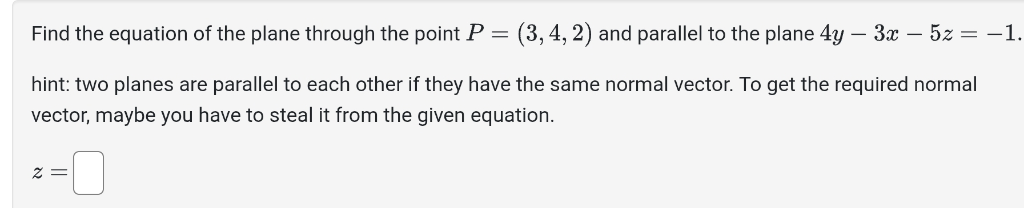 Find the equation of the plane through the point P = (3,4, 2) and parallel to the plane 4y — 3x — 5z = —1.
hint: two planes are parallel to each other if they have the same normal vector. To get the required normal
vector, maybe you have to steal it from the given equation.
+=]
This is AI generated Response.
Asked by: gvr
Created at: 2025-07-25 23:28:02
Asked by: gvr
Created at: 2025-07-25 23:28:02
Final Answer:
Rendered
Raw Text
Did you like this answer?
Let's break down the problem step by step:
### **Step 1: Identify the normal vector**
The given plane is:
\[
4y - 3x - 5z = -1
\]
We can rewrite it as:
\[
-3x + 4y - 5z = -1
\]
The normal vector to this plane is the vector of coefficients of \( x, y, z \):
\[
\vec{n} = (-3, 4, -5)
\]
---
### **Step 2: Equation of the required plane**
The equation of a plane passing through point \( P = (3, 4, 2) \) and having normal vector \( (-3, 4, -5) \) is:
\[
-3(x - 3) + 4(y - 4) - 5(z - 2) = 0
\]
---
### **Step 3: Simplify the equation**
Expand:
\[
-3(x - 3) + 4(y - 4) - 5(z - 2) = 0 \\
-3x + 9 + 4y - 16 - 5z + 10 = 0 \\
-3x + 4y - 5z + 9 - 16 + 10 = 0 \\
-3x + 4y - 5z + 3 = 0
\]
---
### **Step 4: Solve for \( z \)**
\[
-3x + 4y - 5z + 3 = 0 \\
-5z = 3x - 4y - 3 \\
z = \frac{3x - 4y - 3}{-5}
\]
Or, equivalently:
\[
z = -\frac{3x}{5} + \frac{4y}{5} + \frac{3}{5}
\]
---
## **Final Answer**
\[
\boxed{z = -\frac{3x}{5} + \frac{4y}{5} + \frac{3}{5}}
\]
Let me know if you need further clarification!
Question:
i need step by step detailed calculations of each part along with the final Answer
This is AI generated Response.
Asked by: gvr
Created at: 2025-07-25 23:30:39
Asked by: gvr
Created at: 2025-07-25 23:30:39
Final Answer:
Rendered
Raw Text
Did you like this answer?
Certainly! Let's go through each step in detail, including all calculations and explanations.
---
### **Problem Restatement:**
Find the equation of a plane that:
- Passes through the point \( P = (3, 4, 2) \),
- Is parallel to the plane \( 4y - 3x - 5z = -1 \).
---
### **Step 1: Understand what it means for planes to be parallel**
- Two planes are **parallel** if they have the **same normal vector**.
- The **normal vector** of a plane is derived from the coefficients of \( x, y, z \) in its equation.
---
### **Step 2: Find the normal vector of the given plane**
Given the plane:
\[
4y - 3x - 5z = -1
\]
Rewrite in standard form:
\[
-3x + 4y - 5z = -1
\]
The **normal vector** \( \vec{n} \) is the vector of coefficients:
\[
\boxed{
\vec{n} = (-3, 4, -5)
}
\]
---
### **Step 3: Write the general form of the new plane**
Since the new plane is parallel to the given one, it will have the **same normal vector**:
\[
\boxed{
\text{Normal vector } \vec{n} = (-3, 4, -5)
}
\]
The general form of a plane with this normal vector passing through a point \( (x_0, y_0, z_0) \) is:
\[
-3(x - x_0) + 4(y - y_0) - 5(z - z_0) = 0
\]
Given \( P = (3, 4, 2) \):
\[
-3(x - 3) + 4(y - 4) - 5(z - 2) = 0
\]
---
### **Step 4: Expand the equation**
Let's expand each term carefully:
- Expand \( -3(x - 3) \):
\[
-3x + 9
\]
- Expand \( 4(y - 4) \):
\[
4y - 16
\]
- Expand \( -5(z - 2) \):
\[
-5z + 10
\]
Now, sum all these:
\[
(-3x + 9) + (4y - 16) + (-5z + 10) = 0
\]
Combine like terms:
\[
-3x + 4y - 5z + (9 - 16 + 10) = 0
\]
Calculate the constant sum:
\[
9 - 16 + 10 = 3
\]
So, the **equation of the plane** is:
\[
-3x + 4y - 5z + 3 = 0
\]
---
### **Step 5: Write the final equation**
The equation of the required plane in standard form:
\[
\boxed{
-3x + 4y - 5z + 3 = 0
}
\]
Alternatively, you can express \( z \) explicitly:
\[
-3x + 4y - 5z + 3 = 0
\]
\[
-5z = 3x - 4y - 3
\]
\[
z = -\frac{3x}{5} + \frac{4y}{5} + \frac{3}{5}
\]
---
### **Final answer:**
\[
\boxed{
\textbf{Equation of the plane:} \quad -3x + 4y - 5z + 3 = 0
}
\]
or equivalently:
\[
z = -\frac{3}{5}x + \frac{4}{5}y + \frac{3}{5}
\]
---
**Feel free to ask if you'd like more clarification on any step!**
📢 Instructions:
- Ask anything relatd to above question only.
- For new Question goto :