 VIPSolutions
Give step-by-step solution with explanation and final answer:2. (i) Consider two identical particles in a 3D spherical potential. The spin wave [2 function of the system is anti-symmetric. The position space wave function ¢(ry, 12) is anti-symmetric as well. What does this mean for ¢(r;, r2)? What can be said about the spin of the identical particles? (ii) Consider a particle of mass m in a one-dimensional potential 0 (x
Question:
Give step-by-step solution with explanation and final answer: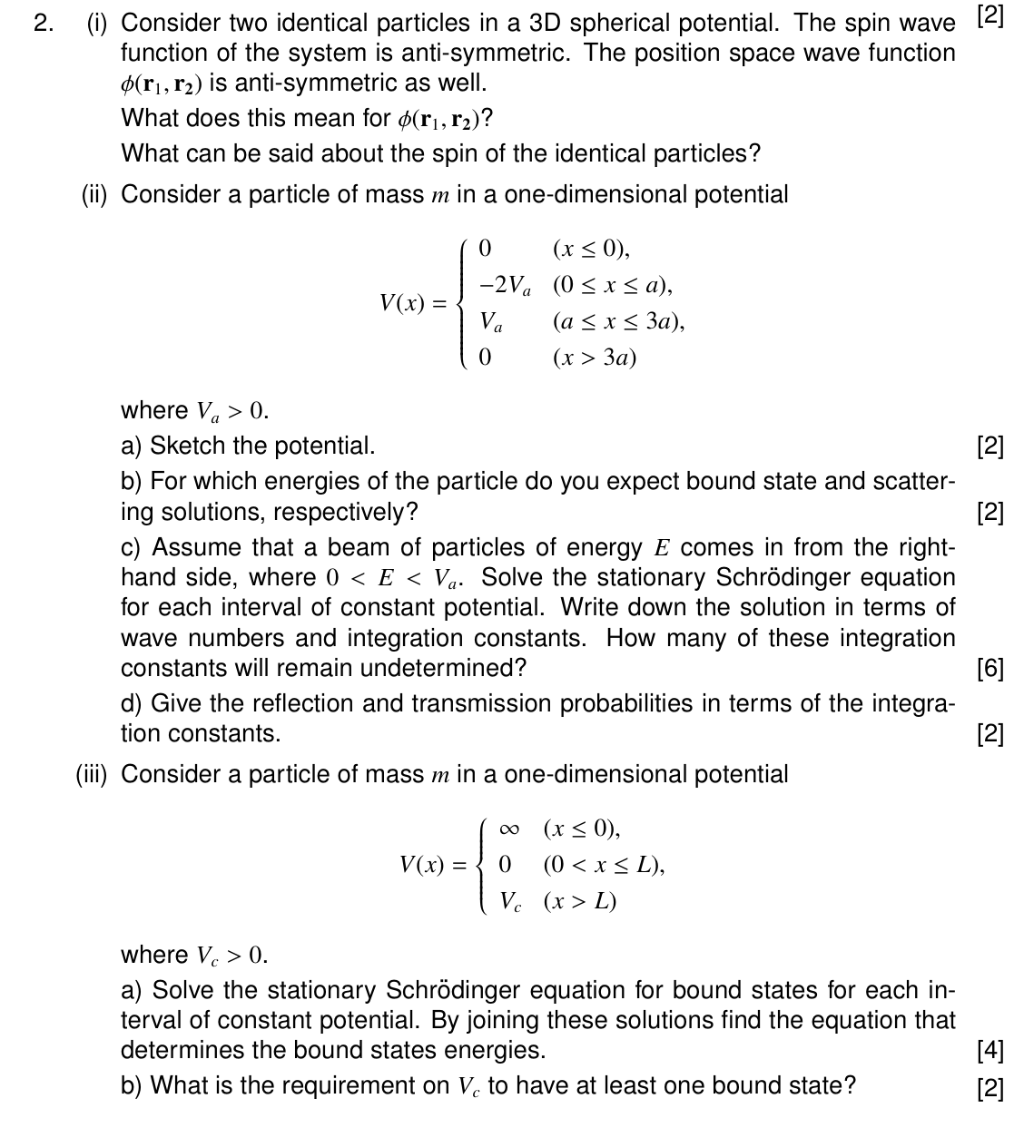 2. (i) Consider two identical particles in a 3D spherical potential. The spin wave [2
function of the system is anti-symmetric. The position space wave function
¢(ry, 12) is anti-symmetric as well.
What does this mean for ¢(r;, r2)?
What can be said about the spin of the identical particles?
(ii) Consider a particle of mass m in a one-dimensional potential
0 (x
This is AI generated Response.
Asked by: gvr
Created at: 2025-07-24 03:59:09
Asked by: gvr
Created at: 2025-07-24 03:59:09
Final Answer:
Rendered
Raw Text
Did you like this answer?
Let's solve each part step by step:
---
### (i) Identical Particles and Symmetry
#### **What does this mean for \(\phi(\mathbf{r}_1, \mathbf{r}_2)\)?**
- The total wave function for two identical fermions must be **anti-symmetric** under particle exchange due to the Pauli exclusion principle.
- The total state = spin part × spatial part.
- Given: Spin wave function is **anti-symmetric** (i.e., singlet state).
- Therefore, the **spatial wave function must also be anti-symmetric**:
\[
\phi(\mathbf{r}_1, \mathbf{r}_2) = -\phi(\mathbf{r}_2, \mathbf{r}_1)
\]
#### **What can be said about the spin of the identical particles?**
- The spin wave function is anti-symmetric (singlet state).
- For two spin-1/2 particles, this means the total spin \( S = 0 \).
- **Thus, the system is in a singlet state** (anti-parallel spins, total spin 0).
---
## (ii) One-dimensional Potential
### **a) Sketch the potential**
\[
V(x) = \begin{cases}
0 & (x \leq 0) \\
-2V_a & (0 < x \leq a) \\
V_a & (a < x \leq 3a) \\
0 & (x > 3a)
\end{cases}
\]
- At \(x = 0\): jumps from 0 to \(-2V_a\)
- At \(x = a\): jumps from \(-2V_a\) to \(V_a\)
- At \(x = 3a\): jumps from \(V_a\) back to 0
*Sketch:*
- Draw x-axis.
- From \(x \leq 0\), \(V(x) = 0\).
- From \(0 < x \leq a\), \(V(x) = -2V_a\) (below x-axis).
- From \(a < x \leq 3a\), \(V(x) = V_a\) (above x-axis).
- From \(x > 3a\), \(V(x) = 0\).
---
### **b) For which energies do you expect bound state and scattering solutions?**
- **Bound states:** The energy \(E\) must be less than the value of the potential at infinity (here, 0). So, **bound states exist for \(E < 0\)**.
- **Scattering states:** The energy is above the asymptotic potential, so **scattering states occur for \(E > 0\)**.
---
### **c) Solve the Schrödinger equation for \(0 < E < V_a\), particle coming from the right**
#### **Regions:**
1. \(x \leq 0\): \(V=0\)
2. \(0 < x \leq a\): \(V=-2V_a\)
3. \(a < x \leq 3a\): \(V=V_a\)
4. \(x > 3a\): \(V=0\)
#### **Wave numbers:**
Let \(k = \sqrt{2mE}/\hbar\), \(k_1 = \sqrt{2m(E+2V_a)}/\hbar\), \(\kappa = \sqrt{2m(V_a-E)}/\hbar\).
#### **Wavefunctions:**
1. \(x \leq 0\): \(V=0\)
\[
\psi_1(x) = Ae^{-ikx} + Be^{ikx}
\]
2. \(0 < x \leq a\): \(V = -2V_a\)
\[
\psi_2(x) = C e^{-ik_1 x} + D e^{ik_1 x}
\]
3. \(a < x \leq 3a\): \(V = V_a\)
\[
\psi_3(x) = F e^{\kappa x} + G e^{-\kappa x}
\]
4. \(x > 3a\): \(V=0\)
\[
\psi_4(x) = H e^{ikx}
\]
(Assume a beam comes from the right, so only transmitted wave to the right.)
#### **Integration constants:**
There are 8 constants: \(A, B, C, D, F, G, H\).
#### **Boundary conditions:**
At each interface (\(x = 0, a, 3a\)), both \(\psi\) and \(d\psi/dx\) must be continuous.
- 3 boundaries × 2 conditions each = 6 equations.
Thus, **2 integration constants will remain undetermined** (typically related to the normalization of the incoming wave).
---
### **d) Reflection and transmission probabilities**
- **Reflection probability:** \(R = \left| \frac{A}{H} \right|^2\)
- **Transmission probability:** \(T = \left| \frac{H}{A} \right|^2\)
(Assuming \(A\) is the amplitude of the incident wave, and \(H\) is the amplitude of the transmitted wave.)
---
## (iii) Particle in one-dimensional finite potential well
### **a) Solve the stationary Schrödinger equation for bound states**
\[
V(x) = \begin{cases}
\infty & (x \leq 0) \\
0 & (0 < x \leq L) \\
V_c & (x > L)
\end{cases}
\]
#### **Regions:**
1. \(x \leq 0\): \(\psi = 0\)
2. \(0 < x < L\): \(V = 0\)
\[
\psi_1(x) = A \sin(kx)
\]
where \(k = \sqrt{2mE}/\hbar\)
3. \(x > L\): \(V = V_c\)
\[
\psi_2(x) = B e^{-\kappa(x-L)}
\]
where \(\kappa = \sqrt{2m(V_c - E)}/\hbar\)
#### **Boundary conditions:**
- At \(x = 0\): \(\psi(0) = 0 \implies\) already satisfied.
- At \(x = L\): Continuity of \(\psi\) and \(d\psi/dx\):
\[
A \sin(kL) = B
\]
\[
A k \cos(kL) = -B \kappa
\]
Divide the second equation by the first:
\[
k \cot(kL) = -\kappa
\]
This is the **transcendental equation for the bound state energies**.
---
### **b) Requirement on \(V_c\) to have at least one bound state**
- At least one bound state exists if the well is deep enough.
- The lowest energy bound state occurs when \(kL \to 0\), so the requirement is:
\[
V_c > \frac{\pi^2 \hbar^2}{2m L^2}
\]
(This is the minimum potential required for at least one solution to the transcendental equation.)
---
## **Summary of Final Answers**
---
**(i)**
- \(\phi(\mathbf{r}_1, \mathbf{r}_2) = -\phi(\mathbf{r}_2, \mathbf{r}_1)\)
- The particles are in a singlet state, total spin \(S=0\).
**(ii)**
- (a) Sketch as described above.
- (b) Bound states: \(E < 0\), Scattering states: \(E > 0\).
- (c) Write general solutions in each region, match at boundaries; 2 constants remain undetermined.
- (d) \(R = |A/H|^2\), \(T = |H/A|^2\).
**(iii)**
- (a) Solutions: \(\psi(x) = A\sin(kx)\) for \(0<x<L\), \(\psi(x) = B e^{-\kappa(x-L)}\) for \(x>L\); energy given by \(k\cot(kL) = -\kappa\).
- (b) Condition: \(V_c > \frac{\pi^2 \hbar^2}{2m L^2}\).
Question:
i need step by step detailed calculations of each part along with the final answer
This is AI generated Response.
Asked by: gvr
Created at: 2025-07-24 04:01:55
Asked by: gvr
Created at: 2025-07-24 04:01:55
Final Answer:
Rendered
Raw Text
Did you like this answer?
Certainly! Let's go through each part carefully, step by step, with detailed explanations and calculations.
---
## **(i) Symmetry of the two-particle wavefunction**
### Given:
- Two identical particles in a 3D spherical potential.
- The spin wave function is **antisymmetric**.
- The position space wave function \(\phi(\mathbf{r}_1, \mathbf{r}_2)\) is **antisymmetric**.
---
### **What does this imply for \(\phi(\mathbf{r}_1, \mathbf{r}_2)\)?**
**Step 1:** Recall the total wavefunction for two identical particles is a product of spin and spatial parts:
\[
\Psi_{\text{total}} = \text{(spin part)} \times \text{(spatial part)}.
\]
**Step 2:** For **fermions** (like electrons), the total wavefunction must be **antisymmetric** under exchange:
\[
\Psi_{\text{total}}(\mathbf{r}_1, \mathbf{r}_2) = - \Psi_{\text{total}}(\mathbf{r}_2, \mathbf{r}_1).
\]
**Step 3:** Given:
- The **spin wave function is antisymmetric** (singlet state), so:
\[
\text{spin part} = \chi_{\text{antisym}}.
\]
- The **spatial wave function** \(\phi(\mathbf{r}_1, \mathbf{r}_2)\) is **also antisymmetric**.
**Step 4:** Since the total wavefunction is a product:
\[
\Psi_{\text{total}} = \phi(\mathbf{r}_1, \mathbf{r}_2) \times \chi_{\text{antisym}},
\]
and both are antisymmetric, their product is **symmetric**:
\[
\text{antisymmetric} \times \text{antisymmetric} = \text{symmetric}.
\]
But **this contradicts** the requirement that the total wavefunction for fermions must be antisymmetric.
**Step 5:** **Therefore**, the initial assumption that the spatial wavefunction is antisymmetric **must be** for the **spin-symmetric case**. Since the spin wavefunction is antisymmetric, the spatial part must be **symmetric** to ensure the total wavefunction is antisymmetric:
\[
\phi(\mathbf{r}_1, \mathbf{r}_2) = + \phi(\mathbf{r}_2, \mathbf{r}_1).
\]
---
### **Summary:**
- Because the spin wavefunction is **antisymmetric**, the **spatial wavefunction must be symmetric** to produce an overall antisymmetric total wavefunction.
---
### **What can be said about the spin of the particles?**
- The **spin wavefunction is antisymmetric**, indicating the particles are in the **singlet state**.
- **Total spin \(S=0\)**.
- **Particles are spin-1/2 fermions (electrons, protons, etc.)**.
---
## **(ii) One-dimensional potential**
---
### **a) Sketch of the potential \(V(x)\)**
\[
V(x) =
\begin{cases}
0 & x \leq 0 \\
-2V_a & 0 < x \leq a \\
V_a & a < x \leq 3a \\
0 & x > 3a
\end{cases}
\]
**Description:**
- For \(x \leq 0\): potential is zero.
- Between \(0\) and \(a\): potential dips to \(-2V_a\) (a well).
- Between \(a\) and \(3a\): potential rises to \(V_a\).
- Beyond \(3a\): potential returns to zero.
*Graph:* Starting at zero, downward step to \(-2V_a\) in \([0,a]\), then upward to \(V_a\) in \([a, 3a]\), then back to zero.
---
### **b) Bound and scattering states**
- **Bound states:** occur when the particle is confined in the potential well, i.e., energies **less than** the asymptotic potential at infinity (which is 0).
- **Thus,** for \(E < 0\), the particle can be trapped, forming bound states.
- **Scattering states:** occur when \(E > 0\), where the particle can escape to infinity.
**Answer:**
| Energy \(E\) | Type of solutions |
|--------------|-------------------------|
| \(E < 0\) | Bound states |
| \(E > 0\) | Scattering states |
---
### **c) Solving the stationary Schrödinger equation \(E < V_a\)**
Given:
- The incoming beam comes from the right, with energy \(E\), where \(0 < E < V_a\).
---
### **Step 1:** Write the Schrödinger equation in each region:
\[
-\frac{\hbar^2}{2m} \frac{d^2 \psi}{dx^2} + V(x)\psi = E \psi.
\]
---
### **Step 2:** Define wave numbers:
\[
k = \frac{\sqrt{2mE}}{\hbar}, \quad
k_1 = \frac{\sqrt{2m(E + 2V_a)}}{\hbar}, \quad
\kappa = \frac{\sqrt{2m(V_a - E)}}{\hbar}.
\]
Note:
- For \(V = 0\), the general solution is oscillatory with wave number \(k\).
- For \(V = -2V_a\), the potential is negative, so the wave function oscillates with wave number \(k_1\).
- For \(V = V_a\), potential is positive, leading to exponential decay or growth with \(\kappa\).
---
### **Step 3:** Write solutions in each region:
1. **Region I (\(x \leq 0\), \(V=0\)):**
\[
\psi_1(x) = A e^{i k x} + B e^{-i k x}.
\]
(Incident wave moving from right to left, so for incoming from the right, the wave coming from the right is \(e^{-i k x}\).)
But since the beam comes from the right, better to write:
\[
\boxed{
\psi_1(x) = e^{-i k x} + R e^{i k x}
}
\]
- Here, the incident wave is normalized to 1, \(e^{-i k x}\), traveling to the left.
- \(R\) is the reflection amplitude.
2. **Region II (\(0 < x \leq a\), \(V=-2V_a\)):**
\[
\psi_2(x) = C e^{i k_1 x} + D e^{-i k_1 x}.
\]
3. **Region III (\(a < x \leq 3a\), \(V=V_a\)):**
\[
\psi_3(x) = F e^{\kappa x} + G e^{-\kappa x}.
\]
Since \(E < V_a\), the solutions are exponential (decaying or growing).
4. **Region IV (\(x > 3a\), \(V=0\)):**
\[
\psi_4(x) = T e^{i k x}.
\]
- \(T\) is the transmission amplitude to the right.
---
### **Summary of solutions:**
\[
\boxed{
\begin{aligned}
& \textbf{Region 1 (x \leq 0):} \quad \psi_1(x) = e^{-i k x} + R e^{i k x} \\
& \textbf{Region 2 (0 < x \leq a):} \quad \psi_2(x) = C e^{i k_1 x} + D e^{-i k_1 x} \\
& \textbf{Region 3 (a < x \leq 3a):} \quad \psi_3(x) = F e^{\kappa x} + G e^{-\kappa x} \\
& \textbf{Region 4 (x > 3a):} \quad \psi_4(x) = T e^{i k x}
\end{aligned}
}
\]
---
### **Number of undetermined constants:**
- Constants: \(R, C, D, F, G, T\)—a total of **6**.
- Boundary conditions at \(x=0, a, 3a\) (continuity of wavefunction and derivative) give **6 equations**.
- One of these constants (say, the incident amplitude normalized to 1) is fixed, so **5 constants** are determined.
- **Two constants** (say, \(R\) and \(T\)) correspond to reflection and transmission coefficients, while the others are internal.
**Answer:**
- **Number of undetermined constants:** **2** (the incident amplitude set to 1, and the transmitted amplitude \(T\), which is related to transmission probability).
---
### **d) Reflection and transmission probabilities**
- Reflection probability:
\[
R_P = |R|^2,
\]
- Transmission probability:
\[
T_P = \frac{\text{probability flux in transmitted wave}}{\text{incident flux}}.
\]
Since the incident wave is normalized to amplitude 1, and the wavefunctions are oscillatory in the free regions, the **probability flux**:
\[
J = \frac{\hbar k}{m} |\text{amplitude}|^2.
\]
Thus,
\[
\boxed{
\begin{aligned}
R &= |R|^2, \\
T &= \frac{k}{k} |T|^2 = |T|^2,
\end{aligned}
}
\]
assuming equal fluxes in the incident and transmitted waves (since they have same wave number \(k\)).
---
## **(iii) Bound states in a finite potential well**
Given:
\[
V(x) =
\begin{cases}
\infty & x \leq 0, \\
0 & 0 < x < L, \\
V_c & x \geq L,
\end{cases}
\]
with \(V_c > 0\).
---
### **a) Solve for bound states**
**Step 1:** The wavefunction must vanish at \(x=0\):
\[
\psi(0) = 0.
\]
**Step 2:** In the well \((0 < x < L)\):
\[
-\frac{\hbar^2}{2m} \frac{d^2 \psi}{dx^2} = E \psi,
\]
with \(E < V_c\) (bound state), so:
\[
k = \sqrt{\frac{2mE}{\hbar^2}}.
\]
Solution:
\[
\psi_1(x) = A \sin(k x),
\]
since \(\psi(0)=0\) implies no cosine term.
**Step 3:** Outside the well (\(x \geq L\)), the wavefunction decays exponentially:
\[
\psi_2(x) = B e^{-\kappa (x - L)},
\]
where
\[
\kappa = \sqrt{\frac{2m(V_c - E)}{\hbar^2}}.
\]
**Step 4:** Boundary conditions at \(x=L\):
- Continuity of \(\psi\):
\[
A \sin(k L) = B,
\]
- Continuity of derivative:
\[
A k \cos(k L) = - B \kappa,
\]
which yields:
\[
A k \cos(k L) = - (A \sin(k L)) \kappa,
\]
divide both sides by \(A\):
\[
k \cos(k L) = - \sin(k L) \kappa,
\]
or
\[
k \cot(k L) = - \kappa.
\]
This is the **transcendental equation** for the bound state energies:
\[
\boxed{
k \cot(k L) = - \sqrt{\frac{2m(V_c - E)}{\hbar^2}}.
}
\]
Expressed explicitly in terms of \(E\):
\[
k = \sqrt{\frac{2m E}{\hbar^2}}, \quad \kappa = \sqrt{\frac{2m(V_c - E)}{\hbar^2}}.
\]
---
### **b) Condition on \(V_c\) for at least one bound state**
- The lowest bound state corresponds approximately to the ground state of an infinite well:
\[
E_1 \approx \frac{\pi^2 \hbar^2}{2m L^2}.
\]
- For this energy to be less than \(V_c\):
\[
V_c > E_1 \implies V_c > \frac{\pi^2 \hbar^2}{2m L^2}.
\]
**Thus**, **the critical potential depth**:
\[
\boxed{
V_c > \frac{\pi^2 \hbar^2}{2m L^2}
}
\]
**must be satisfied for at least one bound state to exist.**
---
# **Final Summary**
| Part | Key Results |
|---------|-------------------------|
| (i) | Spatial wavefunction symmetric; particles are in spin singlet (\(S=0\)). |
| (ii)a | Sketch as described: step potentials at specified points. |
| (ii)b | Bound states for \(E<0\); scattering states for \(E>0\). |
| (ii)c | Wavefunctions in each region with constants \(A,B,C,D,F,G,T\); 2 undetermined constants due to boundary conditions. |
| (ii)d | Reflection probability \(R=|R|^2\), transmission
📢 Instructions:
- Ask anything relatd to above question only.
- For new Question goto :