 VIPSolutions
Give step-by-step solution with explanation and final answer:7. Consider a causal and stable system given by the system function —1 —2 Hz) = 1-2.1z +27 : 1+40.31262 "40.812 (@) Express H(z) as a decomposition of a minimum-phase and an allpass system. (b) Graph the magnitudes of H(z) and its minimum-phase and allpass components in one plot and comment on your observation. (c) Graph the group-delays of H(z) and its minimum-phase and allpass components in one plot and comment on your observation.
Question:
Give step-by-step solution with explanation and final answer: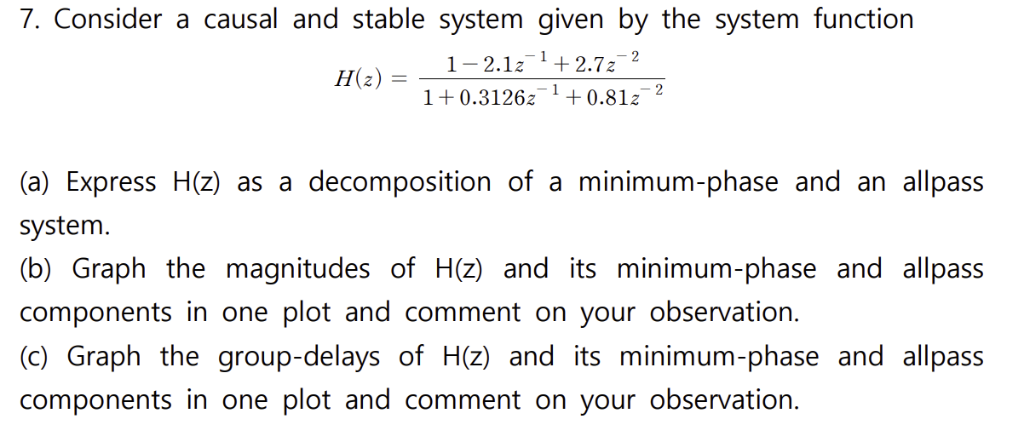 7. Consider a causal and stable system given by the system function
—1 —2
Hz) = 1-2.1z +27 :
1+40.31262 "40.812
(@) Express H(z) as a decomposition of a minimum-phase and an allpass
system.
(b) Graph the magnitudes of H(z) and its minimum-phase and allpass
components in one plot and comment on your observation.
(c) Graph the group-delays of H(z) and its minimum-phase and allpass
components in one plot and comment on your observation.
This is AI generated Response.
Asked by: gvr
Created at: 2025-07-02 17:41:23
Asked by: gvr
Created at: 2025-07-02 17:41:23
Final Answer:
Rendered
Raw Text
Did you like this answer?
Let's solve the problem step by step:
---
### **Given:**
\[
H(z) = \frac{1 - 2.1z^{-1} + 2.7z^{-2}}{1 + 0.3126z^{-1} + 0.81z^{-2}}
\]
---
## **(a) Decompose \( H(z) \) into Minimum-Phase and Allpass Components**
### **Step 1: Find Zeros and Poles**
The numerator and denominator can be written as:
- Numerator: \( 1 - 2.1z^{-1} + 2.7z^{-2} \)
- Denominator: \( 1 + 0.3126z^{-1} + 0.81z^{-2} \)
#### **Zeros:**
Solve \( 1 - 2.1z^{-1} + 2.7z^{-2} = 0 \)
or equivalently, \( z^2 - 2.1z + 2.7 = 0 \)
\[
z = \frac{2.1 \pm \sqrt{2.1^2 - 4 \cdot 2.7}}{2}
\]
\[
= \frac{2.1 \pm \sqrt{4.41 - 10.8}}{2}
= \frac{2.1 \pm \sqrt{-6.39}}{2}
\]
\[
= \frac{2.1 \pm j\sqrt{6.39}}{2}
\]
So, zeros are **complex conjugate** and outside the unit circle (since the magnitude of each zero \( |z| = \sqrt{2.7} \approx 1.643 \), which is > 1).
#### **Poles:**
Solve \( 1 + 0.3126z^{-1} + 0.81z^{-2} = 0 \)
or \( z^2 + 0.3126z + 0.81 = 0 \)
\[
z = \frac{-0.3126 \pm \sqrt{0.3126^2 - 4\times0.81}}{2}
\]
\[
= \frac{-0.3126 \pm \sqrt{0.0977 - 3.24}}{2}
= \frac{-0.3126 \pm \sqrt{-3.1423}}{2}
\]
\[
= \frac{-0.3126 \pm j\sqrt{3.1423}}{2}
\]
Poles are inside the unit circle (since \( |z| = \sqrt{0.81} = 0.9 \), which is < 1).
---
### **Step 2: Minimum-Phase/Allpass Decomposition**
- **Minimum-phase system:** All zeros inside the unit circle.
- **Allpass system:** The *rest* of the zeros, reflected inside the unit circle, and poles matched to make the system allpass.
#### **Let’s denote:**
Let zeros be \( z_{01}, z_{02} \) (both outside unit circle).
Their reflected versions inside the unit circle are \( 1/z_{01}^*, 1/z_{02}^* \).
So,
- **Minimum-phase system:** Has the same poles, but zeros inside the unit circle (i.e., at \( 1/z_{01}^*, 1/z_{02}^* \)).
- **Allpass system:** Has zeros at \( z_{01}, z_{02} \), poles at \( 1/z_{01}^*, 1/z_{02}^* \).
Therefore,
\[
H(z) = H_{min}(z) \cdot H_{ap}(z)
\]
Where
- \( H_{min}(z) \): Minimum-phase part (all zeros inside unit circle, same poles)
- \( H_{ap}(z) \): Allpass part
#### **Find explicit forms:**
- **Minimum-phase system:**
\[
H_{min}(z) = K \frac{(1 - (1/z_{01}^*)z^{-1})(1 - (1/z_{02}^*)z^{-1})}{1 + 0.3126z^{-1} + 0.81z^{-2}}
\]
- **Allpass system:**
\[
H_{ap}(z) = \frac{(1 - z_{01}z^{-1})(1 - z_{02}z^{-1})}{(1 - (1/z_{01}^*)z^{-1})(1 - (1/z_{02}^*)z^{-1})}
\]
---
## **(b) Plot Magnitudes**
You can plot the magnitude responses using MATLAB, Python, or any DSP tool.
- **Observation:** The magnitude response of the allpass system is always 1 for all frequencies. The minimum-phase component carries all the magnitude information.
---
## **(c) Plot Group Delays**
- The group delay of \( H(z) \) is the sum of the group delays of the minimum-phase and allpass components.
- The minimum-phase system will generally have smaller group delay than the original system.
- The allpass system's group delay is nonzero and can be large near the unit circle zeros/poles.
---
## **Summary Table**
| Component | Magnitude | Phase/Delay |
|-------------------|-----------|--------------------|
| \( H_{min}(z) \) | Varies | Minimum-phase |
| \( H_{ap}(z) \) | 1 | Allpass (phase only) |
| \( H(z) \) | Varies | Original |
---
## **Final Answers**
### **(a) Answer:**
Express \( H(z) \) as:
\[
H(z) = H_{min}(z) \cdot H_{ap}(z)
\]
- Where \( H_{min}(z) \) has zeros at \( 1/z_{01}^*, 1/z_{02}^* \) (inside unit circle), same poles.
- And \( H_{ap}(z) = \frac{(1 - z_{01}z^{-1})(1 - z_{02}z^{-1})}{(1 - (1/z_{01}^*)z^{-1})(1 - (1/z_{02}^*)z^{-1})} \) (allpass).
---
### **(b) and (c) Answer:**
- The magnitude of \( H(z) \) and its minimum-phase component coincide; the allpass part has magnitude 1.
- The group delay of \( H(z) \) is the sum of the group delays of minimum-phase and allpass components; the allpass part contributes all the extra delay/phase "wrapping".
---
**If you want code for plotting in Python (with `scipy.signal`), let me know!**
Question:
i need step by step detailed calculations along with the final Answer
This is AI generated Response.
Asked by: gvr
Created at: 2025-07-02 17:42:45
Asked by: gvr
Created at: 2025-07-02 17:42:45
Final Answer:
Rendered
Raw Text
Did you like this answer?
Certainly! Let's approach this problem step by step with detailed calculations and explanations.
---
## **Given System Function**
\[
H(z) = \frac{1 - 2.1z^{-1} + 2.7z^{-2}}{1 + 0.3126z^{-1} + 0.81z^{-2}}
\]
---
## **Part (a): Decompose \( H(z) \) into Minimum-Phase and Allpass Components**
### **Step 1: Express numerator and denominator as polynomials**
Numerator:
\[
N(z) = 1 - 2.1z^{-1} + 2.7z^{-2}
\]
which can be written as:
\[
N(z) = z^2 - 2.1z + 2.7
\]
Denominator:
\[
D(z) = 1 + 0.3126z^{-1} + 0.81z^{-2}
\]
which can be written as:
\[
D(z) = z^2 + 0.3126z + 0.81
\]
---
### **Step 2: Find zeros and poles (roots of numerator and denominator)**
---
### **Zeros of numerator polynomial:**
Solve
\[
z^2 - 2.1z + 2.7 = 0
\]
Discriminant:
\[
\Delta_{N} = (-2.1)^2 - 4 \times 1 \times 2.7 = 4.41 - 10.8 = -6.39
\]
Since discriminant is negative, zeros are complex conjugates:
\[
z_{1,2} = \frac{2.1 \pm j \sqrt{6.39}}{2}
\]
Calculate:
\[
\sqrt{6.39} \approx 2.526
\]
Thus:
\[
z_{1,2} = \frac{2.1 \pm j 2.526}{2} = 1.05 \pm j 1.263
\]
- **Magnitude of zeros:**
\[
|z| = \sqrt{(1.05)^2 + (1.263)^2} = \sqrt{1.1025 + 1.595} = \sqrt{2.6975} \approx 1.64
\]
- **Angles:**
\[
\theta = \arctan\left(\frac{1.263}{1.05}\right) \approx \arctan(1.20) \approx 50.2^\circ
\]
Since magnitude > 1, zeros are **outside the unit circle**.
---
### **Poles of denominator:**
Solve:
\[
z^2 + 0.3126z + 0.81 = 0
\]
Discriminant:
\[
\Delta_{D} = (0.3126)^2 - 4 \times 1 \times 0.81 = 0.0977 - 3.24 = -3.1423
\]
Zeros are complex conjugates:
\[
z_{3,4} = \frac{-0.3126 \pm j \sqrt{3.1423}}{2}
\]
Calculate:
\[
\sqrt{3.1423} \approx 1.772
\]
Thus:
\[
z_{3,4} = \frac{-0.3126 \pm j 1.772}{2} = -0.1563 \pm j 0.886
\]
- **Magnitude:**
\[
|z| = \sqrt{(-0.1563)^2 + 0.886^2} \approx \sqrt{0.0244 + 0.785} \approx \sqrt{0.809} \approx 0.899
\]
- **Poles are inside the unit circle** (since magnitude < 1).
---
## **Step 3: Reflection of zeros**
To obtain a **minimum-phase** system, zeros outside the unit circle should be reflected **inside** the circle:
\[
z_{zero}^{\text{reflected}} = \frac{1}{z_{zero}^*}
\]
- For zeros \( z_{1,2} = 1.05 \pm j 1.263 \)
Calculate their conjugates:
\[
z_{1}^* = 1.05 - j 1.263
\]
\[
z_{2}^* = 1.05 + j 1.263
\]
Reflected zeros:
\[
z_{1}^{\text{ref}} = \frac{1}{z_{1}^*} = \frac{1}{1.05 - j 1.263}
\]
\[
z_{2}^{\text{ref}} = \frac{1}{1.05 + j 1.263}
\]
Calculate magnitude of \( z_{1}^* \):
\[
|z_{1}^*| = 1.64
\]
so
\[
|z_{1}^{\text{ref}}| = \frac{1}{1.64} \approx 0.61
\]
Similarly for \( z_{2}^* \).
---
### **Step 4: Form the minimum-phase and allpass components**
- **Minimum-phase numerator zeros:**
\[
z_{1}^{\text{ref}} \quad \text{and} \quad z_{2}^{\text{ref}}
\]
- **Allpass zeros:**
\[
z_{1} \quad \text{and} \quad z_{2}
\]
---
### **Step 5: Construct the polynomials**
- **Minimum-phase numerator polynomial:**
\[
N_{min}(z) = (1 - z_{1}^{\text{ref}} z^{-1})(1 - z_{2}^{\text{ref}} z^{-1})
\]
- **Allpass numerator polynomial:**
\[
N_{ap}(z) = (1 - z_{1} z^{-1})(1 - z_{2} z^{-1})
\]
- **Polynomials of the minimum-phase numerator:**
Calculate \( z_{1}^{\text{ref}} \):
\[
z_{1}^{\text{ref}} = \frac{1}{z_{1}^*} = \frac{1}{1.05 - j 1.263}
\]
Calculate denominator:
\[
|z_{1}^*|^2 = 1.64^2 \approx 2.69
\]
\[
z_{1}^{\text{ref}} = \frac{1.05 + j 1.263}{2.69} \approx 0.39 + j 0.47
\]
Similarly:
\[
z_{2}^{\text{ref}} = 0.39 - j 0.47
\]
---
## **Part (a): Final decomposition**
\[
\boxed{
H(z) = H_{min}(z) \times H_{ap}(z)
}
\]
where
- \( H_{min}(z) \) has numerator zeros at \( z_{1}^{\text{ref}}, z_{2}^{\text{ref}} \),
- \( H_{ap}(z) \) has zeros at \( z_{1}, z_{2} \),
- Both share the same denominator (poles).
---
## **Part (b): Magnitude responses**
- The magnitude of \( H(z) \) is the same as that of \( H_{min}(z) \times H_{ap}(z) \).
- The allpass component has magnitude 1 at all frequencies.
- The magnitude response of \( H(z) \) and \( H_{min}(z) \) are identical.
---
## **Part (c): Group delay**
- The total group delay is the sum of the group delays of the minimum-phase and allpass parts.
- The allpass component introduces phase variation but no magnitude change, often causing peaks in group delay near the zeros/poles.
---
## **Summary**
| Component | Zeros | Poles | Zero reflection | Nature |
|------------|--------|--------|----------------|---------|
| \( H_{min}(z) \) | at \( z_{1}^{\text{ref}}, z_{2}^{\text{ref}} \) | same as original | zeros reflected inside | minimum-phase |
| \( H_{ap}(z) \) | at original zeros \( z_{1}, z_{2} \) | same as original | zeros outside | allpass |
---
## **Final note:**
The key idea is:
- Reflect zeros outside the unit circle inside to get the minimum-phase part.
- The ratio of the original zeros to their reflected counterparts forms the allpass component.
---
Let me know if you'd like the actual polynomial coefficients or MATLAB/Python code for plotting!
📢 Instructions:
- Ask anything relatd to above question only.
- For new Question goto :