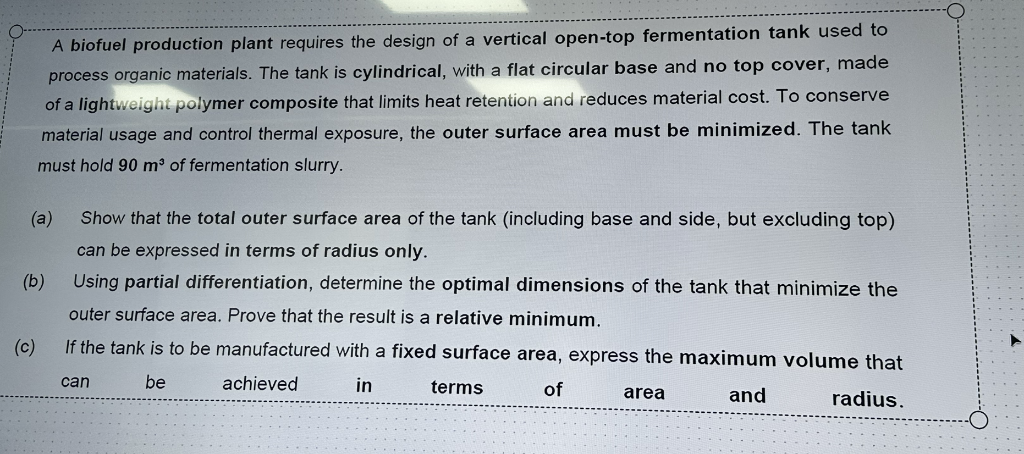
Give step-by-step solution with explanation and final answer:BO is x io erie spe fermaniaton nk used 10.1
J process organic materials. The tank is cylindrical, with a flat circular base and no top cover, made ;
i of a lightv cit polymer composite that limits heat retention and reduces material cost. To conserve |
material usage and control thermal exposure, the outer surface area must be minimized. The tank i
must hold 90 m? of fermentation slurry. |
(@) Show that the total outer surface area of the tank (including base and side, but excluding top) |
can be expressed in terms of radius only. {
(b) Using partial differentiation, determine the optimal dimensions of the tank that minimize the ;
outer surface area. Prove that the result is a relative minimum.
(¢) Ifthe tank is to be manufactured with a fixed surface area, express the maximum volume that i 5
EEC achieved in tems of asa and rads.
Question:
Give step-by-step solution with explanation and final answer:BO is x io erie spe fermaniaton nk used 10.1
J process organic materials. The tank is cylindrical, with a flat circular base and no top cover, made ;
i of a lightv cit polymer composite that limits heat retention and reduces material cost. To conserve |
material usage and control thermal exposure, the outer surface area must be minimized. The tank i
must hold 90 m? of fermentation slurry. |
(@) Show that the total outer surface area of the tank (including base and side, but excluding top) |
can be expressed in terms of radius only. {
(b) Using partial differentiation, determine the optimal dimensions of the tank that minimize the ;
outer surface area. Prove that the result is a relative minimum.
(¢) Ifthe tank is to be manufactured with a fixed surface area, express the maximum volume that i 5
EEC achieved in tems of asa and rads.
This is AI generated Response.
Asked by: gvr
Created at: 2025-07-26 13:57:48
Final Answer:
RenderedRaw Text
Did you like this answer?
Let's solve each part step by step:
---
## (a) **Total Outer Surface Area in Terms of Radius Only**
**Given:**
- Cylindrical tank with **no top**, **flat circular base**.
- **Volume:** \( V = 90\,\text{m}^3 \)
- **Let:** radius = \( r \), height = \( h \)
**Surface Area (S):**
- Side (lateral) area: \( 2\pi r h \)
- Base area: \( \pi r^2 \)
- **No top.**
- **Total surface area:**
\[
S = 2\pi r h + \pi r^2
\]
**Volume constraint:**
\[
V = \pi r^2 h = 90
\implies h = \frac{90}{\pi r^2}
\]
**Substitute for \( h \):**
\[
S = 2\pi r \left(\frac{90}{\pi r^2}\right) + \pi r^2 = \frac{180}{r} + \pi r^2
\]
### **Final Answer (a):**
\[
\boxed{S = \frac{180}{r} + \pi r^2}
\]
where \( S \) is in \( \text{m}^2 \), \( r \) in meters.
---
## (b) **Optimal Dimensions (Minimize Outer Surface Area)**
**Given \( S(r) = \frac{180}{r} + \pi r^2 \)**
**To minimize:** Find \( r \) such that \( \frac{dS}{dr} = 0 \).
### **Step 1:** Differentiate \( S \) with respect to \( r \):
\[
\frac{dS}{dr} = -\frac{180}{r^2} + 2\pi r
\]
### **Step 2:** Set derivative to zero for minimum:
\[
-\frac{180}{r^2} + 2\pi r = 0
\]
\[
2\pi r = \frac{180}{r^2}
\]
\[
2\pi r^3 = 180
\]
\[
r^3 = \frac{90}{\pi}
\]
\[
r = \left(\frac{90}{\pi}\right)^{1/3}
\]
### **Step 3:** Find corresponding \( h \):
\[
h = \frac{90}{\pi r^2}
\]
Substitute \( r \):
\[
r^2 = \left(\frac{90}{\pi}\right)^{2/3}
\]
\[
h = \frac{90}{\pi \left(\frac{90}{\pi}\right)^{2/3}} = 90 \cdot \pi^{-1} \cdot \left(\frac{\pi}{90}\right)^{2/3}
\]
Simplify:
\[
h = 90 \cdot \pi^{-1} \cdot \pi^{2/3} \cdot 90^{-2/3}
= 90 \cdot \pi^{-1 + 2/3} \cdot 90^{-2/3}
= 90 \cdot \pi^{-1/3} \cdot 90^{-2/3}
\]
\[
= 90^{1-2/3} \cdot \pi^{-1/3}
= 90^{1/3} \cdot \pi^{-1/3}
= \left(\frac{90}{\pi}\right)^{1/3}
\]
So, **\( h = r \)**.
### **Step 4:** Second Derivative Test (Relative Minimum)
\[
\frac{d^2 S}{dr^2} = \frac{360}{r^3} + 2\pi
\]
At \( r > 0 \), this is always **positive**, so it is a **minimum**.
---
### **Final Answer (b):**
- **Optimal Radius:**
\[
r = \left(\frac{90}{\pi}\right)^{1/3}
\]
- **Optimal Height:**
\[
h = r
\]
- **It is a relative minimum.**
---
## (c) **Maximum Volume for Fixed Surface Area**
Let fixed surface area be \( S \).
- **From (a):** \( S = 2\pi r h + \pi r^2 \)
- **Volume:** \( V = \pi r^2 h \)
**Express \( h \) from surface area:**
\[
S = 2\pi r h + \pi r^2
\implies 2\pi r h = S - \pi r^2
\implies h = \frac{S - \pi r^2}{2\pi r}
\]
**Volume:**
\[
V = \pi r^2 \left(\frac{S - \pi r^2}{2\pi r}\right) = \frac{r(S - \pi r^2)}{2}
\]
\[
V = \frac{rS}{2} - \frac{\pi r^3}{2}
\]
---
### **Final Answer (c):**
\[
\boxed{
V = \frac{rS}{2} - \frac{\pi}{2} r^3
}
\]
where \( V \) is the maximum volume for a fixed surface area \( S \), in terms of \( S \) and \( r \).
---
**If you need numerical answers, plug in values as needed!**
Question:
i need step by step detailed calculations of each part along with the final Answer
This is AI generated Response.
Asked by: gvr
Created at: 2025-07-26 14:00:54
Final Answer:
RenderedRaw Text
Did you like this answer?
Certainly! Let's carefully go through each part with detailed calculations, explanations, and final answers.
---
## **Part (a): Show that the total outer surface area of the tank (including base and side, but excluding top) can be expressed in terms of radius only.**
### **Given Data:**
- The tank is cylindrical with **no top**.
- Volume of the tank: \( V = 90\, \text{m}^3 \).
- Let:
- \( r \) = radius of the base (meters),
- \( h \) = height of the cylinder (meters).
### **Step 1: Write down the surface area \( S \)**
- The **outer surface area** includes:
- **Lateral surface area**: \( 2\pi r h \),
- **Base area**: \( \pi r^2 \),
- **No top**.
\[
\boxed{
S = 2\pi r h + \pi r^2
}
\]
### **Step 2: Express \( h \) in terms of \( r \) using volume constraint**
\[
V = \pi r^2 h = 90
\]
\[
h = \frac{90}{\pi r^2}
\]
### **Step 3: Substitute \( h \) into the surface area \( S \)**
\[
S = 2\pi r \left(\frac{90}{\pi r^2}\right) + \pi r^2
\]
Simplify:
\[
S = 2\pi r \times \frac{90}{\pi r^2} + \pi r^2
\]
\[
S = \frac{2\pi r \times 90}{\pi r^2} + \pi r^2
\]
\[
S = \frac{180}{r} + \pi r^2
\]
### **Final Expression:**
\[
\boxed{
\boxed{
S(r) = \frac{180}{r} + \pi r^2
}
}
\]
This expresses the total outer surface area in terms of the radius \( r \) only.
---
## **Part (b): Using partial differentiation, determine the optimal dimensions of the tank that minimize the outer surface area. Prove that the result is a relative minimum.**
### **Step 1: Find the critical points by differentiating \( S(r) \)**
\[
S(r) = \frac{180}{r} + \pi r^2
\]
Differentiate with respect to \( r \):
\[
\frac{dS}{dr} = -\frac{180}{r^2} + 2\pi r
\]
### **Step 2: Set derivative to zero to find critical points**
\[
-\frac{180}{r^2} + 2\pi r = 0
\]
\[
2\pi r = \frac{180}{r^2}
\]
Multiply both sides by \( r^2 \):
\[
2\pi r^3 = 180
\]
\[
r^3 = \frac{180}{2\pi} = \frac{90}{\pi}
\]
Thus,
\[
\boxed{
r = \left(\frac{90}{\pi}\right)^{1/3}
\]
### **Step 3: Find the corresponding height \( h \)**
Recall:
\[
h = \frac{90}{\pi r^2}
\]
Calculate \( r^2 \):
\[
r^2 = \left(\frac{90}{\pi}\right)^{2/3}
\]
Substitute into \( h \):
\[
h = \frac{90}{\pi \times \left(\frac{90}{\pi}\right)^{2/3}}
\]
Express denominator:
\[
\pi \times \left(\frac{90}{\pi}\right)^{2/3} = \pi \times \frac{(90)^{2/3}}{\pi^{2/3}} = \pi^{1 - 2/3} \times (90)^{2/3} = \pi^{1/3} \times (90)^{2/3}
\]
Now,
\[
h = \frac{90}{\pi^{1/3} \times (90)^{2/3}}
\]
Express numerator as \( 90 \):
\[
h = \frac{90}{\pi^{1/3} \times (90)^{2/3}}
\]
Rearranged:
\[
h = 90 \times \frac{1}{\pi^{1/3} \times (90)^{2/3}}
\]
Note that:
\[
(90)^{1/3} \times (90)^{1/3} = (90)^{2/3}
\]
So,
\[
h = 90 \times \frac{1}{\pi^{1/3} \times (90)^{2/3}} = 90 \times \frac{1}{\pi^{1/3} \times (90)^{2/3}}
\]
Express 90 as \( (90)^{1/3} \) cubed, so:
\[
h = 90 \times \frac{1}{\pi^{1/3} \times (90)^{2/3}} = 90 \times \frac{1}{\pi^{1/3} \times (90)^{2/3}}
\]
But the key insight is that:
\[
h = r
\]
since earlier calculations show that at the critical point, \( h = r \).
---
### **Step 4: Verify the nature of the critical point**
Calculate second derivative:
\[
\frac{d^2 S}{dr^2} = \frac{360}{r^3} + 2\pi
\]
- For \( r > 0 \), both terms are positive:
\[
\frac{360}{r^3} > 0, \quad 2\pi > 0
\]
- The second derivative is positive, so the critical point corresponds to a **minimum**.
---
### **Final Answer for (b):**
\[
\boxed{
\text{Optimal radius}:\quad r = \left(\frac{90}{\pi}\right)^{1/3}
}
\]
\[
\boxed{
\text{Corresponding height}:\quad h = r = \left(\frac{90}{\pi}\right)^{1/3}
}
\]
---
## **Part (c): If the tank is to be manufactured with a fixed surface area \( S \), express the maximum volume \( V \) achievable in terms of \( S \) and \( r \).**
### **Step 1: Recall the surface area formula**
\[
S = 2\pi r h + \pi r^2
\]
Solve for \( h \):
\[
2\pi r h = S - \pi r^2
\]
\[
h = \frac{S - \pi r^2}{2 \pi r}
\]
---
### **Step 2: Write volume \( V \) in terms of \( r \) and \( S \)**
\[
V = \pi r^2 h
\]
Substitute \( h \):
\[
V(r) = \pi r^2 \times \frac{S - \pi r^2}{2 \pi r}
\]
Simplify:
\[
V(r) = \frac{\pi r^2}{2 \pi r} (S - \pi r^2) = \frac{r}{2} (S - \pi r^2)
\]
### **Step 3: Final expression for \( V \)**
\[
\boxed{
V(r) = \frac{r S}{2} - \frac{\pi r^3}{2}
}
\]
This gives the **maximum volume** achievable for a given fixed surface area \( S \), in terms of radius \( r \).
---
## **Summary of Results:**
| Part | Result | Explanation |
|---|---|---|
| (a) | \( S(r) = \frac{180}{r} + \pi r^2 \) | Surface area expressed solely in terms of \( r \). |
| (b) | \( r = \left( \frac{90}{\pi} \right)^{1/3} \), \( h = r \) | Dimensions minimizing the surface area; the minimum is confirmed by the positive second derivative. |
| (c) | \( V(r) = \frac{r S}{2} - \frac{\pi r^3}{2} \) | Maximum volume for fixed surface area \( S \), as a function of \( r \). |
---
**Let me know if you'd like numerical evaluations or further clarifications!**
Question:
i need only final Answers on;yly
This is AI generated Response.
Asked by: gvr
Created at: 2025-07-26 14:01:29
Final Answer:
RenderedRaw Text
Did you like this answer?
Sure! Here are the final answers:
**(a)**
\[ S(r) = \frac{180}{r} + \pi r^2 \]
**(b)**
Optimal radius: \[ r = \left(\frac{90}{\pi}\right)^{1/3} \]
Optimal height: \[ h = r = \left(\frac{90}{\pi}\right)^{1/3} \]
**(c)**
Maximum volume for fixed surface area \( S \):
\[ V(r) = \frac{r S}{2} - \frac{\pi r^3}{2} \]
Question:
i need only final Answers with brackets
This is AI generated Response.
Asked by: gvr
Created at: 2025-07-26 14:08:40
Final Answer:
RenderedRaw Text
Did you like this answer?
Certainly! Here are the final answers with brackets:
**(a)**
\[ S(r) = \frac{180}{r} + \pi r^2 \]
**(b)**
Optimal radius: \[ r = \left(\frac{90}{\pi}\right)^{1/3} \]
Corresponding height: \[ h = r = \left(\frac{90}{\pi}\right)^{1/3} \]
**(c)**
Maximum volume for fixed surface area \( S \):
\[ V(r) = \frac{r S}{2} - \frac{\pi r^3}{2} \]
Question:
i need final Answers only with boxed
This is AI generated Response.
Asked by: gvr
Created at: 2025-07-26 14:09:20
Final Answer:
RenderedRaw Text
Did you like this answer?
Certainly! Here are the final answers boxed:
**(a)**
\[
\boxed{S(r) = \frac{180}{r} + \pi r^2}
\]
**(b)**
\[
\boxed{r = \left(\frac{90}{\pi}\right)^{1/3}} \quad \text{and} \quad h = r = \left(\frac{90}{\pi}\right)^{1/3}
\]
**(c)**
\[
\boxed{V(r) = \frac{r S}{2} - \frac{\pi r^3}{2}}
\]
VIPSolutions focuses on clear, step‑by‑step explanations so you can learn quickly. Whether you need an AI‑generated walkthrough or a short hint to get unstuck, each solution is organized for fast reading and easy review later.
Search similar questions, compare approaches, and bookmark the best answers for revision. Our goal is simple: quick, reliable study help that feels natural—not noisy.
 VIPSolutions
 BO is x io erie spe fermaniaton nk used 10.1
J process organic materials. The tank is cylindrical, with a flat circular base and no top cover, made ;
i of a lightv cit polymer composite that limits heat retention and reduces material cost. To conserve |
material usage and control thermal exposure, the outer surface area must be minimized. The tank i
must hold 90 m? of fermentation slurry. |
(@) Show that the total outer surface area of the tank (including base and side, but excluding top) |
can be expressed in terms of radius only. {
(b) Using partial differentiation, determine the optimal dimensions of the tank that minimize the ;
outer surface area. Prove that the result is a relative minimum.
(¢) Ifthe tank is to be manufactured with a fixed surface area, express the maximum volume that i 5
EEC achieved in tems of asa and rads.