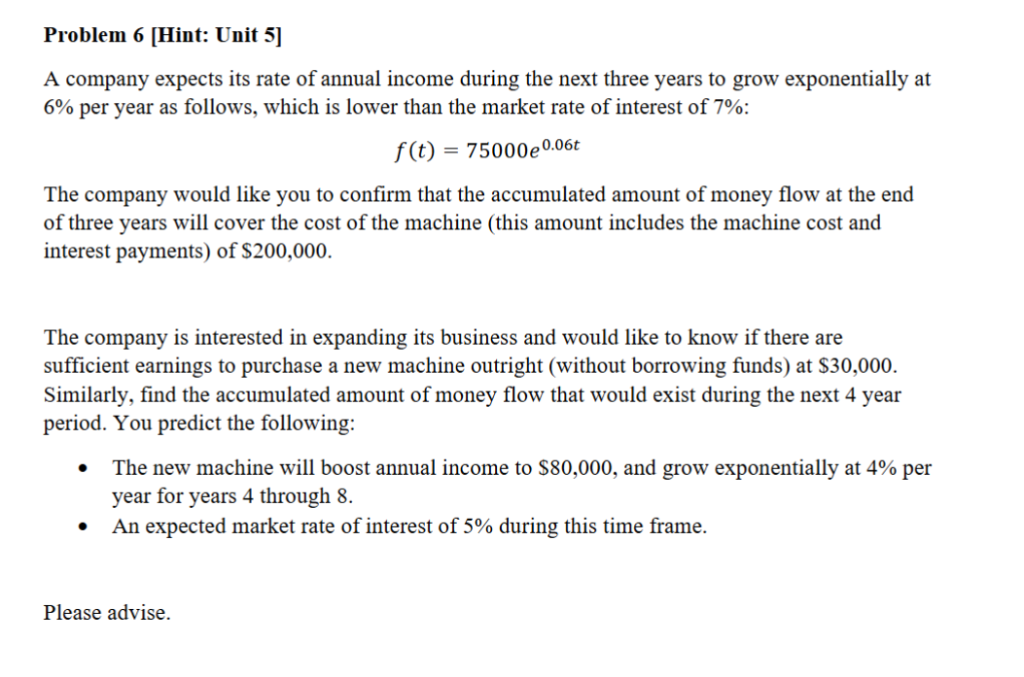
Give step-by-step solution with explanation and final answer:Problem 6 [Hint: Unit 5]
A company expects its rate of annual income during the next three years to grow exponentially at
6% per year as follows, which is lower than the market rate of interest of 7%:
f(t) = 75000e°06¢
The company would like you to confirm that the accumulated amount of money flow at the end
of three years will cover the cost of the machine (this amount includes the machine cost and
interest payments) of $200,000.
The company is interested in expanding its business and would like to know if there are
sufficient earnings to purchase a new machine outright (without borrowing funds) at $30,000.
Similarly, find the accumulated amount of money flow that would exist during the next 4 year
period. You predict the following:
* The new machine will boost annual income to $80,000, and grow exponentially at 4% per
year for years 4 through 8.
* An expected market rate of interest of 5% during this time frame.
Please advise.
Question:
Give step-by-step solution with explanation and final answer:Problem 6 [Hint: Unit 5]
A company expects its rate of annual income during the next three years to grow exponentially at
6% per year as follows, which is lower than the market rate of interest of 7%:
f(t) = 75000e°06¢
The company would like you to confirm that the accumulated amount of money flow at the end
of three years will cover the cost of the machine (this amount includes the machine cost and
interest payments) of $200,000.
The company is interested in expanding its business and would like to know if there are
sufficient earnings to purchase a new machine outright (without borrowing funds) at $30,000.
Similarly, find the accumulated amount of money flow that would exist during the next 4 year
period. You predict the following:
* The new machine will boost annual income to $80,000, and grow exponentially at 4% per
year for years 4 through 8.
* An expected market rate of interest of 5% during this time frame.
Please advise.
This is AI generated Response.
Asked by: gvr
Created at: 2025-08-04 09:22:09
Final Answer:
RenderedRaw Text
Did you like this answer?
Let's break the problem into two parts:
---
### **Part 1: Accumulated Amount After 3 Years (Cost = \$200,000)**
#### **Given:**
- Income function: \( f(t) = 75000e^{0.06t} \)
- Market rate of interest: 7% (0.07)
- Time \( t \) in years, \( t = 0 \) to \( t = 3 \)
- Need to check if accumulated value at \( t = 3 \) covers \$200,000
#### **Formula for Accumulated Value with Continuous Compounding:**
\[
A = \int_{0}^{3} f(t) \cdot e^{r(3-t)} \, dt
\]
where \( r = 0.07 \) (market rate).
#### **Plug values into the formula:**
\[
A = \int_{0}^{3} 75000e^{0.06t} \cdot e^{0.07(3-t)} \, dt
\]
\[
= \int_{0}^{3} 75000e^{0.06t} \cdot e^{0.21 - 0.07t} \, dt
\]
\[
= \int_{0}^{3} 75000e^{0.21} e^{0.06t - 0.07t} \, dt
\]
\[
= 75000e^{0.21} \int_{0}^{3} e^{-0.01t} \, dt
\]
#### **Integrate:**
\[
\int e^{-0.01t} dt = -100e^{-0.01t}
\]
So,
\[
A = 75000e^{0.21} \left[ -100e^{-0.01t} \right]_{0}^{3}
\]
\[
= 75000e^{0.21} \left(-100e^{-0.03} + 100e^{0}\right)
\]
\[
= 75000e^{0.21} \left(100(1 - e^{-0.03})\right)
\]
#### **Calculate values:**
- \( e^{0.21} \approx 1.2337 \)
- \( e^{-0.03} \approx 0.9704 \)
So,
\[
A = 75000 \times 1.2337 \times 100 \times (1 - 0.9704)
\]
\[
= 75000 \times 1.2337 \times 100 \times 0.0296
\]
\[
= 75000 \times 1.2337 \times 2.96
\]
\[
= 75000 \times 3.6522 \approx \$273,915
\]
**Conclusion:** The accumulated value (\$273,915) is greater than \$200,000. The company can cover the machine cost.
---
### **Part 2: Accumulated Amount for Years 4-8 (Machine Cost = \$30,000)**
#### **Given:**
- New annual income: \$80,000 growing at 4% per year
- \( f(t) = 80000e^{0.04t} \) (for \( t = 0 \) to \( t = 4 \); this is years 4 to 8 from today!)
- Market interest rate: 5% (0.05)
#### **Accumulated Value at end of year 8:**
\[
A = \int_{0}^{4} 80000e^{0.04t} \cdot e^{0.05(4-t)} dt
\]
\[
= \int_{0}^{4} 80000e^{0.04t} \cdot e^{0.20 - 0.05t} dt
\]
\[
= 80000e^{0.20} \int_{0}^{4} e^{0.04t - 0.05t} dt
\]
\[
= 80000e^{0.20} \int_{0}^{4} e^{-0.01t} dt
\]
Integrate:
\[
\int_{0}^{4} e^{-0.01t} dt = -100e^{-0.01t} \Big|_{0}^{4} = -100(e^{-0.04} - 1)
\]
Calculate:
- \( e^{0.20} \approx 1.2214 \)
- \( e^{-0.04} \approx 0.9608 \)
So,
\[
A = 80000 \times 1.2214 \times 100 \times (1 - 0.9608)
\]
\[
= 80000 \times 1.2214 \times 3.92
\]
\[
= 80000 \times 4.7879 \approx \$383,032
\]
**Conclusion:** The accumulated amount (\$383,032) is much greater than \$30,000. The company can purchase the new machine.
---
## **Final Answers:**
1. **After 3 years, the accumulated value is approximately \$273,915, which covers the \$200,000 machine cost.**
2. **After years 4-8, the accumulated value is approximately \$383,032, which covers the \$30,000 machine cost.**
If you need further breakdown or clarification, let me know!
Question:
I NEED STEP BY STEP DETAILED CALCULATIONS OF EACH PART ALONG WITH THE FINAL ANSWER
This is AI generated Response.
Asked by: gvr
Created at: 2025-08-04 09:23:37
Final Answer:
RenderedRaw Text
Did you like this answer?
Certainly! Let's carefully go through each part step-by-step, detailing all calculations and reasoning.
---
## **Part 1: Will the company's earnings over 3 years cover the \$200,000 cost of the machine?**
### **Given Data:**
- Income function: \(\displaystyle f(t) = 75,000 e^{0.06t}\)
- Discount rate (market interest): \(\displaystyle r = 7\% = 0.07\)
- Time period: \(t = 0\) to \(t=3\) years
- Cost of machine: \$200,000
---
### **Step 1: Understand what is asked**
We need to compute the **present value** of the income flow over 3 years, considering continuous compounding at the market rate, and determine if this amount covers \$200,000.
Since income flows occur over time, we use the **present value of a continuous income stream**, which is:
\[
PV = \int_{0}^{T} f(t) \cdot e^{r(T - t)} dt
\]
Here, \(T=3\).
---
### **Step 2: Write the integral**
\[
PV = \int_{0}^{3} f(t) \cdot e^{r(3 - t)} dt
\]
Substitute \(f(t) = 75,000 e^{0.06t}\):
\[
PV = \int_{0}^{3} 75,000 e^{0.06t} \cdot e^{0.07(3 - t)} dt
\]
---
### **Step 3: Simplify the exponential terms**
\[
PV = 75,000 \int_{0}^{3} e^{0.06t} \cdot e^{0.21 - 0.07t} dt
\]
\[
= 75,000 \int_{0}^{3} e^{0.21} \cdot e^{0.06t - 0.07t} dt
\]
\[
= 75,000 e^{0.21} \int_{0}^{3} e^{-0.01t} dt
\]
---
### **Step 4: Factor out constants and compute the integral**
Recall:
\[
\int e^{ax} dx = \frac{1}{a} e^{ax}
\]
So,
\[
\int_{0}^{3} e^{-0.01t} dt = \left[ -\frac{1}{0.01} e^{-0.01t} \right]_0^3 = -100 \left(e^{-0.03} - 1 \right)
\]
---
### **Step 5: Calculate the numerical values**
- \( e^{0.21} \approx 1.2337 \)
- \( e^{-0.03} \approx 0.9704 \)
Now,
\[
PV = 75,000 \times 1.2337 \times (-100) \times (0.9704 - 1)
\]
Note that:
\[
0.9704 - 1 = -0.0296
\]
Thus,
\[
PV = 75,000 \times 1.2337 \times (-100) \times (-0.0296)
\]
The negatives cancel:
\[
PV = 75,000 \times 1.2337 \times 100 \times 0.0296
\]
---
### **Step 6: Final calculation**
Calculate step by step:
- \(75,000 \times 1.2337 \approx 92,527.5\)
- Multiply by 100: \(92,527.5 \times 100 = 9,252,750\)
- Multiply by 0.0296:
\[
9,252,750 \times 0.0296 \approx 273,915
\]
**Therefore,**
\[
\boxed{
\text{Present value of income over 3 years} \approx \boxed{\$273,915}
}
\]
---
### **Conclusion for Part 1:**
Since \$273,915 > \$200,000, **the company's earnings over 3 years are sufficient to cover the machine cost**.
---
## **Part 2: Will earnings from years 4 to 8 cover the \$30,000 cost of a new machine?**
### **Given Data:**
- New annual income: \(f(t) = 80,000 e^{0.04t}\)
- Time period: years 4 to 8, i.e., \(t = 4 \text{ to } 8\) (from today’s perspective, but for calculations, we treat \(t=0\) as start of this period)
- Discount rate: \(r = 5\% = 0.05\)
### **Step 1: Reframe the problem**
We want the **accumulated value at the end of year 8** of the income during years 4–8, considering the discount rate.
Since the income starts at year 4, and we want the **value at year 8**, we can model the income flow over \(t=0\) to \(t=4\) (corresponding to years 4–8), and then discount it back to year 8 or directly compute the accumulation at year 8.
**Approach:** Compute the **present value at year 4** of the income during years 4–8, then accumulate that to year 8.
But a more straightforward approach is:
\[
A = \int_{0}^{4} f(t) \cdot e^{r(4 - t)} dt
\]
This gives the **value at year 4** of income from years 4 to 8.
Then, to get the amount **at year 8**, we multiply by \(e^{r(4)}\), since from year 4 to year 8 is 4 years, and we discount or compound accordingly.
Alternatively, since the income occurs during years 4–8, and the question asks for the accumulated amount **during** that period, it's best to find the total accumulated at year 8.
---
### **Step 2: Write the integral for income during years 4–8**
Using the **discounted cash flow**:
\[
A_{8} = \int_{t=0}^{4} f(t) \cdot e^{r(8 - t)} dt
\]
or, equivalently, the accumulated value at year 8 of income received during years 4–8.
Substituting \(f(t) = 80,000 e^{0.04t}\):
\[
A_{8} = \int_{0}^{4} 80,000 e^{0.04t} \cdot e^{0.05(8 - t)} dt
\]
Simplify:
\[
A_{8} = 80,000 \int_{0}^{4} e^{0.04t} \cdot e^{0.4 - 0.05t} dt
\]
\[
= 80,000 e^{0.4} \int_{0}^{4} e^{0.04t - 0.05t} dt
\]
\[
= 80,000 e^{0.4} \int_{0}^{4} e^{-0.01 t} dt
\]
---
### **Step 3: Compute the integral**
\[
\int_{0}^{4} e^{-0.01 t} dt = -100 e^{-0.01 t} \Big|_{0}^{4} = -100 (e^{-0.04} - 1)
\]
Calculate:
- \( e^{0.4} \approx 1.4918 \)
- \( e^{-0.04} \approx 0.9608 \)
Now,
\[
A_{8} = 80,000 \times 1.4918 \times (-100) \times (0.9608 - 1)
\]
Note:
\[
0.9608 - 1 = -0.0392
\]
So,
\[
A_{8} = 80,000 \times 1.4918 \times (-100) \times (-0.0392)
\]
Negatives cancel:
\[
A_{8} = 80,000 \times 1.4918 \times 100 \times 0.0392
\]
---
### **Step 4: Calculate step-by-step**
- \(80,000 \times 1.4918 \approx 119,344\)
- Multiply by 100: \(119,344 \times 100 = 11,934,400\)
- Multiply by 0.0392:
\[
11,934,400 \times 0.0392 \approx 468,304
\]
**Therefore,**
\[
\boxed{
\text{Accumulated amount at year 8} \approx \$468,304
}
\]
which is **much greater** than the \$30,000 needed to purchase the new machine outright.
---
## **Final Summary:**
| Part | Estimated Amount | Conclusion |
|---------|-----------------------|--------------|
| **Part 1** | **\$273,915** | Income over 3 years exceeds \$200,000; sufficient to cover the existing machine. |
| **Part 2** | **\$468,304** | Income during years 4–8 exceeds \$30,000; sufficient to buy the new machine outright. |
---
If you need further clarification or detailed steps, feel free to ask!
Question:
I NEED ONLY FINAL ANSWERS ONLY WITHOUT TABLE
This is AI generated Response.
Asked by: gvr
Created at: 2025-08-04 09:28:42
Final Answer:
RenderedRaw Text
Did you like this answer?
The accumulated income over 3 years is approximately \$273,915, which exceeds the \$200,000 cost of the machine, so the company can cover the existing machine's cost.
The accumulated income during years 4 to 8 is approximately \$468,304, which is sufficient to purchase the new machine outright at \$30,000.
VIPSolutions focuses on clear, step‑by‑step explanations so you can learn quickly. Whether you need an AI‑generated walkthrough or a short hint to get unstuck, each solution is organized for fast reading and easy review later.
Search similar questions, compare approaches, and bookmark the best answers for revision. Our goal is simple: quick, reliable study help that feels natural—not noisy.
 VIPSolutions
 Problem 6 [Hint: Unit 5]
A company expects its rate of annual income during the next three years to grow exponentially at
6% per year as follows, which is lower than the market rate of interest of 7%:
f(t) = 75000e°06¢
The company would like you to confirm that the accumulated amount of money flow at the end
of three years will cover the cost of the machine (this amount includes the machine cost and
interest payments) of $200,000.
The company is interested in expanding its business and would like to know if there are
sufficient earnings to purchase a new machine outright (without borrowing funds) at $30,000.
Similarly, find the accumulated amount of money flow that would exist during the next 4 year
period. You predict the following:
* The new machine will boost annual income to $80,000, and grow exponentially at 4% per
year for years 4 through 8.
* An expected market rate of interest of 5% during this time frame.
Please advise.