 VIPSolutions
Give step-by-step solution with explanation and final answer:An object of mass m is at rest at the top of a smooth slope of height h and horizontal length L. The coefficient of kinetic friction between the object and the surface, k, is small enough that the object will slide down the slope after being given a very small push to get it started. Find an expression for the object's speed at the bottom of the slope in terms of m, h, Land k. Do this using (a) dynamics and kinematics and (b) energy.
Question:
Give step-by-step solution with explanation and final answer: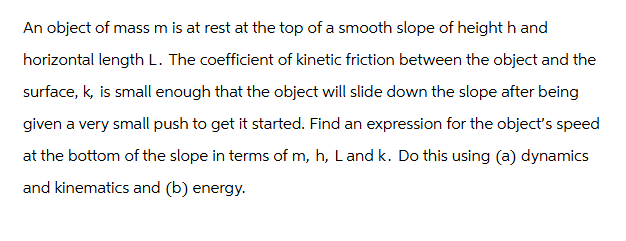 An object of mass m is at rest at the top of a smooth slope of height h and
horizontal length L. The coefficient of kinetic friction between the object and the
surface, k, is small enough that the object will slide down the slope after being
given a very small push to get it started. Find an expression for the object's speed
at the bottom of the slope in terms of m, h, Land k. Do this using (a) dynamics
and kinematics and (b) energy.
This is AI generated Response.
Asked by: gvr
Created at: 2025-06-18 19:55:48
Asked by: gvr
Created at: 2025-06-18 19:55:48
Final Answer:
Rendered
Raw Text
Did you like this answer?
Let's **break down the problem** and solve it step by step using both requested methods.
---
### **Given:**
- Mass of object: \( m \)
- Slope height: \( h \)
- Slope horizontal length: \( L \)
- Coefficient of kinetic friction: \( k \) (often denoted \( \mu_k \))
- Find: **Speed at bottom** of the slope (\( v \)), in terms of \( m, h, L, k \).
---
## **Step 1: Find the length and angle of the slope**
- Let \( \theta \) be the angle of the slope.
The length of the slope (hypotenuse):
\[
d = \frac{h}{\sin\theta}
\]
But also, \(\cos\theta = \frac{L}{d}\) and \(\sin\theta = \frac{h}{d}\).
So,
\[
d = \sqrt{L^2 + h^2}
\]
and
\[
\sin\theta = \frac{h}{\sqrt{L^2 + h^2}}
\]
---
## **(a) Using Dynamics and Kinematics**
**Step 2: Forces**
- Gravity down the slope: \( mg\sin\theta \)
- Friction up the slope: \( f_k = kN = k mg \cos\theta \)
**Net force down the slope:**
\[
F_{net} = mg\sin\theta - k mg \cos\theta
\]
**Step 3: Acceleration**
\[
a = \frac{F_{net}}{m} = g(\sin\theta - k\cos\theta)
\]
---
**Step 4: Kinematics**
Initial velocity \( u = 0 \), distance along slope \( s = d = \sqrt{L^2 + h^2} \):
\[
v^2 = u^2 + 2as \implies v^2 = 2 a d
\]
Plug in \( a \) and \( d \):
\[
v^2 = 2g(\sin\theta - k\cos\theta)\, \sqrt{L^2 + h^2}
\]
Substitute \( \sin\theta = \frac{h}{\sqrt{L^2 + h^2}} \), \( \cos\theta = \frac{L}{\sqrt{L^2 + h^2}} \):
\[
v^2 = 2g\left( \frac{h - kL}{\sqrt{L^2 + h^2}} \right)\sqrt{L^2 + h^2}
\]
\[
v^2 = 2g(h - kL)
\]
\[
\boxed{v = \sqrt{2g(h - kL)}}
\]
---
## **(b) Using Energy**
**Step 1: Initial Energy**
- Potential energy at top: \( U_i = mgh \)
**Step 2: Work done by friction**
- Frictional force: \( f_k = k mg \cos\theta \)
- Distance moved: \( d = \sqrt{L^2 + h^2} \)
- Work by friction: \( W_f = -f_k d = -kmg\cos\theta \cdot d \)
\[
W_f = -kmg\left(\frac{L}{\sqrt{L^2 + h^2}}\right)\sqrt{L^2 + h^2} = -kmgL
\]
**Step 3: Final Energy**
- Kinetic energy at bottom: \( K_f = \frac{1}{2}mv^2 \)
**Step 4: Conservation of Energy**
\[
mgh - kmgL = \frac{1}{2}mv^2
\]
\[
2g(h - kL) = v^2
\]
\[
\boxed{v = \sqrt{2g(h - kL)}}
\]
---
### **Final Answer (Both Methods):**
\[
\boxed{v = \sqrt{2g(h - kL)}}
\]
where:
- \( v \) = speed at the bottom of the slope
- \( g \) = acceleration due to gravity
- \( h \) = height of the slope
- \( L \) = horizontal length of the slope
- \( k \) = coefficient of kinetic friction
Question:
i need only all final Answers only
This is AI generated Response.
Asked by: gvr
Created at: 2025-06-18 19:56:50
Asked by: gvr
Created at: 2025-06-18 19:56:50
Final Answer:
Rendered
Raw Text
Did you like this answer?
\[
\boxed{v = \sqrt{2g(h - kL)}}
\]
📢 Instructions:
- Ask anything relatd to above question only.
- For new Question goto :