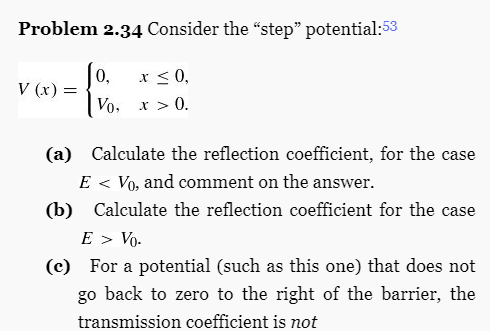
Give step-by-step solution with explanation and final answer:Problem 2.34 Consider the “step” potential:>3
vor-{° x £0,
Vo. x >0.
(a) Calculate the reflection coefficient, for the case
E < Vi, and comment on the answer.
(b) Calculate the reflection coefficient for the case
E> Vp
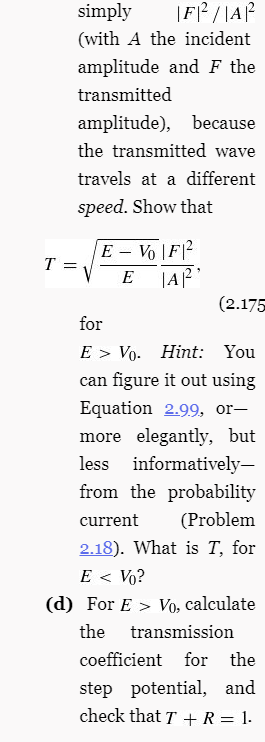
(¢) For a potential (such as this one) that does not
20 back to zero to the right of the barrier, the
transmission coefficient is not
simply |FI?/ [A]
(with A the incident
amplitude and F the
transmitted
amplitude), because
the transmitted wave
travels at a different
speed. Show that
E—Vo|FP
T= J “Fiaf
(2.175
for
E> Vo. Hint: You
can figure it out using
Equation 2.99, or—
more elegantly, but
less informatively—
from the probability
current (Problem
2.18). What is T, for
E < Vp?
(d) For E > Vy, calculate
the transmission
coefficient for the
step potential, and
check that 7 4 R = 1.
Question:
Give step-by-step solution with explanation and final answer:Problem 2.34 Consider the “step” potential:>3
vor-{° x £0,
Vo. x >0.
(a) Calculate the reflection coefficient, for the case
E < Vi, and comment on the answer.
(b) Calculate the reflection coefficient for the case
E> Vp
(¢) For a potential (such as this one) that does not
20 back to zero to the right of the barrier, the
transmission coefficient is not
simply |FI?/ [A]
(with A the incident
amplitude and F the
transmitted
amplitude), because
the transmitted wave
travels at a different
speed. Show that
E—Vo|FP
T= J “Fiaf
(2.175
for
E> Vo. Hint: You
can figure it out using
Equation 2.99, or—
more elegantly, but
less informatively—
from the probability
current (Problem
2.18). What is T, for
E < Vp?
(d) For E > Vy, calculate
the transmission
coefficient for the
step potential, and
check that 7 4 R = 1.
This is AI generated Response.
Asked by: gvr
Created at: 2025-06-23 20:49:34
Final Answer:
RenderedRaw Text
Did you like this answer?
Let's break down each part of the problem:
---
### **Step Potential:**
\[
V(x) = \begin{cases}
0, & x \leq 0 \\
V_0, & x > 0
\end{cases}
\]
A particle of energy \(E\) approaches the step from the left.
---
## **Part (a): Reflection Coefficient for \(E < V_0\)**
### **Step 1: Write the Schrödinger Equation Solutions**
For \(x \leq 0\) (region I, \(V=0\)):
\[
\psi_I(x) = Ae^{ik_1x} + Be^{-ik_1x}
\]
where \(k_1 = \sqrt{2mE}/\hbar\).
For \(x > 0\) (region II, \(V=V_0\)):
\[
\psi_{II}(x) = Ce^{-\kappa x}
\]
where \(\kappa = \sqrt{2m(V_0 - E)}/\hbar\) (since \(E < V_0\), the wave decays exponentially).
### **Step 2: Boundary Conditions at \(x = 0\)**
- Continuity of wavefunction: \(\psi_I(0) = \psi_{II}(0)\)
- Continuity of derivative: \(\psi_I'(0) = \psi_{II}'(0)\)
So:
1. \(A + B = C\)
2. \(ik_1A - ik_1B = -\kappa C\)
### **Step 3: Solve for \(B/A\) (Reflection Amplitude)**
From (1): \(C = A + B\)
Plug into (2):
\[
ik_1A - ik_1B = -\kappa (A + B)
\]
\[
ik_1A - ik_1B + \kappa A + \kappa B = 0
\]
\[
(ik_1 + \kappa)A + (-ik_1 + \kappa)B = 0
\]
\[
(ik_1 + \kappa)A = (ik_1 - \kappa)B
\]
\[
\frac{B}{A} = \frac{ik_1 + \kappa}{ik_1 - \kappa}
\]
### **Step 4: Reflection Coefficient**
The reflection coefficient is \(R = |B/A|^2\):
\[
R = \left|\frac{ik_1 + \kappa}{ik_1 - \kappa}\right|^2
\]
But, for \(E < V_0\), \(k_1\) and \(\kappa\) are both real, so:
\[
|ik_1 + \kappa|^2 = k_1^2 + \kappa^2
\]
\[
|ik_1 - \kappa|^2 = k_1^2 + \kappa^2
\]
So,
\[
R = 1
\]
**Comment:** For \(E < V_0\), the reflection coefficient is 1. This means the particle is totally reflected and cannot penetrate the step, which matches classical expectations.
---
## **Part (b): Reflection Coefficient for \(E > V_0\)**
### **Step 1: Solutions**
For \(x > 0\): \(\psi_{II}(x) = Fe^{ik_2x}\), where \(k_2 = \sqrt{2m(E-V_0)}/\hbar\).
### **Step 2: Boundary Conditions**
1. \(A + B = F\)
2. \(ik_1A - ik_1B = ik_2F\)
### **Step 3: Solve for \(B/A\)**
From (1): \(F = A + B\)
Plug into (2):
\[
ik_1A - ik_1B = ik_2(A + B)
\]
\[
ik_1A - ik_1B - ik_2A - ik_2B = 0
\]
\[
(i k_1 - i k_2)A + (-i k_1 - i k_2)B = 0
\]
\[
(k_1 - k_2)A = (k_1 + k_2)B
\]
\[
\frac{B}{A} = \frac{k_1 - k_2}{k_1 + k_2}
\]
### **Step 4: Reflection Coefficient**
\[
R = \left| \frac{k_1 - k_2}{k_1 + k_2} \right|^2
\]
---
## **Part (c): Transmission Coefficient \(T\) for \(E > V_0\)**
Given:
\[
T = \frac{k_2}{k_1} \left| \frac{F}{A} \right|^2
\]
From boundary conditions:
\[
F = A + B
\]
Substitute \(B = \frac{k_1 - k_2}{k_1 + k_2}A\):
\[
F = A + \frac{k_1 - k_2}{k_1 + k_2}A = \frac{2k_1}{k_1 + k_2}A
\]
So:
\[
\left| \frac{F}{A} \right|^2 = \left| \frac{2k_1}{k_1 + k_2} \right|^2
\]
\[
T = \frac{k_2}{k_1} \left| \frac{2k_1}{k_1 + k_2} \right|^2 = \frac{k_2}{k_1} \cdot \frac{4k_1^2}{(k_1 + k_2)^2} = \frac{4k_1 k_2}{(k_1 + k_2)^2}
\]
---
## **Part (d): Check \(T + R = 1\) for \(E > V_0\)**
\[
T = \frac{4k_1 k_2}{(k_1 + k_2)^2}
\]
\[
R = \left| \frac{k_1 - k_2}{k_1 + k_2} \right|^2 = \frac{(k_1 - k_2)^2}{(k_1 + k_2)^2}
\]
\[
T + R = \frac{4k_1 k_2 + (k_1 - k_2)^2}{(k_1 + k_2)^2} = \frac{4k_1 k_2 + (k_1^2 - 2k_1k_2 + k_2^2)}{(k_1 + k_2)^2}
\]
\[
= \frac{k_1^2 + 2k_1k_2 + k_2^2}{(k_1 + k_2)^2} = 1
\]
---
## **Summary of Answers**
### **(a) \(E < V_0\):**
\[
R = 1 \qquad (\text{total reflection, classically expected})
\]
### **(b) \(E > V_0\):**
\[
R = \left| \frac{k_1 - k_2}{k_1 + k_2} \right|^2
\]
### **(c) \(E > V_0\):**
\[
T = \frac{4k_1 k_2}{(k_1 + k_2)^2}
\]
or as in the problem statement,
\[
T = \sqrt{\frac{E - V_0}{E}} \cdot \left| \frac{F}{A} \right|^2
\]
### **(d) \(T + R = 1\)** is confirmed.
---
#### **Where:**
- \(k_1 = \sqrt{2mE}/\hbar\)
- \(k_2 = \sqrt{2m(E-V_0)}/\hbar\)
- \(\kappa = \sqrt{2m(V_0-E)}/\hbar\) (for \(E < V_0\))
If you need any step explained further, let me know!
Question:
i need each part 1 theory line for explanation
This is AI generated Response.
Asked by: gvr
Created at: 2025-06-23 20:51:12
Final Answer:
RenderedRaw Text
Did you like this answer?
Certainly! Here's a concise, one-line theoretical explanation for each part:
---
### **Part (a):**
When \(E < V_0\), the wave cannot propagate into the barrier and is totally reflected, so the reflection coefficient \(R = 1\).
### **Part (b):**
When \(E > V_0\), the wave partially transmits and reflects, with the reflection coefficient given by \(\left| \frac{k_1 - k_2}{k_1 + k_2} \right|^2\), reflecting the impedance mismatch.
### **Part (c):**
The transmission coefficient for \(E > V_0\) is proportional to the ratio of transmitted to incident wave amplitudes, scaled by the ratio of their wave numbers, resulting in \(T = \frac{4k_1 k_2}{(k_1 + k_2)^2}\).
### **Part (d):**
Because probability current is conserved, the sum of transmission and reflection coefficients satisfies \(T + R = 1\) for \(E > V_0\).
---
Let me know if you'd like any further clarification!
VIPSolutions focuses on clear, step‑by‑step explanations so you can learn quickly. Whether you need an AI‑generated walkthrough or a short hint to get unstuck, each solution is organized for fast reading and easy review later.
Search similar questions, compare approaches, and bookmark the best answers for revision. Our goal is simple: quick, reliable study help that feels natural—not noisy.
 VIPSolutions
 Problem 2.34 Consider the “step” potential:>3
vor-{° x £0,
Vo. x >0.
(a) Calculate the reflection coefficient, for the case
E < Vi, and comment on the answer.
(b) Calculate the reflection coefficient for the case
E> Vp
(¢) For a potential (such as this one) that does not
20 back to zero to the right of the barrier, the
transmission coefficient is not
simply |FI?/ [A]
(with A the incident
amplitude and F the
transmitted
amplitude), because
the transmitted wave
travels at a different
speed. Show that
E—Vo|FP
T= J “Fiaf
(2.175
for
E> Vo. Hint: You
can figure it out using
Equation 2.99, or—
more elegantly, but
less informatively—
from the probability
current (Problem
2.18). What is T, for
E < Vp?
(d) For E > Vy, calculate
the transmission
coefficient for the
step potential, and
check that 7 4 R = 1.