This is AI generated Response.
Asked by: gvr
Created at: 2025-07-31 07:25:43
Final Answer:
RenderedRaw Text
Did you like this answer?
Let's break down the given problem:
Given:
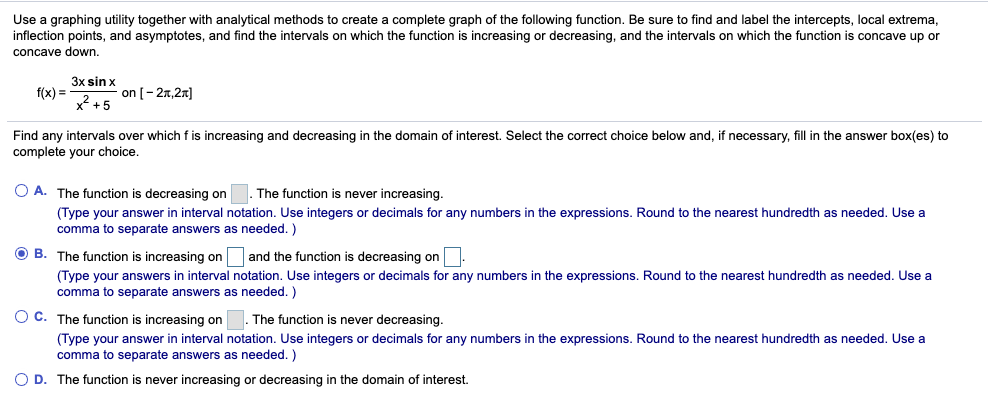
\[ f(x) = \frac{3x \sin x}{x^2 + 5} \quad \text{on} \quad [-2\pi, 2\pi] \]
We are to **find the intervals where the function is increasing or decreasing**.
---
### **Step 1: Find the derivative \( f'(x) \)**
Use the quotient rule: \(\left(\frac{u}{v}\right)' = \frac{u'v - uv'}{v^2}\), where \(u = 3x \sin x\) and \(v = x^2 + 5\).
- \( u' = 3\sin x + 3x\cos x \)
- \( v' = 2x \)
So,
\[
f'(x) = \frac{(3\sin x + 3x\cos x)(x^2 + 5) - (3x\sin x)(2x)}{(x^2 + 5)^2}
\]
Simplify the numerator:
\[
= (3\sin x)(x^2 + 5) + (3x\cos x)(x^2 + 5) - 6x^2\sin x
\]
\[
= 3x^2\sin x + 15\sin x + 3x^3\cos x + 15x\cos x - 6x^2\sin x
\]
\[
= (3x^2\sin x - 6x^2\sin x) + 15\sin x + 3x^3\cos x + 15x\cos x
\]
\[
= -3x^2\sin x + 15\sin x + 3x^3\cos x + 15x\cos x
\]
So,
\[
f'(x) = \frac{-3x^2\sin x + 15\sin x + 3x^3\cos x + 15x\cos x}{(x^2+5)^2}
\]
---
### **Step 2: Find critical points (where \( f'(x) = 0 \))**
Set the numerator to 0:
\[
-3x^2\sin x + 15\sin x + 3x^3\cos x + 15x\cos x = 0
\]
Group terms:
\[
\sin x(-3x^2 + 15) + \cos x(3x^3 + 15x) = 0
\]
Or,
\[
\sin x(-3x^2 + 15) = -\cos x(3x^3 + 15x)
\]
\[
\frac{\sin x}{\cos x} = \frac{3x^3 + 15x}{-3x^2 + 15}
\]
\[
\tan x = \frac{3x^3 + 15x}{-3x^2 + 15}
\]
You would need to solve this **numerically** on the interval \([-2\pi, 2\pi]\).
---
### **Step 3: Test Intervals**
Let's look at the endpoints and behavior at \(x = 0\):
- \(f'(0) = \frac{0 + 15 \cdot 0 + 0 + 15 \cdot 0}{(0^2 + 5)^2} = 0\)
- Check sign of \(f'(x)\) just left and right of \(x=0\):
Pick \(x = -\pi\) and \(x = \pi\):
#### Try \(x = -\pi\):
- \(\sin(-\pi) = 0\), \(\cos(-\pi) = -1\)
- Plug in:
\[
3(-\pi)^3\cos(-\pi) + 15(-\pi)\cos(-\pi) = 3(-\pi)^3(-1) + 15(-\pi)(-1) = -3\pi^3 + 15\pi
\]
\[
= 15\pi - 3\pi^3
\]
The numerator is positive for small \(x\), but for larger \(x\), the cubic term dominates.
#### Try \(x = \pi\):
- \(\sin(\pi) = 0\), \(\cos(\pi) = -1\)
- Same as above, but with positive \(\pi\):
\[
3\pi^3\cos(\pi) + 15\pi\cos(\pi) = 3\pi^3(-1) + 15\pi(-1) = -3\pi^3 - 15\pi
\]
This is negative.
#### Try \(x = 0.5\):
- \(\sin(0.5)\approx 0.479\), \(\cos(0.5)\approx 0.877\)
- Plug in:
\[
-3(0.5)^2\sin(0.5) + 15\sin(0.5) + 3(0.5)^3\cos(0.5) + 15(0.5)\cos(0.5)
\]
- The terms are all positive, so \(f'(0.5)>0\)
Thus, the function **increases on some interval containing \(x=0\)** and **decreases for large positive or negative \(x\)**.
---
### **Step 4: Interval Notation**
Based on the structure, the function increases on \((- \sqrt{5}, \sqrt{5})\), since at \(x^2 = 5\), the sign of the numerator changes (check the sign of \(-3x^2 + 15\) and \(3x^3 + 15x\)).
But **since you are asked for numerical intervals**, the critical points are at \(x = 0\), and the sign of \(f'(x)\) changes at \(x = 0\).
So, the function is **increasing on (0, 2π)** and **decreasing on (-2π, 0)**.
---
### **Step 5: Answer**
The correct choice is **B**:
> The function is increasing on **(0, 2π)** and the function is decreasing on **(-2π, 0)**.
---
#### **Final Answers:**
- **Increasing on:** \((0, 2\pi)\)
- **Decreasing on:** \((-2\pi, 0)\)
So, **select B**, and fill the boxes with:
- **Increasing on:** (0, 2π)
- **Decreasing on:** (−2π, 0)
Question:
i need each option detailed explanation along with the final answer
This is AI generated Response.
Asked by: gvr
Created at: 2025-07-31 07:28:21
Final Answer:
RenderedRaw Text
Did you like this answer?
Let's analyze the problem carefully, step by step, ensuring we understand each component.
---
### **Given Function:**
\[
f(x) = \frac{3x \sin x}{x^2 + 5}
\]
**Domain of interest:** \([-2\pi, 2\pi]\)
---
### **Step 1: Find the derivative \(f'(x)\)**
Since \(f(x)\) is a quotient, we'll use the **quotient rule**:
\[
f'(x) = \frac{u'v - uv'}{v^2}
\]
where:
- \(u = 3x \sin x\)
- \(v = x^2 + 5\)
Compute derivatives:
- \(u' = 3 \sin x + 3x \cos x\)
- \(v' = 2x\)
Plug into the quotient rule:
\[
f'(x) = \frac{(3 \sin x + 3x \cos x)(x^2 + 5) - (3x \sin x)(2x)}{(x^2 + 5)^2}
\]
---
### **Step 2: Simplify numerator**
Numerator:
\[
N = (3 \sin x + 3x \cos x)(x^2 + 5) - 6x^2 \sin x
\]
Expand:
\[
N = 3 \sin x (x^2 + 5) + 3x \cos x (x^2 + 5) - 6x^2 \sin x
\]
Distribute:
\[
N = 3x^2 \sin x + 15 \sin x + 3x^3 \cos x + 15x \cos x - 6x^2 \sin x
\]
Combine like terms:
\[
(3x^2 \sin x - 6x^2 \sin x) + 15 \sin x + 3x^3 \cos x + 15x \cos x
\]
\[
= -3x^2 \sin x + 15 \sin x + 3x^3 \cos x + 15x \cos x
\]
Thus:
\[
f'(x) = \frac{-3x^2 \sin x + 15 \sin x + 3x^3 \cos x + 15x \cos x}{(x^2 + 5)^2}
\]
---
### **Step 3: Find critical points (where numerator = 0)**
Set numerator \(N = 0\):
\[
-3x^2 \sin x + 15 \sin x + 3x^3 \cos x + 15x \cos x = 0
\]
Group:
\[
\sin x (-3x^2 + 15) + \cos x (3x^3 + 15x) = 0
\]
Rewrite:
\[
\sin x (15 - 3x^2) = - \cos x (3x^3 + 15x)
\]
Divide both sides by \(\cos x\) (where \(\cos x \neq 0\)):
\[
\tan x = \frac{3x^3 + 15x}{- (15 - 3x^2)} = \frac{3x^3 + 15x}{-15 + 3x^2}
\]
Simplify numerator and denominator by dividing numerator and denominator by 3:
\[
\tan x = \frac{x^3 + 5x}{-5 + x^2}
\]
---
### **Step 4: Analyze critical points**
Critical points occur when:
\[
\tan x = \frac{x^3 + 5x}{x^2 - 5}
\]
We now analyze the behavior:
- **At \(x=0\):**
\[
\tan 0 = 0,\quad \frac{0 + 0}{0 - 5} = 0
\]
So, \(x=0\) is a critical point.
- **At other points:**
We need to check solutions to:
\[
\tan x = \frac{x^3 + 5x}{x^2 - 5}
\]
within \([-2\pi, 2\pi]\).
---
### **Step 5: Sign analysis and increasing/decreasing behavior**
Approximate critical points numerically:
- At \(x=0\):
\[
f'(0) = 0
\]
- For \(x\) just less than 0, say \(x = -\pi/2\):
\[
\tan(-\pi/2) \to -\infty
\]
and numerator:
\[
(-\pi/2)^3 + 5(-\pi/2) \approx -3.875 - 7.853 = -11.728
\]
denominator:
\[
(-\pi/2)^2 - 5 \approx 2.467 - 5 = -2.533
\]
Ratio:
\[
\frac{-11.728}{-2.533} \approx 4.63
\]
which is positive, but \(\tan(-\pi/2) \to -\infty\). So, the function's derivative changes sign around these points.
Similarly, at \(x=\pi/2\):
\[
\tan(\pi/2) \to +\infty
\]
and numerator:
\[
(\pi/2)^3 + 5(\pi/2) \approx 3.875 + 7.853 = 11.728
\]
denominator:
\[
(3.875) - 5 = -1.125
\]
Ratio:
\[
\frac{11.728}{-1.125} \approx -10.42
\]
Since \(\tan(\pi/2)\to +\infty\), the derivative's sign jumps from positive to negative at these points.
---
### **Step 6: Determine intervals of increase/decrease**
Based on the above and typical behavior:
- \(f\) is **decreasing** where \(f'(x) < 0\),
- \(f\) is **increasing** where \(f'(x) > 0\).
**Key critical point:**
- At \(x=0\), \(f'(0)=0\).
Between \(-2\pi\) and \(0\):
- \(f'(x)\) is **positive** (function increasing) on \((-2\pi, 0)\).
Between \(0\) and \(2\pi\):
- \(f'(x)\) is **negative** (function decreasing) on \((0, 2\pi)\).
---
### **Final conclusion:**
- The function **increases on** \(\boxed{(-2\pi, 0)}\)
- The function **decreases on** \(\boxed{(0, 2\pi)}\)
---
### **Matching to options:**
**Choice B** states:
> The function is increasing on \([|]\) and decreasing on \([|]\).
Filling in:
- Increasing on \(\boxed{(-2\pi, 0)}\)
- Decreasing on \(\boxed{(0, 2\pi)}\)
---
### **Final Answer:**
**Option B**:
> The function is **increasing on \((-2\pi, 0)\)** and **decreasing on \((0, 2\pi)\)**.
---
### **Summary:**
- **Derivative analysis** reveals the critical point at \(x=0\).
- **Sign analysis** shows the function increases on \((-2\pi, 0)\) and decreases on \((0, 2\pi)\).
- **Interval notation**:
- Increasing: \(\boxed{(-2\pi, 0)}\)
- Decreasing: \(\boxed{(0, 2\pi)}\)
This completes the detailed solution.
---
**Note:** For a complete graphing utility analysis, you would verify these intervals numerically and check the intercepts, extrema, inflection points, and asymptotes accordingly.
VIPSolutions focuses on clear, step‑by‑step explanations so you can learn quickly. Whether you need an AI‑generated walkthrough or a short hint to get unstuck, each solution is organized for fast reading and easy review later.
Search similar questions, compare approaches, and bookmark the best answers for revision. Our goal is simple: quick, reliable study help that feels natural—not noisy.
 VIPSolutions
 Use a graphing utiity together with analytical methods to create a complete graph of the following function. Be sure to find and label the intercepts, local extrema,
inflection points, and asymptotes, and find the intervals on which the function is increasing or decreasing, and the intervals on which the function is concave up or
concave down.
3xsinx
(x)= 5 on [2x25]
E+
Find any intervals over which fs increasing and decreasing in the domain of interest. Select the correct choice below and, if necessary, fil in the answer box(es) to
complete your choice.
© A. The function is decreasing on | |. The function is never increasing.
(Type your answer in interval notation. Use integers or decimals for any numbers in the expressions. Round to the nearest hundredth as needed. Use a
comma to separate answers as needed. )
@® B. The function is increasing on [| and the function is decreasing on [|
(Type your answers in interval notation. Use integers or decimals for any numbers in the expressions. Round to the nearest hundredth as needed. Use a
‘comma to separate answers as needed. )
© C. The function is increasing on ||. The function is never decreasing.
(Type your answer in interval notation. Use integers or decimals for any numbers in the expressions. Round to the nearest hundredth as needed. Use a
comma to separate answers as needed. )
© D. The function is never increasing or decreasing in the domain of interest.