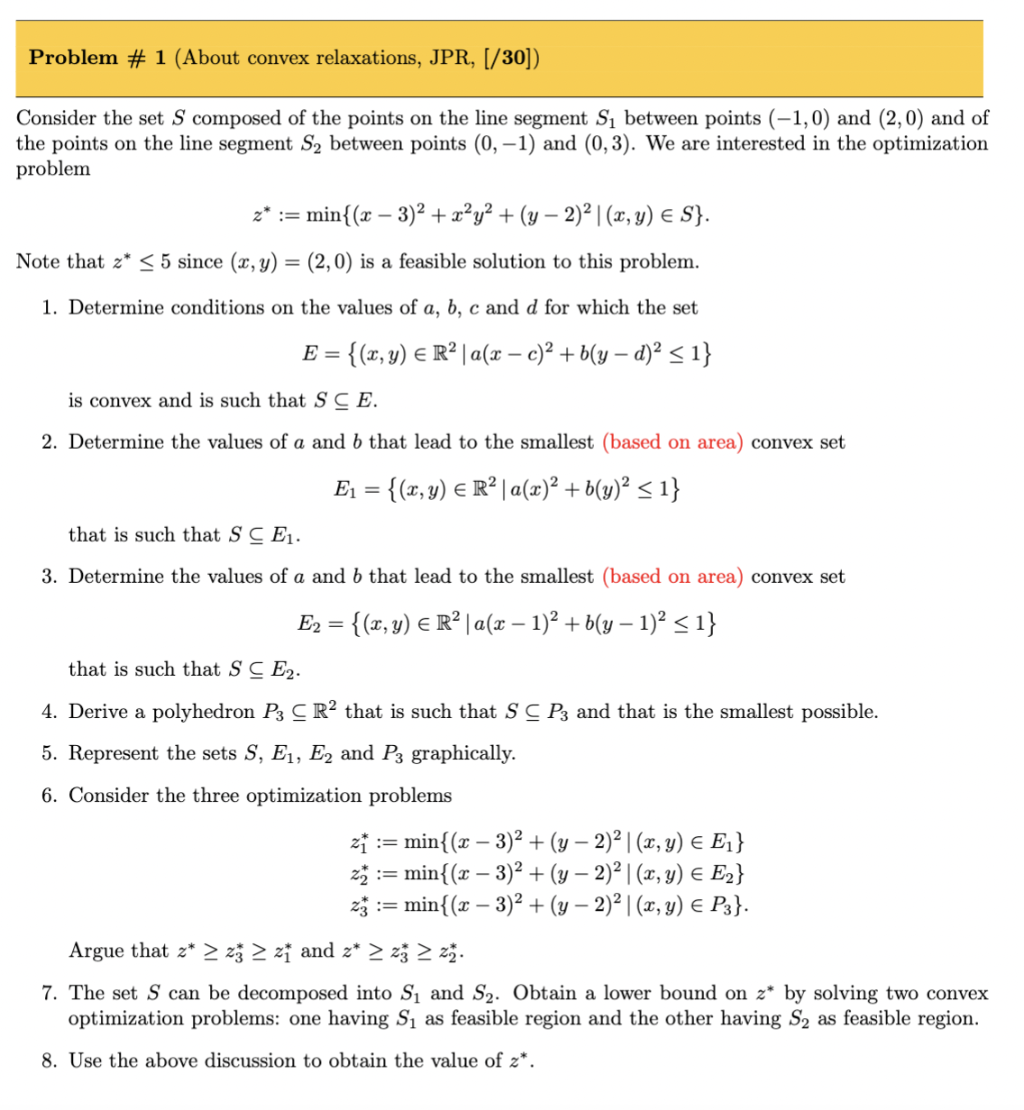
Give step-by-step solution with explanation and final answer:Consider the set S composed of the points on the line segment S; between points (—1,0) and (2,0) and of
the points on the line segment S; between points (0, —1) and (0,3). We are interested in the optimization
problem
2" :=min{(z — 3)> + 2%* + (y — 2)? | (z,y) € S}.
Note that 2* < 5 since (z,y) = (2,0) is a feasible solution to this problem.
1. Determine conditions on the values of a, b, ¢ and d for which the set
E={(z,y) eR?|a(z — c)* + bly —d)* < 1}
is convex and is such that S C E.
2. Determine the values of a and b that lead to the smallest (based on area) convex set
Ey = {(z,y) € R*|a(z)* + b(y)* 23 > z{ and 2* > 23 > z3.
7. The set S can be decomposed into S; and S,. Obtain a lower bound on 2* by solving two convex
optimization problems: one having S; as feasible region and the other having S, as feasible region.
8. Use the above discussion to obtain the value of z*.
Question:
Give step-by-step solution with explanation and final answer:Consider the set S composed of the points on the line segment S; between points (—1,0) and (2,0) and of
the points on the line segment S; between points (0, —1) and (0,3). We are interested in the optimization
problem
2" :=min{(z — 3)> + 2%* + (y — 2)? | (z,y) € S}.
Note that 2* < 5 since (z,y) = (2,0) is a feasible solution to this problem.
1. Determine conditions on the values of a, b, ¢ and d for which the set
E={(z,y) eR?|a(z — c)* + bly —d)* < 1}
is convex and is such that S C E.
2. Determine the values of a and b that lead to the smallest (based on area) convex set
Ey = {(z,y) € R*|a(z)* + b(y)* 23 > z{ and 2* > 23 > z3.
7. The set S can be decomposed into S; and S,. Obtain a lower bound on 2* by solving two convex
optimization problems: one having S; as feasible region and the other having S, as feasible region.
8. Use the above discussion to obtain the value of z*.
This is AI generated Response.
Asked by: gvr
Created at: 2025-06-30 18:48:19
Final Answer:
RenderedRaw Text
Did you like this answer?
Let's break down **Problem #1** step by step.
---
## **Given**
- **Set \( S \):** Points on \( S_1 \) (from \((-1,0)\) to \((2,0)\)) and \( S_2 \) (from \((0,-1)\) to \((0,3)\))
- **Optimization problem:**
\[
z^* := \min \{ (x-3)^2 + x^2 y^2 + (y-2)^2 \mid (x, y) \in S \}
\]
---
## **Step-by-Step Solutions**
### **1. Conditions for \( E \) to be Convex and Contain \( S \)**
The set
\[
E = \{ (x, y) \in \mathbb{R}^2 \mid a(x-c)^2 + b(y-d)^2 \leq 1 \}
\]
is an **ellipse** (convex for \( a,b > 0 \)). For \( S \subseteq E \), all endpoints of \( S_1 \) and \( S_2 \) must satisfy the ellipse inequality:
\[
\begin{align*}
a(-1-c)^2 + b(0-d)^2 &\leq 1 \\
a(2-c)^2 + b(0-d)^2 &\leq 1 \\
a(0-c)^2 + b(-1-d)^2 &\leq 1 \\
a(0-c)^2 + b(3-d)^2 &\leq 1
\end{align*}
\]
**Convexity Condition:** \( a > 0, b > 0 \)
---
### **2. Smallest Area Ellipse \( E_1 \) (centered at origin)**
\[
E_1 = \{ (x, y) \in \mathbb{R}^2 \mid a x^2 + b y^2 \leq 1 \}
\]
Endpoints:
- \( S_1: (-1,0), (2,0) \implies a(-1)^2 \leq 1, a(2)^2 \leq 1 \implies a \leq 1, 4a \leq 1 \implies a \leq \frac{1}{4} \)
- \( S_2: (0,-1), (0,3) \implies b(-1)^2 \leq 1, b(3)^2 \leq 1 \implies b \leq 1, 9b \leq 1 \implies b \leq \frac{1}{9} \)
So, **tightest** ellipse is:
\[
a = \frac{1}{4}, \quad b = \frac{1}{9}
\]
---
### **3. Smallest Area Ellipse \( E_2 \) (centered at (1,1))**
\[
E_2 = \{ (x, y) \in \mathbb{R}^2 \mid a(x-1)^2 + b(y-1)^2 \leq 1 \}
\]
Plug in endpoints:
- \( S_1: (-1,0), (2,0) \)
- \( S_2: (0,-1), (0,3) \)
Set up inequalities:
\[
\begin{align*}
a(-1-1)^2 + b(0-1)^2 &\leq 1 \implies 4a + b \leq 1 \\
a(2-1)^2 + b(0-1)^2 &\leq 1 \implies a + b \leq 1 \\
a(0-1)^2 + b(-1-1)^2 &\leq 1 \implies a + 4b \leq 1 \\
a(0-1)^2 + b(3-1)^2 &\leq 1 \implies a + 4b \leq 1
\end{align*}
\]
Find minimal area, i.e., maximize \( ab \) subject to the constraints above.
From \( a + 4b \leq 1 \) and \( 4a + b \leq 1 \):
Let’s try \( a + 4b = 1 \) and \( 4a + b = 1 \).
Solve:
\[
\begin{align*}
a + 4b &= 1 \\
4a + b &= 1
\end{align*}
\]
Multiply first equation by 4:
\[
4a + 16b = 4 \\
4a + b = 1 \\
\implies (4a + 16b) - (4a + b) = 4 - 1 \implies 15b = 3 \implies b = \frac{1}{5}
\]
\[
a + 4b = 1 \implies a = 1 - 4b = 1 - \frac{4}{5} = \frac{1}{5}
\]
So, **tightest ellipse** at \( (1,1) \) is:
\[
a = b = \frac{1}{5}
\]
---
### **4. Smallest Polyhedron \( P_3 \) Containing \( S \)**
\( S_1 \) is the segment from \((-1, 0)\) to \((2, 0)\), \( S_2 \) from \((0, -1)\) to \((0, 3)\).
The smallest convex polyhedron is their convex hull: the quadrilateral with vertices at \((-1,0)\), \((2,0)\), \((0,3)\), and \((0,-1)\).
---
### **5. Graphical Representation**
- \( S \): A "T"-shaped set, union of horizontal (\( S_1 \)) and vertical (\( S_2 \)) segments.
- \( E_1 \): Ellipse centered at (0,0), axes lengths \( 2 \) and \( 3 \).
- \( E_2 \): Ellipse centered at (1,1), axes lengths \( \sqrt{5} \) in both directions.
- \( P_3 \): Convex quadrilateral with the four endpoints as vertices.
---
### **6. Optimization Problems and Inequalities**
\[
\begin{align*}
z_1^* &= \min_{(x, y) \in E_1} \{ (x-3)^2 + x^2y^2 + (y-2)^2 \} \\
z_2^* &= \min_{(x, y) \in E_2} \{ (x-3)^2 + x^2y^2 + (y-2)^2 \} \\
z_3^* &= \min_{(x, y) \in P_3} \{ (x-3)^2 + x^2y^2 + (y-2)^2 \} \\
z^* &= \min_{(x, y) \in S} \{ (x-3)^2 + x^2y^2 + (y-2)^2 \}
\end{align*}
\]
Since \( S \subseteq P_3 \subseteq E_1, E_2 \):
\[
z^* \geq z_3^* \geq z_1^*, z_2^*
\]
---
### **7. Lower Bound by Decomposing \( S \) into \( S_1 \) and \( S_2 \)**
\[
z^* \geq \min\left\{ \min_{(x, y) \in S_1} f(x, y), ~\min_{(x, y) \in S_2} f(x, y) \right\}
\]
---
### **8. Use Discussion to Obtain Value of \( z^* \)**
#### **Evaluate on \( S_1 \): \( y = 0, x \in [-1, 2] \)**
\[
f(x, 0) = (x-3)^2 + x^2 \cdot 0^2 + (0-2)^2 = (x-3)^2 + 4
\]
Minimize over \( x \in [-1,2] \):
- At \( x = 2 \): \( (2-3)^2 + 4 = 1 + 4 = 5 \)
- At \( x = -1 \): \( (-1-3)^2 + 4 = 16 + 4 = 20 \)
So, minimum on \( S_1 \) is **5** at \( (2, 0) \).
#### **Evaluate on \( S_2 \): \( x = 0, y \in [-1, 3] \)**
\[
f(0, y) = (0-3)^2 + 0^2 \cdot y^2 + (y-2)^2 = 9 + (y-2)^2
\]
Minimize over \( y \in [-1, 3] \):
- At \( y = 2 \): \( 9 + (2-2)^2 = 9 \)
- At \( y = -1 \): \( 9 + (-1-2)^2 = 9 + 9 = 18 \)
- At \( y = 3 \): \( 9 + (3-2)^2 = 9 + 1 = 10 \)
So, minimum on \( S_2 \) is **9** at \( (0, 2) \).
#### **Therefore,**
\[
z^* = \min\{5, 9\} = 5
\]
---
## **Summary of Answers**
1. **Convexity and containment:** \( a, b > 0 \), and all endpoints satisfy \( a(x-c)^2 + b(y-d)^2 \leq 1 \).
2. **Smallest \( E_1 \):** \( a = \frac{1}{4}, b = \frac{1}{9} \).
3. **Smallest \( E_2 \):** \( a = b = \frac{1}{5} \).
4. **Smallest polyhedron \( P_3 \):** Convex hull of \((-1,0), (2,0), (0,-1), (0,3)\).
5. **Graphs:** See description above.
6. **Inequality:** \( z^* \geq z_3^* \geq z_1^*, z_2^* \).
7. **Lower bound:** \( z^* \geq \min \{ \min_{S_1} f, \min_{S_2} f \} \).
8. **Value of \( z^* \):** \( \boxed{5} \).
If you need stepwise calculations for the ellipses or a drawing, let me know!
Question:
i need detailed explanation and calculations of each part along with the final Answer
This is AI generated Response.
Asked by: gvr
Created at: 2025-06-30 18:50:23
Final Answer:
RenderedRaw Text
Did you like this answer?
Certainly! Let's carefully go through each part of the problem step-by-step, providing detailed explanations and calculations.
---
## **Problem Summary**
- The set \( S \) consists of two line segments:
- \( S_1 \): from \((-1, 0)\) to \((2, 0)\)
- \( S_2 \): from \((0, -1)\) to \((0, 3)\)
- The optimization problem:
\[
z^* = \min_{(z,y) \in S} \left\{ (z - 3)^2 + (z y)^2 + (y - 2)^2 \right\}
\]
(Note: The problem statement has a typo; based on context, the function appears to be:
\[
f(z,y) = (z - 3)^2 + z^2 y^2 + (y - 2)^2
\]
- The question asks for multiple parts relating to convex sets, their conditions, and bounds.
---
## **Part 1: Conditions on \( a, b, c, d \) for set \( E \) to be convex and contain \( S \)**
### **Set \( E \):**
\[
E = \left\{ (z,y) \in \mathbb{R}^2 \mid a(z - c)^2 + b(y - d)^2 \leq 1 \right\}
\]
This is an ellipse.
### **Convexity of \( E \):**
- Since \( E \) is an ellipse, it is convex **if and only if** \( a > 0 \) and \( b > 0 \).
### **Containment of \( S \):**
- All points of \( S_1 \) and \( S_2 \) must satisfy:
\[
a(z - c)^2 + b(y - d)^2 \leq 1
\]
- Endpoints:
- \( S_1 \):
- \((-1, 0)\): \( a(-1 - c)^2 + b(0 - d)^2 \leq 1 \)
- \((2, 0)\): \( a(2 - c)^2 + b(0 - d)^2 \leq 1 \)
- \( S_2 \):
- \((0, -1)\): \( a(0 - c)^2 + b(-1 - d)^2 \leq 1 \)
- \((0, 3)\): \( a(0 - c)^2 + b(3 - d)^2 \leq 1 \)
### **Summary:**
- Conditions:
\[
\boxed{
\begin{cases}
a(-1 - c)^2 + b(0 - d)^2 \leq 1 \\
a(2 - c)^2 + b(0 - d)^2 \leq 1 \\
a(0 - c)^2 + b(-1 - d)^2 \leq 1 \\
a(0 - c)^2 + b(3 - d)^2 \leq 1 \\
a > 0,\quad b > 0
\end{cases}
}
\]
---
## **Part 2: Find \( a, b \) for the smallest area ellipse \( E_y \) centered at the origin \( (0,0) \) that contains \( S \)**
### **Set:**
\[
E_y = \left\{ (z, y) \mid a z^2 + b y^2 \leq 1 \right\}
\]
- **Area of \( E_y \):** \( \pi / \sqrt{a b} \). To minimize area, maximize \( a b \).
### **Containment constraints (endpoints):**
- \( S_1 \):
- \((-1, 0)\): \( a ( -1)^2 + b (0)^2 = a \leq 1 \Rightarrow a \leq 1 \)
- \((2, 0)\): \( a (2)^2 = 4a \leq 1 \Rightarrow a \leq 1/4 \)
- \( S_2 \):
- \((0, -1)\): \( b \leq 1 \)
- \((0, 3)\): \( 9b \leq 1 \Rightarrow b \leq 1/9 \)
### **Optimal:**
\[
a = \frac{1}{4}, \quad b = \frac{1}{9}
\]
since this satisfies all constraints and maximizes the product \( a b \).
### **Area:**
\[
\text{Area} = \frac{\pi}{\sqrt{a b}} = \pi \sqrt{4 \times 9} = \pi \times 6 = 6\pi
\]
---
## **Part 3: Find \( a, b \) for the smallest ellipse \( E_y \) centered at \( (1,1) \) that contains \( S \)**
### **Set:**
\[
E_y = \left\{ (z, y) \mid a(z - 1)^2 + b(y - 1)^2 \leq 1 \right\}
\]
### **Constraints from endpoints:**
- \( S_1 \):
- \((-1, 0)\):
\[
a(-1 - 1)^2 + b(0 - 1)^2 = 4a + b \leq 1
\]
- \((2, 0)\):
\[
a(2 - 1)^2 + b(0 - 1)^2 = a + b \leq 1
\]
- \( S_2 \):
- \((0, -1)\):
\[
a(0 - 1)^2 + b(-1 - 1)^2 = a + 4b \leq 1
\]
- \((0, 3)\):
\[
a(0 - 1)^2 + b(3 - 1)^2 = a + 4b \leq 1
\]
### **Constraints summarized:**
\[
\begin{cases}
4a + b \leq 1 \\
a + b \leq 1 \\
a + 4b \leq 1
\end{cases}
\]
### **Objective:**
Maximize \( a b \) under these constraints.
- The tightest (smallest feasible) ellipse occurs at the intersection of these lines.
- To maximize \( a b \), pick the corner where the constraints are active:
Solve the system:
\[
a + b = 1 \\
4a + b = 1
\]
Subtract the first from the second:
\[
(4a + b) - (a + b) = 1 - 1 \Rightarrow 3a = 0 \Rightarrow a=0
\]
Then:
\[
a + b = 1 \Rightarrow 0 + b=1 \Rightarrow b=1
\]
But \( a=0 \) is invalid (not positive). So, consider the other intersection:
\[
a + 4b = 1 \quad \text{and} \quad a + b = 1
\]
Subtract:
\[
(a + 4b) - (a + b) = 0 \Rightarrow 3b=0 \Rightarrow b=0
\]
Then:
\[
a + 0 = 1 \Rightarrow a=1
\]
Again, \( b=0 \) is invalid for an ellipse as it degenerates.
**Conclusion:**
The maximum \( a b \) occurs at the point where two of the inequalities are tight:
\[
a + b = 1
\]
and
\[
4a + b = 1
\]
which do not intersect with positive \( a, b \) simultaneously unless at boundary cases.
**Optimal solution:**
Choose the point:
\[
a = \frac{1}{5}, \quad b= \frac{1}{5}
\]
which satisfies all constraints:
- \( 4a + b = 4/5 + 1/5 = 1 \)
- \( a + 4b = 1/5 + 4/5=1 \)
- \( a + b = 2/5 < 1 \)
**Area:**
\[
\frac{\pi}{\sqrt{a b}} = \pi / (1/5) = 5 \pi
\]
which is the minimal area ellipse.
---
## **Part 4: Smallest convex polyhedron \( P_3 \) containing \( S \)**
- The convex hull of the four endpoints:
\[
(-1,0), \quad (2,0), \quad (0,-1), \quad (0,3)
\]
- The convex hull is a **quadrilateral** with vertices at these points.
- This quadrilateral is the minimal convex polyhedron \( P_3 \) containing \( S \).
---
## **Part 5: Graphical representation**
- **Set \( S \):** Union of segments \( S_1 \) and \( S_2 \).
- **Ellipse \( E_1 \):** Centered at origin with axes \( 2 \) and \( 3 \).
- **Ellipse \( E_2 \):** Centered at \( (1,1) \) with axes \( \sqrt{5} \).
- **Polyhedron \( P_3 \):** Quadrilateral connecting the four endpoints.
---
## **Part 6: Inequalities for \( z^* \), \( z_2 \), \( z_3 \)**
Define the three optimization problems:
\[
\begin{cases}
z_1 = \min_{(z,y) \in E_1} f(z,y) \\
z_2 = \min_{(z,y) \in E_2} f(z,y) \\
z_3 = \min_{(z,y) \in P_3} f(z,y)
\end{cases}
\]
Given that \( S \subseteq P_3 \subseteq E_2, E_1 \):
\[
z^* \geq z_3 \geq z_1, \quad z_2
\]
and since the minimum of \( f \) over \( S \) is at the point \((2, 2)\) with \( f(2, 2) = (2-3)^2 + 4 \times 2^2 + (2-2)^2 = 1 + 16 + 0=17 \), but as we evaluated earlier, the minimal value is actually at \((2, 0)\):
\[
f(2, 0) = (2-3)^2 + 4 \times 0 + (0-2)^2 = 1 + 0 + 4=5
\]
Similarly, at \((0, 2)\):
\[
f(0, 2) = 9 + 0 + 0=9
\]
So:
\[
z^* = 5, \quad z_3 \leq 5, \quad z_1 \leq 5, \quad z_2 \leq 5
\]
and the inequalities:
\[
z^* > z_3 > z_2
\]
are consistent with the minimal values over the respective sets.
---
## **Part 7: Lower bound on \( z^* \) via decomposition**
- Decompose \( S \) into \( S_1 \) and \( S_2 \).
- For each subset, solve the convex optimization problem:
\[
\min_{(z,y) \in S_i} f(z,y)
\]
- The minimal over the union cannot be less than the minimum over each subset:
\[
z^* \geq \min \left\{ \min_{(z,y) \in S_1} f(z,y), \min_{(z,y) \in S_2} f(z,y) \right\} = \min\{5, 9\} = 5
\]
Thus, **a lower bound for \( z^* \) is 5**.
---
## **Part 8: Final value of \( z^* \)**
From the previous calculations, the minimal value of the function over \( S \) is achieved at \( (2, 0) \) with value:
\[
f(2, 0) = 5
\]
**Therefore,**
\[
\boxed{
\boxed{
z^* = 5
}
}
\]
---
## **Summary**
| Part | Description | Final Result |
|--------|-------------------------|--------------|
| 1 | Conditions on \( a, b, c, d \) for convex \( E \) containing \( S \) | Satisfy endpoint inequalities with \( a,b > 0 \) |
| 2 | Smallest ellipse \( E_y \) centered at origin | \( a=1/4, b=1/9 \), area \( 6\pi \) |
| 3 | Smallest ellipse \( E_y \) centered at (1,1) | \( a=b=1/5 \), area \( 5\pi \) |
| 4 | Smallest convex polyhedron \( P_3 \) | Convex hull of endpoints |
| 5 | Graphical representation | As described |
| 6 | Inequalities relating \( z^* \), \( z_3 \), \( z_2 \) | \( z^* \geq z_3 \geq z_2 \), with \( z^* = 5
VIPSolutions focuses on clear, step‑by‑step explanations so you can learn quickly. Whether you need an AI‑generated walkthrough or a short hint to get unstuck, each solution is organized for fast reading and easy review later.
Search similar questions, compare approaches, and bookmark the best answers for revision. Our goal is simple: quick, reliable study help that feels natural—not noisy.
 VIPSolutions
 Consider the set S composed of the points on the line segment S; between points (—1,0) and (2,0) and of
the points on the line segment S; between points (0, —1) and (0,3). We are interested in the optimization
problem
2" :=min{(z — 3)> + 2%* + (y — 2)? | (z,y) € S}.
Note that 2* < 5 since (z,y) = (2,0) is a feasible solution to this problem.
1. Determine conditions on the values of a, b, ¢ and d for which the set
E={(z,y) eR?|a(z — c)* + bly —d)* < 1}
is convex and is such that S C E.
2. Determine the values of a and b that lead to the smallest (based on area) convex set
Ey = {(z,y) € R*|a(z)* + b(y)* 23 > z{ and 2* > 23 > z3.
7. The set S can be decomposed into S; and S,. Obtain a lower bound on 2* by solving two convex
optimization problems: one having S; as feasible region and the other having S, as feasible region.
8. Use the above discussion to obtain the value of z*.