Give step-by-step solution with explanation and final answer:A
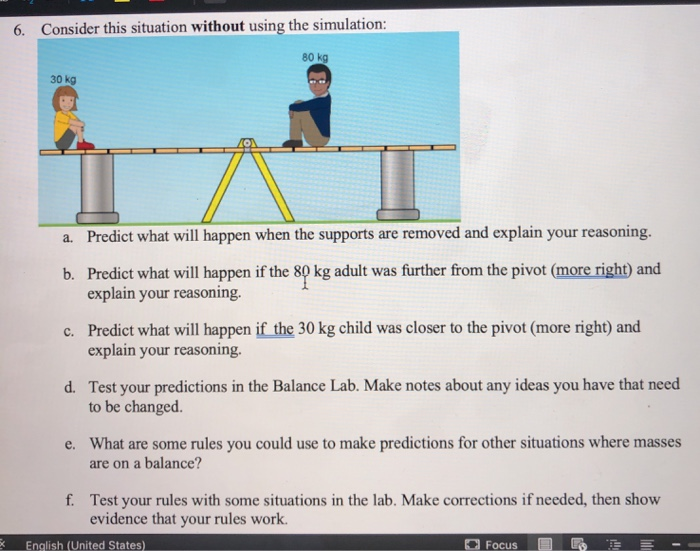
6. Consider this situation without using the simulation:
re I
E |] | I :
Ll
— =
a. Predict what will happen when the supports are removed and explain your reasoning.
b. Predict what will happen if the 8 kg adult was further from the pivot (more right) and
explain your reasoning.
¢. Predict what will happen if the 30 kg child was closer to the pivot (more right) and.
explain your reasoning.
d. Test your predictions in the Balance Lab. Make notes about any ideas you have that need
to be changed.
e. What are some rules you could use to make predictions for other situations where masses.
are on a balance?
f. Test your rules with some situations in the lab. Make corrections if needed, then show
evidence that your rules work
Question:
Give step-by-step solution with explanation and final answer:A
6. Consider this situation without using the simulation:
re I
E |] | I :
Ll
— =
a. Predict what will happen when the supports are removed and explain your reasoning.
b. Predict what will happen if the 8 kg adult was further from the pivot (more right) and
explain your reasoning.
¢. Predict what will happen if the 30 kg child was closer to the pivot (more right) and.
explain your reasoning.
d. Test your predictions in the Balance Lab. Make notes about any ideas you have that need
to be changed.
e. What are some rules you could use to make predictions for other situations where masses.
are on a balance?
f. Test your rules with some situations in the lab. Make corrections if needed, then show
evidence that your rules work
This is AI generated Response.
Asked by: gvr
Created at: 2025-06-24 22:31:01
Final Answer:
RenderedRaw Text
Did you like this answer?
Let's solve each part **step-by-step** with explanations:
---
### a. **Predict what will happen when the supports are removed and explain your reasoning.**
**Answer:**
When the supports are removed, the seesaw will tip down on the side where the 80 kg adult is sitting.
**Reasoning:**
The adult is much heavier than the child (80 kg vs. 30 kg), and if they are sitting at equal distances from the pivot, the heavier side will create a greater turning effect (torque), causing that side to go down.
---
### b. **Predict what will happen if the 80 kg adult was further from the pivot (more right) and explain your reasoning.**
**Answer:**
If the 80 kg adult moves further from the pivot, the seesaw will tip even more quickly and steeply on the adult's side.
**Reasoning:**
Torque = Force × Distance from Pivot
By moving further from the pivot, the adult increases their torque, making it even harder for the child to balance the seesaw.
---
### c. **Predict what will happen if the 30 kg child was closer to the pivot (more right) and explain your reasoning.**
**Answer:**
If the 30 kg child moves closer to the pivot, the seesaw will tip down on the adult's side even more.
**Reasoning:**
Moving closer to the pivot decreases the child's torque (since distance from the pivot is smaller), making it even less likely for the child to balance the adult's larger torque.
---
### d. **Test your predictions in the Balance Lab. Make notes about any ideas you have that need to be changed.**
**Answer:**
This step requires using a simulation or physical balance. You would follow the above changes and see if the seesaw tips as predicted. If results differ, you would adjust your understanding of how torque works.
---
### e. **What are some rules you could use to make predictions for other situations where masses are on a balance?**
**Answer:**
**Rules for Balance:**
1. Calculate torque for each side: **Torque = Mass × Distance from pivot**.
2. The seesaw will balance if the torque on both sides is equal.
\[
(Mass_1 \times Distance_1) = (Mass_2 \times Distance_2)
\]
3. If one side's torque is greater, that side will tip down.
---
### f. **Test your rules with some situations in the lab. Make corrections if needed, then show evidence that your rules work.**
**Answer:**
Again, this is a practical/experimental step. You'd place different masses at various distances and use your rules to predict which way the seesaw will tip or if it will balance. If predictions match outcomes, your rules are confirmed.
---
## **Summary Table**
| Part | Prediction | Reasoning |
|------|------------|-----------|
| a | Seesaw tips down on adult's side | Adult is much heavier (greater torque) |
| b | Tips even more to adult's side | Further distance increases torque |
| c | Tips even more to adult's side | Closer distance decreases child's torque |
| e | Use torque (mass × distance) to predict balance | Balance if torques are equal |
Let me know if you want a worked example with numbers!
Question:
yes with example
This is AI generated Response.
Asked by: gvr
Created at: 2025-06-24 22:32:14
Final Answer:
RenderedRaw Text
Did you like this answer?
Certainly! Let's work through an example with numbers to illustrate how to apply the rules using torque calculations.
---
### **Example Scenario:**
Suppose we have a seesaw with a **pivot in the middle**.
- **Adult:** 80 kg, sitting **3 meters** from the pivot on the right side.
- **Child:** 30 kg, sitting **2 meters** from the pivot on the left side.
---
### **Step 1: Calculate the torque for each side**
**Torque formula:**
\[
\text{Torque} = \text{Mass} \times \text{Distance from pivot}
\]
- Convert mass to force (though in many cases, since gravity cancels out, mass can be used directly for comparison as long as consistent units are used).
**For the adult (right side):**
\[
80\, \text{kg} \times 3\, \text{m} = 240\, \text{kg·m}
\]
**For the child (left side):**
\[
30\, \text{kg} \times 2\, \text{m} = 60\, \text{kg·m}
\]
---
### **Step 2: Compare torques**
- Adult torque: **240 kg·m**
- Child torque: **60 kg·m**
Since **240 > 60**, the **adult's side** will tip **down**, and the seesaw will tilt **toward the adult**.
---
### **Step 3: Adjust the situation to balance**
To balance the seesaw, set the torques equal:
\[
\text{Adult's torque} = \text{Child's torque}
\]
\[
80\, \text{kg} \times D_{adult} = 30\, \text{kg} \times D_{child}
\]
Suppose the adult stays at **3 meters**. Find the child's distance:
\[
80 \times 3 = 30 \times D_{child}
\]
\[
240 = 30 \times D_{child}
\]
\[
D_{child} = \frac{240}{30} = 8\, \text{meters}
\]
**Interpretation:**
The child would need to sit **8 meters** from the pivot to balance the adult sitting 3 meters away.
---
### **Summary:**
- To determine if the seesaw balances, compare the torques.
- If torques are equal, the seesaw balances.
- Moving a mass farther from the pivot increases torque; moving closer decreases it.
- By adjusting distances accordingly, you can predict the equilibrium point.
---
### **Final note:**
This example demonstrates how **torque calculations** help make predictions about balance situations involving masses at different distances. The key rule is:
\[
\boxed{
\text{Seesaw balances if} \quad \text{Mass}_1 \times \text{Distance}_1 = \text{Mass}_2 \times \text{Distance}_2
}
\]
Feel free to try different numbers or scenarios!
Question:
i need detailed calculations or explanations of each part along with the final Answer
This is AI generated Response.
Asked by: gvr
Created at: 2025-06-24 22:33:12
Final Answer:
RenderedRaw Text
Did you like this answer?
Certainly! Below is a detailed, step-by-step explanation for each part of the problem, including calculations, reasoning, and final answers.
---
## **Part a: Predict what will happen when the supports are removed**
### **Explanation:**
- The supports hold the seesaw in balance.
- When supports are removed, the seesaw is free to rotate based on the torques (rotational forces) exerted by the masses.
- **Key concept:** The side with the greater torque will tip downward.
### **Given:**
- The adult weighs 80 kg.
- The child weighs 30 kg.
- Both are sitting at some distances from the pivot (not specified explicitly here, but usually equal in initial setup).
### **Prediction:**
- Since the adult is heavier, the side with the adult will tip downward.
### **Final answer:**
> When the supports are removed, the seesaw will tip down on the adult's side because the adult's weight creates a larger torque than the child's.
---
## **Part b: Predict what will happen if the 80 kg adult was further from the pivot (more right)**
### **Explanation:**
- Torque = Force × Distance (from pivot)
- Increasing the distance of the adult from the pivot increases their torque, making their side even more likely to tip downward.
### **Calculation (conceptual):**
- Original torque (assume initial distance \( d \))
- New torque = \( 80\, \text{kg} \times d_{new} \), where \( d_{new} > d \)
### **Prediction:**
- The torque increases.
- Therefore, the side with the adult will tip down **more rapidly** and **more steeply**.
### **Final answer:**
> The adult's side will tip down more quickly because moving the adult further from the pivot increases their torque, amplifying the imbalance.
---
## **Part c: Predict what will happen if the 30 kg child was closer to the pivot (more right)**
### **Explanation:**
- Moving the child closer to the pivot decreases their torque.
- Since torque depends on the product of mass and distance, decreasing distance reduces torque.
### **Calculation (conceptual):**
- Original torque = \( 30\, \text{kg} \times d_{child} \)
- If \( d_{child} \) decreases, then torque decreases proportionally.
### **Prediction:**
- The child's torque becomes smaller.
- The seesaw will tip further downward on the adult's side.
### **Final answer:**
> The seesaw will tip more steeply on the adult's side because bringing the child closer reduces their torque, making it harder for them to balance the adult's larger torque.
---
## **Part d: Test your predictions in the Balance Lab**
### **Explanation:**
- Use the actual setup or simulation to verify predictions.
- Observe if the seesaw behaves as predicted when removing supports, moving masses, etc.
- Record outcomes:
- Does it tip on the adult's side when supports are removed? (Yes/No)
- Does moving the adult further from the pivot cause more tipping? (Yes/No)
- Does bringing the child closer cause the same effect? (Yes/No)
### **Notes:**
- If predictions differ from actual behavior, re-examine assumptions about distances or weights.
- Update understanding accordingly.
---
## **Part e: Rules for predicting balance with masses**
### **Rules:**
1. **Calculate torque for each side:**
\[
\text{Torque} = \text{Mass} \times \text{Distance from pivot}
\]
2. **Balance condition:**
\[
\text{Seesaw is balanced if} \quad \text{Torque}_\text{left} = \text{Torque}_\text{right}
\]
3. **Tipping direction:**
- The side with the larger torque will tip downward.
4. **Moving mass:**
- Moving a mass farther from the pivot increases torque and vice versa.
---
## **Part f: Test these rules with situations in the lab**
### **Method:**
- Place known masses at specific distances.
- Use the torque formula to predict the outcome.
- Observe the actual behavior.
- Adjust your understanding if predictions do not match.
### **Example:**
Suppose:
- Adult (80 kg) sitting **3 meters** from the pivot.
- Child (30 kg) sitting **2 meters** from the pivot.
**Calculate torques:**
\[
\text{Adult torque} = 80\, \text{kg} \times 3\, \text{m} = 240\, \text{kg·m}
\]
\[
\text{Child torque} = 30\, \text{kg} \times 2\, \text{m} = 60\, \text{kg·m}
\]
**Prediction:**
- Since 240 > 60, the seesaw tips toward the adult's side.
**To balance:**
\[
80 \times D_{adult} = 30 \times D_{child}
\]
\[
D_{child} = \frac{80 \times 3}{30} = \frac{240}{30} = 8\, \text{m}
\]
**Conclusion:**
- The child needs to sit **8 meters** from the pivot to balance the adult sitting 3 meters away.
---
## **Summary of key points:**
- **Torque** determines tipping.
- **Balance condition:** torques are equal.
- Moving masses closer or further affects the balance.
- Larger masses or greater distances increase torque.
---
**This detailed explanation with calculations should help you understand how to predict and verify the behavior of a seesaw with different masses and positions.**
VIPSolutions focuses on clear, step‑by‑step explanations so you can learn quickly. Whether you need an AI‑generated walkthrough or a short hint to get unstuck, each solution is organized for fast reading and easy review later.
Search similar questions, compare approaches, and bookmark the best answers for revision. Our goal is simple: quick, reliable study help that feels natural—not noisy.
 VIPSolutions
 A
6. Consider this situation without using the simulation:
re I
E |] | I :
Ll
— =
a. Predict what will happen when the supports are removed and explain your reasoning.
b. Predict what will happen if the 8 kg adult was further from the pivot (more right) and
explain your reasoning.
¢. Predict what will happen if the 30 kg child was closer to the pivot (more right) and.
explain your reasoning.
d. Test your predictions in the Balance Lab. Make notes about any ideas you have that need
to be changed.
e. What are some rules you could use to make predictions for other situations where masses.
are on a balance?
f. Test your rules with some situations in the lab. Make corrections if needed, then show
evidence that your rules work