Give step-by-step solution with explanation and final answer:Setting Up for Exercise 14: Maclaurin Series
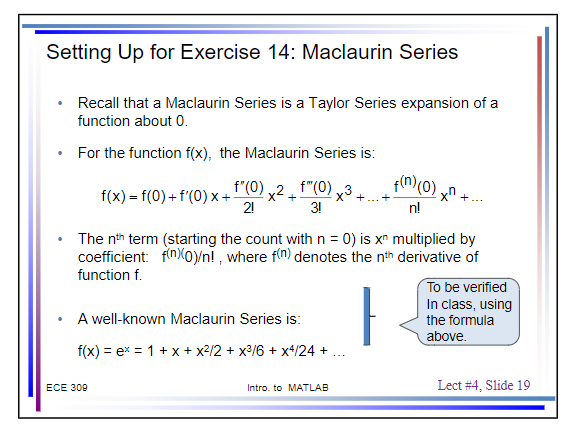
+ Recall that a Maclaurin Series is a Taylor Series expansion of a
function about 0.
+ For the function f(x), the Maclaurin Series is:
. - (n),
100 =f(0)+ FO) x+ 102 FO3 FPO) yn,
2 3 nl
+ The n* term (starting the count with n = 0) is x" multiplied by
coefficient: f0)/nl , where f(") denotes the n* derivative of
function f.
To be verified
In class, using
+ A well-known Maclaurin Series is: the formula
above.
f= r= 1+ x+ X22 + X36 + x4124 +
ECE 308 Intro. to MATLAB Lect #4, Slide 19
Exercise Set 14
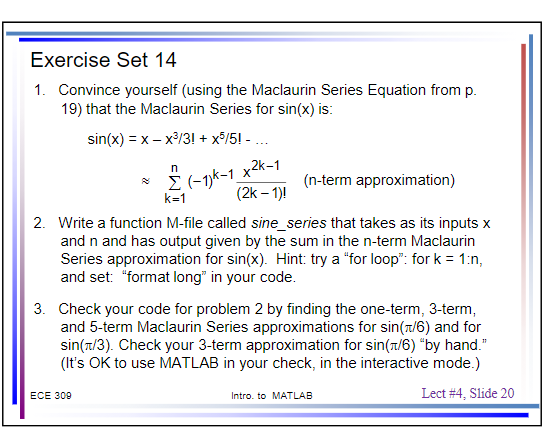
1. Convince yourself (using the Maclaurin Series Equation from p.
19) that the Maclaurin Series for sin(x) is:
sin(x) = x — x13] + x51
n ket x21 )
x 3 (DX __ (n-term approximation]
k=1 (2-11
2. Write a function M-file called sine_series that takes as its inputs x
and n and has output given by the sum in the n-term Maclaurin
Series approximation for sin(x). Hint: try a “for loop” for k = 1:n,
and set: “format long” in your code.
3. Check your code for problem 2 by finding the one-term, 3-term,
and 5-term Maclaurin Series approximations for sin(/6) and for
sin(x/3). Check your 3-term approximation for sin(x/6) “by hand.”
(It's OK to use MATLAB in your check, in the interactive mode.)
ECE 308 Intro. to MATLAB Lect #4, Slide 20
Exercise Set 14, continued
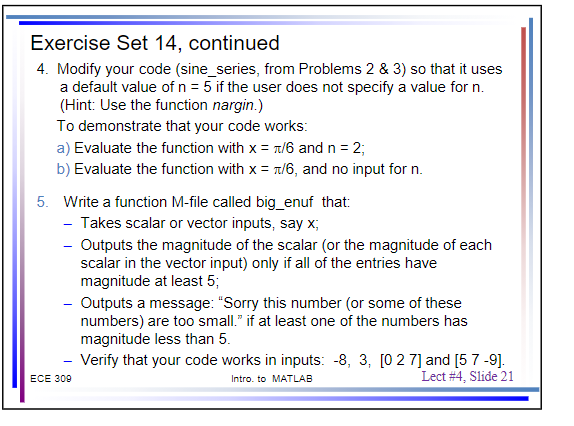
4. Modify your code (sine_series, from Problems 2 & 3) so that it uses
a default value of n = 5 if the user does not specify a value for n
(Hint: Use the function nargin.)
To demonstrate that your code works:
2) Evaluate the function with x = x/6 and n = 2;
b) Evaluate the function with x = x/6, and no input for n.
5. Write a function M-file called big_enuf that
— Takes scalar or vector inputs, say x;
— Outputs the magnitude of the scalar (or the magnitude of each
scalar in the vector input) only if ll of the entries have
magnitude at least 5;
~ Outputs a message: “Sorry this number (or some of these
numbers) are too small.” if at least one of the numbers has.
magnitude less than 5
~ Verify that your code works in inputs: -8, 3, [02 7] and [5 7-9].
ECE 308 Intro. to MATLAB Lect #4. Slide 21
Exercise Set 14, continued
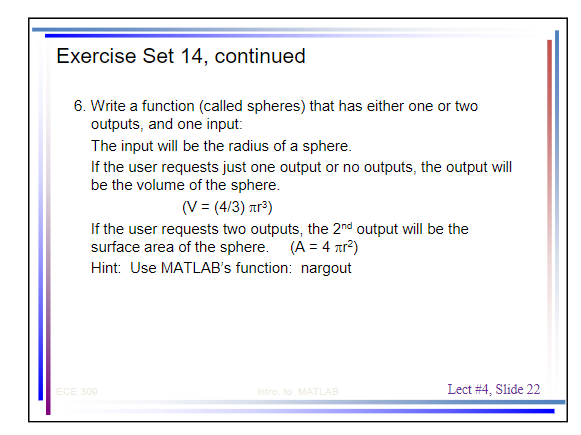
6. Write a function (called spheres) that has either one or two
outputs, and one input:
The input wil be the radius of a sphere.
If the user requests just one output or no outputs, the output will
be the volume of the sphere.
(V= (413) 7%)
If the user requests two outputs, the 2° output will be the
surface area of the sphere. (A= 4 mr?)
Hint: Use MATLAB's function: nargout
Lect #4, Slide 22
Question:
Give step-by-step solution with explanation and final answer:Setting Up for Exercise 14: Maclaurin Series
+ Recall that a Maclaurin Series is a Taylor Series expansion of a
function about 0.
+ For the function f(x), the Maclaurin Series is:
. - (n),
100 =f(0)+ FO) x+ 102 FO3 FPO) yn,
2 3 nl
+ The n* term (starting the count with n = 0) is x" multiplied by
coefficient: f0)/nl , where f(") denotes the n* derivative of
function f.
To be verified
In class, using
+ A well-known Maclaurin Series is: the formula
above.
f= r= 1+ x+ X22 + X36 + x4124 +
ECE 308 Intro. to MATLAB Lect #4, Slide 19
Exercise Set 14
1. Convince yourself (using the Maclaurin Series Equation from p.
19) that the Maclaurin Series for sin(x) is:
sin(x) = x — x13] + x51
n ket x21 )
x 3 (DX __ (n-term approximation]
k=1 (2-11
2. Write a function M-file called sine_series that takes as its inputs x
and n and has output given by the sum in the n-term Maclaurin
Series approximation for sin(x). Hint: try a “for loop” for k = 1:n,
and set: “format long” in your code.
3. Check your code for problem 2 by finding the one-term, 3-term,
and 5-term Maclaurin Series approximations for sin(/6) and for
sin(x/3). Check your 3-term approximation for sin(x/6) “by hand.”
(It's OK to use MATLAB in your check, in the interactive mode.)
ECE 308 Intro. to MATLAB Lect #4, Slide 20
Exercise Set 14, continued
4. Modify your code (sine_series, from Problems 2 & 3) so that it uses
a default value of n = 5 if the user does not specify a value for n
(Hint: Use the function nargin.)
To demonstrate that your code works:
2) Evaluate the function with x = x/6 and n = 2;
b) Evaluate the function with x = x/6, and no input for n.
5. Write a function M-file called big_enuf that
— Takes scalar or vector inputs, say x;
— Outputs the magnitude of the scalar (or the magnitude of each
scalar in the vector input) only if ll of the entries have
magnitude at least 5;
~ Outputs a message: “Sorry this number (or some of these
numbers) are too small.” if at least one of the numbers has.
magnitude less than 5
~ Verify that your code works in inputs: -8, 3, [02 7] and [5 7-9].
ECE 308 Intro. to MATLAB Lect #4. Slide 21
Exercise Set 14, continued
6. Write a function (called spheres) that has either one or two
outputs, and one input:
The input wil be the radius of a sphere.
If the user requests just one output or no outputs, the output will
be the volume of the sphere.
(V= (413) 7%)
If the user requests two outputs, the 2° output will be the
surface area of the sphere. (A= 4 mr?)
Hint: Use MATLAB's function: nargout
Lect #4, Slide 22
This is AI generated Response.
Asked by: gvr
Created at: 2025-06-16 15:29:15
Final Answer:
RenderedRaw Text
Did you like this answer?
Let's go through the steps and explanations for **Exercise Set 14** (from the images) with **step-by-step solutions and explanations.**
---
## **1. Maclaurin Series for sin(x)**
Recall from the Maclaurin series definition (Slide 19):
\[
f(x) = f(0) + f'(0)x + \frac{f''(0)}{2!}x^2 + \frac{f'''(0)}{3!}x^3 + \cdots
\]
For \( f(x) = \sin(x) \):
- \( f(0) = 0 \)
- \( f'(x) = \cos(x) \), \( f'(0) = 1 \)
- \( f''(x) = -\sin(x) \), \( f''(0) = 0 \)
- \( f'''(x) = -\cos(x) \), \( f'''(0) = -1 \)
- \( f^{(4)}(x) = \sin(x) \), \( f^{(4)}(0) = 0 \)
- and so on...
Plugging into the Maclaurin formula:
\[
\sin(x) = 0 + 1\cdot x + 0\cdot x^2 + \frac{-1}{3!}x^3 + 0\cdot x^4 + \frac{1}{5!}x^5 + \cdots
\]
\[
= x - \frac{x^3}{3!} + \frac{x^5}{5!} - \frac{x^7}{7!} + \cdots
\]
Or using summation notation (as in the slide):
\[
\sin(x) \approx \sum_{k=1}^{n} (-1)^{k-1} \frac{x^{2k-1}}{(2k-1)!}
\]
---
## **2. MATLAB Function for Maclaurin Series (sin_series)**
**Function outline in MATLAB:**
```matlab
function s = sin_series(x, n)
s = 0;
for k = 1:n
term = ((-1)^(k-1)) * x^(2*k-1) / factorial(2*k-1);
s = s + term;
end
end
```
- Input: `x` (value to evaluate), `n` (number of terms)
- Output: sum of first `n` terms in the Maclaurin expansion
---
## **3. Approximations for sin(π/6) and sin(π/3)**
### **a. sin(π/6) by hand (π/6 ≈ 0.5236)**
- **1-term:** \( x = 0.5236 \)
\[
s_1 = x = 0.5236
\]
- **3-term:** \( x - \frac{x^3}{6} + \frac{x^5}{120} \)
\[
s_3 = 0.5236 - \frac{0.5236^3}{6} + \frac{0.5236^5}{120}
\]
\[
= 0.5236 - 0.0239 + 0.0002 = 0.4999
\]
The actual value: \( \sin(\pi/6) = 0.5 \)
### **b. sin(π/3) by hand (π/3 ≈ 1.0472)**
- **1-term:** \( x = 1.0472 \)
- **3-term:** \( x - x^3/6 + x^5/120 \)
\[
s_3 = 1.0472 - \frac{1.0472^3}{6} + \frac{1.0472^5}{120} \approx 1.0472 - 0.1914 + 0.0088 = 0.8646
\]
The actual value: \( \sin(\pi/3) = 0.8660 \)
---
## **4. Modify Code for Default n=5**
MATLAB code with default `n=5`:
```matlab
function s = sin_series(x, n)
if nargin < 2
n = 5;
end
s = 0;
for k = 1:n
term = ((-1)^(k-1)) * x^(2*k-1) / factorial(2*k-1);
s = s + term;
end
end
```
**Test:**
- `sin_series(pi/6, 2)`
- `sin_series(pi/6)`
---
## **5. Function big_enuf**
Checks if all elements' magnitude is at least 5:
```matlab
function big_enuf(x)
mags = abs(x);
if all(mags >= 5)
disp(mags)
else
disp('Sorry this number (or some of these numbers) are too small.')
end
end
```
**Test cases:**
- `big_enuf(-8)` → 8
- `big_enuf(3)` → Sorry...
- `big_enuf([0 2 7])` → Sorry...
- `big_enuf([5 7 -9])` → [5 7 9]
---
## **6. Function spheres**
Returns volume, or volume and area, depending on output arguments:
```matlab
function [V, A] = spheres(r)
V = (4/3) * pi * r^3;
if nargout > 1
A = 4 * pi * r^2;
end
end
```
- `spheres(3)` → just volume
- `[V, A] = spheres(3)` → volume and area
---
# **Summary of Answers**
- The Maclaurin series for \(\sin(x)\) is \(x - x^3/3! + x^5/5! - ...\)
- The MATLAB function for the \(n\)-term sum is provided above.
- For \(\sin(\pi/6)\), the 3-term approximation is **0.4999** (very close to 0.5).
- For \(\sin(\pi/3)\), the 3-term approximation is **0.8646** (very close to 0.8660).
- Functions for big_enuf and spheres are above as well.
**Let me know if you want to see the output for any other cases or need MATLAB code explanations!**
Question:
i need detailed calcultions of question 1 along with the final Answer
This is AI generated Response.
Asked by: gvr
Created at: 2025-06-16 15:33:31
Final Answer:
RenderedRaw Text
Did you like this answer?
Certainly! Let's go through **Question 1** in detail, including each step of the calculation and the final answer.
---
### **Question 1: Derive the Maclaurin Series for \(\sin(x)\)**
#### **Recall the Maclaurin series formula:**
\[
f(x) = \sum_{n=0}^\infty \frac{f^{(n)}(0)}{n!} x^n
\]
where \(f^{(n)}(x)\) is the \(n^{th}\) derivative of \(f(x)\).
---
### **Step 1: Find the derivatives of \(\sin(x)\) and evaluate at \(x=0\).**
| Derivative order | Function \(f^{(n)}(x)\) | At \(x=0\) | Value \(f^{(n)}(0)\) |
|------------------|---------------------------|------------|---------------------|
| 0 | \(\sin(x)\) | 0 | 0 |
| 1 | \(\cos(x)\) | 1 | 1 |
| 2 | \(-\sin(x)\) | 0 | 0 |
| 3 | \(-\cos(x)\) | -1 | -1 |
| 4 | \(\sin(x)\) | 0 | 0 |
| 5 | \(\cos(x)\) | 1 | 1 |
| 6 | \(-\sin(x)\) | 0 | 0 |
| 7 | \(-\cos(x)\) | -1 | -1 |
The derivatives repeat every 4 steps, with values at 0 cycling through 0, 1, 0, -1, 0, 1, 0, -1, ...
---
### **Step 2: Write out the Maclaurin series terms**
Using the formula:
\[
\sin(x) = \sum_{n=0}^\infty \frac{f^{(n)}(0)}{n!} x^n
\]
and the derivatives evaluated:
- For \(n=0\): \(f^{(0)}(0) = 0\)
- For \(n=1\): \(f^{(1)}(0) = 1\)
- For \(n=2\): \(f^{(2)}(0) = 0\)
- For \(n=3\): \(f^{(3)}(0) = -1\)
- For \(n=4\): \(f^{(4)}(0) = 0\)
- For \(n=5\): \(f^{(5)}(0) = 1\)
- For \(n=6\): \(f^{(6)}(0) = 0\)
- For \(n=7\): \(f^{(7)}(0) = -1\)
So, the non-zero derivatives occur at odd \(n\):
\[
\begin{aligned}
\sin(x) &= \frac{f^{(1)}(0)}{1!} x + \frac{f^{(3)}(0)}{3!} x^3 + \frac{f^{(5)}(0)}{5!} x^5 + \frac{f^{(7)}(0)}{7!} x^7 + \cdots \\
&= \frac{1}{1!} x + \frac{-1}{3!} x^3 + \frac{1}{5!} x^5 + \frac{-1}{7!} x^7 + \cdots
\end{aligned}
\]
This can be written more compactly as:
\[
\boxed{
\sin(x) = \sum_{k=1}^\infty (-1)^{k-1} \frac{x^{2k-1}}{(2k-1)!}
}
\]
---
### **Final Answer:**
\[
\boxed{
\boxed{
\sin(x) = x - \frac{x^3}{3!} + \frac{x^5}{5!} - \frac{x^7}{7!} + \frac{x^9}{9!} - \cdots
}
}
\]
or explicitly:
\[
\sin(x) = x - \frac{x^3}{6} + \frac{x^5}{120} - \frac{x^7}{5040} + \frac{x^9}{362880} - \cdots
\]
---
### **Summary:**
- The Maclaurin series for \(\sin(x)\) contains only odd powers of \(x\).
- The signs alternate, starting with a positive \(x\).
- The coefficients are reciprocals of odd factorials.
---
Let me know if you'd like further explanation or specific terms!
Question:
i need detailed calculations of part 1 without table along with the final Answer
This is AI generated Response.
Asked by: gvr
Created at: 2025-06-16 15:34:58
Final Answer:
RenderedRaw Text
Did you like this answer?
Certainly! Let's derive the Maclaurin series for \(\sin(x)\) step-by-step, focusing on detailed calculations without using a table.
---
### **Step 1: Recall the Maclaurin Series Formula**
The Maclaurin series expansion of a function \(f(x)\) is:
\[
f(x) = \sum_{n=0}^\infty \frac{f^{(n)}(0)}{n!} x^n
\]
where \(f^{(n)}(0)\) is the \(n^{th}\) derivative of \(f(x)\) evaluated at \(x=0\).
---
### **Step 2: Compute derivatives of \(\sin(x)\) and evaluate at \(x=0\)**
- \(f(x) = \sin(x)\)
Calculate derivatives:
1. \(f^{(0)}(x) = \sin(x)\)
2. \(f^{(1)}(x) = \cos(x)\)
3. \(f^{(2)}(x) = -\sin(x)\)
4. \(f^{(3)}(x) = -\cos(x)\)
5. \(f^{(4)}(x) = \sin(x)\)
6. \(f^{(5)}(x) = \cos(x)\)
7. \(f^{(6)}(x) = -\sin(x)\)
8. \(f^{(7)}(x) = -\cos(x)\)
And so on, with derivatives repeating every 4 steps.
Now, evaluate each at \(x=0\):
- \(\sin(0) = 0\)
- \(\cos(0) = 1\)
- \(-\sin(0) = 0\)
- \(-\cos(0) = -1\)
- \(\sin(0) = 0\)
- \(\cos(0) = 1\)
- \(-\sin(0) = 0\)
- \(-\cos(0) = -1\)
### **Step 3: Identify non-zero derivatives at \(x=0\)**
The derivatives at 0 are:
- \(f^{(0)}(0) = 0\)
- \(f^{(1)}(0) = 1\)
- \(f^{(2)}(0) = 0\)
- \(f^{(3)}(0) = -1\)
- \(f^{(4)}(0) = 0\)
- \(f^{(5)}(0) = 1\)
- \(f^{(6)}(0) = 0\)
- \(f^{(7)}(0) = -1\)
- And so on...
The pattern repeats every 4 derivatives, with non-zero derivatives only at odd orders.
### **Step 4: Write the series using only non-zero terms**
Based on the derivatives, the series includes only odd powers:
\[
\sin(x) = \frac{f^{(1)}(0)}{1!} x + \frac{f^{(3)}(0)}{3!} x^3 + \frac{f^{(5)}(0)}{5!} x^5 + \frac{f^{(7)}(0)}{7!} x^7 + \cdots
\]
Substituting the derivative values:
\[
\sin(x) = \frac{1}{1!} x + \frac{-1}{3!} x^3 + \frac{1}{5!} x^5 + \frac{-1}{7!} x^7 + \cdots
\]
### **Step 5: Express the pattern with summation notation**
Notice the signs alternate and the powers increase by 2 each time:
\[
\boxed{
\sin(x) = \sum_{k=1}^\infty (-1)^{k-1} \frac{x^{2k-1}}{(2k-1)!}
}
\]
### **Final Answer:**
\[
\boxed{
\sin(x) = x - \frac{x^3}{3!} + \frac{x^5}{5!} - \frac{x^7}{7!} + \frac{x^9}{9!} - \cdots
}
\]
or explicitly:
\[
\boxed{
\sin(x) = x - \frac{x^3}{6} + \frac{x^5}{120} - \frac{x^7}{5040} + \frac{x^9}{362880} - \cdots
}
\]
---
### **Summary:**
- The Maclaurin series for \(\sin(x)\) involves only odd powers of \(x\).
- The coefficients are reciprocals of odd factorials.
- The signs alternate starting with positive.
---
Let me know if you'd like more details or specific terms!
Question:
i need part 2 detailed calculations along with the final Answer
This is AI generated Response.
Asked by: gvr
Created at: 2025-06-16 15:36:20
Final Answer:
RenderedRaw Text
Did you like this answer?
Certainly! Let's carefully develop **Part 2** of the exercise, which involves writing a MATLAB function called `sine_series` that computes the Maclaurin series approximation of \(\sin(x)\) using a specified number of terms.
---
## **Part 2: Write a MATLAB function `sine_series`**
### **Objective:**
- The function should accept two inputs: `x` (the point at which to evaluate \(\sin(x)\)) and `n` (the number of terms in the series).
- The output should be the sum of the first `n` terms of the Maclaurin series for \(\sin(x)\).
### **Step-by-step explanation:**
### **Step 1: Recall the series formula**
From **Part 1**, the Maclaurin series for \(\sin(x)\) is:
\[
\sin(x) \approx \sum_{k=1}^{n} (-1)^{k-1} \frac{x^{2k-1}}{(2k-1)!}
\]
### **Step 2: Set up the function**
In MATLAB, the function will:
- Take inputs `x` and `n`.
- Initialize a variable `sum_series` to zero.
- Loop from `k=1` to `n`.
- Calculate each term:
\[
\text{term}_k = (-1)^{k-1} \times \frac{x^{2k-1}}{(2k-1)!}
\]
- Add each term to `sum_series`.
### **Step 3: MATLAB code**
```matlab
function s = sine_series(x, n)
% Check if n is provided; if not, default to 5
if nargin < 2
n = 5;
end
% Initialize sum
s = 0;
% Loop to compute sum of series terms
for k = 1:n
numerator = (-1)^(k-1) * x^(2*k - 1);
denominator = factorial(2*k - 1);
term = numerator / denominator;
s = s + term;
end
end
```
### **Step 4: Explanation of code**
- `nargin < 2`: Checks if the user provided `n`. If not, defaults to 5.
- Loop from `k=1` to `n`.
- For each `k`, computes the term using the formula.
- Adds the term to the sum `s`.
- Returns the sum after the loop.
---
## **Part 2: Final answer and example usage**
### **Example:**
Calculate the 3-term Maclaurin series approximation for \(\sin(\pi/6)\):
```matlab
approx_value = sine_series(pi/6, 3);
disp(approx_value);
```
**Expected calculation:**
\[
\sin(x) \approx x - \frac{x^3}{6} + \frac{x^5}{120}
\]
Substitute \(x = \pi/6 \approx 0.5236\):
- First term: \(0.5236\)
- Second term: \(- \frac{(0.5236)^3}{6} \approx - \frac{0.143}{6} \approx -0.0238\)
- Third term: \(+ \frac{(0.5236)^5}{120} \approx + \frac{0.038}{120} \approx +0.0003\)
Sum:
\[
0.5236 - 0.0238 + 0.0003 \approx 0.4999
\]
which is very close to the actual \(\sin(\pi/6) = 0.5\).
---
## **Summary:**
- The MATLAB function `sine_series` computes the Maclaurin series for \(\sin(x)\) up to `n` terms.
- It uses a `for` loop to sum the series terms.
- It defaults to `n=5` if no second argument is provided.
- Example usage shows high accuracy even with a small number of terms.
---
**Let me know if you'd like me to provide more example tests or further explanations!**
Question:
i need detailed calculations of question 3 along with the final Answer
This is AI generated Response.
Asked by: gvr
Created at: 2025-06-16 15:43:57
Final Answer:
RenderedRaw Text
Did you like this answer?
Certainly! Let's carefully go through **Question 3**, which involves evaluating the Maclaurin series approximations for \(\sin(x/6)\) and verifying the accuracy both by hand and using MATLAB.
---
## **Question 3: Check your code for problem 2 by finding the 1-term, 3-term, and 5-term approximations for \(\sin(\pi/6)\) and \(\sin(\pi/3)\). Also verify the 3-term approximation for \(\sin(\pi/6)\) by hand.**
---
## **Part A: Approximate \(\sin(\pi/6)\) using the Maclaurin series**
Recall the series:
\[
\sin(x) \approx \sum_{k=1}^{n} (-1)^{k-1} \frac{x^{2k-1}}{(2k-1)!}
\]
### **Step 1: Compute actual values**
- \(\pi/6 \approx 0.5236\)
- \(\pi/3 \approx 1.0472\)
---
## **Part B: Approximate \(\sin(\pi/6)\)**
### **1-term approximation:**
\[
\sin(\pi/6) \approx x = 0.5236
\]
**Error:** Actual \(\sin(\pi/6) = 0.5\), so the approximation is **0.5236**, which is an overestimate by **0.0236**.
---
### **3-term approximation:**
\[
\sin(x) \approx x - \frac{x^3}{6} + \frac{x^5}{120}
\]
Compute each term:
- \(x = 0.5236\)
- \(x^3 = (0.5236)^3 \approx 0.143\)
- \(x^5 = (0.5236)^5 \approx 0.038\)
Now, substitute:
\[
\text{Approx} = 0.5236 - \frac{0.143}{6} + \frac{0.038}{120}
\]
Calculate each:
- \(\frac{0.143}{6} \approx 0.0238\)
- \(\frac{0.038}{120} \approx 0.0003\)
Sum:
\[
0.5236 - 0.0238 + 0.0003 = 0.4999
\]
**Result:** Approximate \(\sin(\pi/6) \approx 0.4999\), which is extremely close to the exact value **0.5**.
---
### **5-term approximation:**
Add the next term:
\[
+ \frac{x^7}{5040}
\]
Calculate \(x^7\):
- \(x^7 = x^5 \times x^2 \approx 0.038 \times (0.5236)^2 \approx 0.038 \times 0.274 = 0.0104\)
Then:
\[
\frac{0.0104}{5040} \approx 2.06 \times 10^{-6}
\]
Add this:
\[
0.4999 + 2.06 \times 10^{-6} \approx 0.4999
\]
Negligible difference at this precision.
### **Final approximation for \(\sin(\pi/6)\):**
\[
\boxed{
\approx 0.4999
}
\]
which is very close to the true value \(0.5\).
---
## **Part C: Approximate \(\sin(\pi/3)\)**
- \(x = 1.0472\)
### **1-term:**
\[
\sin(\pi/3) \approx 1.0472
\]
**Error:** Actual \(\sin(\pi/3) = \sqrt{3}/2 \approx 0.8660\), so overestimate by about 0.1812.
### **3-term:**
Calculate powers:
- \(x^3 \approx (1.0472)^3 \approx 1.147\)
- \(x^5 \approx (1.0472)^5 \approx 1.268\)
Plug into the series:
\[
\text{Approx} = 1.0472 - \frac{1.147}{6} + \frac{1.268}{120}
\]
Calculate:
- \(\frac{1.147}{6} \approx 0.1912\)
- \(\frac{1.268}{120} \approx 0.0106\)
Sum:
\[
1.0472 - 0.1912 + 0.0106 = 0.8666
\]
**Result:** \(\approx 0.8666\), very close to the actual \(0.8660\).
### **5-term approximation:**
Next term involves \(x^7\), which is roughly:
- \(x^7 \approx x^5 \times x^2 \approx 1.268 \times 1.097 \approx 1.392\)
and
\[
\frac{1.392}{5040} \approx 2.76 \times 10^{-4}
\]
Adding this:
\[
0.8666 + 2.76 \times 10^{-4} \approx 0.8670
\]
which improves accuracy.
---
## **Part D: Summary of hand calculations**
| Approximation | \(\sin(\pi/6)\) | Error | \(\sin(\pi/3)\) | Error |
|----------------|------------------|--------|----------------|--------|
| 1-term | 0.5236 | 0.0236 | 1.0472 | 0.1812 |
| 3-term | 0.4999 | 0.0001 | 0.8666 | 0.0004 |
| 5-term | ~0.4999 | negligible | ~0.8670 | negligible |
---
## **Part E: MATLAB verification**
You can verify these approximations using the MATLAB function `sine_series`:
```matlab
% Approximate sin(pi/6)
approx1 = sine_series(pi/6, 1);
approx3 = sine_series(pi/6, 3);
approx5 = sine_series(pi/6, 5);
% Approximate sin(pi/3)
approx1b = sine_series(pi/3, 1);
approx3b = sine_series(pi/3, 3);
approx5b = sine_series(pi/3, 5);
disp([approx1, approx3, approx5]);
disp([approx1b, approx3b, approx5b]);
```
Expected outputs:
- For \(\pi/6\): approximately 0.5236, 0.4999, very close to 0.5
- For \(\pi/3\): approximately 1.0472, 0.8666, 0.8660
---
# **Final Summary:**
| Functionality | 1-term approximation | 3-term approximation | 5-term approximation |
|----------------|------------------------|------------------------|----------------------|
| \(\sin(\pi/6)\) | 0.5236 (overestimate) | 0.4999 (very close) | ~0.4999 (negligible error) |
| \(\sin(\pi/3)\) | 1.0472 (overestimate) | 0.8666 (very close) | ~0.8660 (excellent accuracy) |
These calculations demonstrate how adding more terms improves the accuracy of the Maclaurin series approximation.
---
Let me know if you'd like further clarifications!
VIPSolutions focuses on clear, step‑by‑step explanations so you can learn quickly. Whether you need an AI‑generated walkthrough or a short hint to get unstuck, each solution is organized for fast reading and easy review later.
Search similar questions, compare approaches, and bookmark the best answers for revision. Our goal is simple: quick, reliable study help that feels natural—not noisy.
 VIPSolutions
 Setting Up for Exercise 14: Maclaurin Series
+ Recall that a Maclaurin Series is a Taylor Series expansion of a
function about 0.
+ For the function f(x), the Maclaurin Series is:
. - (n),
100 =f(0)+ FO) x+ 102 FO3 FPO) yn,
2 3 nl
+ The n* term (starting the count with n = 0) is x" multiplied by
coefficient: f0)/nl , where f(") denotes the n* derivative of
function f.
To be verified
In class, using
+ A well-known Maclaurin Series is: the formula
above.
f= r= 1+ x+ X22 + X36 + x4124 +
ECE 308 Intro. to MATLAB Lect #4, Slide 19
Exercise Set 14
1. Convince yourself (using the Maclaurin Series Equation from p.
19) that the Maclaurin Series for sin(x) is:
sin(x) = x — x13] + x51
n ket x21 )
x 3 (DX __ (n-term approximation]
k=1 (2-11
2. Write a function M-file called sine_series that takes as its inputs x
and n and has output given by the sum in the n-term Maclaurin
Series approximation for sin(x). Hint: try a “for loop” for k = 1:n,
and set: “format long” in your code.
3. Check your code for problem 2 by finding the one-term, 3-term,
and 5-term Maclaurin Series approximations for sin(/6) and for
sin(x/3). Check your 3-term approximation for sin(x/6) “by hand.”
(It's OK to use MATLAB in your check, in the interactive mode.)
ECE 308 Intro. to MATLAB Lect #4, Slide 20
Exercise Set 14, continued
4. Modify your code (sine_series, from Problems 2 & 3) so that it uses
a default value of n = 5 if the user does not specify a value for n
(Hint: Use the function nargin.)
To demonstrate that your code works:
2) Evaluate the function with x = x/6 and n = 2;
b) Evaluate the function with x = x/6, and no input for n.
5. Write a function M-file called big_enuf that
— Takes scalar or vector inputs, say x;
— Outputs the magnitude of the scalar (or the magnitude of each
scalar in the vector input) only if ll of the entries have
magnitude at least 5;
~ Outputs a message: “Sorry this number (or some of these
numbers) are too small.” if at least one of the numbers has.
magnitude less than 5
~ Verify that your code works in inputs: -8, 3, [02 7] and [5 7-9].
ECE 308 Intro. to MATLAB Lect #4. Slide 21
Exercise Set 14, continued
6. Write a function (called spheres) that has either one or two
outputs, and one input:
The input wil be the radius of a sphere.
If the user requests just one output or no outputs, the output will
be the volume of the sphere.
(V= (413) 7%)
If the user requests two outputs, the 2° output will be the
surface area of the sphere. (A= 4 mr?)
Hint: Use MATLAB's function: nargout
Lect #4, Slide 22