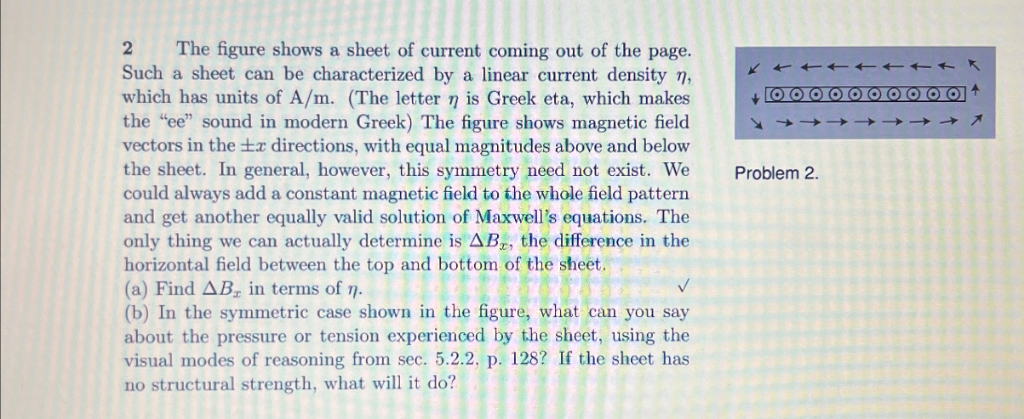
Give step-by-step solution with explanation and final answer:2 The figure shows a sheet of current coming out of the page.
Such a sheet can be characterized by a linear current density 7,
which has units of A/m. (The letter 7 is Greek eta, which makes
the “ee” sound in modern Greek) The figure shows magnetic field
vectors in the z directions, with equal magnitudes above and below bid
the sheet. In general, however, this symuet) ced not exist. We Problem 2. SEE
could always add a constant magnetic field pt : field pattern : 3 i 3 i ;
and get another equally valid solution of Muxvel tions. The iii
only thing we can actually determine is AB, ce in the iil 3: § ]
horizontal field between the top and bottom of t ei
(a) Find AB; in terms of 1. 13 LB v 8585:
(b) In the symmetric case shown in the hat can you say ithe H 5
ii 142 ER
about the pressure or tension experienced by the sheet, using the 239 +4 #
visual modes of reasoning from sec. 5.2.2, p. 128? If the sheet has ERs
no structural strength, what will it do? “eda : :
pe
Question:
Give step-by-step solution with explanation and final answer:2 The figure shows a sheet of current coming out of the page.
Such a sheet can be characterized by a linear current density 7,
which has units of A/m. (The letter 7 is Greek eta, which makes
the “ee” sound in modern Greek) The figure shows magnetic field
vectors in the z directions, with equal magnitudes above and below bid
the sheet. In general, however, this symuet) ced not exist. We Problem 2. SEE
could always add a constant magnetic field pt : field pattern : 3 i 3 i ;
and get another equally valid solution of Muxvel tions. The iii
only thing we can actually determine is AB, ce in the iil 3: § ]
horizontal field between the top and bottom of t ei
(a) Find AB; in terms of 1. 13 LB v 8585:
(b) In the symmetric case shown in the hat can you say ithe H 5
ii 142 ER
about the pressure or tension experienced by the sheet, using the 239 +4 #
visual modes of reasoning from sec. 5.2.2, p. 128? If the sheet has ERs
no structural strength, what will it do? “eda : :
pe
This is AI generated Response.
Asked by: gvr
Created at: 2025-07-01 05:53:54
Final Answer:
RenderedRaw Text
Did you like this answer?
Let's solve the problem **step by step**:
---
### **Problem 2 Analysis**
A **sheet of current** (with current per unit length η, A/m) is coming out of the page. The figure shows magnetic field vectors above and below the sheet, with equal magnitudes but opposite directions.
---
## **(a) Find \(\Delta B_x\) in terms of η**
### **Step 1: Apply Ampère's Law**
Ampère's law for a path crossing the sheet (take a rectangular loop perpendicular to the sheet):
\[
\oint \vec{B} \cdot d\vec{l} = \mu_0 I_{\text{enc}}
\]
- The current sheet has current per unit length η (A/m).
- For a path crossing the sheet, let the length parallel to the sheet be \( L \).
- The total current enclosed: \( I_{\text{enc}} = \eta L \).
### **Step 2: Contribution to the Integral**
- **Above the sheet**: \( B_{\text{above}} \)
- **Below the sheet**: \( B_{\text{below}} \)
- The field is parallel to the path on both sides, but in opposite directions.
Total line integral:
\[
\oint \vec{B} \cdot d\vec{l} = (B_{\text{above}} - B_{\text{below}})L
\]
Set equal to \( \mu_0 \eta L \):
\[
(B_{\text{above}} - B_{\text{below}})L = \mu_0 \eta L
\]
\[
B_{\text{above}} - B_{\text{below}} = \mu_0 \eta
\]
### **Step 3: Express \(\Delta B_x\)**
\[
\boxed{\Delta B_x = \mu_0 \eta}
\]
Where \( \Delta B_x \) is the difference in the horizontal (x) component of the magnetic field between the top and bottom of the sheet.
---
## **(b) Pressure or Tension on the Sheet**
### **Symmetric Case Reasoning**
- In the symmetric case: \( B_{\text{above}} = -B_{\text{below}} \)
- The magnetic field **exerts a force on the current sheet**.
- Magnetic pressure is given by: \( P = \frac{B^2}{2\mu_0} \)
- The field above pushes down; the field below pushes up.
- **Net effect**: The sheet experiences a tension, trying to pull it apart (like the sides of a current loop repel).
### **What if the Sheet Has No Structural Strength?**
- The sheet will **expand/disperse outward** due to the mutual repulsion of current elements (each bit of current repels its neighbor).
- If it's not held together, it will **fly apart**, like a wire "exploding" from its own current's magnetic pressure.
---
## **Final Answers**
### **(a)**
\[
\boxed{\Delta B_x = \mu_0 \eta}
\]
### **(b)**
- The sheet experiences an **outward tension** due to magnetic pressure.
- If the sheet has no structural strength, it will **fly apart/disperse** due to this tension.
Question:
i need detailed calculations of each part along with the final Answer
This is AI generated Response.
Asked by: gvr
Created at: 2025-07-01 05:56:31
Final Answer:
RenderedRaw Text
Did you like this answer?
Let's carefully analyze and solve each part of the problem with detailed steps and explanations.
---
## **Given Data & Concepts**
- The sheet carries a **current per unit length** \(\eta\) (units: A/m), coming out of the page.
- The magnetic field vectors are shown above and below the sheet, with equal magnitudes but opposite directions.
- The magnetic field difference across the sheet is \(\Delta B_x = B_{\text{above}} - B_{\text{below}}\).
- We can add an arbitrary uniform magnetic field \( \mathbf{B}_0 \), but only the *difference* \(\Delta B_x\) is physically meaningful for the force calculations.
---
## **Part (a): Find \(\Delta B_x\) in terms of \(\eta\)**
### **Step 1: Recall Ampère’s Law**
Ampère’s Law in differential form relates magnetic field to current:
\[
\oint \vec{B} \cdot d\vec{l} = \mu_0 I_{\text{enc}}
\]
- For a sheet of current with **current per unit length** \(\eta\), the **enclosed current** when crossing the sheet over length \(L\) is:
\[
I_{\text{enc}} = \eta \times L
\]
- The magnetic field \(\vec{B}\) is tangential and approximately uniform just above and below the sheet.
### **Step 2: Choose an Amperian Loop**
- The loop is a rectangle crossing the sheet perpendicularly, with sides:
- Length \(L\) **parallel** to the sheet (say along the x-direction).
- Short segments of length \(h\) **perpendicular** to the sheet, above and below.
- The magnetic field is constant in the regions just above and below.
- The contributions from the sides parallel to the sheet are:
\[
B_{\text{above}} \times L \quad \text{and} \quad - B_{\text{below}} \times L
\]
- The contributions from the vertical sides (perpendicular to the sheet) cancel out because the field is parallel to the sides and doesn't do work in the perpendicular direction.
### **Step 3: Write the Ampère Loop Integral**
\[
\oint \vec{B} \cdot d\vec{l} = B_{\text{above}} \times L - B_{\text{below}} \times L = \mu_0 \times (\eta L)
\]
Dividing both sides by \(L\):
\[
B_{\text{above}} - B_{\text{below}} = \mu_0 \eta
\]
### **Final result for part (a):**
\[
\boxed{
\boxed{
\Delta B_x = B_{\text{above}} - B_{\text{below}} = \mu_0 \eta
}
}
\]
---
## **Part (b): Magnetic pressure and the behavior of the sheet**
### **Step 1: Symmetric magnetic field configuration**
- The problem states "the symmetric case shown"—meaning:
\[
B_{\text{above}} = - B_{\text{below}} = B
\]
- From part (a):
\[
B_{\text{above}} - B_{\text{below}} = \mu_0 \eta
\]
- Substituting \( B_{\text{below}} = - B_{\text{above}} = - B \):
\[
B - (- B) = 2 B = \mu_0 \eta
\]
- Therefore:
\[
B = \frac{\mu_0 \eta}{2}
\]
### **Step 2: Magnetic pressure**
- The **magnetic pressure** exerted by a magnetic field \(B\) is:
\[
P = \frac{B^2}{2 \mu_0}
\]
- Substituting \( B = \frac{\mu_0 \eta}{2} \):
\[
P = \frac{1}{2 \mu_0} \left( \frac{\mu_0 \eta}{2} \right)^2 = \frac{1}{2 \mu_0} \times \frac{\mu_0^2 \eta^2}{4} = \frac{\mu_0 \eta^2}{8}
\]
### **Step 3: Force per unit area and tension**
- The magnetic pressure acts perpendicular to the sheet, trying to **push the sheet outward**.
- The net force (per unit area) tending to **expand or repel the sheet** is:
\[
F/A = P = \frac{\mu_0 \eta^2}{8}
\]
### **Step 4: If the sheet has no structural strength**
- Without any mechanical support, this outward magnetic pressure will cause the sheet to **expand or disperse**.
- Physically, the magnetic repulsion tends to **push the current elements apart**, leading the sheet to **fly apart**, similar to how a current-carrying wire or plasma might behave.
---
## **Final Answers**
### **(a) Difference in magnetic field across the sheet:**
\[
\boxed{
\Delta B_x = \mu_0 \eta
}
\]
### **(b) Magnetic pressure/tension on the sheet:**
- The magnetic pressure is:
\[
P = \frac{\mu_0 \eta^2}{8}
\]
- If the sheet **lacks any structural strength**, this magnetic pressure will cause it to **expand or disintegrate** due to mutual repulsion.
---
**Summary:**
| Part | Result | Explanation |
|---------|---------|--------------|
| (a) | \(\Delta B_x = \mu_0 \eta\) | Derived from Ampère’s law considering the current sheet. |
| (b) | Magnetic pressure \(P = \frac{\mu_0 \eta^2}{8}\) | Based on the magnetic field in the symmetric case; causes outward force on the sheet. Without structural support, the sheet will disperse. |
---
Let me know if you'd like further clarification or additional details!
VIPSolutions focuses on clear, step‑by‑step explanations so you can learn quickly. Whether you need an AI‑generated walkthrough or a short hint to get unstuck, each solution is organized for fast reading and easy review later.
Search similar questions, compare approaches, and bookmark the best answers for revision. Our goal is simple: quick, reliable study help that feels natural—not noisy.
 VIPSolutions
 2 The figure shows a sheet of current coming out of the page.
Such a sheet can be characterized by a linear current density 7,
which has units of A/m. (The letter 7 is Greek eta, which makes
the “ee” sound in modern Greek) The figure shows magnetic field
vectors in the z directions, with equal magnitudes above and below bid
the sheet. In general, however, this symuet) ced not exist. We Problem 2. SEE
could always add a constant magnetic field pt : field pattern : 3 i 3 i ;
and get another equally valid solution of Muxvel tions. The iii
only thing we can actually determine is AB, ce in the iil 3: § ]
horizontal field between the top and bottom of t ei
(a) Find AB; in terms of 1. 13 LB v 8585:
(b) In the symmetric case shown in the hat can you say ithe H 5
ii 142 ER
about the pressure or tension experienced by the sheet, using the 239 +4 #
visual modes of reasoning from sec. 5.2.2, p. 128? If the sheet has ERs
no structural strength, what will it do? “eda : :
pe