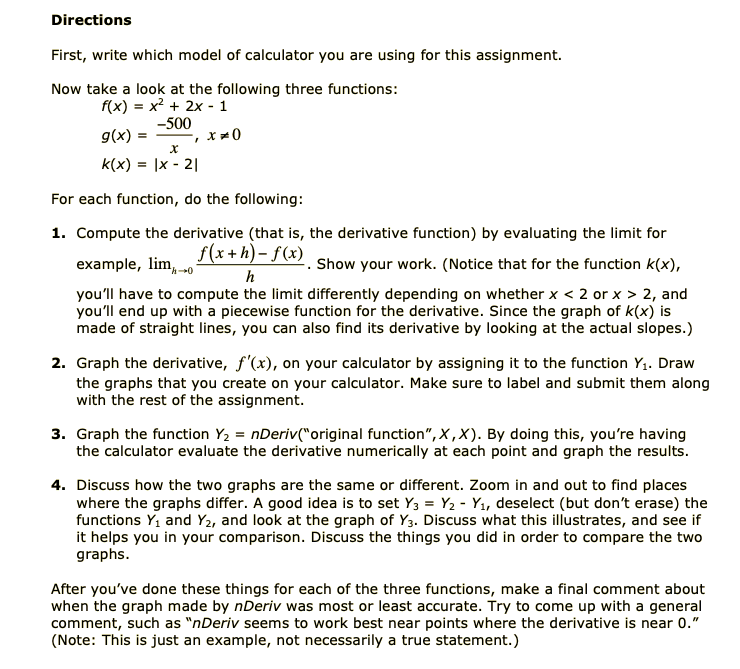
Give step-by-step solution with explanation and final answer:Directions
First, write which model of calculator you are using for this assignment.
Now take a look at the following three functions:
fx) =x + 2x1
500
900 = =, x#0
x
Kx) = 1x2]
For each function, do the following:
1. Compute the derivative (that is, the derivative function) by evaluating the limit for
h h)-
example, lim, RiGLDL Show your work. (Notice that for the function k(x),
you'll have to compute the limit differently depending on whether x < 2 or x > 2, and
you'll end up with a piecewise function for the derivative. Since the graph of k(x) is
made of straight lines, you can also find its derivative by looking at the actual slopes.)
2. Graph the derivative, f(x), on your calculator by assigning it to the function Y;. Draw
the graphs that you create on your calculator. Make sure to label and submit them along
with the rest of the assignment.
3. Graph the function ¥; = nDeriv(*original function”, X, X). By doing this, you're having
the calculator evaluate the derivative numerically at each point and graph the results.
4. Discuss how the two graphs are the same or different. Zoom in and out to find places
where the graphs differ. A good idea is to set Ys = Y; - Y;, deselect (but don't erase) the
functions Y; and ¥z, and look at the graph of Ya. Discuss what this illustrates, and see if
it helps you in your comparison. Discuss the things you did in order to compare the two
graphs.
After you've done these things for each of the three functions, make a final comment about
when the graph made by nDeriv was most or least accurate. Try to come up with a general
comment, such as “nDeriv seems to work best near points where the derivative is near 0.”
(Note: This is just an example, not necessarily a true statement.)
Question:
Give step-by-step solution with explanation and final answer:Directions
First, write which model of calculator you are using for this assignment.
Now take a look at the following three functions:
fx) =x + 2x1
500
900 = =, x#0
x
Kx) = 1x2]
For each function, do the following:
1. Compute the derivative (that is, the derivative function) by evaluating the limit for
h h)-
example, lim, RiGLDL Show your work. (Notice that for the function k(x),
you'll have to compute the limit differently depending on whether x < 2 or x > 2, and
you'll end up with a piecewise function for the derivative. Since the graph of k(x) is
made of straight lines, you can also find its derivative by looking at the actual slopes.)
2. Graph the derivative, f(x), on your calculator by assigning it to the function Y;. Draw
the graphs that you create on your calculator. Make sure to label and submit them along
with the rest of the assignment.
3. Graph the function ¥; = nDeriv(*original function”, X, X). By doing this, you're having
the calculator evaluate the derivative numerically at each point and graph the results.
4. Discuss how the two graphs are the same or different. Zoom in and out to find places
where the graphs differ. A good idea is to set Ys = Y; - Y;, deselect (but don't erase) the
functions Y; and ¥z, and look at the graph of Ya. Discuss what this illustrates, and see if
it helps you in your comparison. Discuss the things you did in order to compare the two
graphs.
After you've done these things for each of the three functions, make a final comment about
when the graph made by nDeriv was most or least accurate. Try to come up with a general
comment, such as “nDeriv seems to work best near points where the derivative is near 0.”
(Note: This is just an example, not necessarily a true statement.)
This is AI generated Response.
Asked by: gvr
Created at: 2025-06-30 12:38:42
Final Answer:
RenderedRaw Text
Did you like this answer?
Let's break down the assignment step by step for **each function** \( f(x), g(x), k(x) \).
---
## **1. Compute the Derivative Analytically**
### **Function 1: \( f(x) = x^2 + 2x - 1 \)**
#### **Step 1: Compute the Derivative**
\[
f'(x) = \lim_{h \to 0} \frac{f(x+h) - f(x)}{h}
\]
\[
f(x+h) = (x+h)^2 + 2(x+h) - 1 = x^2 + 2xh + h^2 + 2x + 2h - 1
\]
\[
f(x+h) - f(x) = (x^2 + 2xh + h^2 + 2x + 2h - 1) - (x^2 + 2x - 1) = 2xh + h^2 + 2h
\]
\[
\frac{f(x+h) - f(x)}{h} = \frac{2xh + h^2 + 2h}{h} = 2x + h + 2
\]
\[
\lim_{h \to 0} (2x + h + 2) = 2x + 2
\]
\[
\boxed{f'(x) = 2x + 2}
\]
---
### **Function 2: \( g(x) = \frac{-500}{x}, \; x \neq 0 \)**
#### **Step 1: Compute the Derivative**
\[
g'(x) = \lim_{h \to 0} \frac{g(x+h) - g(x)}{h}
\]
\[
g(x+h) = \frac{-500}{x+h}
\]
\[
\frac{g(x+h) - g(x)}{h} = \frac{\frac{-500}{x+h} - \frac{-500}{x}}{h}
= \frac{-500 \left(\frac{1}{x+h} - \frac{1}{x}\right)}{h}
= \frac{-500 \left(\frac{x - (x+h)}{x(x+h)}\right)}{h}
= \frac{-500 \left(\frac{-h}{x(x+h)}\right)}{h}
= \frac{500h}{h x(x+h)}
= \frac{500}{x(x+h)}
\]
\[
\lim_{h \to 0} \frac{500}{x(x+h)} = \frac{500}{x^2}
\]
\[
\boxed{g'(x) = \frac{500}{x^2}}
\]
---
### **Function 3: \( k(x) = |x - 2| \)**
#### **Step 1: Compute the Derivative (Piecewise)**
- For \( x > 2: \quad k(x) = x - 2 \rightarrow k'(x) = 1 \)
- For \( x < 2: \quad k(x) = -(x - 2) = -x + 2 \rightarrow k'(x) = -1 \)
- At \( x = 2 \): The left and right derivatives are \( -1 \) and \( 1 \), so the derivative **does not exist** at \( x = 2 \).
\[
k'(x) =
\begin{cases}
1, & x > 2 \\
-1, & x < 2 \\
\text{undefined}, & x = 2
\end{cases}
\]
---
## **2. Graph the Derivative**
- On your calculator, enter:
- \( Y_1 = 2X + 2 \)
- \( Y_1 = \frac{500}{X^2} \) (restrict domain to \( X \neq 0 \))
- \( Y_1 = \text{piecewise: 1 for } X > 2, -1 \text{ for } X < 2 \) (no value at \( X = 2 \))
## **3. Graph the Numerical Derivative**
- Use the calculator's `nDeriv` function:
- \( Y_2 = nDeriv(f(X), X, X) \)
- \( Y_2 = nDeriv(g(X), X, X) \)
- \( Y_2 = nDeriv(k(X), X, X) \)
## **4. Compare and Discuss**
- Plot \( Y_1 \) and \( Y_2 \) together.
- Set \( Y_3 = Y_2 - Y_1 \) and look for differences.
- Discuss where the graphs match or differ (e.g., at \( x = 2 \) for \( k(x) \), \( x = 0 \) for \( g(x) \)), and how accurate the numerical derivative is.
---
## **Summary Table**
| Function | Analytic Derivative | Notable Points |
|------------|----------------------------------|-------------------------------|
| \( f(x) \) | \( 2x + 2 \) | Linear; matches exactly |
| \( g(x) \) | \( \frac{500}{x^2} \) | Undefined at \( x = 0 \) |
| \( k(x) \) | \( 1 \) if \( x>2 \), \( -1 \) if \( x<2 \); undefined at \( x=2 \) | Sharp corner at \( x=2 \) |
---
### **Final Comment Example**
> The analytic and numerical derivatives matched very closely except at points where the derivative is undefined or changes abruptly (like at \( x = 2 \) for \( k(x) \)). The `nDeriv` function on the calculator approximates the derivative well except near discontinuities or cusps, where it may not reflect the undefined nature of the derivative.
---
**If you need step-by-step calculator keystrokes, let me know which calculator model you are using!**
Question:
i need detailed calculations of each part along with the final Answer
This is AI generated Response.
Asked by: gvr
Created at: 2025-06-30 12:39:58
Final Answer:
RenderedRaw Text
Did you like this answer?
Certainly! Let's go through each function step-by-step, showing detailed calculations, and then summarize the final answers.
---
### **Function 1: \( f(x) = x^2 + 2x - 1 \)**
#### **Step 1: Compute the derivative \( f'(x) \) using the limit definition**
\[
f'(x) = \lim_{h \to 0} \frac{f(x+h) - f(x)}{h}
\]
Calculate \( f(x+h) \):
\[
f(x+h) = (x+h)^2 + 2(x+h) - 1
\]
Expand:
\[
(x+h)^2 = x^2 + 2xh + h^2
\]
\[
2(x+h) = 2x + 2h
\]
So,
\[
f(x+h) = x^2 + 2xh + h^2 + 2x + 2h - 1
\]
Now, subtract \( f(x) = x^2 + 2x - 1 \):
\[
f(x+h) - f(x) = (x^2 + 2xh + h^2 + 2x + 2h - 1) - (x^2 + 2x - 1)
\]
Simplify:
\[
= 2xh + h^2 + 2h
\]
Divide by \( h \):
\[
\frac{f(x+h) - f(x)}{h} = \frac{2xh + h^2 + 2h}{h} = 2x + h + 2
\]
Take the limit as \( h \to 0 \):
\[
f'(x) = \lim_{h \to 0} (2x + h + 2) = 2x + 2
\]
**Final derivative:**
\[
\boxed{f'(x) = 2x + 2}
\]
---
### **Function 2: \( g(x) = -\frac{500}{x} \), \( x \neq 0 \)**
#### **Step 1: Compute the derivative \( g'(x) \) using the limit definition**
\[
g'(x) = \lim_{h \to 0} \frac{g(x+h) - g(x)}{h}
\]
Calculate \( g(x+h) \):
\[
g(x+h) = -\frac{500}{x+h}
\]
Subtract:
\[
g(x+h) - g(x) = -\frac{500}{x+h} - \left(-\frac{500}{x}\right) = -\frac{500}{x+h} + \frac{500}{x}
\]
Combine over a common denominator:
\[
= \frac{500}{x} - \frac{500}{x+h} = \frac{500(x+h) - 500x}{x(x+h)} = \frac{500x + 500h - 500x}{x(x+h)} = \frac{500h}{x(x+h)}
\]
Divide by \( h \):
\[
\frac{g(x+h) - g(x)}{h} = \frac{500h}{x(x+h) \cdot h} = \frac{500}{x(x+h)}
\]
Now, take the limit as \( h \to 0 \):
\[
g'(x) = \lim_{h \to 0} \frac{500}{x(x+h)} = \frac{500}{x \cdot x} = \frac{500}{x^2}
\]
**Final derivative:**
\[
\boxed{g'(x) = \frac{500}{x^2}}
\]
---
### **Function 3: \( k(x) = |x - 2| \)**
This function involves an absolute value, so the derivative depends on the sign of \( x - 2 \).
#### **Step 1: Understand the piecewise nature**
- For \( x > 2 \):
\[
k(x) = x - 2 \quad \Rightarrow \quad k'(x) = 1
\]
- For \( x < 2 \):
\[
k(x) = -(x - 2) = -x + 2 \quad \Rightarrow \quad k'(x) = -1
\]
- At \( x = 2 \):
\[
k(x) \text{ has a cusp; derivative does not exist at } x=2
\]
**Final piecewise derivative:**
\[
k'(x) =
\begin{cases}
1, & x > 2 \\
-1, & x < 2 \\
\text{undefined at } x=2
\end{cases}
\]
---
## **Summary of derivatives:**
| Function | Derivative \( f'(x) \) | Explanation |
|---|---|---|
| \( f(x) = x^2 + 2x - 1 \) | \( 2x + 2 \) | Polynomial, straightforward derivative |
| \( g(x) = -500/x \) | \( \frac{500}{x^2} \) | Power rule with negative exponent |
| \( k(x) = |x - 2| \) | piecewise \( 1 \) (for \( x>2 \)), \(-1\) (for \( x<2 \)), undefined at 2 | Absolute value function |
---
## **Next Steps:**
- **Graph each derivative**:
- For \( f'(x) = 2x + 2 \), graph a straight line.
- For \( g'(x) = 500/x^2 \), graph a positive curve approaching infinity near \( x=0 \).
- For \( k'(x) \), plot a step function with values \( 1 \) and \( -1 \), undefined at \( x=2 \).
- **Graph the numerical derivative**:
- Use the calculator's `nDeriv` function with the original functions.
- Compare the numerical results with the analytical derivatives.
- **Analysis**:
- Look for differences, especially near points where derivatives are undefined or change abruptly.
- Discuss the accuracy of `nDeriv` at various points.
---
### **Final comment example:**
> The numerical derivatives closely approximate the analytical derivatives where the functions are smooth and continuous. However, near points of discontinuity or where the derivative is undefined (e.g., at \( x=2 \) for \( k(x) \)), the `nDeriv` function may produce less accurate or undefined results. This illustrates that numerical methods are most reliable in regions where the function is smooth and well-behaved.
---
**Please specify your calculator model if you need exact keysteps for inputting these functions!**
VIPSolutions focuses on clear, step‑by‑step explanations so you can learn quickly. Whether you need an AI‑generated walkthrough or a short hint to get unstuck, each solution is organized for fast reading and easy review later.
Search similar questions, compare approaches, and bookmark the best answers for revision. Our goal is simple: quick, reliable study help that feels natural—not noisy.
 VIPSolutions
 Directions
First, write which model of calculator you are using for this assignment.
Now take a look at the following three functions:
fx) =x + 2x1
500
900 = =, x#0
x
Kx) = 1x2]
For each function, do the following:
1. Compute the derivative (that is, the derivative function) by evaluating the limit for
h h)-
example, lim, RiGLDL Show your work. (Notice that for the function k(x),
you'll have to compute the limit differently depending on whether x < 2 or x > 2, and
you'll end up with a piecewise function for the derivative. Since the graph of k(x) is
made of straight lines, you can also find its derivative by looking at the actual slopes.)
2. Graph the derivative, f(x), on your calculator by assigning it to the function Y;. Draw
the graphs that you create on your calculator. Make sure to label and submit them along
with the rest of the assignment.
3. Graph the function ¥; = nDeriv(*original function”, X, X). By doing this, you're having
the calculator evaluate the derivative numerically at each point and graph the results.
4. Discuss how the two graphs are the same or different. Zoom in and out to find places
where the graphs differ. A good idea is to set Ys = Y; - Y;, deselect (but don't erase) the
functions Y; and ¥z, and look at the graph of Ya. Discuss what this illustrates, and see if
it helps you in your comparison. Discuss the things you did in order to compare the two
graphs.
After you've done these things for each of the three functions, make a final comment about
when the graph made by nDeriv was most or least accurate. Try to come up with a general
comment, such as “nDeriv seems to work best near points where the derivative is near 0.”
(Note: This is just an example, not necessarily a true statement.)