 VIPSolutions
Give step-by-step solution with explanation and final answer:i 51. Let A and B be (n x n) matrices. Verify that N(A)NN(B) CN(A + B). i 52. Let A be an (m x r) matrix and B an (r x n) matrix. a) Show that N'(B) C N(AB). b) Show that R(AB) C R(A).
Question:
Give step-by-step solution with explanation and final answer: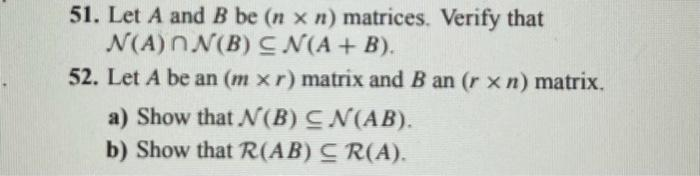 i 51. Let A and B be (n x n) matrices. Verify that
N(A)NN(B) CN(A + B).
i 52. Let A be an (m x r) matrix and B an (r x n) matrix.
a) Show that N'(B) C N(AB).
b) Show that R(AB) C R(A).
This is AI generated Response.
Asked by: gvr
Created at: 2025-06-18 04:40:32
Asked by: gvr
Created at: 2025-06-18 04:40:32
Final Answer:
Rendered
Raw Text
Did you like this answer?
Let's solve each problem step by step with explanations.
---
### **51. Let \(A\) and \(B\) be \(n \times n\) matrices. Verify that \(\mathcal{N}(A) \cap \mathcal{N}(B) \subseteq \mathcal{N}(A+B)\).**
#### **Step 1: Understand the notation**
- \(\mathcal{N}(A)\) is the null space (kernel) of \(A\): the set of all vectors \(x\) such that \(A x = 0\).
- \(\mathcal{N}(B)\) is the null space of \(B\).
- \(\mathcal{N}(A) \cap \mathcal{N}(B)\) is the set of all \(x\) such that both \(A x = 0\) and \(B x = 0\).
- \(\mathcal{N}(A+B)\) is the set of all \(x\) such that \((A+B)x = 0\).
#### **Step 2: Show the subset relation**
Let \(x \in \mathcal{N}(A) \cap \mathcal{N}(B)\).
- Then \(A x = 0\) and \(B x = 0\).
Now, consider \((A+B)x\):
\[
(A+B)x = Ax + Bx = 0 + 0 = 0
\]
So, \(x \in \mathcal{N}(A+B)\).
#### **Step 3: Conclusion**
Thus, every \(x \in \mathcal{N}(A) \cap \mathcal{N}(B)\) is also in \(\mathcal{N}(A+B)\), so:
\[
\boxed{\mathcal{N}(A) \cap \mathcal{N}(B) \subseteq \mathcal{N}(A+B)}
\]
---
### **52. Let \(A\) be an \(m \times r\) matrix and \(B\) an \(r \times n\) matrix.**
#### **(a) Show that \(\mathcal{N}(B) \subseteq \mathcal{N}(AB)\).**
- \(\mathcal{N}(B)\): Set of all \(x\) such that \(B x = 0\).
- \(AB\) is an \(m \times n\) matrix.
Let \(x \in \mathcal{N}(B)\). Then \(B x = 0\).
Now, consider \(AB x\):
\[
AB x = A (B x) = A(0) = 0
\]
So, \(x \in \mathcal{N}(AB)\).
\[
\boxed{\mathcal{N}(B) \subseteq \mathcal{N}(AB)}
\]
---
#### **(b) Show that \(\mathcal{R}(AB) \subseteq \mathcal{R}(A)\).**
- \(\mathcal{R}(AB)\): Range (column space) of \(AB\).
- \(\mathcal{R}(A)\): Range of \(A\).
Let \(y \in \mathcal{R}(AB)\). Then there exists some \(x\) such that \(y = ABx\).
But \(ABx = A(Bx)\). Let \(z = Bx\), so \(y = A z\).
Thus, \(y\) is in the range of \(A\).
\[
\boxed{\mathcal{R}(AB) \subseteq \mathcal{R}(A)}
\]
---
## **Final Answers**
**51.** \(\mathcal{N}(A) \cap \mathcal{N}(B) \subseteq \mathcal{N}(A+B)\)
**52.**
(a) \(\mathcal{N}(B) \subseteq \mathcal{N}(AB)\)
(b) \(\mathcal{R}(AB) \subseteq \mathcal{R}(A)\)
Question:
i need detailed calculations of each part along with the final Answer
This is AI generated Response.
Asked by: gvr
Created at: 2025-06-18 04:41:48
Asked by: gvr
Created at: 2025-06-18 04:41:48
Final Answer:
Rendered
Raw Text
Did you like this answer?
Certainly! Let's go through each part in detail, including step-by-step explanations and calculations where relevant.
---
## **Problem 51**
**Claim:** For square matrices \(A, B \in \mathbb{R}^{n \times n}\), show that:
\[
\mathcal{N}(A) \cap \mathcal{N}(B) \subseteq \mathcal{N}(A + B)
\]
---
### **Step-by-step Solution:**
### **Step 1: Recall definitions**
- \(\mathcal{N}(A) = \{ x \in \mathbb{R}^n \mid A x = 0 \}\)
- \(\mathcal{N}(B) = \{ x \in \mathbb{R}^n \mid B x = 0 \}\)
- \(\mathcal{N}(A + B) = \{ x \in \mathbb{R}^n \mid (A + B) x = 0 \}\)
---
### **Step 2: Take an arbitrary vector in the intersection**
Let \(x \in \mathcal{N}(A) \cap \mathcal{N}(B)\).
This means:
\[
A x = 0 \quad \text{and} \quad B x = 0
\]
---
### **Step 3: Check whether \(x\) belongs to \(\mathcal{N}(A + B)\)**
Calculate:
\[
(A + B) x = A x + B x
\]
Since \(A x = 0\) and \(B x = 0\):
\[
(A + B) x = 0 + 0 = 0
\]
Thus, \(x \in \mathcal{N}(A + B)\).
---
### **Step 4: Conclusion**
Because our choice of \(x\) was arbitrary in \(\mathcal{N}(A) \cap \mathcal{N}(B)\), and we showed that such \(x\) is in \(\mathcal{N}(A + B)\), it follows that:
\[
\boxed{\mathcal{N}(A) \cap \mathcal{N}(B) \subseteq \mathcal{N}(A + B)}
\]
---
## **Problem 52**
Given matrices:
- \(A\) of size \(m \times r\),
- \(B\) of size \(r \times n\).
---
### **Part (a): Show that \(\mathcal{N}(B) \subseteq \mathcal{N}(AB)\).**
---
### **Step 1: Understand the null spaces**
- \(\mathcal{N}(B) = \{ x \in \mathbb{R}^n \mid B x = 0 \}\)
- \(A B\) is an \(m \times n\) matrix, so:
\[
\mathcal{N}(A B) = \{ x \in \mathbb{R}^n \mid (A B) x = 0 \}
\]
---
### **Step 2: Take an arbitrary vector in \(\mathcal{N}(B)\)**
Let \(x \in \mathcal{N}(B)\):
\[
B x = 0
\]
---
### **Step 3: Compute \(A B x\)**
\[
A B x = A (B x) = A (0) = 0
\]
Thus, \(x \in \mathcal{N}(A B)\).
---
### **Step 4: Conclude the subset relation**
Since the choice of \(x\) was arbitrary in \(\mathcal{N}(B)\), we have:
\[
\boxed{\mathcal{N}(B) \subseteq \mathcal{N}(A B)}
\]
---
### **Part (b): Show that \(\mathcal{R}(A B) \subseteq \mathcal{R}(A)\).**
---
### **Step 1: Understand the ranges**
- \(\mathcal{R}(A B) = \{ y \in \mathbb{R}^m \mid y = A B x \text{ for some } x \in \mathbb{R}^n \}\)
- \(\mathcal{R}(A) = \{ y \in \mathbb{R}^m \mid y = A z, z \in \mathbb{R}^r \}\)
---
### **Step 2: Take an arbitrary vector in \(\mathcal{R}(A B)\)**
Let \(y \in \mathcal{R}(A B)\). Then:
\[
\exists x \in \mathbb{R}^n \quad \text{such that} \quad y = A B x
\]
Define:
\[
z := B x
\]
Since \(z \in \mathbb{R}^r\), then:
\[
y = A z
\]
This shows that \(y\) is in the range of \(A\).
---
### **Step 3: Final conclusion**
Because the above argument holds for any \(y \in \mathcal{R}(A B)\), we have:
\[
\boxed{\mathcal{R}(A B) \subseteq \mathcal{R}(A)}
\]
---
## **Summary of Final Answers**
\[
\boxed{
\begin{aligned}
&\text{51.} \quad \mathcal{N}(A) \cap \mathcal{N}(B) \subseteq \mathcal{N}(A + B) \\
&\text{52.} \quad
\begin{cases}
\text{(a)} \quad \mathcal{N}(B) \subseteq \mathcal{N}(A B) \\
\text{(b)} \quad \mathcal{R}(A B) \subseteq \mathcal{R}(A)
\end{cases}
\end{aligned}
}
\]
These inclusions follow directly from the definitions and properties of null spaces and ranges of linear transformations/matrices.
📢 Instructions:
- Ask anything relatd to above question only.
- For new Question goto :