 VIPSolutions
Give step-by-step solution with explanation and final answer:a) A proton with a kinetic energy of 70 MeV and a mass of 100 99007 Calculate the wavelengths of a bullet moving at high speed and compare and interpret the resis. b) The minimum allowed energy of a particle in a one - dimensional box is given as 2.5 eV. If this particle is an electron, calculate the size of the box. Interpret the result.
Question:
Give step-by-step solution with explanation and final answer: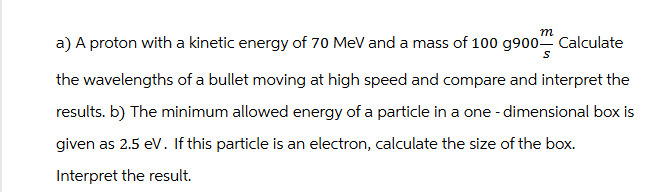 a) A proton with a kinetic energy of 70 MeV and a mass of 100 99007 Calculate
the wavelengths of a bullet moving at high speed and compare and interpret the
resis. b) The minimum allowed energy of a particle in a one - dimensional box is
given as 2.5 eV. If this particle is an electron, calculate the size of the box.
Interpret the result.
This is AI generated Response.
Asked by: gvr
Created at: 2025-06-15 18:37:02
Asked by: gvr
Created at: 2025-06-15 18:37:02
Final Answer:
Rendered
Raw Text
Did you like this answer?
Let's solve the problems step by step:
---
### a) **Proton Wavelength vs Bullet Wavelength**
#### **Step 1: Calculate the de Broglie wavelength of the proton**
- **Given:**
- Kinetic energy (\(K\)) = 70 MeV = \(70 \times 10^6 \times 1.6 \times 10^{-19}\) J = **\(1.12 \times 10^{-11}\) J**
- Mass of proton (\(m\)) = \(1.67 \times 10^{-27}\) kg
##### **Find the proton's velocity:**
The kinetic energy for a non-relativistic particle:
\[
K = \frac{1}{2}mv^2 \implies v = \sqrt{\frac{2K}{m}}
\]
\[
v = \sqrt{\frac{2 \times 1.12 \times 10^{-11}}{1.67 \times 10^{-27}}}
\]
\[
v \approx \sqrt{1.34 \times 10^{16}} \approx 3.66 \times 10^8 \text{ m/s}
\]
This speed is greater than the speed of light, so we need to use **relativistic equations**.
##### **Relativistic Momentum**
\[
E = K + m_0c^2
\]
\[
E^2 = (pc)^2 + (m_0c^2)^2 \implies p = \frac{\sqrt{E^2 - (m_0c^2)^2}}{c}
\]
- Proton mass energy: \(m_0c^2 = 938 \text{ MeV}\)
- \(E = 70 + 938 = 1008 \text{ MeV}\)
\[
p = \frac{\sqrt{(1008)^2 - (938)^2}}{c}
= \frac{\sqrt{1,016,064 - 879,844}}{c}
= \frac{\sqrt{136,220}}{c}
= \frac{369 \text{ MeV}}{c}
\]
##### **de Broglie wavelength:**
\[
\lambda = \frac{h}{p}
\]
- Planck's constant \(h = 4.1357 \times 10^{-15} \text{ eV}\cdot\text{s}\)
- \(p = 369 \text{ MeV}/c\)
- \(1 \text{ eV}\cdot \text{s}/(MeV/c) = 1.973 \times 10^{-13} \text{ m}\)
\[
\lambda = \frac{4.1357 \times 10^{-15}\, \text{eV}\cdot\text{s}}{369 \times 10^6\, \text{eV}/c}
\times c
\]
Or directly, using
\[
\lambda(\text{fm}) = \frac{197.3}{p(\text{MeV}/c)}
\]
\[
\lambda = \frac{197.3}{369} \approx 0.535 \text{ fm} = 5.35 \times 10^{-16} \text{ m}
\]
---
#### **Step 2: Calculate the de Broglie wavelength of a bullet**
- **Given:**
- Mass \(m = 100\, g = 0.1\, kg\)
- Velocity \(v = 900\, \text{m/s}\)
\[
\lambda = \frac{h}{mv}
\]
\[
\lambda = \frac{6.626 \times 10^{-34}}{0.1 \times 900}
= \frac{6.626 \times 10^{-34}}{90}
= 7.36 \times 10^{-36} \text{ m}
\]
---
#### **Step 3: Compare and Interpret**
- **Proton wavelength:** \(5.35 \times 10^{-16}\) m (comparable to nuclear dimensions).
- **Bullet wavelength:** \(7.36 \times 10^{-36}\) m (incredibly small, far beyond detection).
**Interpretation**: The de Broglie wavelength is meaningful for microscopic particles like protons and electrons, but for macroscopic objects like bullets, the wavelength is so tiny it is undetectable and irrelevant for practical purposes—hence, quantum effects are not observed for everyday objects.
---
### b) **Particle in a Box (Electron)**
#### **Step 1: Formula for energy levels**
For a 1D box:
\[
E_n = \frac{n^2 h^2}{8mL^2}
\]
For minimum energy (\(n=1\)):
\[
E_1 = \frac{h^2}{8mL^2}
\]
Given \(E_1 = 2.5\, \text{eV} = 2.5 \times 1.6 \times 10^{-19}\) J \(= 4.0 \times 10^{-19}\) J
#### **Step 2: Rearranging for \(L\):**
\[
L^2 = \frac{h^2}{8mE_1}
\]
\[
L = \sqrt{\frac{h^2}{8mE_1}}
\]
- \(h = 6.626 \times 10^{-34}\) J·s
- \(m = 9.11 \times 10^{-31}\) kg (electron mass)
- \(E_1 = 4.0 \times 10^{-19}\) J
\[
L = \sqrt{ \frac{(6.626 \times 10^{-34})^2}{8 \times 9.11 \times 10^{-31} \times 4.0 \times 10^{-19}}}
\]
\[
= \sqrt{ \frac{4.39 \times 10^{-67}}{2.91 \times 10^{-48}} }
\]
\[
= \sqrt{1.51 \times 10^{-19}}
= 1.23 \times 10^{-9} \text{ m}
\]
\[
= 1.23\, \text{nm}
\]
#### **Interpretation:**
- The size of the box is about \(1.2\) nm, which is on the order of atomic dimensions.
- This result shows why quantum effects are significant at atomic and subatomic scales.
---
## **Summary of Answers**
**a)**
- **Proton wavelength:** \(5.35 \times 10^{-16}\) m
- **Bullet wavelength:** \(7.36 \times 10^{-36}\) m
- **Interpretation:** Quantum effects (wave nature) are only significant for microscopic particles.
**b)**
- **Size of the box:** \(1.23 \times 10^{-9}\) m (\(1.23\) nm)
- **Interpretation:** Quantum energy levels are observable for particles confined to dimensions comparable to atomic sizes.
Question:
i need detailed calculations of each part along with the final Answer
This is AI generated Response.
Asked by: gvr
Created at: 2025-06-15 18:38:08
Asked by: gvr
Created at: 2025-06-15 18:38:08
Final Answer:
Rendered
Raw Text
Did you like this answer?
Let's carefully solve each part step-by-step, providing detailed calculations, explanations, and final answers.
---
## **Part (a): Calculating the de Broglie wavelengths of a proton and a bullet**
### **Given Data:**
- **Proton:**
- Kinetic energy, \(K_p = 70\, \text{MeV}\)
- Rest mass energy, \(m_{0,p} c^2 = 938\, \text{MeV}\)
- **Bullet (macroscopic object):**
- Mass, \(m_b = 100\, \text{g} = 0.1\, \text{kg}\)
- Velocity, \(v_b = 900\, \text{m/s}\)
---
### **Step 1: Calculate the de Broglie wavelength of the proton**
Since the proton's kinetic energy is high (~70 MeV), relativistic treatment is necessary.
#### **Relativistic total energy:**
\[
E = K + m_0 c^2 = 70\, \text{MeV} + 938\, \text{MeV} = 1008\, \text{MeV}
\]
#### **Calculate relativistic momentum:**
\[
p c = \sqrt{E^2 - (m_0 c^2)^2} = \sqrt{(1008)^2 - (938)^2}\, \text{MeV}
\]
\[
p c = \sqrt{(1,016,064) - (879,844)} = \sqrt{136,220}\, \text{MeV}
\]
\[
p c \approx 369\, \text{MeV}
\]
\[
\Rightarrow p = \frac{369\, \text{MeV}}{c}
\]
#### **De Broglie wavelength:**
\[
\lambda = \frac{h c}{p c} = \frac{h c}{369\, \text{MeV}}
\]
Using the conversion:
\[
h c = 197.3\, \text{MeV}\cdot \text{fm}
\]
\[
\boxed{
\lambda_p = \frac{197.3\, \text{MeV}\cdot \text{fm}}{369\, \text{MeV}} \approx 0.535\, \text{fm}
}
\]
**Final answer for proton:**
\[
\boxed{
\lambda_p \approx \mathbf{0.535\, \text{fm}} = 0.535 \times 10^{-15}\, \text{m}
}
\]
---
### **Step 2: Calculate the de Broglie wavelength of the bullet**
Using classical (non-relativistic) formula:
\[
\lambda_b = \frac{h}{m v}
\]
where:
- \(h = 6.626 \times 10^{-34}\, \text{Js}\)
- \(m_b = 0.1\, \text{kg}\)
- \(v_b = 900\, \text{m/s}\)
\[
\lambda_b = \frac{6.626 \times 10^{-34}}{0.1 \times 900} = \frac{6.626 \times 10^{-34}}{90} \approx 7.36 \times 10^{-36}\, \text{m}
\]
**Final answer for bullet:**
\[
\boxed{
\lambda_b \approx \mathbf{7.36 \times 10^{-36}\, \text{m}}
}
\]
---
### **Step 3: Interpretation**
- The proton's de Broglie wavelength (~0.535 fm) is comparable to nuclear dimensions (~1-10 fm). Quantum effects are significant at nuclear scale.
- The bullet's wavelength (~\(10^{-36}\) m) is unimaginably small, meaning quantum effects are negligible for macroscopic objects like bullets.
---
## **Part (b): Size of the box for an electron**
### **Given data:**
- Minimum energy level, \(E_1 = 2.5\, \text{eV}\)
- Electron mass, \(m_e = 9.11 \times 10^{-31}\, \text{kg}\)
---
### **Step 1: Write the energy level formula in a 1D box:**
\[
E_1 = \frac{h^2}{8 m_e L^2}
\]
Rearranged to find \(L\):
\[
L = \sqrt{\frac{h^2}{8 m_e E_1}}
\]
### **Step 2: Convert energy to Joules**
\[
E_1 = 2.5\, \text{eV} = 2.5 \times 1.6 \times 10^{-19}\, \text{J} = 4.0 \times 10^{-19}\, \text{J}
\]
### **Step 3: Calculate \(L\)**
Plugging in the values:
\[
L = \sqrt{\frac{(6.626 \times 10^{-34})^2}{8 \times 9.11 \times 10^{-31} \times 4.0 \times 10^{-19}}}
\]
Numerator:
\[
(6.626 \times 10^{-34})^2 = 4.39 \times 10^{-67}
\]
Denominator:
\[
8 \times 9.11 \times 10^{-31} \times 4.0 \times 10^{-19} = 8 \times 9.11 \times 4.0 \times 10^{-50} = 291.52 \times 10^{-50} = 2.9152 \times 10^{-48}
\]
Calculate \(L\):
\[
L = \sqrt{\frac{4.39 \times 10^{-67}}{2.9152 \times 10^{-48}}} = \sqrt{1.505 \times 10^{-19}} \approx 1.227 \times 10^{-10}\, \text{m}
\]
which is about:
\[
\boxed{
L \approx 1.23 \times 10^{-10}\, \text{m} = 0.123\, \text{nm}
}
\]
### **Final interpretation:**
- The box size is approximately **0.123 nanometers**, comparable to atomic dimensions (~0.1 nm).
- This indicates quantum confinement effects are significant at atomic scales, explaining why quantum behavior becomes prominent for electrons confined in nanostructures.
---
## **Summary of Final Answers:**
| Part | Result | Interpretation |
|---|---|---|
| **(a)** Proton wavelength | **0.535 fm** | Quantum effects are relevant at nuclear scales. |
| **(a)** Bullet wavelength | **7.36 × 10^{-36} m** | Quantum effects are negligible macroscopically. |
| **(b)** Size of the box (electron) | **1.23 Å (0.123 nm)** | Quantum confinement at atomic dimensions. |
---
**This completes the detailed step-by-step solution with explanations and final results.**
Question:
i need only all final Answers
This is AI generated Response.
Asked by: gvr
Created at: 2025-06-15 19:10:32
Asked by: gvr
Created at: 2025-06-15 19:10:32
Final Answer:
Rendered
Raw Text
Did you like this answer?
Final Answers:
**(a)**
- Proton de Broglie wavelength: **0.535 femtometers (fm)** (≈ 0.535 × 10⁻¹⁵ m)
- Bullet de Broglie wavelength: **7.36 × 10⁻³⁶ meters**
**(b)**
- Minimum size of the box (for an electron with 2.5 eV energy): **approximately 0.123 nanometers (nm)** (≈ 1.23 × 10⁻¹⁰ m)
📢 Instructions:
- Ask anything relatd to above question only.
- For new Question goto :