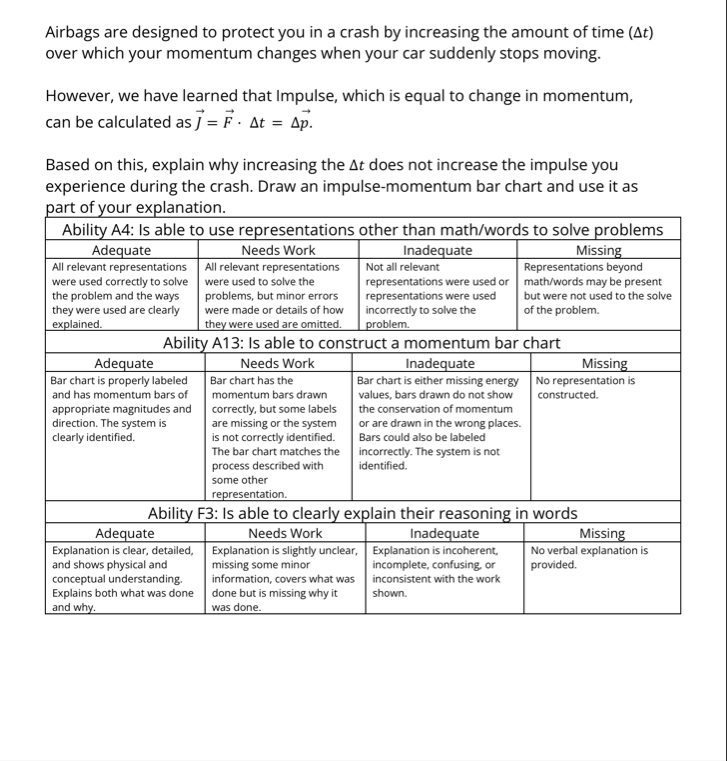
Give step-by-step solution with explanation and final answer:Airbags are designed to protect you in a crash by increasing the amount of time (Af)
over which your momentum changes when your car suddenly stops moving.
However, we have learned that Impulse, which is equal to change in momentum,
can be calculated as J = F - At = Ap.
Based on this, explain why increasing the At does not increase the impulse you
experience during the crash. Draw an impulse-momentum bar chart and use it as
part of your explanation.
Ability A4: Is able to use representations other than math/words to solve problems
NeedsWork | Inadequate | ___ Missing____|
Aireevant representations | Alreevnt representations | Nota ivan Representations beyond
were used correctly to solve. | were used to soe the representations were used or | mathwords may be present
the problem and theways | problems, but minor erors | representations were used | but were not used oth save
theywere used are ary | were made or detais of how | incorrect to solvethe | of the problem.
exiained they were used are amittes. | problem.
Ability A13: Is able to construct a momentum bar chart
NeedsWork | inadequate [| Missing |
Sar chats propery labeled | Bar chat has the Bar charts eter missing energy | No representation 5
and hos momentum bars of | momentum bars drawn | vakes, brs drawn do not show. | constructed
Spproprise magnitudes and | corecy, but some abes | te conservation of momentum
rection Ta ystems | are missing o the system | of ae craw the wrong places
early dented. i not correct dented. | Bars coud iso be labeled
The bo chart matches the | incorrectly The system not
proces descbedwith | dented.
Some other
representation
Ability F3: Is able to clearly explain their reasoning in words
NeedsWork | Inadequate | Missing |
Eipanation scar, etaied, | Expanaton'ssghty uncea, | Eanations ncoherem, | Novara explanations
and shows physical and | missing some minor incomplete, confusing. or | proved.
conceptual understanding, | information, covers what ws. | inconsistent with th work
Explains bot what was done | done buts missing why x | shown.
and wh was done.
Question:
Give step-by-step solution with explanation and final answer:Airbags are designed to protect you in a crash by increasing the amount of time (Af)
over which your momentum changes when your car suddenly stops moving.
However, we have learned that Impulse, which is equal to change in momentum,
can be calculated as J = F - At = Ap.
Based on this, explain why increasing the At does not increase the impulse you
experience during the crash. Draw an impulse-momentum bar chart and use it as
part of your explanation.
Ability A4: Is able to use representations other than math/words to solve problems
NeedsWork | Inadequate | ___ Missing____|
Aireevant representations | Alreevnt representations | Nota ivan Representations beyond
were used correctly to solve. | were used to soe the representations were used or | mathwords may be present
the problem and theways | problems, but minor erors | representations were used | but were not used oth save
theywere used are ary | were made or detais of how | incorrect to solvethe | of the problem.
exiained they were used are amittes. | problem.
Ability A13: Is able to construct a momentum bar chart
NeedsWork | inadequate [| Missing |
Sar chats propery labeled | Bar chat has the Bar charts eter missing energy | No representation 5
and hos momentum bars of | momentum bars drawn | vakes, brs drawn do not show. | constructed
Spproprise magnitudes and | corecy, but some abes | te conservation of momentum
rection Ta ystems | are missing o the system | of ae craw the wrong places
early dented. i not correct dented. | Bars coud iso be labeled
The bo chart matches the | incorrectly The system not
proces descbedwith | dented.
Some other
representation
Ability F3: Is able to clearly explain their reasoning in words
NeedsWork | Inadequate | Missing |
Eipanation scar, etaied, | Expanaton'ssghty uncea, | Eanations ncoherem, | Novara explanations
and shows physical and | missing some minor incomplete, confusing. or | proved.
conceptual understanding, | information, covers what ws. | inconsistent with th work
Explains bot what was done | done buts missing why x | shown.
and wh was done.
This is AI generated Response.
Asked by: gvr
Created at: 2025-06-18 04:44:29
Final Answer:
RenderedRaw Text
Did you like this answer?
Let's break down the step-by-step solution with the required explanations and a sketch of the impulse-momentum bar chart:
---
### **Step 1: Understanding the Physics**
- **Impulse (\(\vec{J}\))** is defined as the change in momentum (\(\Delta \vec{p}\)):
\[
\vec{J} = \vec{F} \cdot \Delta t = \Delta \vec{p}
\]
- **Airbags** increase the time (\(\Delta t\)) over which the force acts, but the initial and final momentum of the car (and thus the occupant) does **not change**—it only takes a longer time to reach zero velocity.
---
### **Step 2: Why Increasing \(\Delta t\) Does Not Change Impulse**
- The change in momentum (\(\Delta \vec{p}\)) depends only on the initial and final velocities:
\[
\Delta \vec{p} = m(v_f - v_i)
\]
- Whether you stop quickly (small \(\Delta t\)) or slowly (large \(\Delta t\)), the change in momentum is the same if you start and end at the same speeds.
- **Impulse (\(\vec{J}\))** is **always equal** to this change in momentum, regardless of how long it takes.
---
### **Step 3: Drawing the Impulse-Momentum Bar Chart**
#### **Bar Chart:**
Let's say the car (and passenger) initially moves to the right. We'll use bars to represent momentum before and after the crash.
| State | Momentum Bar (→ = right) |
|------------------------|------------------------------|
| **Before Crash** | \(\longrightarrow\) |
| **After Crash (stopped)** | (no bar; momentum is zero) |
- **Impulse bar:** Shows the change from initial to final momentum (to the left, since momentum decreases).
```
Before: |====> (initial momentum, to the right)
After: | (zero momentum, stopped)
Impulse: |<==== (equal in size to the initial, but to the left, as a change)
```
---
### **Step 4: Clear Explanation**
Airbags protect you by increasing the time (\(\Delta t\)) over which you stop, but the **impulse** (change in momentum) is the same, because you start and finish at the same speeds regardless of how long it takes. By increasing \(\Delta t\), the force (\(\vec{F}\)) experienced at any moment is reduced, because
\[
\vec{F} = \frac{\Delta \vec{p}}{\Delta t}
\]
So, **the same impulse is delivered more gently over a longer time**, reducing the risk of injury.
---
## **Final Answer:**
**Increasing the time interval (\(\Delta t\)) over which you stop does not change the impulse you experience, because impulse depends only on the total change in momentum, not the time taken. The impulse-momentum bar chart shows that your momentum changes from its initial value to zero, and the impulse is equal to this change. Airbags help by increasing the stopping time, which reduces the force you feel, but the total impulse remains the same.**
---
If you need a hand-drawn bar chart, let me know!
Question:
i need detailed calculations and explanations of each part along with the final Answer
This is AI generated Response.
Asked by: gvr
Created at: 2025-06-18 04:45:53
Final Answer:
RenderedRaw Text
Did you like this answer?
Let's analyze the problem step-by-step with detailed explanations, calculations, and a clear understanding of the physics involved.
---
### **Step 1: Understanding the Concepts**
- **Impulse (\(\vec{J}\))**: It is the product of the average force and the time over which the force acts:
\[
\vec{J} = \vec{F}_{avg} \times \Delta t
\]
- **Change in Momentum (\(\Delta \vec{p}\))**: It equals the impulse:
\[
\Delta \vec{p} = \vec{J}
\]
- **Implication**: For a given change in momentum, the impulse remains constant, regardless of the duration (\(\Delta t\)).
---
### **Step 2: Initial and Final Momentum**
Assuming the car and occupant have:
- Initial velocity: \(v_i\) (say, forward)
- Final velocity: \(v_f = 0\) (completely stopped)
Let the mass of the occupant and car combined be \(m\).
**Initial momentum:**
\[
p_i = m v_i
\]
**Final momentum:**
\[
p_f = 0
\]
**Change in momentum:**
\[
\Delta p = p_f - p_i = - m v_i
\]
(Note: Negative sign indicates momentum decreases in the initial direction.)
---
### **Step 3: Effect of Airbags (Increasing \(\Delta t\))**
- Airbags increase the **stopping time** (\(\Delta t\)), which reduces the **force** experienced at any instant:
\[
F_{avg} = \frac{\Delta p}{\Delta t}
\]
- For a **larger** \(\Delta t\), the **average force** decreases:
\[
F_{avg} \propto \frac{1}{\Delta t}
\]
- **However**, the **total impulse** (\(\Delta p\)) remains **unchanged** because it depends only on the initial and final velocities, not on the time.
---
### **Step 4: Mathematical Representation**
Suppose:
- Initial momentum: \(p_i = m v_i\)
- Final momentum: \(p_f = 0\)
- Change in momentum: \(\Delta p = - m v_i\)
The impulse delivered is:
\[
J = \Delta p = - m v_i
\]
This is **constant** regardless of \(\Delta t\).
**Force experienced at any moment:**
\[
F_{avg} = \frac{\Delta p}{\Delta t}
\]
- If \(\Delta t\) is increased, \(F_{avg}\) decreases proportionally.
- The **area** under the force vs. time graph (which is the impulse) remains the same.
---
### **Step 5: Impulse-Momentum Bar Chart**
**Description:**
- Draw a horizontal bar representing the initial momentum \(p_i\) pointing to the right.
- The final momentum \(p_f\) is zero, represented by no bar.
- The **change** in momentum (impulse) is represented by a bar of equal length but pointing in the opposite direction, illustrating the reduction from \(p_i\) to zero.
**Visual:**
```
|====> (initial momentum, to the right)
| (final momentum, zero)
<==== (impulse: change in momentum, magnitude equal to initial momentum)
```
- The **area** of the impulse bar corresponds to \(\left| \Delta p \right|\).
**Key Point:**
- The **area** under the force-time curve (force multiplied by \(\Delta t\)) equals the impulse.
- Increasing \(\Delta t\) spreads the same impulse over a longer period, decreasing the force at each instant.
---
### **Step 6: Final Explanation**
**Why increasing \(\Delta t\) does not increase the impulse:**
- Impulse depends solely on the **initial and final momentum**:
\[
\boxed{
\Delta p = m v_i - 0 = m v_i
}
\]
- The **total change in momentum** is fixed; it cannot be increased by simply increasing the stopping time.
- Increasing \(\Delta t\) **reduces** the **average force**, making the impact less severe, but the **total impulse** remains **the same**.
---
### **Final Summary:**
**Increasing the stopping time (\(\Delta t\)) during a crash does not increase the impulse experienced because impulse equals the total change in momentum, which depends only on initial and final velocities. The impulse-momentum bar chart illustrates that the magnitude of the change in momentum remains constant, regardless of how long the deceleration takes. Airbags work by increasing \(\Delta t\), thereby reducing the force felt at any instant, which helps prevent injuries, but they do not change the total impulse.**
---
**If you'd like, I can also assist you in drawing the bar chart or further clarifying any part!**
Question:
i need final Answer only
This is AI generated Response.
Asked by: gvr
Created at: 2025-06-18 04:55:52
Final Answer:
RenderedRaw Text
Did you like this answer?
Increasing the time (\(\Delta t\)) over which you stop does not increase the impulse because impulse depends solely on the change in momentum, which is determined by the initial and final velocities. No matter how long it takes to come to rest, the total change in momentum remains the same, and thus the impulse remains unchanged. Airbags increase the stopping time, reducing the force experienced at each moment, but the overall impulse (total change in momentum) stays constant.
VIPSolutions focuses on clear, step‑by‑step explanations so you can learn quickly. Whether you need an AI‑generated walkthrough or a short hint to get unstuck, each solution is organized for fast reading and easy review later.
Search similar questions, compare approaches, and bookmark the best answers for revision. Our goal is simple: quick, reliable study help that feels natural—not noisy.
 VIPSolutions
 Airbags are designed to protect you in a crash by increasing the amount of time (Af)
over which your momentum changes when your car suddenly stops moving.
However, we have learned that Impulse, which is equal to change in momentum,
can be calculated as J = F - At = Ap.
Based on this, explain why increasing the At does not increase the impulse you
experience during the crash. Draw an impulse-momentum bar chart and use it as
part of your explanation.
Ability A4: Is able to use representations other than math/words to solve problems
NeedsWork | Inadequate | ___ Missing____|
Aireevant representations | Alreevnt representations | Nota ivan Representations beyond
were used correctly to solve. | were used to soe the representations were used or | mathwords may be present
the problem and theways | problems, but minor erors | representations were used | but were not used oth save
theywere used are ary | were made or detais of how | incorrect to solvethe | of the problem.
exiained they were used are amittes. | problem.
Ability A13: Is able to construct a momentum bar chart
NeedsWork | inadequate [| Missing |
Sar chats propery labeled | Bar chat has the Bar charts eter missing energy | No representation 5
and hos momentum bars of | momentum bars drawn | vakes, brs drawn do not show. | constructed
Spproprise magnitudes and | corecy, but some abes | te conservation of momentum
rection Ta ystems | are missing o the system | of ae craw the wrong places
early dented. i not correct dented. | Bars coud iso be labeled
The bo chart matches the | incorrectly The system not
proces descbedwith | dented.
Some other
representation
Ability F3: Is able to clearly explain their reasoning in words
NeedsWork | Inadequate | Missing |
Eipanation scar, etaied, | Expanaton'ssghty uncea, | Eanations ncoherem, | Novara explanations
and shows physical and | missing some minor incomplete, confusing. or | proved.
conceptual understanding, | information, covers what ws. | inconsistent with th work
Explains bot what was done | done buts missing why x | shown.
and wh was done.