 VIPSolutions
Give step-by-step solution with explanation and final answer:Graphing Quadratic Surfaces Graph each equation by hand. Be neat. Use a ruler. 1.x2+22=9 2.4y+3z=12 x2 yr oz? 3tEte=1 4xt+yr=z x oy? oz? 55 -Tgtg =! 2 x2 gy? Era
Question:
Give step-by-step solution with explanation and final answer: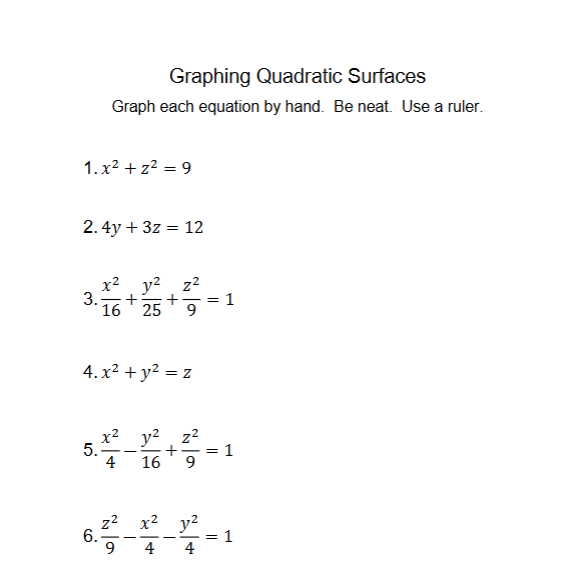 Graphing Quadratic Surfaces
Graph each equation by hand. Be neat. Use a ruler.
1.x2+22=9
2.4y+3z=12
x2 yr oz?
3tEte=1
4xt+yr=z
x oy? oz?
55 -Tgtg =!
2 x2 gy?
Era
This is AI generated Response.
Asked by: gvr
Created at: 2025-06-16 09:51:18
Asked by: gvr
Created at: 2025-06-16 09:51:18
Final Answer:
Rendered
Raw Text
Did you like this answer?
Let's go through **each equation** step by step and describe what each surface is and how you would graph it.
---
### 1. \( x^2 + z^2 = 9 \)
**Step 1:** Recognize the form.
This is the equation of a **circle** in the \(xz\)-plane with center at \((0,0)\) and radius 3.
**Step 2:** Since \(y\) does not appear, this is actually a **cylinder** extending infinitely along the \(y\)-axis.
**Graphing:**
- Draw the \(xz\)-plane.
- Draw a circle centered at the origin with radius 3.
- Indicate that this circle is extruded along the \(y\)-axis (cylinder).
---
### 2. \( 4y + 3z = 12 \)
**Step 1:** Rewrite as \( y = -\frac{3}{4}z + 3 \).
**Step 2:** This is the equation of a **plane** in three dimensions.
**Graphing:**
- The intercepts are:
- When \(y=0\): \(z=4\)
- When \(z=0\): \(y=3\)
- Plot these intercepts and draw a plane through them.
---
### 3. \( \frac{x^2}{16} + \frac{y^2}{25} + \frac{z^2}{9} = 1 \)
**Step 1:** Recognize the form.
This is the equation of an **ellipsoid** centered at the origin.
**Step 2:** The axes are:
- Along \(x\): length 4 (\(\sqrt{16}\))
- Along \(y\): length 5 (\(\sqrt{25}\))
- Along \(z\): length 3 (\(\sqrt{9}\))
**Graphing:**
- Draw an ellipse in each coordinate plane with the correct axis lengths.
- Sketch an ellipsoid shape.
---
### 4. \( x^2 + y^2 = z \)
**Step 1:** Rearranged: \(z = x^2 + y^2\)
**Step 2:** This is a **paraboloid** opening along the positive \(z\)-axis.
**Graphing:**
- At \(z=0\), point is at the origin.
- For increasing \(z\), circles of radius \(\sqrt{z}\).
- Draw a bowl-shaped surface opening upwards.
---
### 5. \( \frac{x^2}{4} - \frac{y^2}{16} + \frac{z^2}{9} = 1 \)
**Step 1:** Recognize the form.
This is a **hyperboloid of one sheet** because one variable is negative and the other two are positive.
**Step 2:** The axes are:
- Along \(x\): length 2 (\(\sqrt{4}\))
- Along \(y\): length 4 (\(\sqrt{16}\)), but negative sign means hyperbola
- Along \(z\): length 3 (\(\sqrt{9}\))
**Graphing:**
- Draw hyperbolic cross-sections in the \(xy\)-plane.
- Elliptical cross-sections in \(xz\) and \(yz\)-planes.
- Shape looks like a "saddle" or "hourglass".
---
### 6. \( \frac{z^2}{9} - \frac{x^2}{4} - \frac{y^2}{4} = 1 \)
**Step 1:** Recognize the form.
This is a **hyperboloid of two sheets** because two variables are negative and one is positive.
**Step 2:** The axes are:
- Along \(z\): length 3 (\(\sqrt{9}\))
- Along \(x\): length 2 (\(\sqrt{4}\)), negative sign
- Along \(y\): length 2 (\(\sqrt{4}\)), negative sign
**Graphing:**
- For \(|z| > 3\), real solutions exist.
- Shape: two separate "bowls" opening along the \(z\)-axis, above and below.
---
## **Summary Table**
| # | Equation | Surface Type | Key Features |
|---|----------|-------------|--------------|
| 1 | \(x^2 + z^2 = 9\) | Cylinder | Circle in \(xz\)-plane, extends in \(y\) |
| 2 | \(4y + 3z = 12\) | Plane | Linear, intercepts at \(y=3\), \(z=4\) |
| 3 | \(\frac{x^2}{16} + \frac{y^2}{25} + \frac{z^2}{9} = 1\) | Ellipsoid | Center at origin, axes: 4, 5, 3 |
| 4 | \(x^2 + y^2 = z\) | Paraboloid | Opens along \(z\)-axis |
| 5 | \(\frac{x^2}{4} - \frac{y^2}{16} + \frac{z^2}{9} = 1\) | Hyperboloid (1-sheet) | "Hourglass" shape |
| 6 | \(\frac{z^2}{9} - \frac{x^2}{4} - \frac{y^2}{4} = 1\) | Hyperboloid (2-sheets) | Two bowls, opens along \(z\) |
If you need actual hand-drawn graphs, let me know!
Question:
i need detailed calculations and explanations along with the final Answer
This is AI generated Response.
Asked by: gvr
Created at: 2025-06-16 09:53:28
Asked by: gvr
Created at: 2025-06-16 09:53:28
Final Answer:
Rendered
Raw Text
Did you like this answer?
Certainly! Let's go through each equation carefully with detailed explanations, calculations, and how you would graph each surface by hand.
---
### 1. \( x^2 + z^2 = 9 \)
**Type:** Cylinder
**Step-by-step explanation:**
- **Identify the form:**
The equation resembles a circle in the \(xz\)-plane:
\[
x^2 + z^2 = r^2
\]
with \(r^2 = 9\), so \(r=3\).
- **Interpretation:**
Since \(y\) does not appear in the equation, this describes a **cylinder** extending infinitely along the \(y\)-axis.
- **Graphing process:**
- Draw the \(xz\)-plane.
- Plot a circle centered at \((0,0)\) with radius 3:
Points like \((3,0)\), \((-3,0)\), \((0,3)\), \((0,-3)\).
- Extend this circle infinitely along the \(y\)-direction: draw lines parallel to the \(y\)-axis passing through the circle's boundary points.
- The resulting surface is a **cylinder** with a circular cross-section.
---
### 2. \( 4y + 3z = 12 \)
**Type:** Plane
**Step-by-step explanation:**
- **Rewrite the equation:**
Solve for \(y\):
\[
4y = 12 - 3z \implies y = -\frac{3}{4}z + 3
\]
- **Intercepts:**
- When \(z=0\),
\[
y = -\frac{3}{4} \times 0 + 3 = 3
\]
So point: \((x, y, z) = (\text{any } x, 3, 0)\).
- When \(y=0\),
\[
0 = -\frac{3}{4}z + 3 \implies -\frac{3}{4}z = -3 \implies z=4
\]
So point: \((x, 0, 4)\).
- **Graphing process:**
- Plot these intercept points: \((x, y, z) = (x, 3, 0)\) and \((x, 0, 4)\).
- Draw the plane passing through these points.
- The plane cuts through the space, extending infinitely in all directions.
---
### 3. \( \frac{x^2}{16} + \frac{y^2}{25} + \frac{z^2}{9} = 1 \)
**Type:** Ellipsoid
**Step-by-step explanation:**
- **Identify axes lengths:**
- Along \(x\):
\[
\frac{x^2}{16} = 1 \implies x^2 = 16 \implies x = \pm 4
\]
- Along \(y\):
\[
y^2/25=1 \implies y = \pm 5
\]
- Along \(z\):
\[
z^2/9=1 \implies z = \pm 3
\]
- **Graphing process:**
- Draw an ellipse in the \(xy\)-plane at \(z=0\) with axes 4 (along \(x\)) and 5 (along \(y\)).
- Similarly, draw ellipses in the \(xz\)- and \(yz\)-planes with the appropriate axes.
- Sketch a smooth, oval-shaped ellipsoid centered at the origin, with the axes lengths as above.
---
### 4. \( x^2 + y^2 = z \)
**Type:** Paraboloid
**Step-by-step explanation:**
- **Rearranged as:**
\[
z = x^2 + y^2
\]
- **Interpretation:**
For each fixed \(z\), the cross-section in the \(xy\)-plane is a circle of radius \(\sqrt{z}\).
- When \(z=0\), point at the origin.
- For \(z>0\), circles grow larger as \(z\) increases.
- **Graphing process:**
- Draw the \(xy\)-plane and mark the circle at \(z=0\): just the origin.
- For increasing \(z\), draw circles with radius \(\sqrt{z}\).
- Connect these in a smooth, bowl-shaped surface opening upward.
---
### 5. \( \frac{x^2}{4} - \frac{y^2}{16} + \frac{z^2}{9} = 1 \)
**Type:** Hyperboloid of one sheet
**Step-by-step explanation:**
- **Identify axes and shape:**
- \(x^2/4\): \(x\)-axis length \(\pm 2\)
- \(- y^2/16\): negative term, indicating a hyperbolic shape in \(y\)
- \(+ z^2/9\): positive, elongated along \(z\)
- **Key features:**
- Cross-sections at constant \(z\):
\[
\frac{x^2}{4} - \frac{y^2}{16} = 1 - \frac{z^2}{9}
\]
For \(|z| < 3\), the right side is positive, giving hyperbolas.
- As \(z\) increases, the hyperbolas widen.
- **Graphing process:**
- Draw hyperbolas in the \(xy\)-plane at various \(z\)-values.
- The surface looks like a "saddle" or "hourglass" shape with a central "waist" at \(z=0\).
---
### 6. \( \frac{z^2}{9} - \frac{x^2}{4} - \frac{y^2}{4} = 1 \)
**Type:** Hyperboloid of two sheets
**Step-by-step explanation:**
- **Identify axes:**
- \(z^2/9\): positive, opening along \(z\)-axis.
- \(- x^2/4\), \(- y^2/4\): negative, indicating the surface exists only for certain \(z\).
- **Key features:**
- For \(|z| > 3\), the equation holds because the left side is positive and equals 1.
- The surface consists of two separate "bowls" or sheets, above and below the plane \(z=0\).
- **Graphing process:**
- For \(z > 3\), draw the cross-section in the \(xy\)-plane:
\[
- \frac{x^2}{4} - \frac{y^2}{4} = 1 - \frac{z^2}{9}
\]
which is valid only when the RHS is positive, i.e., \(|z|>3\).
- Sketch two separate sheets opening along \(z\), symmetric about the plane \(z=0\).
---
## **Summary of Surfaces:**
| # | Equation | Surface Type | Key Features |
|---|------------------------------------------------------------|------------------------------|------------------------------|
| 1 | \(x^2 + z^2 = 9\) | Circular cylinder | Extends infinitely along \(y\) |
| 2 | \(4y + 3z = 12\) | Plane | Intercepts at \(y=3\), \(z=4\) |
| 3 | \(\frac{x^2}{16} + \frac{y^2}{25} + \frac{z^2}{9} = 1\) | Ellipsoid | Centered at origin with axes 4,5,3 |
| 4 | \(z = x^2 + y^2\) | Paraboloid | Bowl shape opening upward |
| 5 | \(\frac{x^2}{4} - \frac{y^2}{16} + \frac{z^2}{9} = 1\) | Hyperboloid (1-sheet) | "Hourglass" shape |
| 6 | \(\frac{z^2}{9} - \frac{x^2}{4} - \frac{y^2}{4} = 1\) | Hyperboloid (2-sheets) | Two separate "bowls" along \(z\) |
---
**Final note:** When graphing by hand, start with the basic shapes:
- Draw the intercepts and cross-sections in each principal plane.
- Sketch the general surface shape, ensuring symmetry and correct axes lengths.
- Use a ruler for straight lines (planes) and smooth freehand for curved surfaces.
Feel free to ask if you'd like a visual sketch guide!
Question:
i need only final Answers
This is AI generated Response.
Asked by: gvr
Created at: 2025-06-16 10:06:09
Asked by: gvr
Created at: 2025-06-16 10:06:09
Final Answer:
Rendered
Raw Text
Did you like this answer?
Certainly! Here are the final answers for each equation:
1. **\(x^2 + z^2 = 9\)**
- Surface: **Cylinder** extending infinitely along the \(y\)-axis, with a circular cross-section of radius 3 in the \(xz\)-plane.
2. **\(4y + 3z = 12\)**
- Surface: **Plane** intersecting the axes at \(y=3\) and \(z=4\).
3. **\(\frac{x^2}{16} + \frac{y^2}{25} + \frac{z^2}{9} = 1\)**
- Surface: **Ellipsoid** centered at the origin with semi-axes 4 (x), 5 (y), and 3 (z).
4. **\(x^2 + y^2 = z\)**
- Surface: **Paraboloid** opening upward along the \(z\)-axis.
5. **\(\frac{x^2}{4} - \frac{y^2}{16} + \frac{z^2}{9} = 1\)**
- Surface: **Hyperboloid of one sheet** (hourglass shape).
6. **\(\frac{z^2}{9} - \frac{x^2}{4} - \frac{y^2}{4} = 1\)**
- Surface: **Hyperboloid of two sheets**, with two separate "bowls" opening along \(\pm z\).
These are the types and key features of each quadratic surface.
📢 Instructions:
- Ask anything relatd to above question only.
- For new Question goto :