This is AI generated Response.
Asked by: gvr
Created at: 2025-06-25 10:20:05
Final Answer:
RenderedRaw Text
Did you like this answer?
Let's solve each part step by step:
---
### **Part 1**
Given:
- At 1 m from the charge, the voltage is **9 V**.
The electric potential \( V \) from a point charge falls off as \( V \propto \frac{1}{r} \).
#### 1. What is the voltage 2 m away from the charge?
Since voltage is inversely proportional to distance:
\[
V_2 = V_1 \times \frac{r_1}{r_2} = 9 \text{ V} \times \frac{1}{2} = 4.5 \text{ V}
\]
**ANSWER:** \( 4.5 \) V
---
#### 2. What is the voltage 3 m away from the charge?
\[
V_3 = V_1 \times \frac{r_1}{r_3} = 9 \text{ V} \times \frac{1}{3} = 3 \text{ V}
\]
**ANSWER:** \( 3.0 \) V
---
### **Part 2**
#### 3. Which statement is true?
Let's analyze the options:
- **a)** At any point, the electric field is **perpendicular** to the equipotential line at that point, and it is directed toward lines of lower voltages.
- **b)** At any point, the electric field is **parallel** to the equipotential line at that point.
- **c)** At any point, the electric field is **perpendicular** to the equipotential line at that point, and it is directed toward lines of higher voltages.
**Correct statement:**
The electric field is always **perpendicular** to equipotential lines and points from higher to lower potential (voltage).
**ANSWER:** a)
---
### **Part 3**
#### 4. Which statement best describes the distribution of the equipotential lines?
- **a)** The equipotential lines are equally spaced. The distance between each line is the same for all regions in the field.
- **b)** The equipotential lines are closer together in regions where the electric field is stronger.
- **c)** The equipotential lines are closer together in regions where the electric field is weaker.
**Correct statement:**
Equipotential lines are **closer together where the electric field is stronger**, because the potential changes more rapidly in those regions.
**ANSWER:** b)
---
## **Final Answers**
**1.** \( 4.5 \) V
**2.** \( 3.0 \) V
**3.** a) At any point, the electric field is perpendicular to the equipotential line at that point, and it is directed toward lines of lower voltages.
**4.** b) The equipotential lines are closer together in regions where the electric field is stronger.
Question:
i need detailed calculations and explanation of each part along with the final Answer
This is AI generated Response.
Asked by: gvr
Created at: 2025-06-25 10:22:08
Final Answer:
RenderedRaw Text
Did you like this answer?
Certainly! Here's a detailed, step-by-step explanation for each part, including the reasoning, formulas, and calculations:
---
## **Part 1: Voltage at different distances from a point charge**
### **Understanding the concept:**
- The electric potential \( V \) due to a point charge \( Q \) at a distance \( r \) is given by:
\[
V = \frac{kQ}{r}
\]
where \( k \) is Coulomb's constant (\( 8.99 \times 10^9 \, \mathrm{Nm^2/C^2} \)).
- Since \( V \propto \frac{1}{r} \), the potential decreases with increasing distance.
### **Given:**
- Voltage at 1 m from the charge, \( V_1 = 9\, V \).
### **Question 1: What is the voltage 2 m away?**
**Step 1: Write the proportionality:**
\[
V \propto \frac{1}{r}
\]
**Step 2: Set up the ratio:**
\[
\frac{V_2}{V_1} = \frac{r_1}{r_2}
\]
where:
- \( V_1 = 9\, V \) at \( r_1 = 1\, m \),
- \( r_2 = 2\, m \),
- \( V_2 = ? \).
**Step 3: Calculate \( V_2 \):**
\[
V_2 = V_1 \times \frac{r_1}{r_2} = 9\, V \times \frac{1\, m}{2\, m} = 9\, V \times 0.5 = 4.5\, V
\]
**Final answer:** **4.5 V**
---
### **Question 2: What is the voltage 3 m away?**
**Step 1:** Use the same proportionality:
\[
V_3 = V_1 \times \frac{r_1}{r_3} = 9\, V \times \frac{1\, m}{3\, m} = 9\, V \times \frac{1}{3} = 3\, V
\]
**Final answer:** **3.0 V**
---
## **Part 2: Relationship between electric field and equipotential lines**
### **Understanding:**
- **Electric field \( \vec{E} \)** points in the direction of decreasing potential.
- **Equipotential lines** are lines where the potential \( V \) is constant.
- The electric field is **perpendicular** to these lines.
- The magnitude of the electric field relates to how rapidly the potential changes with distance.
### **Question 3: Which statement is true?**
Let's analyze each option:
**a)** *"At any point, the electric field is perpendicular to the equipotential line at that point, and it is directed toward lines of lower voltages."*
- **True.** The electric field always points from higher to lower potential and is perpendicular to equipotential lines.
**b)** *"At any point, the electric field is parallel to the equipotential line at that point."*
- **False.** Electric field is perpendicular, not parallel, to equipotential lines.
**c)** *"At any point, the electric field is perpendicular to the equipotential line at that point, and it is directed toward lines of higher voltages."*
- **False.** Electric field points **toward lower voltages**, not higher.
**Final answer:** **a)**
---
## **Part 3: Distribution of equipotential lines**
### **Understanding:**
- The potential difference between two equipotential lines is constant (e.g., 3 V).
- The spacing of these lines indicates the strength of the electric field:
- **Closer lines** mean a **stronger electric field**.
- **Farther lines** mean a **weaker electric field**.
### **Question 4: Which statement best describes the distribution?**
**a)** *"The equipotential lines are equally spaced. The distance between each line is the same for all regions."*
- **False.** In fields with non-uniform strength, spacing varies.
**b)** *"The equipotential lines are closer together in regions where the electric field is stronger."*
- **True.** The closer the lines, the stronger the electric field.
**c)** *"The equipotential lines are closer together in regions where the electric field is weak."*
- **False.** Closer spacing indicates stronger fields.
**Final answer:** **b)**
---
# **Summary of Final Answers:**
| Part | Question | Final Answer | Explanation |
|---------|-------------------------|-------------------|----------------------------------------------------------|
| 1 | Voltage at 2 m from charge | **4.5 V** | Voltage inversely proportional to distance \( V \propto 1/r \). |
| 2 | Voltage at 3 m from charge | **3.0 V** | Same proportionality, \( V \propto 1/r \). |
| 3 | Electric field and equipotential lines | **a)** | Electric field is perpendicular and points toward lower potential lines. |
| 4 | Distribution of equipotential lines | **b)** | Lines are closer in regions of stronger electric field. |
---
Feel free to ask if you'd like further clarification or more detailed derivations!
VIPSolutions focuses on clear, step‑by‑step explanations so you can learn quickly. Whether you need an AI‑generated walkthrough or a short hint to get unstuck, each solution is organized for fast reading and easy review later.
Search similar questions, compare approaches, and bookmark the best answers for revision. Our goal is simple: quick, reliable study help that feels natural—not noisy.
 VIPSolutions
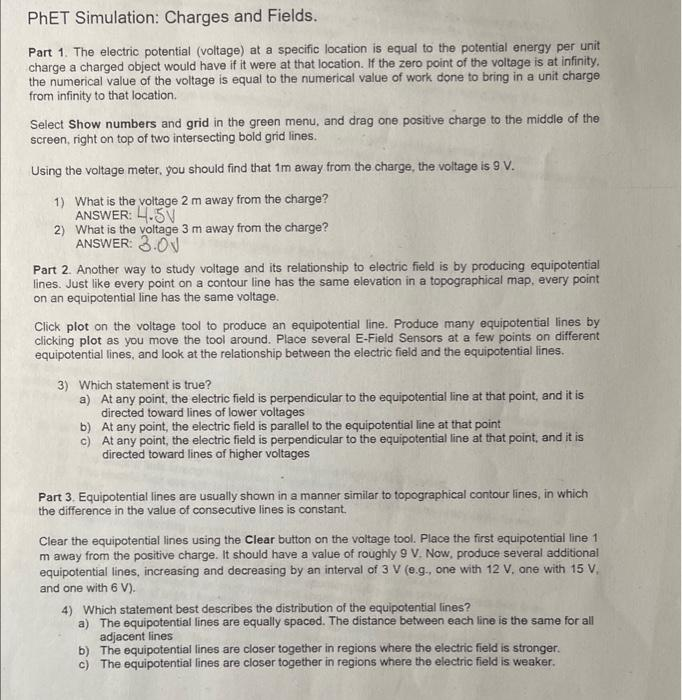 PhET Simulation: Charges and Fields. Ek
Part 1. The electric potential (voltage) at a specific location is equal to the potential energy per unit
charge a charged object would have if it were at that location. If the zero paint of the voltage is at infinity, 3
the numerical value of the voltage s equal to the numerical value of work Gone fo bring in @ unit charge
from infinity to that location
Select Show numbers and grid in the green menu, and drag one positive charge to the middle of the
screon. right on top of two intersecting bold grid fines.
Using the voltage meter, ou should find that 1m away fom the charge, the voltage is OV.
1) Whats the voltage 2 m away from the charge?
ANSWER: LI.5\|
2) Whatis the yotage 3m away from the charge?
ANSWER: 3.0)
Part 2. Another way to study voltage and its relationship to electric fied is by producing equipotental
lines. Just like every paint on a contour line has the same elevation in a topographical map, every point
on an equipotenial ine has the same voltage.
Click plot on the voltage tool to produce an equipotential fine. Produce many equipotent lines by
clicking plot as you move the tool around. Place several E-Field Sensors at a few points on different!
‘squipotential ines, and look at the relationship between the electric field and the equipotential fines.
3) Which statement is true?
a) At any point, the electric fied is perpendicular to the equipotentil fine at that point, and tis.
directed toward ines of lower voltages
b) At any point, the siectic field is parallel to the equipotential ine at that point
©) Atany point the electric fek is perpendicular to the equipotential ine at that point. and itis
directed toward fines of higher voltages.
Part 3. Equipotential lines ara usually shown in @ manner similar fo topographical contour fines, in which
the difference in the valus of consecutive nes is constant.
Clear the squipotential ines using the Clear button on the voltage tool. Plac the first squipotantial ne 1
m away from the positive charge. It should have a value of roughiy § V. Now, produce several additional
eauipotential ines, increasing and decraasing by an interval of 3 V (0.g., one with 12 V, ane with 15 V,
and one with 6).
4) Which statement best describes the distributn of the equipatenial ines?
a) The equipotentia ines are equally spaced. The distance between each ine is the same for all
adjacent ines
b) Tne squipotential lines are closer together in ragions Whar the sieciric fields stronger.
2) The squipotentia ines are closer together in regions wher the electric fiekd Is weak.