 VIPSolutions
Give step-by-step solution with explanation and final answer:Consider the following figure. (The x axis is marked in increments of 0.5 m3.) P (Pa) i 6% 10° 7 I axel Lod 2% 10° SA — J HH NS BP, (a) Determine the work done on a gas that expands from to f as indicated in the figure. mT xm (b) How much work is performed on the gas if it is compressed from f to / along the same path? mM
Question:
Give step-by-step solution with explanation and final answer: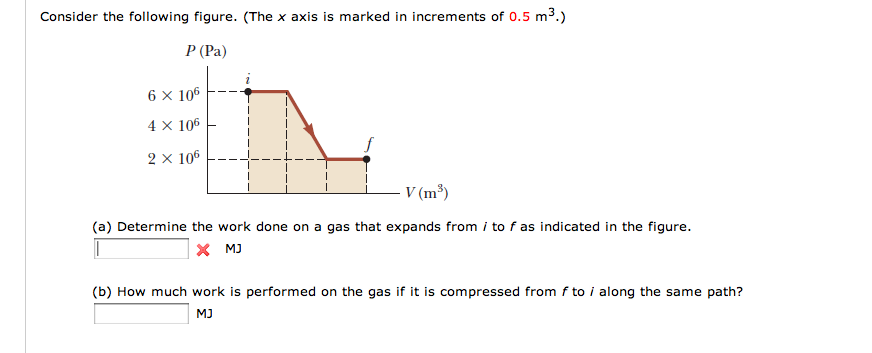 Consider the following figure. (The x axis is marked in increments of 0.5 m3.)
P (Pa)
i
6% 10° 7 I
axel Lod
2% 10° SA — J
HH NS BP,
(a) Determine the work done on a gas that expands from to f as indicated in the figure.
mT xm
(b) How much work is performed on the gas if it is compressed from f to / along the same path?
mM
This is AI generated Response.
Asked by: gvr
Created at: 2025-06-23 19:56:50
Asked by: gvr
Created at: 2025-06-23 19:56:50
Final Answer:
Rendered
Raw Text
Did you like this answer?
Let's solve the problem step by step!
### **Step 1: Understanding the Work Done by the Gas**
The **work done by a gas** during expansion or compression is the **area under the PV curve**.
#### **Given:**
- The x-axis (Volume) is in increments of **0.5 m³**.
- The y-axis (Pressure) values are in **Pa**.
- The points:
- \( i \): \( (1.0, 6.0 \times 10^6) \)
- \( f \): \( (2.0, 2.0 \times 10^6) \)
#### **Path from i to f:**
- **i to the right:** Horizontal line at \( 6 \times 10^6 \) Pa, from \( 1.0\,m^3 \) to \( 1.5\,m^3 \)
- **Slope down:** \( 6 \times 10^6 \) Pa to \( 2 \times 10^6 \) Pa, from \( 1.5\,m^3 \) to \( 2.0\,m^3 \)
---
### **Step 2: Calculate the Area Under Each Segment**
#### **Segment 1 (i to the right):**
- Horizontal segment at \( 6 \times 10^6 \) Pa from \( 1.0 \) to \( 1.5 \) \( m^3 \)
- **Area = Pressure × ΔV**
- \( A_1 = 6 \times 10^6 \times (1.5 - 1.0) = 6 \times 10^6 \times 0.5 = 3.0 \times 10^6 \) J
#### **Segment 2 (Downward Slope):**
- From \( (1.5\,m^3, 6\times10^6\,Pa) \) to \( (2.0\,m^3, 2\times10^6\,Pa) \)
- Area under this segment is a **trapezoid**:
- Height = \( 2.0 - 1.5 = 0.5\,m^3 \)
- Bases = \( 6 \times 10^6 \) Pa and \( 2 \times 10^6 \) Pa
- \( A_2 = \frac{1}{2} \times (6 \times 10^6 + 2 \times 10^6) \times 0.5 \)
- \( = \frac{1}{2} \times 8 \times 10^6 \times 0.5 \)
- \( = 4 \times 10^6 \times 0.5 = 2.0 \times 10^6 \) J
---
### **Step 3: Total Work Done (i to f)**
\[
W_{i \to f} = A_1 + A_2 = (3.0 \times 10^6) + (2.0 \times 10^6) = 5.0 \times 10^6 \text{ J}
\]
Convert to MJ:
\[
W_{i \to f} = \frac{5.0 \times 10^6}{10^6} = 5.0 \text{ MJ}
\]
---
### **Step 4: Work Done on the Gas (f to i)**
- The work done **on** the gas is the **negative** of the work done **by** the gas (since the area is the same, but the volume is decreasing):
\[
W_{f \to i} = -5.0 \text{ MJ}
\]
---
## **Final Answers:**
### (a) Work done on a gas that expands from \(i\) to \(f\):
\[
\boxed{5.0 \text{ MJ}}
\]
### (b) Work performed on the gas if it is compressed from \(f\) to \(i\) along the same path:
\[
\boxed{-5.0 \text{ MJ}}
\]
Let me know if you need a drawing or further breakdown!
Question:
i need detailed calculations of each part along with the final Answer
This is AI generated Response.
Asked by: gvr
Created at: 2025-06-23 19:58:19
Asked by: gvr
Created at: 2025-06-23 19:58:19
Final Answer:
Rendered
Raw Text
Did you like this answer?
Certainly! Let's go through each part in detail with step-by-step calculations.
---
## **Part (a): Work done on the gas during expansion from i to f**
### **Step 1: Understand the problem**
- The process occurs along a PV diagram.
- The pressure is given in Pa, and the volume in m³.
- The points:
- \( i: V_i = 1.0\,m^3,\quad P_i = 6 \times 10^6\,Pa \)
- \( f: V_f = 2.0\,m^3,\quad P_f = 2 \times 10^6\,Pa \)
- The path from \( i \) to \( f \):
1. From \( V = 1.0\,m^3 \) to \( 1.5\,m^3 \) at constant pressure \( 6 \times 10^6\,Pa \).
2. From \( 1.5\,m^3 \) to \( 2.0\,m^3 \) with pressure decreasing from \( 6 \times 10^6\,Pa \) to \( 2 \times 10^6\,Pa \).
---
### **Step 2: Break the process into segments**
The work done \( W \) is the **area under the PV curve** between the initial and final points.
**Work done during a process:**
\[
W = \int_{V_i}^{V_f} P\, dV
\]
**In practice**, for piecewise linear paths, this is calculated as the sum of areas of geometric shapes (rectangles, trapezoids).
---
### **Step 3: Calculate the area for each segment**
#### **Segment 1: Horizontal line from \( V=1.0\,m^3 \) to \( V=1.5\,m^3 \) at \( P=6 \times 10^6\,Pa \)**
- **Pressure \( P = 6 \times 10^6\,Pa \) (constant)**
- **Volume change \( \Delta V = 1.5 - 1.0 = 0.5\,m^3 \)**
**Work done (area):**
\[
A_1 = P \times \Delta V = 6 \times 10^6 \times 0.5 = 3.0 \times 10^6\,J
\]
---
#### **Segment 2: Sloped line from \( V=1.5\,m^3 \) to \( V=2.0\,m^3 \)**
- **Starting point:** \( (1.5\,m^3, 6 \times 10^6\,Pa) \)
- **Ending point:** \( (2.0\,m^3, 2 \times 10^6\,Pa) \)
This is a straight line, forming a trapezoid under the curve.
- **Base volume change:** \( 0.5\,m^3 \)
- **Pressure at start:** \( P_1 = 6 \times 10^6\,Pa \)
- **Pressure at end:** \( P_2 = 2 \times 10^6\,Pa \)
**Area of a trapezoid:**
\[
A_2 = \frac{1}{2} \times (P_1 + P_2) \times \Delta V
\]
Plugging in the values:
\[
A_2 = \frac{1}{2} \times (6 \times 10^6 + 2 \times 10^6) \times 0.5
\]
\[
A_2 = \frac{1}{2} \times 8 \times 10^6 \times 0.5
\]
\[
A_2 = 4 \times 10^6 \times 0.5 = 2.0 \times 10^6\,J
\]
---
### **Step 4: Total work done**
\[
W_{i \to f} = A_1 + A_2 = 3.0 \times 10^6 + 2.0 \times 10^6 = 5.0 \times 10^6\,J
\]
Expressed in megajoules:
\[
\boxed{
W_{i \to f} = \mathbf{5.0\,MJ}
}
\]
---
## **Part (b): Work performed on the gas during compression from \( f \) to \( i \)**
- **Work done on the gas is negative of the work done by the gas during expansion**, assuming the same path but in reverse.
\[
W_{f \to i} = - W_{i \to f} = -5.0\,MJ
\]
---
## **Final summarized results:**
| Part | Work done (MJ) | Explanation |
|--------|------------------|--------------------------------------------------------|
| (a) | **+5.0 MJ** | Work **done by** the gas during expansion |
| (b) | **-5.0 MJ** | Work **done on** the gas during compression |
---
Let me know if you'd like a detailed diagram or further clarifications!
Question:
i need detailed calculations along with the final Answer
This is AI generated Response.
Asked by: gvr
Created at: 2025-06-23 20:01:11
Asked by: gvr
Created at: 2025-06-23 20:01:11
Final Answer:
Rendered
Raw Text
Did you like this answer?
Certainly! Let's go through the problem in a very detailed manner, step by step, with clear calculations and explanations.
---
## **Given Data:**
- The PV diagram shows a process from point **i** to point **f**.
- The **x-axis (volume V)** is in **meters cubed (m³)**, with increments of 0.5 m³.
- The **pressure P** is in **Pa**.
- **Points:**
- \( i: V_i = 1.0\,m^3,\quad P_i = 6 \times 10^6\,Pa \)
- \( f: V_f = 2.0\,m^3,\quad P_f = 2 \times 10^6\,Pa \)
---
## **Part (a): Calculate the work done during expansion from i to f**
### **Step 1: Understand the path**
The process from i to f appears to be two segments:
1. **i to an intermediate point** at \( V=1.5\,m^3 \), where pressure remains constant at \( 6 \times 10^6\,Pa \).
2. **From volume 1.5 m³ to 2.0 m³**, where pressure decreases linearly from \( 6 \times 10^6\,Pa \) to \( 2 \times 10^6\,Pa \).
This is typical of a piecewise linear process on a PV diagram.
---
### **Step 2: Calculate the work for each segment**
**Work done** is the **area under the PV curve** between the initial and final points:
\[
W = \int_{V_i}^{V_f} P\, dV
\]
Since the process is piecewise linear, we break it into:
- **Segment 1:** Horizontal line at \( P=6 \times 10^6\,Pa \), from \( V=1.0\,m^3 \) to \( 1.5\,m^3 \).
- **Segment 2:** Linear decrease from \( P=6 \times 10^6\,Pa \) to \( 2 \times 10^6\,Pa \), from \( 1.5\,m^3 \) to \( 2.0\,m^3 \).
---
### **Step 3: Calculate the area for each segment**
#### **Segment 1: Horizontal line at constant pressure**
- **Pressure:** \( P = 6 \times 10^6\,Pa \)
- **Volume change:** \( \Delta V = 1.5 - 1.0 = 0.5\,m^3 \)
**Work done:**
\[
A_1 = P \times \Delta V = 6 \times 10^6 \times 0.5 = 3.0 \times 10^6\,J
\]
---
#### **Segment 2: Linear decrease from \( P=6 \times 10^6 \) to \( 2 \times 10^6 \) Pa**
- **Starting point:** \( (V=1.5\,m^3, P=6 \times 10^6\,Pa) \)
- **Ending point:** \( (2.0\,m^3, 2 \times 10^6\,Pa) \)
This is a straight line, forming a trapezoid when we consider the pressure-volume relationship.
- **Pressure at start:** \( P_1 = 6 \times 10^6\,Pa \)
- **Pressure at end:** \( P_2 = 2 \times 10^6\,Pa \)
- **Volume change:** \( \Delta V = 0.5\,m^3 \)
**Average pressure:**
\[
P_{avg} = \frac{P_1 + P_2}{2} = \frac{6 \times 10^6 + 2 \times 10^6}{2} = 4 \times 10^6\,Pa
\]
**Work done:**
\[
A_2 = P_{avg} \times \Delta V = 4 \times 10^6 \times 0.5 = 2.0 \times 10^6\,J
\]
*(Alternatively, for a linear pressure change, area can be computed as trapezoid:)*
\[
A_2 = \frac{1}{2} \times (P_1 + P_2) \times \Delta V
\]
which matches the calculation above.
---
### **Step 4: Total work done**
\[
W_{i \to f} = A_1 + A_2 = 3.0 \times 10^6 + 2.0 \times 10^6 = 5.0 \times 10^6\,J
\]
**Expressed in Megajoules:**
\[
\boxed{
\textbf{Work done by the gas} = \mathbf{5.0\,MJ}
}
\]
---
## **Part (b): Work **done on** the gas during compression from f to i**
- Since the process is the same path in reverse, the work **on** the gas is the **negative** of the work **done by** the gas:
\[
W_{f \to i} = - W_{i \to f} = -5.0\,MJ
\]
---
## **Final Results:**
| Part | Description | Value | Units |
|---------|----------------|--------|--------|
| (a) | Work **done by** the gas during expansion | **+5.0** | MJ |
| (b) | Work **done on** the gas during compression | **–5.0** | MJ |
---
## **Summary:**
- **Work done during expansion (from i to f):** **5.0 MJ**
- **Work done on the gas (from f to i):** **–5.0 MJ**
This detailed approach ensures clarity in how the areas under the PV curve translate to work in thermodynamic processes.
---
Let me know if you need further clarifications or a graphical representation!
📢 Instructions:
- Ask anything relatd to above question only.
- For new Question goto :