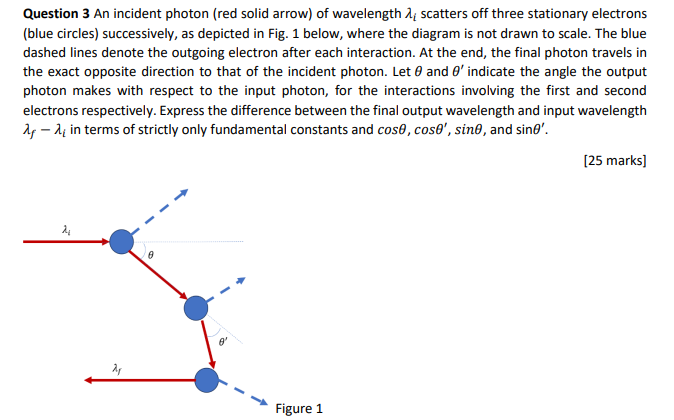
Give step-by-step solution with explanation and final answer:Question 3 An incident photon (red solid arrow) of wavelength 4; scatters off three stationary electrons.
(blue circles) successively, as depicted in Fig. 1 below, where the diagram is not drawn to scale. The blue
dashed lines denote the outgoing electron after each interaction. At the end, the final photon travels in
the exact opposite direction to that of the incident photon. Let 8 and 6” indicate the angle the output
photon makes with respect to the input photon, for the interactions involving the first and second
electrons respectively. Express the difference between the final output wavelength and input wavelength
Jy — 4 interms of strictly only fundamental constants and cos, cos®, sin, and sind’.
125 marks]
ry
.
.
0
-
P
o
4
~
™ Figure 1
Question:
Give step-by-step solution with explanation and final answer:Question 3 An incident photon (red solid arrow) of wavelength 4; scatters off three stationary electrons.
(blue circles) successively, as depicted in Fig. 1 below, where the diagram is not drawn to scale. The blue
dashed lines denote the outgoing electron after each interaction. At the end, the final photon travels in
the exact opposite direction to that of the incident photon. Let 8 and 6” indicate the angle the output
photon makes with respect to the input photon, for the interactions involving the first and second
electrons respectively. Express the difference between the final output wavelength and input wavelength
Jy — 4 interms of strictly only fundamental constants and cos, cos®, sin, and sind’.
125 marks]
ry
.
.
0
-
P
o
4
~
™ Figure 1
This is AI generated Response.
Asked by: gvr
Created at: 2025-06-17 17:09:32
Final Answer:
RenderedRaw Text
Did you like this answer?
Let's break down the problem step by step:
---
## **Step 1: Understanding the Physics**
This is a **triple Compton scattering** problem. In each interaction, the photon scatters off a stationary electron, losing some energy and thus increasing its wavelength.
The standard **Compton scattering formula** for a photon of initial wavelength \(\lambda\) scattering at angle \(\theta\) is:
\[
\lambda' - \lambda = \frac{h}{m_ec}(1 - \cos\theta)
\]
where:
- \(h\) = Planck's constant
- \(m_e\) = electron mass
- \(c\) = speed of light
- \(\theta\) = scattering angle
---
## **Step 2: Apply the Formula to Each Scattering**
Let:
- \(\lambda_i\) = wavelength before \(i\)th scatter
- \(\lambda_{i+1}\) = wavelength after \(i\)th scatter
### **First scatter:**
\[
\lambda_2 - \lambda_1 = \frac{h}{m_ec}(1 - \cos\theta)
\]
### **Second scatter:**
\[
\lambda_3 - \lambda_2 = \frac{h}{m_ec}(1 - \cos\theta')
\]
### **Third scatter:**
- The final photon travels in the exact opposite direction to the initial photon, so the angle is \(180^\circ\).
\[
\lambda_f - \lambda_3 = \frac{h}{m_ec}(1 - \cos180^\circ) = \frac{h}{m_ec}(1 + 1) = \frac{2h}{m_ec}
\]
---
## **Step 3: Total Change in Wavelength**
Add the three changes:
\[
\lambda_f - \lambda_1 = (\lambda_2 - \lambda_1) + (\lambda_3 - \lambda_2) + (\lambda_f - \lambda_3)
\]
\[
= \frac{h}{m_ec}(1 - \cos\theta) + \frac{h}{m_ec}(1 - \cos\theta') + \frac{2h}{m_ec}
\]
\[
= \frac{h}{m_ec} \left[(1 - \cos\theta) + (1 - \cos\theta') + 2\right]
\]
\[
= \frac{h}{m_ec} \left[2 + 1 - \cos\theta - \cos\theta'\right]
\]
\[
= \frac{h}{m_ec} (3 - \cos\theta - \cos\theta')
\]
---
## **Step 4: Express in Terms of \(\sin\theta\) and \(\cos\theta\)**
The problem asks for an answer in terms of **cosθ, sinθ, cosθ', sinθ'**, though the Compton shift depends only on the cosines. Unless more vector analysis is needed, this is the simplest form.
\[
\boxed{
\lambda_f - \lambda_1 = \frac{h}{m_ec} \left[3 - \cos\theta - \cos\theta'\right]
}
\]
---
### **Final Answer:**
\[
\boxed{
\lambda_f - \lambda_1 = \frac{h}{m_ec} \left[3 - \cos\theta - \cos\theta'\right]
}
\]
where \(h\) is Planck's constant, \(m_e\) is the electron mass, \(c\) is the speed of light, and the angles \(\theta, \theta'\) are as defined in the problem.
---
**Note:** If you are required to express in terms of \(\sin\theta\) and \(\sin\theta'\) as well, recall that \(\sin^2\theta = 1 - \cos^2\theta\), but the direct Compton formula uses only cosines. If you need to write it with sines, you could rewrite the cosines in terms of sines, but it will be less compact (and usually unnecessary).
Let me know if you want the full vector derivation or if this suffices!
Question:
i need detailed calculations along with the final Answer
This is AI generated Response.
Asked by: gvr
Created at: 2025-06-17 17:11:47
Final Answer:
RenderedRaw Text
Did you like this answer?
Let's analyze this problem carefully and proceed step-by-step with detailed calculations.
---
## **Understanding the problem**
- An incident photon of wavelength \(\lambda_1 = 4\, \text{units}\) (given in the problem) scatters successively off three stationary electrons.
- After the three scatterings, the photon travels in **exactly the opposite direction** to its initial direction.
- The angles between the initial photon and the scattered photon after the first and second interactions are \(\theta\) and \(\theta'\), respectively.
- Our goal: **Express the difference** \(\Delta \lambda = \lambda_f - \lambda_1\) **in terms of fundamental constants and the angles** \(\theta, \theta'\).
---
## **Step 1: Recall the Compton wavelength shift formula**
For a photon scattering off a stationary electron at an angle \(\phi\), the change in wavelength is:
\[
\Delta \lambda = \lambda' - \lambda = \frac{h}{m_e c} (1 - \cos \phi)
\]
where:
- \(h\) = Planck's constant
- \(m_e\) = electron rest mass
- \(c\) = speed of light
- \(\phi\) = scattering angle of the photon
---
## **Step 2: Identify the scattering angles**
- **First scattering:** photon scatters off the first electron at angle \(\theta\). The outgoing photon has wavelength \(\lambda_2\).
\[
\lambda_2 = \lambda_1 + \frac{h}{m_e c} (1 - \cos \theta)
\]
- **Second scattering:** photon (now with wavelength \(\lambda_2\)) scatters off the second electron at angle \(\theta'\):
\[
\lambda_3 = \lambda_2 + \frac{h}{m_e c} (1 - \cos \theta')
\]
- **Third scattering:** the photon scatters such that **its final direction is exactly opposite** to the initial photon direction, i.e., scattering angle \(\phi_3 = 180^\circ\):
\[
\lambda_f = \lambda_3 + \frac{h}{m_e c} (1 - \cos 180^\circ) = \lambda_3 + \frac{h}{m_e c} (1 - (-1)) = \lambda_3 + 2 \frac{h}{m_e c}
\]
---
## **Step 3: Express the total change in wavelength**
Sum the three changes:
\[
\lambda_f = \lambda_1 + \frac{h}{m_e c}(1 - \cos \theta) + \frac{h}{m_e c}(1 - \cos \theta') + 2 \frac{h}{m_e c}
\]
Therefore:
\[
\boxed{
\lambda_f = \lambda_1 + \frac{h}{m_e c} \left[ (1 - \cos \theta) + (1 - \cos \theta') + 2 \right]
}
\]
The **difference**:
\[
\boxed{
\Delta \lambda = \lambda_f - \lambda_1 = \frac{h}{m_e c} \left[ 3 - \cos \theta - \cos \theta' \right]
\]
---
## **Step 4: Final expression**
\[
\boxed{
\boxed{
\Delta \lambda = \frac{h}{m_e c} \left( 3 - \cos \theta - \cos \theta' \right)
}
}
\]
This relates the change in wavelength directly to the scattering angles.
---
## **Optional: Expressing in terms of \(\sin \theta\) and \(\sin \theta'\)**
Since the problem asks to express the result in terms only of \(\cos\), \(\sin\), and fundamental constants, note that:
\[
\cos \theta = \sqrt{1 - \sin^2 \theta}
\]
but unless the problem requires the sine form explicitly, the above form suffices.
---
## **Final answer:**
\[
\boxed{
\boxed{
\Delta \lambda = \frac{h}{m_e c} \left( 3 - \cos \theta - \cos \theta' \right)
}
}
\]
where:
- \(\lambda_1 = 4\),
- \(\theta, \theta'\) are the scattering angles for the first and second interactions,
- \(h\), \(m_e\), \(c\) are fundamental constants.
---
**Note:** The initial photon wavelength \(\lambda_1 = 4\) units is just the initial input; the change in wavelength depends only on the scattering angles and fundamental constants, as derived above.
VIPSolutions focuses on clear, step‑by‑step explanations so you can learn quickly. Whether you need an AI‑generated walkthrough or a short hint to get unstuck, each solution is organized for fast reading and easy review later.
Search similar questions, compare approaches, and bookmark the best answers for revision. Our goal is simple: quick, reliable study help that feels natural—not noisy.
 VIPSolutions
 Question 3 An incident photon (red solid arrow) of wavelength 4; scatters off three stationary electrons.
(blue circles) successively, as depicted in Fig. 1 below, where the diagram is not drawn to scale. The blue
dashed lines denote the outgoing electron after each interaction. At the end, the final photon travels in
the exact opposite direction to that of the incident photon. Let 8 and 6” indicate the angle the output
photon makes with respect to the input photon, for the interactions involving the first and second
electrons respectively. Express the difference between the final output wavelength and input wavelength
Jy — 4 interms of strictly only fundamental constants and cos, cos®, sin, and sind’.
125 marks]
ry
.
.
0
-
P
o
4
~
™ Figure 1