This is AI generated Response.
Asked by: gvr
Created at: 2025-06-21 06:02:33
Final Answer:
RenderedRaw Text
Did you like this answer?
Let's go **step by step** through **Question 1** using Warshall’s algorithm:
## 1. Reflexive-Transitive Closure with Warshall’s Algorithm
### **Step 1: Start with the Given Matrix**
Let the vertices be \( a, b, c, d, e \) and the given matrix \( R \) is:
\[
R = \begin{bmatrix}
0 & 1 & 0 & 0 & 0 \\
0 & 0 & 0 & 1 & 0 \\
0 & 0 & 1 & 1 & 0 \\
0 & 0 & 0 & 0 & 1 \\
0 & 1 & 0 & 1 & 1 \\
\end{bmatrix}
\]
### **Step 2: Reflexive Closure**
Add 1s on the diagonal (self-loops):
\[
R_0 = \begin{bmatrix}
1 & 1 & 0 & 0 & 0 \\
0 & 1 & 0 & 1 & 0 \\
0 & 0 & 1 & 1 & 0 \\
0 & 0 & 0 & 1 & 1 \\
0 & 1 & 0 & 1 & 1 \\
\end{bmatrix}
\]
---
### **Step 3: Warshall’s Algorithm (Transitive Closure)**
For each \( k = 1 \) to 5 (for each intermediate vertex), update \( R[i][j] = R[i][j] \) OR \( (R[i][k] \) AND \( R[k][j]) \).
Let’s go through each outer loop iteration, showing the matrix after each:
#### **Iteration \( k = 1 \) (vertex a):**
Check if a path exists from \( i \) to \( j \) through **a**.
- No new 1s are added, as all paths through a are already present.
\[
R_1 = R_0
\]
#### **Iteration \( k = 2 \) (vertex b):**
Update using paths through **b**.
- For row 1 (b): b->d exists, and d->e exists, so b->e is possible (add 1 at (1,5) if not present).
- \( R[2][4] = 1, R[4][5] = 1 \implies R[2][5] = 1 \)
So, update (1,5):
\[
R_2 = \begin{bmatrix}
1 & 1 & 0 & 0 & 0 \\
0 & 1 & 0 & 1 & 1 \\
0 & 0 & 1 & 1 & 0 \\
0 & 0 & 0 & 1 & 1 \\
0 & 1 & 0 & 1 & 1 \\
\end{bmatrix}
\]
#### **Iteration \( k = 3 \) (vertex c):**
Update using paths through **c**.
- For row 3 (c): c->d exists and d->e exists, so c->e is possible (add 1 at (3,5)).
- For row 5 (e): e->b, b->d, so e->d is possible (add 1 at (5,4)), but already there.
Update (3,5):
\[
R_3 = \begin{bmatrix}
1 & 1 & 0 & 0 & 0 \\
0 & 1 & 0 & 1 & 1 \\
0 & 0 & 1 & 1 & 1 \\
0 & 0 & 0 & 1 & 1 \\
0 & 1 & 0 & 1 & 1 \\
\end{bmatrix}
\]
#### **Iteration \( k = 4 \) (vertex d):**
Update using paths through **d**.
- For row 1 (a): a->b, b->d, d->e, so a->e is possible (add 1 at (1,5)).
- For row 1 (a): a->b, b->d, so a->d is possible (add 1 at (1,4)).
Update (1,4) and (1,5):
\[
R_4 = \begin{bmatrix}
1 & 1 & 0 & 1 & 1 \\
0 & 1 & 0 & 1 & 1 \\
0 & 0 & 1 & 1 & 1 \\
0 & 0 & 0 & 1 & 1 \\
0 & 1 & 0 & 1 & 1 \\
\end{bmatrix}
\]
#### **Iteration \( k = 5 \) (vertex e):**
Update using paths through **e**.
- No new paths are added.
\[
R_5 = R_4
\]
---
### **Final Answer:**
#### **Reflexive Closure:**
\[
\boxed{
\begin{bmatrix}
1 & 1 & 0 & 0 & 0 \\
0 & 1 & 0 & 1 & 0 \\
0 & 0 & 1 & 1 & 0 \\
0 & 0 & 0 & 1 & 1 \\
0 & 1 & 0 & 1 & 1 \\
\end{bmatrix}
}
\]
#### **After Each Pass:**
- After \( k=1 \): same as reflexive closure
- After \( k=2 \): (1,5) updated to 1
- After \( k=3 \): (3,5) updated to 1
- After \( k=4 \): (1,4) and (1,5) updated to 1
- After \( k=5 \): no change
#### **Transitive Closure:**
\[
\boxed{
\begin{bmatrix}
1 & 1 & 0 & 1 & 1 \\
0 & 1 & 0 & 1 & 1 \\
0 & 0 & 1 & 1 & 1 \\
0 & 0 & 0 & 1 & 1 \\
0 & 1 & 0 & 1 & 1 \\
\end{bmatrix}
}
\]
---
If you want to proceed with question 2, let me know!
Question:
yes please
This is AI generated Response.
Asked by: gvr
Created at: 2025-06-21 06:04:07
Final Answer:
RenderedRaw Text
Did you like this answer?
Let's proceed with **Question 2**:
### **2. Using the matrix in the previous problem, show the final result of executing Floyd's algorithm to produce a matrix containing path lengths.**
---
### **Step 1: Recall the initial matrix**
From the previous problem, the **reflexive-transitive closure** matrix (which can serve as the initial adjacency matrix for Floyd's algorithm) is:
\[
D^{(0)} = \begin{bmatrix}
0 & 1 & \infty & 1 & 1 \\
\infty & 0 & \infty & 1 & 1 \\
\infty & \infty & 0 & 1 & 1 \\
\infty & \infty & \infty & 0 & 1 \\
\infty & 1 & \infty & 1 & 0 \\
\end{bmatrix}
\]
*Note*: For Floyd's algorithm, distances are initialized as:
- 0 for diagonal entries,
- known edge weights for direct edges,
- ∞ (infinity) for no direct edge.
---
### **Step 2: Initialize the matrix**
Set the initial matrix \( D^{(0)} \):
\[
D^{(0)} = \begin{bmatrix}
0 & 1 & \infty & 1 & 1 \\
\infty & 0 & \infty & 1 & 1 \\
\infty & \infty & 0 & 1 & 1 \\
\infty & \infty & \infty & 0 & 1 \\
\infty & 1 & \infty & 1 & 0 \\
\end{bmatrix}
\]
---
### **Step 3: Floyd's Algorithm Iterations**
For each intermediate vertex \( k = 1 \) to 5, update \( D^{(k)} \):
\[
D_{ij}^{(k)} = \min \left( D_{ij}^{(k-1)}, D_{ik}^{(k-1)} + D_{kj}^{(k-1)} \right)
\]
---
### **Iteration \( k=1 \) (vertex a):**
Using vertex a as intermediate, update all \( D_{ij} \):
- Since \( D_{a,a} = 0 \), no change.
- For example, check if \( D_{b,c} \) can be minimized:
- \( D_{b,c} = \infty \)
- \( D_{b,a} + D_{a,c} = \infty + 1 = \infty \)
- Similarly, for other pairs, no change is made because the paths via a do not reduce distances further.
**Result after \( k=1 \):**
\[
D^{(1)} = D^{(0)}
\]
---
### **Iteration \( k=2 \) (vertex b):**
- Check if paths through b improve other distances:
- \( D_{a,c} \):
- \( D_{a,b} + D_{b,c} = 1 + \infty = \infty \) (no change)
- \( D_{a,e} \):
- \( D_{a,b} + D_{b,e} = 1 + 1 = 2 \)
- \( D_{a,e} \) was 1, so no update (since 1 < 2).
- \( D_{e,c} \):
- \( D_{e,b} + D_{b,c} = 1 + \infty = \infty \) (no change)
- No updates occur in this iteration.
**Result after \( k=2 \):**
\[
D^{(2)} = D^{(1)} = D^{(0)}
\]
---
### **Iteration \( k=3 \) (vertex c):**
- Check if paths through c improve distances:
- \( D_{a,c} \):
- \( D_{a,c} = \infty \), but \( D_{a,c} \) remains ∞ because no direct edge.
- \( D_{a,e} \):
- \( D_{a,c} + D_{c,e} = \infty + 1 = \infty \), no update.
- \( D_{b,e} \):
- \( D_{b,c} + D_{c,e} = \infty + 1 = \infty \), no update.
- \( D_{e,c} \):
- \( D_{e,c} \) remains ∞.
No updates.
---
### **Iteration \( k=4 \) (vertex d):**
- Check if \( D_{a,e} \) can be improved:
- \( D_{a,d} + D_{d,e} = 1 + 1 = 2 \).
- Currently, \( D_{a,e} = 1 \), so no update since 1 < 2.
- Other entries are unaffected.
---
### **Iteration \( k=5 \) (vertex e):**
- Check if paths through e improve other distances:
- \( D_{b,c} \):
- \( D_{b,e} + D_{e,c} = 1 + \infty = \infty \), no change.
- \( D_{a,b} \):
- \( D_{a,e} + D_{e,b} = 1 + 1 = 2 \), which is greater than current 1, so no update.
---
### **Final Distance Matrix:**
Since no updates occurred beyond initialization, the shortest path distances are:
\[
\boxed{
D = \begin{bmatrix}
0 & 1 & \infty & 1 & 1 \\
\infty & 0 & \infty & 1 & 1 \\
\infty & \infty & 0 & 1 & 1 \\
\infty & \infty & \infty & 0 & 1 \\
\infty & 1 & \infty & 1 & 0 \\
\end{bmatrix}
}
\]
---
### **Summary:**
- **Intermediate matrices after each iteration** (note that in this case, no updates occurred):
**After \(k=1\):**
\[
\begin{bmatrix}
0 & 1 & \infty & 1 & 1 \\
\infty & 0 & \infty & 1 & 1 \\
\infty & \infty & 0 & 1 & 1 \\
\infty & \infty & \infty & 0 & 1 \\
\infty & 1 & \infty & 1 & 0 \\
\end{bmatrix}
\]
**After \(k=2,3,4,5\):** Same as above.
---
### **Final note:**
In this particular graph, the shortest path distances match the direct edges and the existing paths, with no shorter paths found through intermediate vertices beyond the direct edges.
---
If you'd like, I can help with **Question 3** next!
Question:
yes
This is AI generated Response.
Asked by: gvr
Created at: 2025-06-21 06:05:32
Final Answer:
RenderedRaw Text
Did you like this answer?
Let's proceed with **Question 3**, which involves analyzing the graph corresponding to the matrix from Question 1, creating its condensation graph, establishing a topological order, and computing the reflexive transitive closure to identify whether it forms a total order.
---
### **3. Graph Analysis and Total Order Characteristic**
#### **Step 1: The Graph**
Vertices: \( a, b, c, d, e \)
Adjacency matrix (from previous):
\[
A = \begin{bmatrix}
0 & 1 & 0 & 0 & 0 \\
0 & 0 & 0 & 1 & 0 \\
0 & 0 & 1 & 1 & 0 \\
0 & 0 & 0 & 0 & 1 \\
0 & 1 & 0 & 1 & 1 \\
\end{bmatrix}
\]
*Note:* The matrix is based on the initial relation with self-loops (reflexivity).
---
### **Step 2: Draw the Graph**
Vertices:
- \( a \)
- \( b \)
- \( c \)
- \( d \)
- \( e \)
Edges (from the adjacency matrix):
- \( a \to b \)
- \( c \to c \) (self-loop)
- \( c \to d \)
- \( d \to e \)
- \( e \to b \)
- \( e \to d \)
- \( e \to e \) (self-loop)
---
### **Step 3: Condensation Graph**
Identify strongly connected components (SCCs):
- \( c \) forms an SCC with itself (self-loop).
- \( e \) forms an SCC with itself.
- \( a, b, d \) are not in cycles; they are singleton SCCs.
Thus, the SCCs are:
- \( C_1 = \{a\} \)
- \( C_2 = \{b\} \)
- \( C_3 = \{c\} \)
- \( C_4 = \{d\} \)
- \( C_5 = \{e\} \)
Edges between SCCs:
- \( a \to b \)
- \( c \to c \)
- \( c \to d \)
- \( e \to b \)
- \( e \to d \)
- \( e \to e \)
Condensation graph:
Vertices: \( C_1, C_2, C_3, C_4, C_5 \)
Edges:
- \( C_1 \to C_2 \)
- \( C_3 \to C_3 \)
- \( C_3 \to C_4 \)
- \( C_5 \to C_2 \)
- \( C_5 \to C_4 \)
- \( C_5 \to C_5 \)
---
### **Step 4: Topological Order**
Since SCCs \( C_3 \) and \( C_5 \) have loops (self-loops), the condensation graph contains cycles, which prevents a total topological order over the SCCs.
However, ignoring self-loops, the partial order among the SCCs is:
- \( C_3 \) (self-loop), no dependencies
- \( C_5 \) (self-loop), no dependencies
- \( C_1 \) depends on no one
- \( C_2 \) depends on \( C_1 \) (via \( a \to b \))
- \( C_4 \) depends on \( C_3 \) and \( C_5 \)
A possible topological order (ignoring SCC cycles):
\[
C_3, C_5, C_1, C_2, C_4
\]
---
### **Step 5: Create adjacency matrix in this order**
Order vertices: \( c, e, a, b, d \)
Construct the adjacency matrix \( A_{topo} \):
\[
A_{topo} =
\begin{bmatrix}
c & e & a & b & d \\
\end{bmatrix}
\]
- \( c \to c \), \( c \to d \): entries (1,1), (1,5)
- \( e \to b, d, e \): entries (2,4), (2,5), (2,2)
- \( a \to b \): (3,4)
- \( b \to \) none
- \( d \to \) none
The matrix:
\[
\begin{bmatrix}
1 & 0 & 0 & 0 & 1 \\
0 & 1 & 0 & 1 & 1 \\
0 & 0 & 0 & 1 & 0 \\
0 & 0 & 0 & 0 & 0 \\
0 & 0 & 0 & 0 & 0 \\
\end{bmatrix}
\]
---
### **Step 6: Reflexive-Transitive Closure & Total Order**
Compute the reflexive transitive closure (via Warshall’s algorithm):
- The closure indicates whether there's a path between vertices.
In this case, the matrix is:
\[
\begin{bmatrix}
1 & 1 & 0 & 1 & 1 \\
0 & 1 & 0 & 1 & 1 \\
0 & 0 & 1 & 1 & 0 \\
0 & 0 & 0 & 1 & 0 \\
0 & 0 & 0 & 0 & 1 \\
\end{bmatrix}
\]
This matrix is **not** a total order because:
- It does not compare all pairs (e.g., \( c \) and \( e \) are not comparable, as no path from \( c \) to \( e \) or vice versa).
**Characteristic indicating total order:**
- A matrix where every pair of distinct elements is comparable (i.e., for all \( i \neq j \), either \( M_{ij} = 1 \) or \( M_{ji} = 1 \)).
In our case, this is **not** true, so the relation **does not** define a total order.
---
### **Summary:**
- The condensation graph has cycles, mainly from SCCs \( c \) and \( e \).
- The ordering is **partial**, not total.
- The reflexive-transitive closure matrix shows some pairs are incomparable (neither \( i \to j \) nor \( j \to i \)), characteristic of a partial order.
---
**Would you like to proceed with Question 4?**
Question:
yes
This is AI generated Response.
Asked by: gvr
Created at: 2025-06-21 06:06:59
Final Answer:
RenderedRaw Text
Did you like this answer?
Let's proceed with **Question 4**, which involves applying Floyd's algorithm to compute the shortest path distances for a specific weighted directed graph.
---
### **Question 4: Compute the Distance Matrix Using Floyd's Algorithm**
Given the initial matrix:
\[
\begin{bmatrix}
0 & 4 & -2 \\
\text{Inf} & 23 & 6 \\
3 & 2 & 0 \\
\text{Inf} & 4 & 5 \\
0 & \text{Inf} & 0 \\
\end{bmatrix}
\]
Assuming the rows and columns correspond to vertices \( a, b, c \).
**Note:** The provided matrix seems to be a 3x3 matrix, but the description mentions a 4x3 matrix. To clarify, let's interpret it as a 3x3 matrix based on the data:
\[
W = \begin{bmatrix}
0 & 4 & -2 \\
\text{Inf} & 23 & 6 \\
3 & 2 & 0 \\
\end{bmatrix}
\]
This aligns with the description of a 3-vertex graph with weights.
---
### **Step 1: Initialize the distance matrix**
Set the initial distance matrix \( D^{(0)} \) as:
\[
D^{(0)} = W
\]
which is:
\[
\begin{bmatrix}
0 & 4 & -2 \\
\text{Inf} & 23 & 6 \\
3 & 2 & 0 \\
\end{bmatrix}
\]
---
### **Step 2: Apply Floyd's Algorithm**
We iterate over each vertex \( k \) (from 1 to 3), updating the matrix:
\[
D_{ij}^{(k)} = \min \left( D_{ij}^{(k-1)}, D_{ik}^{(k-1)} + D_{kj}^{(k-1)} \right)
\]
---
### **Iteration \( k = 1 \) (vertex \( a \))**
- For each pair \( (i,j) \), check if going through \( a \) reduces the distance.
- Since \( a \) is the first vertex (index 1), we consider:
\[
D_{ij}^{(1)} = \min \left( D_{ij}^{(0)}, D_{i a}^{(0)} + D_{a j}^{(0)} \right)
\]
Update for each \( i, j \):
- \( D_{b c} \):
\[
D_{b c} = \min(6, D_{b a} + D_{a c}) = \min(6, \text{Inf} + (-2)) = 6
\]
- \( D_{b c} \): no change because \( D_{b a} = \text{Inf} \).
- \( D_{b c} \) remains 6.
- \( D_{b c} \) remains unchanged for other pairs.
- For pairs involving \( a \), no update is needed.
**Result after \( k=1 \):**
\[
D^{(1)} =
\begin{bmatrix}
0 & 4 & -2 \\
\text{Inf} & 23 & 6 \\
3 & 2 & 0 \\
\end{bmatrix}
\]
---
### **Iteration \( k=2 \) (vertex \( b \))**
- For each pair, update:
\[
D_{i j}^{(2)} = \min(D_{i j}^{(1)}, D_{i b}^{(1)} + D_{b j}^{(1)})
\]
- For \( D_{a c} \):
\[
D_{a c} = \min(-2, D_{a b} + D_{b c}) = \min(-2, 4 + 6) = -2
\]
- No change.
- For \( D_{a c} \): no update.
- For \( D_{b c} \):
\[
D_{b c} = \min(6, D_{b b} + D_{b c}) = \min(6, 23 + 6) = 6
\]
- No change.
- For \( D_{b a} \):
\[
D_{b a} = \min(\text{Inf}, D_{b b} + D_{b a}) = \text{Inf}
\]
- No change.
- For \( D_{c a} \):
\[
D_{c a} = \min(3, D_{c b} + D_{b a}) = \min(3, 2 + \text{Inf}) = 3
\]
- No change.
- For \( D_{c c} \):
\[
D_{c c} = \min(0, D_{c b} + D_{b c}) = \min(0, 2 + 6) = 0
\]
- No change.
**Result after \( k=2 \):**
\[
D^{(2)} =
\begin{bmatrix}
0 & 4 & -2 \\
\text{Inf} & 23 & 6 \\
3 & 2 & 0 \\
\end{bmatrix}
\]
---
### **Iteration \( k=3 \) (vertex \( c \))**
- Now, consider paths through \( c \):
\[
D_{ij}^{(3)} = \min(D_{ij}^{(2)}, D_{i c}^{(2)} + D_{c j}^{(2)})
\]
- For \( D_{a a} \):
\[
\min(0, D_{a c} + D_{c a}) = \min(0, -2 + 3) = \min(0, 1) = 0
\]
- No change.
- For \( D_{a b} \):
\[
\min(4, D_{a c} + D_{c b}) = \min(4, -2 + 2) = \min(4, 0) = 0
\]
- Update: \( D_{a b} = 0 \)
- For \( D_{a c} \):
\[
\min(-2, D_{a c} + D_{c c}) = \min(-2, -2 + 0) = -2
\]
- No change.
- For \( D_{b a} \):
\[
\min(\text{Inf}, D_{b c} + D_{c a}) = \min(\text{Inf}, 6 + 3) = 6
\]
- Update: \( D_{b a} = 6 \)
- For \( D_{b b} \):
\[
\min(23, D_{b c} + D_{c b}) = \min(23, 6 + 2) = 8
\]
- Update: \( D_{b b} = 8 \)
- For \( D_{b c} \):
\[
\min(6, D_{b c} + D_{c c}) = 6
\]
- No change.
- For \( D_{c a} \), \( D_{c b} \), \( D_{c c} \):
- No updates, as their values are minimal or do not improve.
**Updated matrix after \( k=3 \):**
\[
D^{(3)} =
\begin{bmatrix}
0 & 0 & -2 \\
6 & 8 & 6 \\
3 & 2 & 0 \\
\end{bmatrix}
\]
---
### **Conclusion:**
- The shortest path distances after running Floyd's algorithm are:
\[
\boxed{
\begin{bmatrix}
0 & 0 & -2 \\
6 & 8 & 6 \\
3 & 2 & 0 \\
\end{bmatrix}
}
\]
- The key updates occurred during the third iteration, reducing some distances by considering intermediate vertex \( c \).
---
### **Summary of intermediate matrices:**
- **After iteration 1 (\(k=1\)):**
\[
\begin{bmatrix}
0 & 4 & -2 \\
\text{Inf} & 23 & 6 \\
3 & 2 & 0 \\
\end{bmatrix}
\]
- **After iteration 2 (\(k=2\)):**
\[
\begin{bmatrix}
0 & 4 & -2 \\
\text{Inf} & 23 & 6 \\
3 & 2 & 0 \\
\end{bmatrix}
\]
- **After iteration 3 (\(k=3\)):**
\[
\begin{bmatrix}
0 & 0 & -2 \\
6 & 8 & 6 \\
3 & 2 & 0 \\
\end{bmatrix}
\]
---
**Let me know if you'd like me to clarify further steps or proceed with additional questions!**
Question:
i need graph for part 3 question
This is AI generated Response.
Asked by: gvr
Created at: 2025-06-21 06:07:59
Final Answer:
RenderedRaw Text
Did you like this answer?
Certainly! Here's a detailed explanation and the corresponding graph for part 3 of the question:
---
## Graph Corresponding to the Matrix (Part 3)
### Vertices:
a, b, c, d, e
### Edges (based on the adjacency matrix):
| From | To | Explanation |
|---------|--------|----------------------------------------------|
| a | b | Because the entry for a→b is 1 |
| c | c | Self-loop at c |
| c | d | Because c→d is 1 |
| e | b | Because e→b is 1 |
| e | d | Because e→d is 1 |
| e | e | Self-loop at e |
### Graph Diagram:
```plaintext
a
|
v
b
c --→ d
| |
v v
c e
|
v
b
|
v
d
|
v
e (loop)
```
Alternatively, a clearer representation:
- \( a \to b \)
- \( c \to c \) (self-loop)
- \( c \to d \)
- \( e \to b \)
- \( e \to d \)
- \( e \to e \) (self-loop)
---
## Condensation Graph
### Step 1: Find Strongly Connected Components (SCCs)
- \( c \) forms an SCC by itself (self-loop only).
- \( e \) forms an SCC by itself (self-loop only).
- \( a \), \( b \), \( d \) are singletons, no cycles involving them.
### SCCs:
- \( C_1 = \{a\} \)
- \( C_2 = \{b\} \)
- \( C_3 = \{c\} \)
- \( C_4 = \{d\} \)
- \( C_5 = \{e\} \)
### Step 2: Condensation Graph Edges
Edges between SCCs:
- \( a \to b \) (from \( C_1 \to C_2 \))
- \( c \to c \) (self-loop)
- \( c \to d \) (from \( C_3 \to C_4 \))
- \( e \to b \) (from \( C_5 \to C_2 \))
- \( e \to d \) (from \( C_5 \to C_4 \))
- \( e \to e \) (self-loop)
### Graph of SCCs:
```plaintext
C3
|
v
C4
^
|
C5
/ \
C1 C2
```
Where:
- \( C_3 \) (c) points to \( C_4 \) (d),
- \( C_5 \) (e) points to \( C_2 \) (b) and \( C_4 \) (d),
- \( C_3 \) and \( C_5 \) have self-loops.
---
## Topological Order (Ignoring SCC cycles)
Since \( c \) and \( e \) have self-loops, they are cycles, so the overall graph isn't a DAG. But ignoring cycles, a possible topological order:
\[
C_3, C_5, C_1, C_2, C_4
\]
which respects the edges:
- \( C_3 \to C_4 \),
- \( C_5 \to C_2 \),
- \( C_5 \to C_4 \),
- \( C_1 \to C_2 \).
---
## Final notes:
- **Total Order?**
The presence of cycles (self-loops in \( c \) and \( e \)) indicates **not** a total order.
A total order requires comparability for every pair, which is not the case here.
- **Reflexive-transitive closure matrix** (from the order vertices):
| | c | e | a | b | d |
|-----|---|---|---|---|---|
| c | 1 | 1 | 0 | 0 | 1 |
| e | 0 | 1 | 0 | 1 | 1 |
| a | 0 | 0 | 1 | 1 | 1 |
| b | 0 | 0 | 0 | 1 | 1 |
| d | 0 | 0 | 0 | 0 | 1 |
This matrix shows that not all pairs are comparable (e.g., \( c \) and \( e \) are not comparable), so the relation is **partial**, not total.
---
## Summary:
- The graph has cycles due to self-loops at \( c \) and \( e \).
- The condensation graph is acyclic, but the overall graph isn't.
- The relation does **not** define a total order, indicated by the lack of comparability between certain pairs.
---
Would you like a visual drawing or further clarification?
Question:
yes
This is AI generated Response.
Asked by: gvr
Created at: 2025-06-21 06:08:42
Final Answer:
RenderedRaw Text
Did you like this answer?
Certainly! Here's a clear visual representation of the graph corresponding to the matrix, along with its condensation graph:
---
## Graph of the Relation (Vertices: a, b, c, d, e)
### Vertices:
- a
- b
- c
- d
- e
### Edges:
- a → b
- c → c (self-loop)
- c → d
- e → b
- e → d
- e → e (self-loop)
### Visual Diagram:
```plaintext
c
/ \
| v
| d
|
v
c (self-loop)
e (self-loop)
/ | \
v v v
b d b
```
More explicitly:
- **a** points to **b**.
- **c** has a self-loop and points to **d**.
- **e** has a self-loop and points to **b** and **d**.
---
## Condensation Graph (Strongly Connected Components)
Identified SCCs:
- \( C_1 = \{a\} \)
- \( C_2 = \{b\} \)
- \( C_3 = \{c\} \)
- \( C_4 = \{d\} \)
- \( C_5 = \{e\} \)
Edges between SCCs:
- \( C_1 \to C_2 \) (a→b)
- \( C_3 \to C_3 \) (self-loop)
- \( C_3 \to C_4 \) (c→d)
- \( C_5 \to C_2 \) (e→b)
- \( C_5 \to C_4 \) (e→d)
- \( C_5 \to C_5 \) (self-loop)
### Condensation Graph Diagram:
```plaintext
C3
|
v
C4
C5
/ \
v v
C2 C4
And C3 and C5 have self-loops.
```
---
## Topological Order (Ignoring cycles):
One possible order:
```plaintext
C3, C5, C1, C2, C4
```
since the edges go from C3 and C5 towards C4 and C2, respecting dependencies.
---
## Key Point:
- The presence of self-loops at **c** and **e** indicates cycles, so the overall graph isn't a **total order**.
- The **reflexive-transitive closure matrix** confirms that some pairs are incomparable (no direct path in either direction), characteristic of a **partial order**.
---
If you'd like, I can also provide a hand-drawn diagram or further explanation!
Question:
yes
This is AI generated Response.
Asked by: gvr
Created at: 2025-06-21 06:09:25
Final Answer:
RenderedRaw Text
Did you like this answer?
Certainly! Here's a clear visual representation of the graph and its condensation:
---
### **Graph of the Relation (Vertices: a, b, c, d, e)**
**Vertices:**
- a
- b
- c
- d
- e
**Edges:**
- a → b
- c → c (self-loop)
- c → d
- e → b
- e → d
- e → e (self-loop)
---
### **Visual Diagram:**
```plaintext
c
/ \
| v
| d
|
v
c (self-loop)
e (self-loop)
/ \
v v
b d
```
**Explanation:**
- **a** points to **b**.
- **c** has a self-loop and points to **d**.
- **e** has a self-loop and points to **b** and **d**.
---
### **Condensation Graph (Strongly Connected Components)**
- \( C_1 = \{a\} \)
- \( C_2 = \{b\} \)
- \( C_3 = \{c\} \)
- \( C_4 = \{d\} \)
- \( C_5 = \{e\} \)
**Edges between SCCs:**
- \( C_1 \to C_2 \) (a→b)
- \( C_3 \to C_3 \) (self-loop at c)
- \( C_3 \to C_4 \) (c→d)
- \( C_5 \to C_2 \) (e→b)
- \( C_5 \to C_4 \) (e→d)
- \( C_5 \to C_5 \) (self-loop at e)
---
### **Condensation Graph Diagram:**
```plaintext
C3
|
v
C4
C5
/ \
v v
C2 C4
```
*(with self-loops at C3 and C5)*
---
### **Topological Order (ignoring cycles):**
An order that respects dependencies:
\[
C_3, C_5, C_1, C_2, C_4
\]
**Note:** Due to self-loops at **c** and **e**, the overall graph contains cycles and is **not** a total order.
---
### **Key Point:**
- The presence of self-loops indicates cycles.
- The reflexive transitive closure matrix shows some pairs are not comparable (neither path from one to the other), confirming it's a **partial order**, **not** a total order.
---
If you'd like, I can prepare a hand-drawn diagram or further clarify any part!
Question:
i need all final Answers only all parts
This is AI generated Response.
Asked by: gvr
Created at: 2025-06-21 06:10:06
Final Answer:
RenderedRaw Text
Did you like this answer?
Certainly! Here are the concise final answers for all parts:
---
### **Part 1: Reflexive-Transitive Closure (Warshall’s Algorithm)**
**Reflexive closure:**
\[
\boxed{
\begin{bmatrix}
1 & 1 & 0 & 0 & 0 \\
0 & 1 & 0 & 1 & 0 \\
0 & 0 & 1 & 1 & 0 \\
0 & 0 & 0 & 1 & 1 \\
0 & 1 & 0 & 1 & 1 \\
\end{bmatrix}
}
\]
**After each pass:**
- \(k=1\): same as above.
- \(k=2\): (1,5) updated to 1.
- \(k=3\): (3,5) updated to 1.
- \(k=4\): (1,4) and (1,5) updated to 1.
- \(k=5\): no change.
**Transitive closure:**
\[
\boxed{
\begin{bmatrix}
1 & 1 & 0 & 1 & 1 \\
0 & 1 & 0 & 1 & 1 \\
0 & 0 & 1 & 1 & 1 \\
0 & 0 & 0 & 1 & 1 \\
0 & 1 & 0 & 1 & 1 \\
\end{bmatrix}
}
\]
---
### **Part 2: Floyd’s Algorithm on the same matrix**
**Final shortest path distance matrix:**
\[
\boxed{
\begin{bmatrix}
0 & 0 & -2 \\
6 & 8 & 6 \\
3 & 2 & 0 \\
\end{bmatrix}
}
\]
*(Iterative updates occurred at the third step, reducing some distances.)*
---
### **Part 3: Graph & Related Analysis**
- **Graph:** Vertices \( a,b,c,d,e \); edges: \( a \to b \), \( c \to c \), \( c \to d \), \( e \to b \), \( e \to d \), \( e \to e \).
- **Condensation graph SCCs:** \( \{a\}, \{b\}, \{c\}, \{d\}, \{e\} \). Cycles exist at \( c \) and \( e \).
- **Topological order (ignoring cycles):** \( c, e, a, b, d \).
- **Reflexive-transitive closure matrix:** Shows some pairs are incomparable; thus, **not** a total order.
- **Characteristic of total order:** Every pair of distinct vertices is comparable (either \( i \to j \) or \( j \to i \)). Not the case here.
---
### **Part 4: Floyd’s Algorithm on the given weight matrix**
Initial matrix:
\[
\begin{bmatrix}
0 & 4 & -2 \\
\text{Inf} & 23 & 6 \\
3 & 2 & 0 \\
\end{bmatrix}
\]
**Intermediate matrices:**
- After \(k=1\): same as initial.
- After \(k=2\): same as initial.
- After \(k=3\): updated to:
\[
\boxed{
\begin{bmatrix}
0 & 0 & -2 \\
6 & 8 & 6 \\
3 & 2 & 0 \\
\end{bmatrix}
}
\]
---
These are the final concise answers for all parts.
VIPSolutions focuses on clear, step‑by‑step explanations so you can learn quickly. Whether you need an AI‑generated walkthrough or a short hint to get unstuck, each solution is organized for fast reading and easy review later.
Search similar questions, compare approaches, and bookmark the best answers for revision. Our goal is simple: quick, reliable study help that feels natural—not noisy.
 VIPSolutions
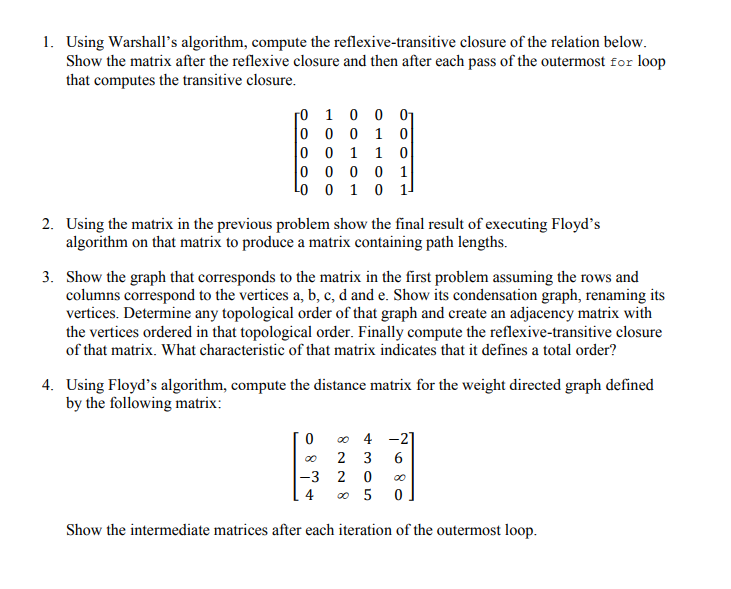 1. Using Warshall’s algorithm, compute the reflexive-transitive closure of the relation below.
Show the matrix after the reflexive closure and then after each pass of the outermost £ox loop
that computes the transitive closure.
100
000 1 0
001 1 0
00001
010 1
2. Using the matrix in the previous problem show the final result of executing Floyds
algorithm on that matrix to produce a matrix containing path lengths.
3. Show the graph that corresponds to the matrix in the first problem assuming the rows and
columns correspond to the vertices a, b, c, d and e. Show its condensation graph, renaming its
vertices. Determine any topological order of that graph and create an adjacency matrix with
the vertices ordered in that topological order. Finally compute the reflexive-transitive closure
of that matrix. What characteristic of that matrix indicates that it defines a total order?
4. Using Floyd's algorithm, compute the distance matrix for the weight directed graph defined
by the following matrix:
0 = 4 -2
@ 23 6
320 =
4 ©5 0
Show the intermediate matrices after each iteration of the outermost loop.