 VIPSolutions
Give step-by-step solution with explanation and final answer:= coe go cog [IES al] £77 & 5 5 aN | fl Eax38 8 2am pr IRE gE 2E ERE : 3s | P aa Ss 82 enoic 3 | $2 _%& 2 Nc | & ELU3Ezsma 3 £% o 52 gg SCH Ri 5 & Pa gioNEe 3 3 8s RE 2 a admis | g 25 8 El: 3 =2§2:8%38 | 3 23 3 = Gana ag % co © & ars S 3 25. £8 < 8 ~ 5 3g eNs 3 Hl es 8igkE S 2 =¢ma=8d H = © 2 Hichaes z ag & om | ES 2g Eng | E £838 5>5 | g 6 & 5 3& £ §pEzg = Sg orams | 5 55388 | 35 8 FE | g mae ee = g 34 m2 Zz £2038 $088 | a ER | 8 £ 5 o als | 9 2 saiNnga 2 gg 2 28 3S $25 8 2 258 s8 g ERC ES §aefc5sd g 23dds lat 3 BEF ¢ = gd 8 Eg 5 3 § EDGR 5 = CS Ran P Fr = Hs Lied |e H Fg 2 8 A mp 1 a
Question:
Give step-by-step solution with explanation and final answer: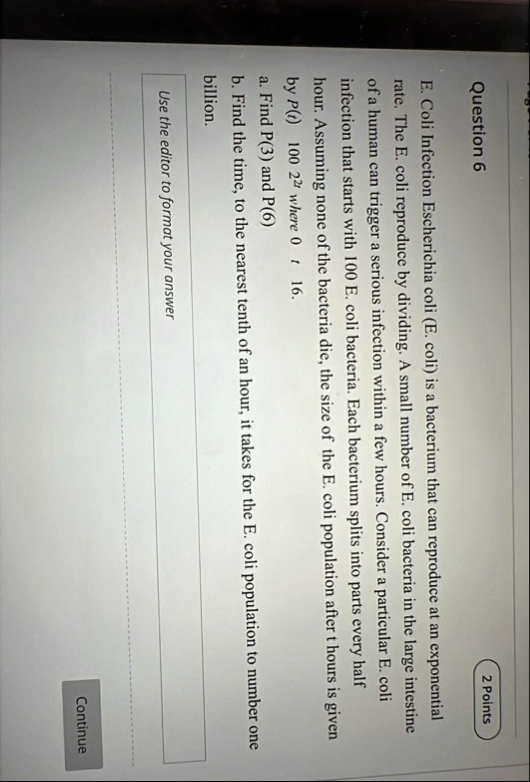 = coe go cog [IES
al] £77 & 5 5 aN
| fl Eax38 8 2am
pr IRE gE 2E ERE
: 3s | P aa Ss 82 enoic
3 | $2 _%& 2 Nc
| & ELU3Ezsma
3 £% o 52 gg SCH
Ri 5 & Pa gioNEe 3
3 8s RE 2 a admis |
g 25 8 El:
3 =2§2:8%38 |
3 23 3 = Gana
ag % co © & ars
S 3 25. £8
< 8 ~ 5 3g eNs
3 Hl es 8igkE
S 2 =¢ma=8d
H = © 2 Hichaes
z ag & om |
ES 2g Eng |
E £838 5>5 |
g 6 & 5 3&
£ §pEzg
= Sg orams |
5 55388 |
35 8 FE |
g mae ee
= g 34 m2
Zz £2038
$088 |
a ER |
8 £ 5 o als |
9 2 saiNnga
2 gg 2 28
3S $25 8
2 258 s8
g ERC
ES §aefc5sd
g 23dds
lat 3 BEF ¢
= gd 8 Eg
5
3 § EDGR
5 = CS Ran P
Fr = Hs
Lied |e H Fg
2 8 A
mp
1 a
This is AI generated Response.
Asked by: gvr
Created at: 2025-08-01 21:29:21
Asked by: gvr
Created at: 2025-08-01 21:29:21
Final Answer:
Rendered
Raw Text
Did you like this answer?
Let's solve the problem step by step.
---
**Given:**
- The population at time \( t \) hours:
\[
P(t) = 100 \times 2^{2t}
\]
where \( t \) is between 0 and 16.
---
### **a. Find \( P(3) \) and \( P(6) \)**
#### **Find \( P(3) \):**
\[
P(3) = 100 \times 2^{2 \times 3}
= 100 \times 2^{6}
= 100 \times 64
= 6400
\]
#### **Find \( P(6) \):**
\[
P(6) = 100 \times 2^{2 \times 6}
= 100 \times 2^{12}
= 100 \times 4096
= 409600
\]
---
### **b. Find the time it takes for the E. coli population to number one billion**
One billion is \( 1,000,000,000 = 10^9 \).
Set \( P(t) = 10^9 \):
\[
100 \times 2^{2t} = 10^9
\]
Divide both sides by 100:
\[
2^{2t} = \frac{10^9}{100} = 10^7
\]
Take logarithm (base 2) of both sides:
\[
2t = \log_2(10^7)
\]
Recall: \( \log_2(10^7) = 7 \log_2(10) \)
We know \( \log_2(10) \approx 3.3219 \):
\[
2t = 7 \times 3.3219 = 23.2533
\]
\[
t = \frac{23.2533}{2} = 11.62665
\]
Rounded to the nearest tenth:
\[
t \approx 11.6
\]
---
## **Final Answers:**
**a.**
- \( P(3) = 6400 \)
- \( P(6) = 409600 \)
**b.**
- Time to reach one billion: **11.6 hours** (to the nearest tenth of an hour)
Question:
i need 2 lines pure theory for explanation no need any terms
This is AI generated Response.
Asked by: gvr
Created at: 2025-08-01 21:30:17
Asked by: gvr
Created at: 2025-08-01 21:30:17
Final Answer:
Rendered
Raw Text
Did you like this answer?
The population doubles every fixed interval, following an exponential growth pattern. To find the time to reach a certain population, we set the growth equation equal to that population and solve for time.
📢 Instructions:
- Ask anything relatd to above question only.
- For new Question goto :