 VIPSolutions
Give step-by-step solution with explanation and final answer:3. A particle moves along a circular track of radius R = 10 m, and its speed varies with time according to the equation vt) = 21 m/s, where / is the time in seconds. a. Determine the particles acceleration when 1 = 3 s. Provide final answer in the box below. Working space provided on next page.
Question:
Give step-by-step solution with explanation and final answer: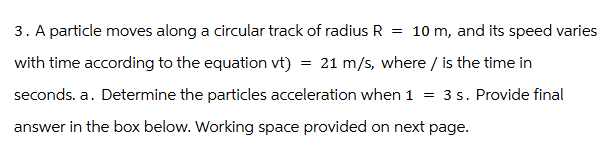 3. A particle moves along a circular track of radius R = 10 m, and its speed varies
with time according to the equation vt) = 21 m/s, where / is the time in
seconds. a. Determine the particles acceleration when 1 = 3 s. Provide final
answer in the box below. Working space provided on next page.
This is AI generated Response.
Asked by: gvr
Created at: 2025-06-20 09:26:39
Asked by: gvr
Created at: 2025-06-20 09:26:39
Final Answer:
Rendered
Raw Text
Did you like this answer?
Let's break down the problem step by step.
---
### **Given:**
- Radius of the circle, \( R = 10 \) m
- Speed as a function of time: \( v(t) = 2t + 1 \) m/s
- Time, \( t = 3 \) s
We are to **find the particle's acceleration** at \( t = 3 \) s.
---
### **Step 1: Types of Acceleration in Circular Motion**
A particle moving in a circle can have two components of acceleration:
1. **Tangential acceleration (\( a_t \))**: Due to change in speed.
2. **Centripetal (radial) acceleration (\( a_c \))**: Due to change in direction.
Total acceleration,
\[
a = \sqrt{a_t^2 + a_c^2}
\]
---
### **Step 2: Tangential Acceleration (\( a_t \))**
Tangential acceleration is the time derivative of speed:
\[
a_t = \frac{dv}{dt}
\]
Given: \( v(t) = 2t + 1 \)
\[
\frac{dv}{dt} = 2
\]
So,
\[
a_t = 2 \text{ m/s}^2
\]
---
### **Step 3: Centripetal Acceleration (\( a_c \))**
\[
a_c = \frac{v^2}{R}
\]
At \( t = 3 \) s,
\[
v(3) = 2(3) + 1 = 7 \text{ m/s}
\]
\[
a_c = \frac{(7)^2}{10} = \frac{49}{10} = 4.9 \text{ m/s}^2
\]
---
### **Step 4: Total Acceleration**
\[
a = \sqrt{a_t^2 + a_c^2}
\]
\[
a = \sqrt{(2)^2 + (4.9)^2}
\]
\[
a = \sqrt{4 + 24.01}
\]
\[
a = \sqrt{28.01}
\]
\[
a \approx 5.29 \text{ m/s}^2
\]
---
### **Final Answer:**
\[
\boxed{5.29\ \text{m/s}^2}
\]
This is the acceleration of the particle at \( t = 3 \) s.
Question:
i need 1 line pure theory for explanation
This is AI generated Response.
Asked by: gvr
Created at: 2025-06-20 09:36:36
Asked by: gvr
Created at: 2025-06-20 09:36:36
Final Answer:
Rendered
Raw Text
Did you like this answer?
The total acceleration of a particle moving in a circle is the vector sum of tangential acceleration, due to change in speed, and centripetal acceleration, due to change in direction.
📢 Instructions:
- Ask anything relatd to above question only.
- For new Question goto :