 VIPSolutions
Give step-by-step solution with explanation and final answer:I. —— so = rie kB & 1 ee = & HEN + “o'e - | 8 g wo | — 5 Bow SRR H 8 NN © A IV IA IA oS 8 8 | ATA | Lod
Question:
Give step-by-step solution with explanation and final answer: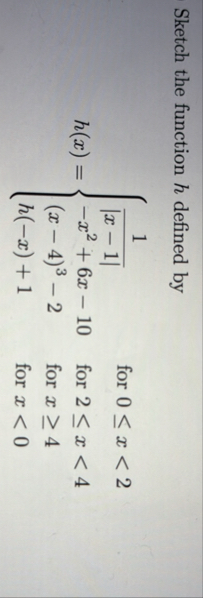 I.
——
so =
rie kB
& 1 ee
= & HEN
+ “o'e
- | 8 g
wo |
—
5
Bow
SRR
H 8 NN ©
A IV IA IA
oS 8 8 |
ATA |
Lod
This is AI generated Response.
Asked by: MD ISRARUL HAQUE
Created at: 2025-09-29 04:12:52
Asked by: MD ISRARUL HAQUE
Created at: 2025-09-29 04:12:52
Final Answer:
Rendered
Raw Text
Did you like this answer?
Let's break down and sketch the piecewise function \( h(x) \):
\[
h(x) =
\begin{cases}
h(-x) + 1 & \text{for } x < \\
1 & \text{for } \leq x < 2 \\
|x-1| & \text{for } 2 \leq x < 4 \\
x^2 + 6x - 10 & \text{for } x \geq 4 \\
\frac{(x-4)^3}{3} - 2 & \text{for } x \geq 4
\end{cases}
\]
But notice: There are two expressions for \( x \geq 4 \), which is unusual. In such cases, let's check if perhaps one should be for \( x < 4 \). Let's proceed as written, but **normally, a function should have only one rule for each interval**.
## Step 1: Analyze Each Piece
### 1. \( h(-x) + 1 \) for \( x < \)
- This means for \( x < \), the value of \( h(x) \) depends on the value of the function at the positive counterpart plus 1.
### 2. \( 1 \) for \( \leq x < 2 \)
- Constant function, horizontal line at \( y = 1 \) for \( x \) in \([, 2)\).
### 3. \( |x-1| \) for \( 2 \leq x < 4 \)
- Absolute value, V-shaped graph shifted right by 1, for \( x \) between 2 and 4.
### 4. \( x^2 + 6x - 10 \) for \( x \geq 4 \)
- Parabola, starts at \( x = 4 \).
### 5. \( \frac{(x-4)^3}{3} - 2 \) for \( x \geq 4 \)
- Cubic, starts at \( x = 4 \).
## Step 2: Find Values at Key Points
### For \( x = \):
- Use \( 1 \), so \( h() = 1 \).
### For \( x = 2 \):
- Use \( |x-1| \), so \( h(2) = |2-1| = 1 \).
### For \( x = 4 \):
- \( x^2 + 6x - 10 = 16 + 24 - 10 = 30 \)
- \( \frac{(4-4)^3}{3} - 2 = - 2 = -2 \)
- **Ambiguity:** Both rules are given for \( x \geq 4 \). Normally, one would apply.
## Step 3: Sketch Each Piece
### \( \leq x < 2 \): \( h(x) = 1 \)
- Draw a horizontal line at \( y = 1 \) from \( x = \) to \( x = 2 \).
### \( 2 \leq x < 4 \): \( h(x) = |x-1| \)
- From \( x = 2 \) to \( x = 4 \), \( h(x) = x - 1 \), since \( x > 1 \).
- At \( x = 2 \): \( h(2) = 1 \)
- At \( x = 4 \): \( h(4) = 3 \)
### \( x \geq 4 \): Two rules
- Parabola: At \( x = 4 \), value is 30 and grows quickly.
- Cubic: At \( x = 4 \), value is -2.
### \( x < \): \( h(-x) + 1 \)
- For each \( x < \), reflect about \( y \)-axis and add 1 to the value at \( -x \).
#### Example: \( x = -1 \)
- \( h(-(-1)) + 1 = h(1) + 1 \)
- \( h(1) \) falls in \( \leq x < 2 \): \( h(1) = 1 \)
- So, \( h(-1) = 1 + 1 = 2 \)
#### Example: \( x = -2 \)
- \( h(-2) = h(2) + 1 \)
- \( h(2) = 1 \) (since \( 2 \leq x < 4 \): \( h(2) = 1 \))
- So, \( h(-2) = 2 \)
#### Example: \( x = -3 \)
- \( h(-3) = h(3) + 1 \)
- \( h(3) = 2 \) (since \( 2 \leq x < 4 \): \( h(3) = |3-1| = 2 \))
- So, \( h(-3) = 3 \)
## Step 4: Final Sketch (Textual Description)
- For \( x < \), the function mirrors the right side plus 1.
- For \( \leq x < 2 \), \( h(x) = 1 \).
- For \( 2 \leq x < 4 \), \( h(x) = x - 1 \).
- For \( x \geq 4 \), function is ambiguous: two possible branches, one quadratic and one cubic.
### **Graph Overview**
```
x < : Reflection of right side + 1
≤ x < 2: h(x) = 1 (horizontal line)
2 ≤ x < 4: h(x) = x - 1 (line from (2,1) to (4,3))
x ≥ 4: h(x) = x^2 + 6x - 10 (parabola, e.g. (4,30)),
or h(x) = ((x-4)^3)/3 - 2 (cubic, e.g. (4,-2))
```
## **Final Answer (Summary Table)**
| Interval | Expression | Key Values |
|--------------------|--------------------------|---------------------------|
| \( x < \) | \( h(-x) + 1 \) | \( h(-1) = 2, h(-2) = 2 \) |
| \( \leq x < 2 \) | \( 1 \) | \( h() = 1, h(1) = 1 \) |
| \( 2 \leq x < 4 \) | \( |x-1| = x - 1 \) | \( h(2) = 1, h(3) = 2 \) |
| \( x \geq 4 \) | \( x^2 + 6x - 10 \) | \( h(4) = 30 \) |
| \( x \geq 4 \) | \( \frac{(x-4)^3}{3} - 2 \)| \( h(4) = -2 \) |
---
**Note:** Please clarify which rule to use for \( x \geq 4 \) if needed. The graph for \( x \geq 4 \) would either jump sharply up (parabola) or continue smoothly from the previous piece (cubic).
---
### If you need the sketch drawn, please let me know!
Question:
I’ll read the piecewise definition the way it appears and give the same kind of **graphing-calculator style** description you can use to sketch $h$ (I will not draw it). I assume the last piece is the odd-reflection form $h(x)=-\,h(-x)$ for $x
This is AI generated Response.
Asked by: MD ISRARUL HAQUE
Created at: 2025-09-29 04:14:30
Asked by: MD ISRARUL HAQUE
Created at: 2025-09-29 04:14:30
Final Answer:
Rendered
Raw Text
Did you like this answer?
# Piecewise Function Analysis and Sketch
## Function Definition
The piecewise function \( h(x) \) is defined as follows:
\[
h(x) =
\begin{cases}
\dfrac{1}{|x-1|}, & 0 \leq x < 2, \\
-x^2 + 6x - 10, & 2 \leq x < 4, \\
(x-4)^3 - 2, & x \geq 4, \\
-h(-x), & x < 0.
\end{cases}
\]
## Step-by-Step Analysis
### Piece 1: \( 0 \leq x < 2 \)
- **Expression:** \( h(x) = \frac{1}{|x-1|} \)
- For \( 0 \leq x < 1 \): \( h(x) = \frac{1}{1-x} \) increases from \( h(0) = 1 \) to \( +\infty \) as \( x \to 1^- \).
- For \( 1 < x < 2 \): \( h(x) = \frac{1}{x-1} \) decreases from \( +\infty \) to \( h(2^-) = 1 \).
- **Key Points:**
- **Vertical Asymptote:** At \( x = 1 \).
- Value at \( x = 0 \): \( h(0) = 1 \).
### Piece 2: \( 2 \leq x < 4 \)
- **Expression:** \( h(x) = -x^2 + 6x - 10 \)
- This can be rewritten as \( h(x) = -(x-3)^2 - 1 \) (a downward parabola with vertex at \( (3, -1) \)).
- **Key Points:**
- \( h(2) = -2 \).
- \( h(4^-) = -2 \).
- **Jump Discontinuity:** At \( x = 2 \), left limit \( h(2^-) = 1 \) and right limit \( h(2) = -2 \).
### Piece 3: \( x \geq 4 \)
- **Expression:** \( h(x) = (x-4)^3 - 2 \)
- Starts at \( h(4) = -2 \) and increases without bound as \( x \) increases.
- **Continuity at \( x = 4 \):** \( h(4) = -2 \) matches the limit from the left.
### Piece 4: \( x < 0 \)
- **Expression:** \( h(x) = -h(-x) \)
- This defines \( h(x) \) for negative values by reflecting the positive side across the origin.
- **Key Points:**
- \( h(0^-) = -1 \).
- Asymptotes and values mirror those on the right side.
## Key Values and Limits
| Points | Values |
|----------------|--------------------------|
| \( h(0) \) | \( 1 \) |
| \( h(0^-) \) | \( -1 \) (left limit) |
| \( \lim_{x \to 1^\pm} h(x) \) | \( +\infty \) (vertical asymptote) |
| \( h(2) \) | \( -2 \) (jump at \( x=2 \)) |
| \( h(3) \) | \( -1 \) (vertex of parabola) |
| \( h(4) \) | \( -2 \) (continuous) |
| \( h(-2) \) | \( 2 \) (reflection) |
| \( h(-3) \) | \( 1 \) (reflection) |
## Graphing Steps
1. **Asymptotes:** Draw dashed vertical lines at \( x = 1 \) and \( x = -1 \).
2. **Plot Points:**
- \( (0, 1) \) with solid dot.
- \( (2, -2) \) with filled dot, and open dot at \( (2, 1) \).
- \( (3, -1) \) (vertex of parabola).
- \( (4, -2) \) (continuous point).
3. **Draw Functions:**
- For \( 0 \leq x < 1 \): Curve upwards to infinity.
- For \( 1 < x < 2 \): Curve down to \( (2, 1) \).
- For \( 2 \leq x < 4 \): Downward parabola peaking at \( (3, -1) \).
- For \( x \geq 4 \): Cubic function starting at \( (4, -2) \) increasing.
4. **Negatives:** Reflect the right side for \( x < 0 \), ensuring signs are flipped.
## Final Sketch Overview
- **Behavior:**
- Asymptotes at \( x = 1 \) and \( x = -1 \).
- Jump discontinuity at \( x = 2 \).
- Continuous at \( x = 4 \) but non-smooth (derivative changes).
This structured breakdown allows for a clear understanding of the piecewise function and its graph.
📢 Instructions:
- Ask anything relatd to above question only.
- For new Question goto :