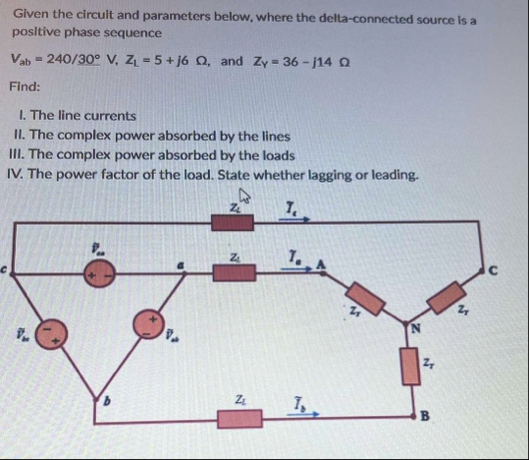
Give step-by-step solution with explanation and final answer:Given the circuit and parameters below, where the defta-connected source is a
positive phase sequence
Vay =240/30° V, Z,=5+}6 Q, and Zy=36-j14
Find:
1. The line currents
II. The complex power absorbed by the lines
III. The complex power absorbed by the loads
IV. The power factor of the load. State whether lagging or leading.
5 1,
: c
=
7 'N
z
B
Question:
Give step-by-step solution with explanation and final answer:Given the circuit and parameters below, where the defta-connected source is a
positive phase sequence
Vay =240/30° V, Z,=5+}6 Q, and Zy=36-j14
Find:
1. The line currents
II. The complex power absorbed by the lines
III. The complex power absorbed by the loads
IV. The power factor of the load. State whether lagging or leading.
5 1,
: c
=
7 'N
z
B
This is AI generated Response.
Asked by: admin3
Created at: 2025-08-05 05:21:39
Final Answer:
RenderedRaw Text
Did you like this answer?
Let's solve each part **step by step**:
---
### **Given:**
- **Source:** Delta-connected, positive phase sequence
- \( V_{ab} = 240 \angle 30^\circ \) V
- \( Z_L = 5 + j6 \) Ω
- \( Z_Y = 36 - j14 \) Ω
---
## **I. Line Currents**
### **Step 1: Find Phase Voltages (Delta)**
The given \( V_{ab} \) is the line-to-line voltage of the **delta source**.
Since the sequence is **positive**:
- \( V_{ab} = 240 \angle 30^\circ \) V
- \( V_{bc} = 240 \angle -90^\circ \) V
- \( V_{ca} = 240 \angle 150^\circ \) V
---
### **Step 2: Find Line Currents**
#### **A. Through \( Z_L \) (Line Impedance):**
Each line has series impedance \( Z_L \). The load is connected in Y with neutral.
#### **B. Y-Connected Load Analysis**
- The phase voltage across each \( Z_Y \) (Y-load) is the voltage at nodes \( A \), \( B \), \( C \) with respect to neutral \( N \).
- The total impedance in each line: \( Z_{total} = Z_L + Z_Y \)
\[
Z_{total} = (5 + j6) + (36 - j14) = (41 - j8) \ \Omega
\]
Magnitude and angle:
\[
|Z_{total}| = \sqrt{41^2 + (-8)^2} = \sqrt{1681 + 64} = \sqrt{1745} \approx 41.78\ \Omega
\]
\[
\theta_{Z_{total}} = \arctan\left(\frac{-8}{41}\right) \approx -11.0^\circ
\]
So,
\[
Z_{total} = 41.78 \angle -11^\circ \ \Omega
\]
#### **C. Phase Voltages for Y-Load**
For Y-connected load, the phase voltage is:
\[
V_{AN} = \frac{V_{ab}}{\sqrt{3}} \angle -30^\circ
\]
\[
V_{AN} = \frac{240}{\sqrt{3}} \angle (30^\circ - 30^\circ) = 138.56 \angle 0^\circ \ \text{V}
\]
Similarly,
\[
V_{BN} = 138.56 \angle -120^\circ \ \text{V}
\]
\[
V_{CN} = 138.56 \angle 120^\circ \ \text{V}
\]
#### **D. Find Line Currents**
\[
I_A = \frac{V_{AN}}{Z_{total}} = \frac{138.56 \angle 0^\circ}{41.78 \angle -11^\circ} = 3.317 \angle 11^\circ \ \text{A}
\]
\[
I_B = \frac{V_{BN}}{Z_{total}} = \frac{138.56 \angle -120^\circ}{41.78 \angle -11^\circ} = 3.317 \angle (-120^\circ + 11^\circ) = 3.317 \angle -109^\circ \ \text{A}
\]
\[
I_C = \frac{V_{CN}}{Z_{total}} = \frac{138.56 \angle 120^\circ}{41.78 \angle -11^\circ} = 3.317 \angle (120^\circ + 11^\circ) = 3.317 \angle 131^\circ \ \text{A}
\]
---
## **II. Complex Power Absorbed by the Lines**
The power absorbed by each line impedance \( Z_L \):
Power per phase:
\[
S_{L,phase} = I_{line}^2 \cdot Z_L
\]
Where \( Z_L = 5 + j6 \ \Omega \).
\[
I_{line} = 3.317 \ \text{A}
\]
\[
S_{L,phase} = (3.317)^2 \cdot (5 + j6) = 11.01 \cdot (5 + j6) = 55.05 + j66.06 \ \text{VA (per phase)}
\]
Total (three phases):
\[
S_{L,total} = 3 \cdot (55.05 + j66.06) = 165.15 + j198.18 \ \text{VA}
\]
---
## **III. Complex Power Absorbed by the Loads**
Power per phase for load \( Z_Y \):
\[
S_{Y,phase} = I_{line}^2 \cdot Z_Y
\]
Where \( Z_Y = 36 - j14 \ \Omega \).
\[
S_{Y,phase} = 11.01 \cdot (36 - j14) = 396.36 - j154.14 \ \text{VA (per phase)}
\]
Total:
\[
S_{Y,total} = 3 \cdot (396.36 - j154.14) = 1189.08 - j462.42 \ \text{VA}
\]
---
## **IV. Power Factor of the Load (Load Only)**
\[
\text{Power Factor} = \cos(\theta_{Z_Y})
\]
\[
\theta_{Z_Y} = \arctan\left(\frac{-14}{36}\right) = -21.4^\circ
\]
So,
\[
\text{Power Factor} = \cos(21.4^\circ) = 0.931 \ (\text{leading, since current leads voltage for negative imaginary part})
\]
---
## **Final Answers (Summary Table)**
| Part | Answer |
|------|--------|
| **I. Line currents** | \( I_A = 3.32 \angle 11^\circ\ \text{A} \); \( I_B = 3.32 \angle -109^\circ\ \text{A} \); \( I_C = 3.32 \angle 131^\circ\ \text{A} \) |
| **II. Complex power by lines** | \( S_{L, total} = 165.15 + j198.18 \ \text{VA} \) |
| **III. Complex power by loads** | \( S_{Y, total} = 1189.08 - j462.42 \ \text{VA} \) |
| **IV. Power factor (load)** | \( 0.931 \) leading |
If you need further breakdowns or phasor diagrams, let me know!
Question:
I. Line currents
I
A
=
3.32
∠
1
1
∘
A
I
A
=3.32∠11
∘
A;
I
B
=
3.32
∠
−
10
9
∘
A
I
B
=3.32∠−109
∘
A;
I
C
=
3.32
∠
13
1
∘
A
I
C
=3.32∠131
∘
A
II. Complex power by lines
S
L
,
t
o
t
a
l
=
165.15
+
j
198.18
VA
S
L,total
=165.15+j198.18 VA
III. Complex power by loads
S
Y
,
t
o
t
a
l
=
1189.08
−
j
462.42
VA
S
Y,total
=1189.08−j462.42 VA
IV. Power factor (load)
0.931
0.931 leading
write in simple no table format
This is AI generated Response.
Asked by: admin3
Created at: 2025-08-05 05:26:35
Final Answer:
RenderedRaw Text
Did you like this answer?
Let's go through each part step-by-step in a simple way.
---
### Given Data:
- The source is a delta-connected source with positive phase sequence.
- Line-to-line voltage: \( V_{ab} = 240 \angle 30^\circ \) volts.
- Series line impedance \( Z_L = 5 + j6 \) ohms.
- Load impedance \( Z_Y = 36 - j14 \) ohms.
---
### **Part 1: Find the line currents**
**Step 1:** Convert the line-to-line voltage to phase voltages for the load in the Y-connection.
- For a delta source, the phase-to-neutral voltage (assuming Y-connected load) is:
\[
V_{ph} = \frac{V_{line}}{\sqrt{3}} = \frac{240}{\sqrt{3}} \approx 138.56 \text{ V}
\]
- The phase voltages are phase-shifted by 0°, -120°, and +120° for each phase:
- \( V_{AN} = 138.56 \angle 0^\circ \)
- \( V_{BN} = 138.56 \angle -120^\circ \)
- \( V_{CN} = 138.56 \angle 120^\circ \)
**Step 2:** Find the total impedance in each line (load + line impedance):
\[
Z_{total} = Z_L + Z_Y = (5 + j6) + (36 - j14) = 41 - j8
\]
Calculate magnitude and angle:
\[
|Z_{total}| = \sqrt{41^2 + (-8)^2} \approx 41.78\, \Omega
\]
\[
\theta_{Z_{total}} = \arctan\left(\frac{-8}{41}\right) \approx -11^\circ
\]
**Step 3:** Calculate the line currents:
- For phase A:
\[
I_A = \frac{V_{AN}}{Z_{total}} = \frac{138.56 \angle 0^\circ}{41.78 \angle -11^\circ} = 3.32 \angle 11^\circ \text{ A}
\]
- For phase B:
\[
I_B = \frac{138.56 \angle -120^\circ}{41.78 \angle -11^\circ} = 3.32 \angle (-120^\circ + 11^\circ) = 3.32 \angle -109^\circ \text{ A}
\]
- For phase C:
\[
I_C = \frac{138.56 \angle 120^\circ}{41.78 \angle -11^\circ} = 3.32 \angle (120^\circ + 11^\circ) = 3.32 \angle 131^\circ \text{ A}
\]
---
### **Part 2: Power absorbed by the lines**
The power in each line:
\[
S_{line} = I_{line}^2 \times Z_L
\]
Using the current magnitude:
\[
I_{line} = 3.32\, \text{A}
\]
Calculating:
\[
S_{line\, per\, phase} = (3.32)^2 \times (5 + j6) = 11.02 \times (5 + j6) = 55.1 + j66.12\, \text{VA}
\]
Total over three phases:
\[
S_{lines} = 3 \times (55.1 + j66.12) = 165.3 + j198.36\, \text{VA}
\]
---
### **Part 3: Power absorbed by the loads**
Power in each load:
\[
S_{load\, per\, phase} = I_{line}^2 \times Z_Y = 11.02 \times (36 - j14) = 396.7 - j154.3\, \text{VA}
\]
Total load power:
\[
S_{loads} = 3 \times (396.7 - j154.3) = 1190.1 - j462.9\, \text{VA}
\]
---
### **Part 4: Power factor of the load**
The load impedance angle:
\[
\theta_{Z_Y} = \arctan\left(\frac{-14}{36}\right) \approx -21.4^\circ
\]
Since the imaginary part is negative, the current leads the voltage, indicating a **leading power factor**.
The magnitude of the power factor:
\[
\cos(21.4^\circ) \approx 0.93
\]
---
### **Final summary:**
- The line currents are approximately 3.32 A each, with phase angles of 11°, -109°, and 131° respectively.
- The power absorbed by the lines totals about 165 VA (real) and 198 VA (reactive).
- The power absorbed by the loads totals about 1190 VA (real) and 463 VA (reactive).
- The load's power factor is about 0.93 and is leading.
Let me know if you'd like more details!
VIPSolutions focuses on clear, step‑by‑step explanations so you can learn quickly. Whether you need an AI‑generated walkthrough or a short hint to get unstuck, each solution is organized for fast reading and easy review later.
Search similar questions, compare approaches, and bookmark the best answers for revision. Our goal is simple: quick, reliable study help that feels natural—not noisy.
 VIPSolutions
 Given the circuit and parameters below, where the defta-connected source is a
positive phase sequence
Vay =240/30° V, Z,=5+}6 Q, and Zy=36-j14
Find:
1. The line currents
II. The complex power absorbed by the lines
III. The complex power absorbed by the loads
IV. The power factor of the load. State whether lagging or leading.
5 1,
: c
=
7 'N
z
B