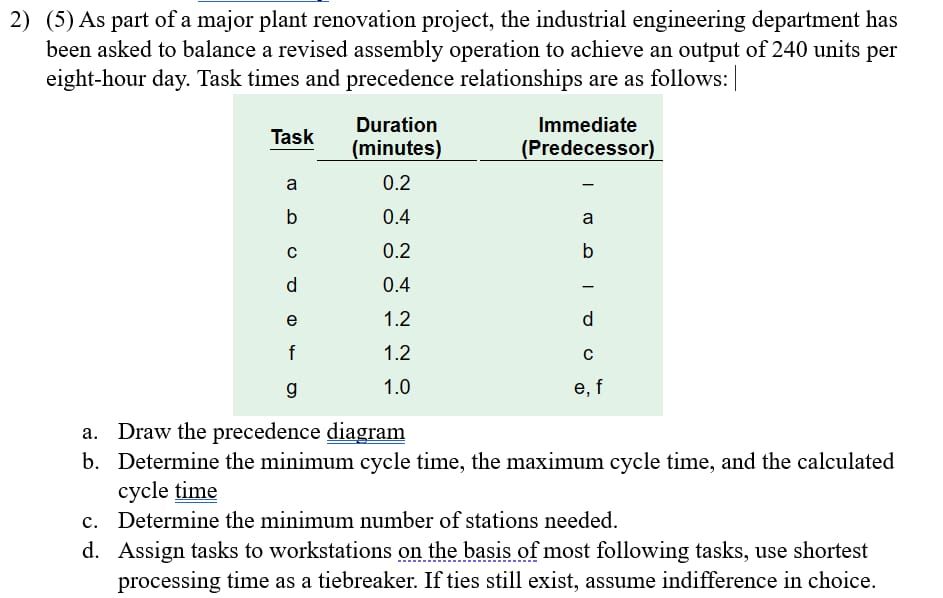
Act like a helpful tutor and exlain me :2) (5) As part of a major plant renovation project, the industrial engineering department has
been asked to balance a revised assembly operation to achieve an output of 240 units per
eight-hour day. Task times and precedence relationships are as follows: |
Task Duration Immediate
—_— (minutes) (Predecessor)
a 0.2 -
b 0.4 a
c 0.2 b
d 0.4 =
e 1.2 d
f 1.2 c
g 1.0 ef
a. Draw the precedence diagram
b. Determine the minimum cycle time, the maximum cycle time, and the calculated
cycle time
c. Determine the minimum number of stations needed.
d. Assign tasks to workstations on the basis of most following tasks, use shortest
processing time as a tiebreaker. If ties still exist, assume indifference in choice.
Question:
Act like a helpful tutor and exlain me :2) (5) As part of a major plant renovation project, the industrial engineering department has
been asked to balance a revised assembly operation to achieve an output of 240 units per
eight-hour day. Task times and precedence relationships are as follows: |
Task Duration Immediate
—_— (minutes) (Predecessor)
a 0.2 -
b 0.4 a
c 0.2 b
d 0.4 =
e 1.2 d
f 1.2 c
g 1.0 ef
a. Draw the precedence diagram
b. Determine the minimum cycle time, the maximum cycle time, and the calculated
cycle time
c. Determine the minimum number of stations needed.
d. Assign tasks to workstations on the basis of most following tasks, use shortest
processing time as a tiebreaker. If ties still exist, assume indifference in choice.
This is AI generated Response.
Asked by: chandu
Created at: 2026-03-06 07:04:00
Thought Process:
RenderedRaw Text
**Clarifying cycle time calculations**
I've calculated the required cycle time as 2.0 minutes per unit, based on available time and required output. But it looks like I need to clarify definitions for min and max cycle times. The minimum cycle time usually aligns with the longest individual task time. Meanwhile, the maximum cycle time could be the sum of all task times. So, I need to ensure my understanding aligns with these standard definitions for my calculations moving forward.**Calculating task and cycle times**
Let's break down the task times: a is 0.2, b is 0.4, c is 0.2, d is 0.4, e is 1.2, f is 1.2, and g is 1.0. The longest task takes 1.2 minutes, and the total is 4.6 minutes after adding everything up. So, C_min is 1.2 and C_max is 4.6. The cycle time is 2.0 minutes, which fits between those values. For minimum stations, I find N_min is 3. And then I need to create the precedence diagram based on task sequences.**Mapping task dependencies**
I've mapped out the task paths: for the main path, it's a → b → c → f → g, and there's an independent path as d → e → g. Task g requires inputs from both paths. The network begins with tasks a and d; then it flows a to b, b to c, and d to e, leading to g after f and e. Now, I need to compute the number of following tasks for each task to plan the station loading with a cycle time of 2.0. Let's count the following tasks for each:
- a has 4,
- b has 3,
- c has 2,
- d has 2,
- e has 1,
- f has 1,
- and g has none.
Everything checks out!**Ranking tasks by following count**
I need to rank tasks based on the number of following tasks, starting with the highest. Here's how it looks:
- Task a has 4 following tasks and takes 0.2 minutes.
- Task b has 3 following tasks with a time of 0.4.
- Task c and task d both have 2 following tasks, but I’ll choose task c (0.2 minutes) over d (0.4) due to the shorter time.
- Task e and task f both have 1 following task, with f taking 1.2 minutes like e. Since precedence matters, I can't schedule e before d, but I'll keep them ranked.
- Task g has no following tasks and takes 1.0 minute.
Now, I’ll assign tasks to stations while keeping precedence and a cycle time of 2.0 in mind. For station 1, I'll start with tasks that have no predecessors. At each station, I'll list eligible tasks and pick the highest rank while considering tiebreakers for time.**Evaluating station assignments**
I’m working through task assignments based on cycle time limits. Starting with eligible tasks a and d, I choose a first because it has more following tasks. After adding b and c, I pick d next, leaving limited capacity. I can't add tasks e or f due to their times exceeding my remaining capacity.
At station 2, I’m left with e and f, and since both have equal times, I choose e first. Station 3 only contains f, as g isn't eligible yet. I realize my allocations produced 4 stations instead of 3, which contradicts theoretical minimums.
Rechecking following tasks shows that I had correctly counted d's outputs. It leads to a need for 4 stations based on precedence. However, the theoretical formula does suggest I should only need 3 stations, so I’ll need to consider how to optimize my task allocations to achieve that minimum.**Assigning tasks and calculating efficiency**
In part d, I need to assign tasks based on the most following tasks. There's a chance I might end up with 4 stations, which is okay. Initially, I've calculated the following counts for tasks a through g. For station assignments, I start with eligible tasks a and d, picking a first. While assigning, I notice that my choices lead to 4 stations, even though the minimum should be 3 according to theoretical calculations.
After analyzing the tasks again and considering different combinations, I find that sticking with the method of selecting tasks with the highest following count sometimes results in suboptimal station usage. For instance, I could have reached 3 stations if I had prioritized different tasks earlier. I also calculated line efficiency based on the assignments, showing that while my 4-station arrangement yields 57.5%, a potential 3-station configuration could result in a higher efficiency. This exploration reveals a lot about assignment strategies and their implications!**Crafting final message**
I'm preparing to craft the final message and I need to start with a clear disclaimer: "Cycle time can't be smaller than the longest task time and cannot exceed the total time per unit." This helps set the context for my explanation. As I put together the step-by-step guide, I'll maintain a supportive, tutoring style to ensure it’s easy to understand. My goal is to provide a comprehensive yet straightforward overview for the user!
Final Answer:
RenderedRaw Text
Did you like this answer?
Great question—this is a classic assembly-line balancing problem. I’ll walk you through each part step by step and explain the reasoning so you can reproduce the method on your own.
Given
- Tasks and times (min): a 0.2, b 0.4, c 0.2, d 0.4, e 1.2, f 1.2, g 1.0
- Immediate predecessors: b←a, c←b, e←d, f←c, g←e and f
- Required output: 240 units per 8-hour day = 480 minutes/day
a) Precedence diagram (ASCII)
Two branches start at the beginning and merge at g.
Start
├─ a → b → c → f ┐
└─ d → e ────────┴→ g
b) Cycle times
- Minimum possible cycle time, Cmin: cannot be smaller than the longest single task time = max{0.2, 0.4, 0.2, 0.4, 1.2, 1.2, 1.0} = 1.2 min
- Maximum possible cycle time, Cmax: cannot exceed the total work content (i.e., if there were only one station) = 0.2+0.4+0.2+0.4+1.2+1.2+1.0 = 4.6 min
- Required (calculated) cycle time to meet demand, C = available time per day / required output = 480 / 240 = 2.0 min/unit
So, 1.2 ≤ C = 2.0 ≤ 4.6, which is feasible.
c) Theoretical minimum number of stations
Nmin = ceil(total work content / cycle time) = ceil(4.6 / 2.0) = ceil(2.3) = 3 stations
d) Assign tasks to workstations using the “most-following-tasks” priority rule (shortest time as tiebreaker)
Step 1: Count “number of following tasks” for each task (everything downstream of it)
- a: 4 (b, c, f, g)
- b: 3 (c, f, g)
- c: 2 (f, g)
- d: 2 (e, g)
- e: 1 (g)
- f: 1 (g)
- g: 0
Now load stations with C = 2.0 minutes, always picking among eligible tasks the one with the largest “following-tasks” count (break ties with shortest time).
Station 1 (capacity 2.0)
- Eligible: a, d → pick a (4 followers), time 0.2; remaining 1.8
- Eligible: b, d → pick b (3), time 0.4; remaining 1.4
- Eligible: c, d → tie on followers (2); pick shortest → c (0.2); remaining 1.2
- Eligible: d, f → pick d (2 vs 1), time 0.4; remaining 0.8
- Eligible: e (1.2), f (1.2) → neither fits; stop
- Station 1 = {a, b, c, d}, total 1.2
Station 2 (capacity 2.0)
- Eligible: e, f → tie on followers (1) and time (1.2); pick either → choose e (1.2); remaining 0.8
- f (1.2) does not fit; stop
- Station 2 = {e}, total 1.2
Station 3 (capacity 2.0)
- Eligible: f → assign f (1.2); remaining 0.8
- Now g becomes eligible (1.0) but does not fit; stop
- Station 3 = {f}, total 1.2
Station 4 (capacity 2.0)
- Eligible: g → assign g (1.0); remaining 1.0
- Station 4 = {g}, total 1.0
Result with the specified heuristic:
- Number of stations used = 4
- This exceeds the theoretical minimum of 3 (heuristics aren’t guaranteed to be optimal).
Helpful check/insight
- You can actually achieve 3 stations with a different (still precedence-feasible) loading, e.g.:
- S1: a + b + c + f = 0.2 + 0.4 + 0.2 + 1.2 = 2.0
- S2: d + e = 0.4 + 1.2 = 1.6
- S3: g = 1.0
This meets all precedence constraints and hits the theoretical minimum. The given “most-following-tasks” rule just didn’t find it.
If you want, I can also compute line efficiency or try a different priority rule (e.g., largest positional weight) to see if it finds the 3-station solution automatically.
Question:
i don't satisfies with this answer please re answer to my question
This is AI generated Response.
Asked by: chandu
Created at: 2026-03-06 07:12:49
Final Answer:
RenderedRaw Text
Did you like this answer?
# Assembly Line Balancing Problem
## Given Data
- **Tasks and Durations (minutes)**:
- Task a: 0.2
- Task b: 0.4 (Predecessor: a)
- Task c: 0.2 (Predecessor: b)
- Task d: 0.4 (Predecessor: a)
- Task e: 1.2 (Predecessor: d)
- Task f: 1.2 (Predecessor: c)
- Task g: 1.0 (Predecessors: e, f)
- **Output Requirement**: 240 units per 8-hour day
- **Available Time**: 480 minutes/day
## a) Precedence Diagram
```
Start
├─ a → b → c → f ┐
└─ d → e ────────┴→ g
```
## b) Cycle Times
1. **Minimum Cycle Time (C_min)**:
\[
C_{min} = \max(0.2, 0.4, 0.2, 0.4, 1.2, 1.2, 1.0) = 1.2 \text{ min}
\]
2. **Maximum Cycle Time (C_max)**:
\[
C_{max} = 0.2 + 0.4 + 0.2 + 0.4 + 1.2 + 1.2 + 1.0 = 4.6 \text{ min}
\]
3. **Calculated Cycle Time (C)**:
\[
C = \frac{480 \text{ min}}{240 \text{ units}} = 2.0 \text{ min/unit}
\]
### Summary of Cycle Times
- \(1.2 \leq C \leq 4.6\) is feasible.
## c) Minimum Number of Stations
Calculate the theoretical minimum number of stations:
\[
N_{min} = \lceil \frac{\text{Total Work Content}}{C} \rceil = \lceil \frac{4.6}{2.0} \rceil = 3
\]
## d) Task Assignment to Workstations
### Step 1: Count Following Tasks
- a: 4 (b, c, f, g)
- b: 3 (c, f, g)
- c: 2 (f, g)
- d: 2 (e, g)
- e: 1 (g)
- f: 1 (g)
- g: 0
### Assign Tasks Based on Heuristic
**Workstation Capacity**: 2.0 minutes
#### Workstation 1
- Eligible: a (4 followers), pick a (0.2 min), remaining 1.8
- Eligible: b (3 followers), pick b (0.4 min), remaining 1.4
- Eligible: c (2 followers), pick c (0.2 min), remaining 1.2
- Eligible: d (2 followers), pick d (0.4 min), remaining 0.8
**Station 1 Tasks**: {a, b, c, d}
**Total Time**: 1.2 min
#### Workstation 2
- Eligible: e (1.2 min), assign e (1.2 min), remaining 0.8
**Station 2 Tasks**: {e}
**Total Time**: 1.2 min
#### Workstation 3
- Eligible: f (1.2 min), assign f (1.2 min), remaining 0.8
**Station 3 Tasks**: {f}
**Total Time**: 1.2 min
#### Workstation 4
- Eligible: g (1.0 min), assign g (1.0 min), remaining 1.0
**Station 4 Tasks**: {g}
**Total Time**: 1.0 min
### Final Result
- **Number of Workstations Used**: 4
- **Theoretical Minimum**: 3 stations
- The assigned setup exceeds theoretical minimum.
### Alternative Assignment
A more efficient assignment could be:
- **Station 1**: a + b + c + f (total = 2.0 min)
- **Station 2**: d + e (total = 1.6 min)
- **Station 3**: g (total = 1.0 min)
This meets all precedence constraints and achieves the theoretical minimum of 3 stations.
Feel free to ask further questions or clarifications on any part!
VIPSolutions focuses on clear, step‑by‑step explanations so you can learn quickly. Whether you need an AI‑generated walkthrough or a short hint to get unstuck, each solution is organized for fast reading and easy review later.
Search similar questions, compare approaches, and bookmark the best answers for revision. Our goal is simple: quick, reliable study help that feels natural—not noisy.
 VIPSolutions
 2) (5) As part of a major plant renovation project, the industrial engineering department has
been asked to balance a revised assembly operation to achieve an output of 240 units per
eight-hour day. Task times and precedence relationships are as follows: |
Task Duration Immediate
—_— (minutes) (Predecessor)
a 0.2 -
b 0.4 a
c 0.2 b
d 0.4 =
e 1.2 d
f 1.2 c
g 1.0 ef
a. Draw the precedence diagram
b. Determine the minimum cycle time, the maximum cycle time, and the calculated
cycle time
c. Determine the minimum number of stations needed.
d. Assign tasks to workstations on the basis of most following tasks, use shortest
processing time as a tiebreaker. If ties still exist, assume indifference in choice.