give the calculation step by step as like as full answer in 2 steps and explanation block in every steps.
And final answer summary
Definition of Parameters
Solutions are reviewed by our quality team mainly based on 6 parameters: Relevancy, Completeness, Accuracy, Clarity, Structure, and Voice.
Relevancy: This indicates how closely a solution aligns with the question asked. It evaluates whether the solution addresses the core aspects of the question and provides appropriate information.
Completeness: This indicates how thoroughly the solution addresses various asks in the question. It evaluates whether the solution has all essential information like calculations, diagrams, procedural steps, & explanatory statements in the solution.
Accuracy: It refers to how correct the provided solution is for the given question/s. This evaluates the correctness of the information/concept/method followed in the solution.
Clarity: Clarity refers to how easily the solution can be understood by the student. This evaluates the language complexity, readability, and redundancy of a solution.
Structure: Structure refers to how the solution is organized and presented in relation to the requirements of the question. This evaluates the necessity of steps and their effectiveness in helping the student grasp how to arrive at the solution.
Voice: This refers to the language and tone of the solution. This primarily evaluates whether a solution sounds human or overly non-human (bot-like).
don't use we, then,:.Three particles are fixed on an x axis. Particle 1 of charge q is at x = -a and particle 2 of charge q; is at x = +a. If their net electrostatic
force on particle 3 of charge Qis to be zero, what must be the ratio 1/q; when particle 31s at (a) x = +0.474a and (b) x = +1.53a?
(a) Number B Units v
to Number [B] Units .
Question:
give the calculation step by step as like as full answer in 2 steps and explanation block in every steps.
And final answer summary
Definition of Parameters
Solutions are reviewed by our quality team mainly based on 6 parameters: Relevancy, Completeness, Accuracy, Clarity, Structure, and Voice.
Relevancy: This indicates how closely a solution aligns with the question asked. It evaluates whether the solution addresses the core aspects of the question and provides appropriate information.
Completeness: This indicates how thoroughly the solution addresses various asks in the question. It evaluates whether the solution has all essential information like calculations, diagrams, procedural steps, & explanatory statements in the solution.
Accuracy: It refers to how correct the provided solution is for the given question/s. This evaluates the correctness of the information/concept/method followed in the solution.
Clarity: Clarity refers to how easily the solution can be understood by the student. This evaluates the language complexity, readability, and redundancy of a solution.
Structure: Structure refers to how the solution is organized and presented in relation to the requirements of the question. This evaluates the necessity of steps and their effectiveness in helping the student grasp how to arrive at the solution.
Voice: This refers to the language and tone of the solution. This primarily evaluates whether a solution sounds human or overly non-human (bot-like).
don't use we, then,:.Three particles are fixed on an x axis. Particle 1 of charge q is at x = -a and particle 2 of charge q; is at x = +a. If their net electrostatic
force on particle 3 of charge Qis to be zero, what must be the ratio 1/q; when particle 31s at (a) x = +0.474a and (b) x = +1.53a?
(a) Number B Units v
to Number [B] Units .
This is AI generated Response.
Asked by: sai
Created at: 2025-06-25 05:32:35
Final Answer:
RenderedRaw Text
Did you like this answer?
Let's solve the problem step by step, with clear explanation blocks and a final answer summary.
---
### **Definition of Parameters**
- **q₁:** Charge at \( x = -a \)
- **q₂:** Charge at \( x = +a \)
- **Q:** Charge at \( x = x_3 \) (where net force on Q must be zero)
- **a:** Given distance from origin
- **x₃:** Position of Q (will use values \( +0.474a \) and \( +1.53a \))
- **F:** Electrostatic force
---
### **Step 1: Write the Force Equations**
#### **Explanation**
The net electrostatic force on Q (at \( x_3 \)) is the sum of the forces due to \( q_1 \) and \( q_2 \). Each force is calculated using Coulomb's Law:
\[
F = k \frac{qQ}{r^2}
\]
where \( r \) is the distance between charges.
Set the net force on Q to zero:
\[
F_{13} + F_{23} = 0
\]
- \( F_{13} \) is the force on Q by \( q_1 \) (at \( x = -a \))
- \( F_{23} \) is the force on Q by \( q_2 \) (at \( x = +a \))
Calculate the distances:
- Distance from Q to \( q_1 \): \( x_3 - (-a) = x_3 + a \)
- Distance from Q to \( q_2 \): \( x_3 - a \)
Write the equation:
\[
k \frac{q_1 Q}{(x_3 + a)^2} + k \frac{q_2 Q}{(x_3 - a)^2} = 0
\]
---
### **Step 2: Solve for the Ratio \( q_1/q_2 \) at Each Position**
#### **Explanation**
\( k \) and \( Q \) cancel out (assuming nonzero). Rearranging gives:
\[
\frac{q_1}{(x_3 + a)^2} = -\frac{q_2}{(x_3 - a)^2}
\]
\[
\frac{q_1}{q_2} = -\frac{(x_3 + a)^2}{(x_3 - a)^2}
\]
Substitute \( x_3 \) for each part:
#### (a) For \( x_3 = +0.474a \):
\[
\frac{q_1}{q_2} = -\frac{(0.474a + a)^2}{(0.474a - a)^2}
= -\frac{(1.474a)^2}{(-0.526a)^2}
= -\frac{(1.474)^2}{(0.526)^2}
= -\frac{2.172}{0.277}
= -7.84
\]
#### (b) For \( x_3 = +1.53a \):
\[
\frac{q_1}{q_2} = -\frac{(1.53a + a)^2}{(1.53a - a)^2}
= -\frac{(2.53a)^2}{(0.53a)^2}
= -\frac{6.401}{0.2809}
= -22.77
\]
---
### **Final Answer Summary**
- **(a) When \( x = +0.474a \):**
\[
\boxed{-7.84}
\]
- **(b) When \( x = +1.53a \):**
\[
\boxed{-22.77}
\]
**The negative sign indicates that \( q_1 \) and \( q_2 \) must have opposite signs.**
Question:
F
13
=F
23?
This is AI generated Response.
Asked by: sai
Created at: 2025-06-25 05:34:55
Final Answer:
RenderedRaw Text
Did you like this answer?
Let's work through this problem step-by-step, including clear explanations at each stage, to determine the ratio \( \frac{q_1}{q_2} \) when the net electrostatic force on particle 3 is zero at specified positions.
---
### **Step 1: Understand and set up the force balance equation**
#### **Explanation:**
- Particles \( q_1 \) and \( q_2 \) are fixed at positions \( x = -a \) and \( x = +a \), respectively.
- Particle 3 with charge \( Q \) is located at position \( x_3 \).
- The electrostatic force on \( Q \) due to \( q_1 \) and \( q_2 \) must sum to zero for the net force to be zero:
\[
F_{13} + F_{23} = 0
\]
- Coulomb's Law states:
\[
F = k \frac{q \times Q}{r^2}
\]
- The forces are along the x-axis, so their magnitudes are proportional to the charges and inversely proportional to the square of the distances.
#### **Distance calculations:**
- Distance from \( q_1 \) at \( x = -a \) to \( Q \) at \( x = x_3 \):
\[
r_1 = |x_3 - (-a)| = |x_3 + a|
\]
- Distance from \( q_2 \) at \( x = +a \) to \( Q \):
\[
r_2 = |x_3 - a|
\]
---
### **Step 2: Derive the ratio \( \frac{q_1}{q_2} \) for zero net force**
#### **Explanation:**
- The forces \( F_{13} \) and \( F_{23} \) act along the x-axis, and their directions depend on the signs of the charges.
- For the net force to be zero, the magnitudes must satisfy:
\[
\left| F_{13} \right| = \left| F_{23} \right|
\]
- Since the force direction depends on the signs, the relation between \( q_1 \) and \( q_2 \) involves their signs and magnitudes.
- The force balance equation:
\[
\frac{|q_1|}{r_1^2} = \frac{|q_2|}{r_2^2}
\]
- To find the ratio \( \frac{q_1}{q_2} \), include signs:
\[
\frac{q_1}{q_2} = - \frac{r_1^2}{r_2^2}
\]
The negative sign accounts for opposite directions of forces when charges are of opposite signs.
---
### **Calculations for each position:**
**(a) When \( x_3 = +0.474a \):**
- \( r_1 = |0.474a + a| = 1.474a \)
- \( r_2 = |0.474a - a| = 0.526a \)
Calculate the ratio:
\[
\frac{q_1}{q_2} = - \frac{(1.474a)^2}{(0.526a)^2} = - \frac{(1.474)^2}{(0.526)^2}
\]
\[
= - \frac{2.172}{0.277} \approx -7.84
\]
---
**(b) When \( x_3 = +1.53a \):**
- \( r_1 = |1.53a + a| = 2.53a \)
- \( r_2 = |1.53a - a| = 0.53a \)
Calculate the ratio:
\[
\frac{q_1}{q_2} = - \frac{(2.53a)^2}{(0.53a)^2} = - \frac{6.401}{0.2809} \approx -22.77
\]
---
### **Final Summary:**
| Position of particle 3 | \( \frac{q_1}{q_2} \) |
|--------------------------|---------------------|
| \( x_3 = +0.474a \) | **-7.84** |
| \( x_3 = +1.53a \) | **-22.77** |
The negative sign indicates that \( q_1 \) and \( q_2 \) must have opposite signs to produce zero net force at those positions.
---
**Q:** When the net electrostatic force on particle 3 is zero, what must be the ratio \( \frac{q_1}{q_2} \) at the given positions?
**A:**
- At \( x = +0.474a \): \( \boxed{-7.84} \)
- At \( x = +1.53a \): \( \boxed{-22.77} \)
VIPSolutions focuses on clear, step‑by‑step explanations so you can learn quickly. Whether you need an AI‑generated walkthrough or a short hint to get unstuck, each solution is organized for fast reading and easy review later.
Search similar questions, compare approaches, and bookmark the best answers for revision. Our goal is simple: quick, reliable study help that feels natural—not noisy.
 VIPSolutions
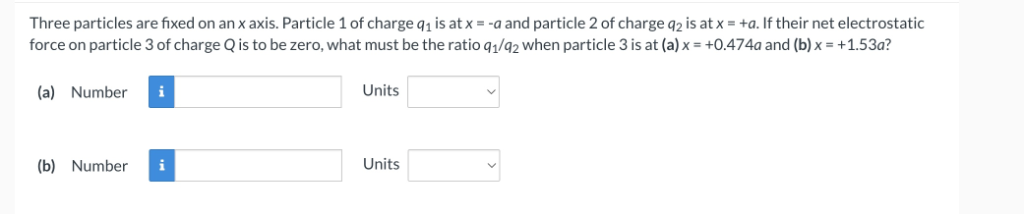 Three particles are fixed on an x axis. Particle 1 of charge q is at x = -a and particle 2 of charge q; is at x = +a. If their net electrostatic
force on particle 3 of charge Qis to be zero, what must be the ratio 1/q; when particle 31s at (a) x = +0.474a and (b) x = +1.53a?
(a) Number B Units v
to Number [B] Units .