 VIPSolutions
Give step-by-step solution with explanation and final answer:B. Sketch the signals. d(t) is a triangular pulse centered at the origin and has a bandwidth of 20. d(t) is now sampled at Nyquist rate. © Draw the d(t) and the sampled signal d(t). State the Nyquist rate and frequency. © The sampled signal, dy(t) is now filtered using an ideal lowpass filter, hy(t) with cutoff frequency . Draw the filtered signals and the filter. o Case 1: 2.504 = 0, o Case: 0g=20 Comment about the recovery of the original signal in both cases.
Question:
Give step-by-step solution with explanation and final answer: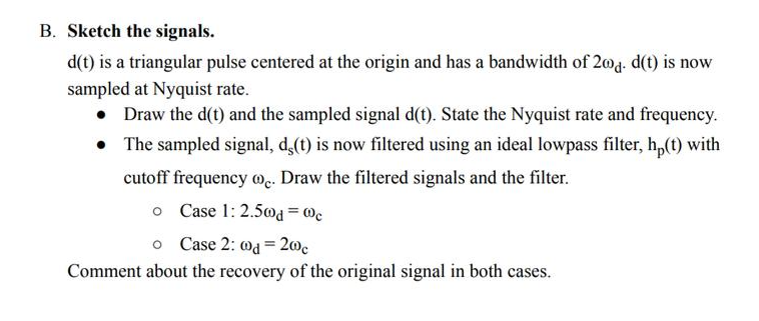 B. Sketch the signals.
d(t) is a triangular pulse centered at the origin and has a bandwidth of 20. d(t) is now
sampled at Nyquist rate.
© Draw the d(t) and the sampled signal d(t). State the Nyquist rate and frequency.
© The sampled signal, dy(t) is now filtered using an ideal lowpass filter, hy(t) with
cutoff frequency . Draw the filtered signals and the filter.
o Case 1: 2.504 = 0,
o Case: 0g=20
Comment about the recovery of the original signal in both cases.
This is AI generated Response.
Asked by: M Murali
Created at: 2025-11-10 08:29:54
Asked by: M Murali
Created at: 2025-11-10 08:29:54
Final Answer:
Rendered
Raw Text
Did you like this answer?
Let's break down and solve the problem step-by-step.
---
# **Step-by-Step Solution**
## **1. Understanding the Signal**
- **d(t)**: Triangular pulse centered at the origin.
- **Bandwidth:** \( 2\omega_d \)
- **Sampled at Nyquist rate.**
---
## **2. Drawing \( d(t) \) and Sampled Signal \( d_s(t) \)**
### **a. \( d(t) \): Triangular Pulse**
- Time domain: Looks like a triangle centered at \( t= \).
### **b. Frequency Domain of \( d(t) \)**
- Its spectrum is nonzero up to \( 2\omega_d \).
### **c. Sampling at Nyquist Rate**
- **Nyquist Rate:** \( 2 \times (\text{bandwidth}) = 2 \times 2\omega_d = 4\omega_d \)
- **Nyquist Frequency:** \( 2\omega_d \) (since highest frequency is \( 2\omega_d \))
### **d. Sampled Signal \( d_s(t) \)**
- In time: \( d(t) \) sampled at intervals \( T = \frac{\pi}{\omega_d} \)
- In frequency: Replicas of the spectrum every \( 2\omega_d \)
---
## **3. Filtering the Sampled Signal**
- Filtering with ideal lowpass filter \( h_p(t) \) with cutoff \( \omega_c \).
---
## **4. Cases for Filtered Signals**
### **Case 1: \( 2.5\omega_d = \omega_c \)**
- **Cutoff is wider than the signal bandwidth** (\( \omega_c > 2\omega_d \)):
- The original spectrum (up to \( 2\omega_d \)) passes through.
- No aliasing, so original signal can be **perfectly recovered**.
- **Sketch**: Filter passes the whole original signal and a bit more (extra frequencies pass, but no extra content).
### **Case 2: \( \omega_d = 2\omega_c \implies \omega_c = .5\omega_d \)**
- **Cutoff is much less than the signal bandwidth** (\( \omega_c < 2\omega_d \)):
- Only part of the spectrum (\( |\omega| < .5\omega_d \)) passes.
- **Most of the original signal is lost.**
- **Sketch**: Only a small central portion of the original spectrum passes through.
---
## **5. Comments on Signal Recovery**
- **Case 1:** The filter passes the entire spectrum of the original triangular pulse. The original signal can be **recovered perfectly**.
- **Case 2:** The filter only passes a small fraction of the signal's spectrum. **Most of the original signal is lost**, and only a heavily lowpass-filtered version (smoothed) remains.
---
# **Final Answers**
### **Nyquist Rate and Frequency**
- **Nyquist Rate:** \( 4\omega_d \)
- **Nyquist Frequency:** \( 2\omega_d \)
---
### **Sketches (Description)**
#### **Time Domain**
- \( d(t) \): Triangular pulse centered at .
- \( d_s(t) \): Series of samples (impulses) at intervals \( T \).
#### **Frequency Domain**
- \( D(\omega) \): Nonzero for \( |\omega| < 2\omega_d \), zero otherwise.
- Sampled signal: Replicas of \( D(\omega) \) at intervals \( 2\omega_d \).
#### **Filtered Signals**
- **Case 1 (\( \omega_c = 2.5\omega_d \))**: Filter passes the entire original spectrum (and then some).
- **Case 2 (\( \omega_c = .5\omega_d \))**: Filter passes only the central part; most original energy lost.
---
### **Signal Recovery**
- **Case 1:** **Perfect recovery** of \( d(t) \).
- **Case 2:** **Severe loss** of information; cannot recover \( d(t) \).
---
## **Summary Table**
| Case | Filter Cutoff (\( \omega_c \)) | Recovery of \( d(t) \) |
|------|-------------------------------|------------------------|
| 1 | \( 2.5\omega_d \) | Perfect |
| 2 | \( .5\omega_d \) | Not possible |
---
## **Illustrative Sketch**
```
Frequency axis:
|---------------------|---------------------|---------------------|
-2ω_d 2ω_d
Original spectrum: [=====]
Case 1 filter: [=============]
Case 2 filter: [==]
[=====] = original signal
[=============] = filter in case 1
[==] = filter in case 2
```
---
**In summary:**
- To recover a band-limited signal sampled at the Nyquist rate, the reconstruction filter should cover the entire original bandwidth.
- If the filter's bandwidth is too narrow, most of the signal's information is lost.
📢 Instructions:
- Ask anything relatd to above question only.
- For new Question goto :