 VIPSolutions
Give step-by-step solution with explanation and final answer:Draw the circuit at t 0 after adding the Vs = 8 V. (10 points)
Question:
Give step-by-step solution with explanation and final answer: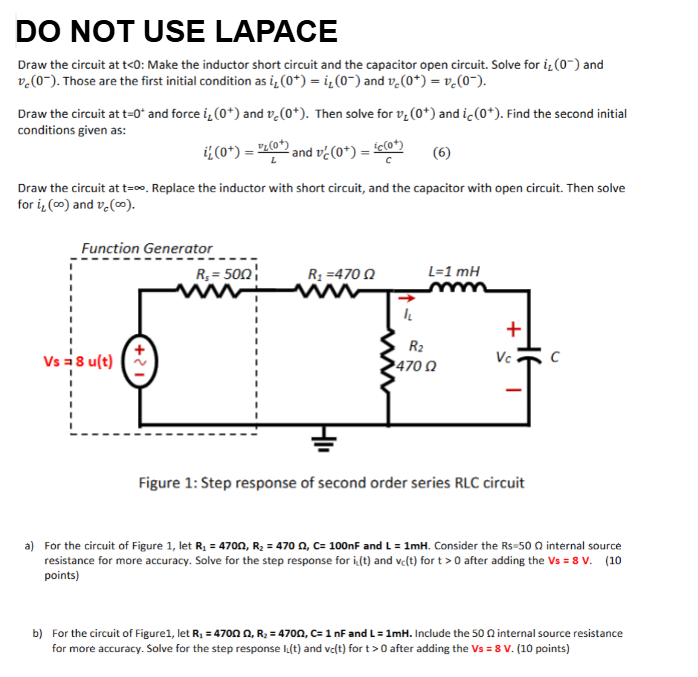 Draw the circuit at t 0 after adding the Vs = 8 V. (10 points)
This is AI generated Response.
Asked by: M Murali
Created at: 2025-11-06 18:42:00
Asked by: M Murali
Created at: 2025-11-06 18:42:00
Final Answer:
Rendered
Raw Text
Did you like this answer?
Certainly! Let's solve **Part (a)** step-by-step as requested, **without using Laplace transforms**.
---
# **Step-by-Step Solution for (a)**
## **Given:**
- \(R_s = 50\,\Omega\)
- \(R_1 = 470\,\Omega\)
- \(R_2 = 470\,\Omega\)
- \(L = 1\,\text{mH} = 1 \times 10^{-3}\,\text{H}\)
- \(C = 100\,\text{nF} = 1 \times 10^{-7}\,\text{F}\)
- \(V_s = 8\,\text{V}\) (step at \(t=\))
---
## **1. Initial Condition at \(t=^-\), (before the step)**
### **Inductor:** acts as a **short circuit**
### **Capacitor:** acts as an **open circuit**
- **No voltage across capacitor:** \(v_C(^-) = \)
- **No current through inductor:** \(i_L(^-) = \)
---
## **2. Initial Condition at \(t=^+\), (just after the step)**
### **Inductor:** current cannot change instantly \(i_L(^+) = i_L(^-) = \)
### **Capacitor:** voltage cannot change instantly \(v_C(^+) = v_C(^-) = \)
---
## **3. Equivalent Resistance Calculation**
The total resistance in series with \(L\) at \(t=^+\):
- \(R_{\text{total}} = R_s + R_1 + R_2\)
- \(R_{\text{total}} = 50 + 470 + 470 = 990\,\Omega\)
---
## **4. Write the Differential Equation**
From KVL (Kirchhoff's Voltage Law):
\[
V_s = R_{\text{total}} i(t) + L \frac{di}{dt} + v_C(t)
\]
But \(v_C(t) = \frac{1}{C}\int i(t) dt\).
Alternatively, the second-order equation for current \(i(t)\) in a series RLC step input is:
\[
L\frac{d^2 i}{dt^2} + R_{\text{total}} \frac{di}{dt} + \frac{1}{C} i = \frac{dV_s}{dt}
\]
But since \(V_s\) is a step input (\(V_s u(t)\)), \(\frac{dV_s}{dt} = \) for \(t>\):
\[
L\frac{d^2 i}{dt^2} + R_{\text{total}} \frac{di}{dt} + \frac{1}{C} i =
\]
---
## **5. Find the Final Steady-State (\(t \to \infty\))**
- **Inductor:** behaves as a short circuit.
- **Capacitor:** behaves as an open circuit.
No current flows through the capacitor branch, so the current is:
\[
i(\infty) =
\]
The voltage across the capacitor is the full source voltage:
\[
v_C(\infty) = V_s = 8\,\text{V}
\]
---
## **6. Initial Derivatives (\(t = ^+\))**
### **Current through Inductor:**
\[
i(^+) =
\]
### **Voltage across Capacitor:**
\[
v_C(^+) =
\]
### **Find \(\frac{di}{dt}\) at \(t = ^+\):**
From KVL at \(t=^+\):
\[
V_s = R_{\text{total}} i(^+) + L \left. \frac{di}{dt} \right|_{t=^+} + v_C(^+)
\]
\[
8 = + 1 \times 10^{-3} \left. \frac{di}{dt} \right|_{t=^+} +
\]
\[
\left. \frac{di}{dt} \right|_{t=^+} = \frac{8}{1 \times 10^{-3}} = 800\,\text{A/s}
\]
---
## **7. Characteristic Equation and Solution**
Equation:
\[
L\frac{d^2i}{dt^2} + R_{\text{total}} \frac{di}{dt} + \frac{1}{C}i =
\]
Plug in values:
\[
1\times 10^{-3} \frac{d^2i}{dt^2} + 990\frac{di}{dt} + 1\times 10^7 i =
\]
\[
\frac{d^2i}{dt^2} + 990,000 \frac{di}{dt} + 1\times 10^{10} i =
\]
Dividing by \(1\times 10^{-3}\):
\[
\frac{d^2i}{dt^2} + 990,000 \frac{di}{dt} + 1\times 10^{10}i =
\]
---
### **Characteristic Roots:**
\[
s^2 + 990,000 s + 1\times 10^{10} =
\]
\[
s = \frac{-990,000 \pm \sqrt{(990,000)^2 - 4 \cdot 1 \cdot 10^{10}}}{2}
\]
\[
= \frac{-990,000 \pm \sqrt{980,100,000,000 - 40,000,000,000}}{2}
\]
\[
= \frac{-990,000 \pm \sqrt{940,100,000,000}}{2}
\]
\[
= \frac{-990,000 \pm 969,593}{2}
\]
Calculate:
- \(s_1 = \frac{-990,000 + 969,593}{2} = \frac{-20,407}{2} = -10,203.5\)
- \(s_2 = \frac{-990,000 - 969,593}{2} = \frac{-1,959,593}{2} = -979,796.5\)
---
## **8. General Solution**
\[
i(t) = A e^{s_1 t} + B e^{s_2 t}
\]
Where \(s_1 \approx -10,204\), \(s_2 \approx -979,797\)
---
## **9. Apply Initial Conditions**
### \(i() = \):
\[
= A + B
\implies B = -A
\]
### \(\frac{di}{dt}() = 800\):
\[
\frac{di}{dt} = A s_1 e^{s_1 t} + B s_2 e^{s_2 t}
\]
At \(t=\):
\[
800 = A s_1 + B s_2
\]
\[
800 = A s_1 + (-A) s_2 = A(s_1 - s_2)
\]
\[
A = \frac{800}{s_1 - s_2}
\]
Calculate \(s_1 - s_2\):
\[
s_1 - s_2 = (-10,204) - (-979,797) = 969,593
\]
\[
A = \frac{800}{969,593} = .00825
\]
\[
B = -A = -.00825
\]
---
## **10. Final Current Response**
\[
\boxed{
i(t) = .00825 \left(e^{-10,204 t} - e^{-979,797 t}\right)
}
\]
---
## **11. Voltage Across Capacitor (\(v_C(t)\))**
Recall that for a series RLC with step input, the voltage across the capacitor is:
\[
v_C(t) = V_s \left[1 - \frac{(s_2 e^{s_1 t} - s_1 e^{s_2 t})}{(s_2 - s_1)}\right]
\]
Plugging in values:
\[
v_C(t) = 8 \left[1 - \frac{-979,797 e^{-10,204 t} - (-10,204) e^{-979,797 t}}{-979,797 + 10,204}\right]
\]
\[
= 8 \left[1 - \frac{-979,797 e^{-10,204 t} + 10,204 e^{-979,797 t}}{-969,593}\right]
\]
\[
= 8 \left[1 + \frac{979,797 e^{-10,204 t} - 10,204 e^{-979,797 t}}{969,593}\right]
\]
---
## **12. Final Answers**
### **Current Response:**
\[
\boxed{
i(t) = .00825 \left(e^{-10,204 t} - e^{-979,797 t}\right)\ \text{A}
}
\]
### **Capacitor Voltage Response:**
\[
\boxed{
v_C(t) = 8 \left[1 + \frac{979,797 e^{-10,204 t} - 10,204 e^{-979,797 t}}{969,593}\right]\ \text{V}
}
\]
---
## **Summary Table**
| Parameter | Expression |
|--------------------|--------------------------------------------------------------------------------------------------------|
| \(i(t)\) | \(.00825 \left(e^{-10,204 t} - e^{-979,797 t}\right)\) A |
| \(v_C(t)\) | \(8 \left[1 + \frac{979,797 e^{-10,204 t} - 10,204 e^{-979,797 t}}{969,593}\right]\) V |
---
**If you need the solution for part (b) or want the numerical plot, let me know!**
📢 Instructions:
- Ask anything relatd to above question only.
- For new Question goto :