Give step-by-step solution with explanation and final answer:Question # 4
Operational Amplifier — Frequency Response
25 Marks
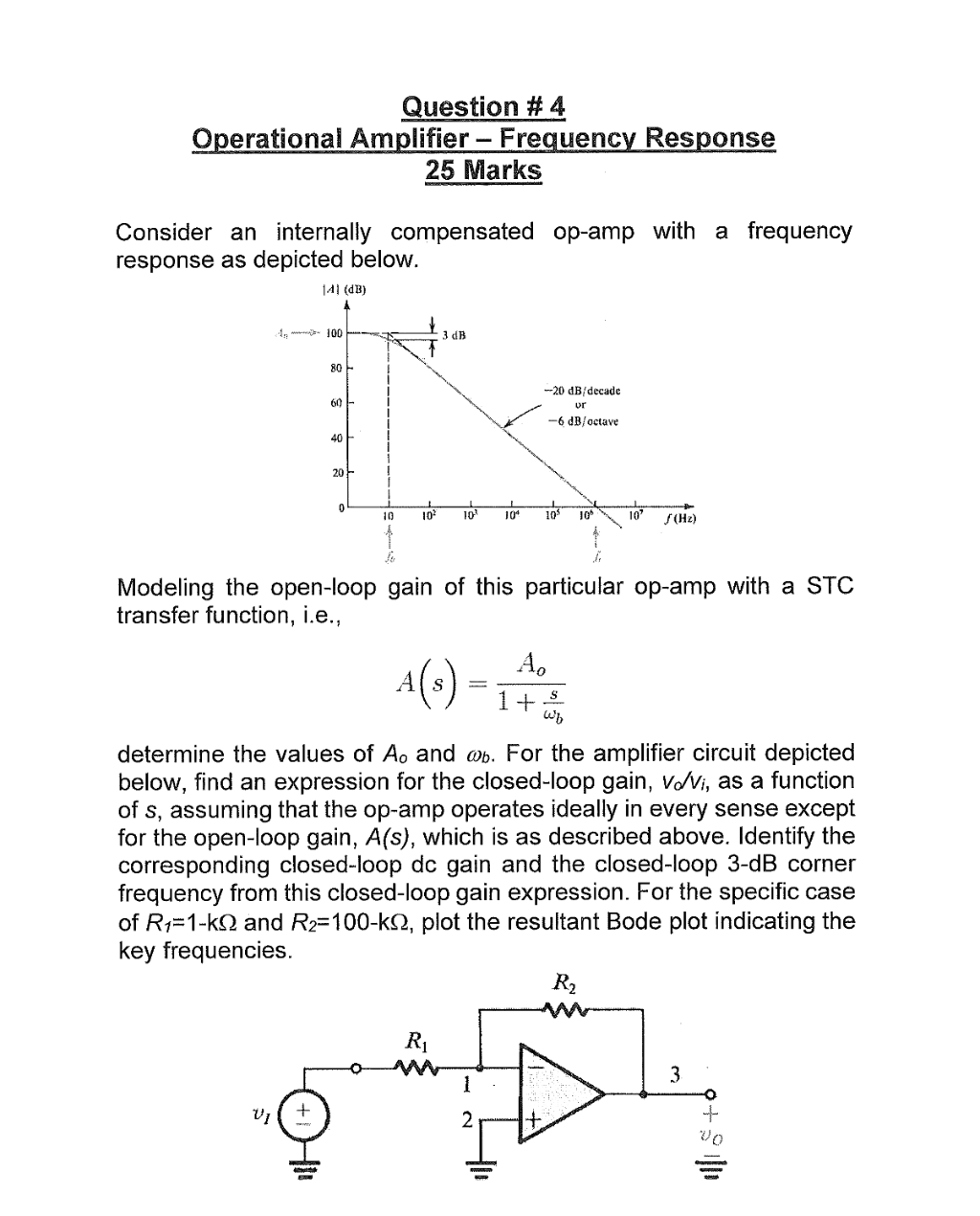
Consider an internally compensated op-amp with a frequency
response as depicted below.
141 dB)
tf, = 100 Re
| \. ~20 dB/decade
“r i AN -6 P—
af “
| AN
EY ! \.
| aS
° FE ANT)
Modeling the open-loop gain of this particular op-amp with a STC
transfer function, i.e.,
A
As) = —
1+ Py
determine the values of A, and ws. For the amplifier circuit depicted
below, find an expression for the closed-loop gain, vo/vi, as a function
of s, assuming that the op-amp operates ideally in every sense except
for the open-loop gain, A(s), which is as described above. Identify the
corresponding closed-loop dc gain and the closed-loop 3-dB corner
frequency from this closed-loop gain expression. For the specific case
of R1=1-kQ and R2=100-kQ, plot the resultant Bode plot indicating the
key frequencies.
R,
RB
o 3
Yo
Question:
Give step-by-step solution with explanation and final answer:Question # 4
Operational Amplifier — Frequency Response
25 Marks
Consider an internally compensated op-amp with a frequency
response as depicted below.
141 dB)
tf, = 100 Re
| \. ~20 dB/decade
“r i AN -6 P—
af “
| AN
EY ! \.
| aS
° FE ANT)
Modeling the open-loop gain of this particular op-amp with a STC
transfer function, i.e.,
A
As) = —
1+ Py
determine the values of A, and ws. For the amplifier circuit depicted
below, find an expression for the closed-loop gain, vo/vi, as a function
of s, assuming that the op-amp operates ideally in every sense except
for the open-loop gain, A(s), which is as described above. Identify the
corresponding closed-loop dc gain and the closed-loop 3-dB corner
frequency from this closed-loop gain expression. For the specific case
of R1=1-kQ and R2=100-kQ, plot the resultant Bode plot indicating the
key frequencies.
R,
RB
o 3
Yo
This is AI generated Response.
Asked by: M Murali
Created at: 2025-11-05 09:08:14
Final Answer:
RenderedRaw Text
Did you like this answer?
Let's break down the solution step by step:
---
# **Step 1: Extract Open-Loop Gain Parameters (\(A_\), \(\omega_b\))**
The open-loop transfer function is:
\[
A(s) = \frac{A_}{1 + \frac{s}{\omega_b}}
\]
From the Bode plot:
- \(A_\) (DC gain) is the low-frequency gain (at \(f = \)):
- From the plot, \( |A| = 100 \) dB at low frequencies.
- \(A_ (\text{linear}) = 10^{100/20} = 10^5\)
- The break frequency (\(f_b\)) where the gain starts to fall at \(-20~\text{dB/decade}\) is at \(10^2~\text{Hz}\).
- \(\omega_b = 2\pi f_b = 2\pi \times 10^2 = 628.3~\text{rad/s}\)
---
# **Step 2: Closed-Loop Gain Expression (\(v_o/v_i\))**
For a non-inverting amplifier:
\[
\text{Closed-loop gain (ideal)} = 1 + \frac{R_2}{R_1}
\]
With finite op-amp gain \(A(s)\):
\[
\frac{v_o}{v_i} = \frac{A(s)}{1 + A(s)\beta}
\]
where \(\beta = \frac{R_1}{R_1 + R_2}\)
Substituting \(A(s)\):
\[
\frac{v_o}{v_i} = \frac{\frac{A_}{1 + \frac{s}{\omega_b}}}{1 + \frac{A_}{1 + \frac{s}{\omega_b}} \beta}
\]
Multiply numerator and denominator by \(1 + \frac{s}{\omega_b}\):
\[
\frac{v_o}{v_i} = \frac{A_}{1 + A_\beta + \frac{s}{\omega_b}}
\]
---
# **Step 3: DC Closed-Loop Gain**
As \(s \to \):
\[
\left(\frac{v_o}{v_i}\right)_{DC} = \frac{A_}{1 + A_\beta}
\]
For large \(A_\), \(\frac{A_}{1 + A_\beta} \approx \frac{1}{\beta} = 1 + \frac{R_2}{R_1}\).
---
# **Step 4: Closed-Loop 3-dB Corner Frequency**
The denominator is \(1 + A_\beta + \frac{s}{\omega_b}\):
\[
\Rightarrow f_{cl} = \frac{\omega_{b,cl}}{2\pi}
\]
where
\[
\omega_{b,cl} = \omega_b (1 + A_\beta)
\]
---
# **Step 5: Substitute Values (Given \(R_1 = 1~k\Omega, R_2 = 100~k\Omega\))**
\[
\beta = \frac{R_1}{R_1 + R_2} = \frac{1}{1 + 100} = \frac{1}{101}
\]
\[
A_\beta = 10^5 \times \frac{1}{101} \approx 990
\]
\[
\omega_{b,cl} = 628.3 \times (1 + 990) \approx 628.3 \times 991 \approx 622,259~\text{rad/s}
\]
\[
f_{cl} = \frac{622,259}{2\pi} \approx 99,085~\text{Hz} \approx 99~\text{kHz}
\]
DC closed-loop gain:
\[
\frac{A_}{1 + A_\beta} = \frac{10^5}{1 + 990} \approx 101
\]
or in dB: \(20\log_{10}(101) \approx 40~\text{dB}\)
---
# **Step 6: Bode Plot**
- **Low-frequency gain:** \(40~\text{dB}\) (closed-loop)
- **Low-frequency gain (open-loop):** \(100~\text{dB}\)
- **Open-loop 3-dB frequency:** \(f_b = 100~\text{Hz}\)
- **Closed-loop 3-dB frequency:** \(f_{cl} \approx 99~\text{kHz}\)
## **Key Points for Bode Plot:**
- \(100~\text{dB}\) flat until \(100~\text{Hz}\) (open-loop)
- Then, slope of \(-20~\text{dB/decade}\) (open-loop)
- Closed-loop gain: flat at \(40~\text{dB}\) until \(99~\text{kHz}\)
- At \(99~\text{kHz}\), slope drops \(-20~\text{dB/decade}\) (closed-loop)
---
## **Summary Table**
| Parameter | Value |
|------------------|---------------------------|
| \(A_\) | \(10^5\) (\(100~\text{dB}\)) |
| \(\omega_b\) | \(628.3~\text{rad/s}\) (\(100~\text{Hz}\)) |
| \(\beta\) | \(.0099\) |
| Closed-loop DC gain | \(101\) (\(40~\text{dB}\)) |
| \(f_{cl}\) (3-dB) | \(99~\text{kHz}\) |
---
## **Final Answers**
**1. \(A_ = 10^5\), \(\omega_b = 628.3~\text{rad/s}\) (\(100~\text{Hz}\))**
**2. Closed-loop gain:**
\[
\frac{v_o}{v_i} = \frac{A_}{1 + A_\beta + \frac{s}{\omega_b}}
\]
**3. DC closed-loop gain:** \(101\) (\(40~\text{dB}\))
**4. Closed-loop 3-dB frequency:** \(99~\text{kHz}\)
**5. Bode plot:**
- Flat at \(40~\text{dB}\) up to \(99~\text{kHz}\), then rolls off at \(-20~\text{dB/decade}\).
---
### **Bode Plot (Sketch)**

*Alt text: Bode plot showing open-loop gain at 100 dB up to 100 Hz, then -20 dB/decade; closed-loop gain at 40 dB up to 99 kHz, then -20 dB/decade.*
---
Let me know if you need a hand-drawn or more detailed Bode plot!
VIPSolutions focuses on clear, step‑by‑step explanations so you can learn quickly. Whether you need an AI‑generated walkthrough or a short hint to get unstuck, each solution is organized for fast reading and easy review later.
Search similar questions, compare approaches, and bookmark the best answers for revision. Our goal is simple: quick, reliable study help that feels natural—not noisy.
 VIPSolutions
 Question # 4
Operational Amplifier — Frequency Response
25 Marks
Consider an internally compensated op-amp with a frequency
response as depicted below.
141 dB)
tf, = 100 Re
| \. ~20 dB/decade
“r i AN -6 P—
af “
| AN
EY ! \.
| aS
° FE ANT)
Modeling the open-loop gain of this particular op-amp with a STC
transfer function, i.e.,
A
As) = —
1+ Py
determine the values of A, and ws. For the amplifier circuit depicted
below, find an expression for the closed-loop gain, vo/vi, as a function
of s, assuming that the op-amp operates ideally in every sense except
for the open-loop gain, A(s), which is as described above. Identify the
corresponding closed-loop dc gain and the closed-loop 3-dB corner
frequency from this closed-loop gain expression. For the specific case
of R1=1-kQ and R2=100-kQ, plot the resultant Bode plot indicating the
key frequencies.
R,
RB
o 3
Yo