 VIPSolutions
Give step-by-step solution with explanation and final answer:The following problems should be solved primarily by hand to prepare for the exam. However, MATLAB or other computational tools are allowed. 1. You have determined a state feedback control law to place the poles for the following system with the desired closed-loop poles below. ._[0 1 0 x=[y Qfx+fe y=[1 ox Desired poles of controller: s = —=3 + 2i Design a closed-loop estimator to use with this system.
Question:
Give step-by-step solution with explanation and final answer: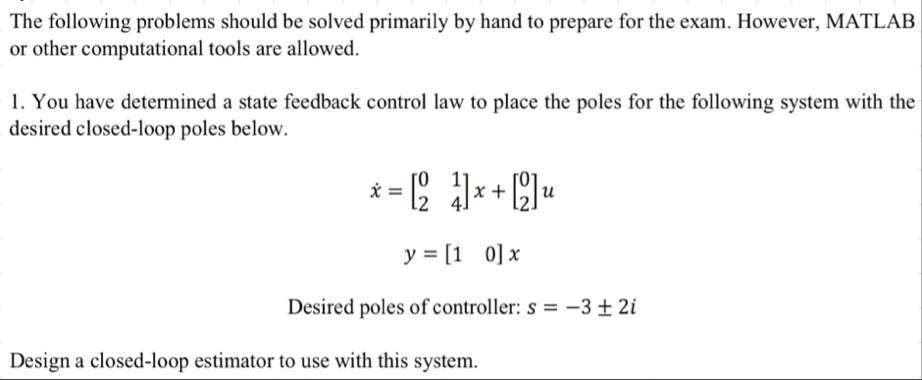 The following problems should be solved primarily by hand to prepare for the exam. However, MATLAB
or other computational tools are allowed.
1. You have determined a state feedback control law to place the poles for the following system with the
desired closed-loop poles below.
._[0 1 0
x=[y Qfx+fe
y=[1 ox
Desired poles of controller: s = —=3 + 2i
Design a closed-loop estimator to use with this system.
This is AI generated Response.
Asked by: M Murali
Created at: 2025-11-05 05:41:05
Asked by: M Murali
Created at: 2025-11-05 05:41:05
Final Answer:
Rendered
Raw Text
Did you like this answer?
Let's break down the problem and **design a closed-loop estimator** (observer) for the given system.
---
## **Given System**
\[
\dot{x} = \begin{bmatrix} & 1 \\ 2 & 4 \end{bmatrix} x + \begin{bmatrix} \\ 2 \end{bmatrix} u
\]
\[
y = \begin{bmatrix} 1 & \end{bmatrix} x
\]
---
## **Step 1: Observer Structure**
The standard observer (Luenberger observer) is:
\[
\dot{\hat{x}} = A\hat{x} + Bu + L(y - C\hat{x})
\]
Where
- \( A = \begin{bmatrix} & 1 \\ 2 & 4 \end{bmatrix} \)
- \( B = \begin{bmatrix} \\ 2 \end{bmatrix} \)
- \( C = \begin{bmatrix} 1 & \end{bmatrix} \)
- \( L \) is the observer gain to be designed
---
## **Step 2: Error Dynamics**
Define the estimation error \( e = x - \hat{x} \):
\[
\dot{e} = (A - LC)e
\]
We design \( L \) so that the eigenvalues of \( (A - LC) \) are at desired locations.
---
## **Step 3: Choose Observer Poles**
Usually, observer poles are chosen to be **faster** than controller poles.
Controller poles: \( s = -3 \pm 2i \)
Let’s choose observer poles to be at \( s = -5 \pm 4i \) (arbitrary, but faster).
---
## **Step 4: Observer Gain Calculation**
Let \( L = \begin{bmatrix} l_1 \\ l_2 \end{bmatrix} \).
\[
A - LC = \begin{bmatrix}
& 1 \\
2 & 4
\end{bmatrix} -
\begin{bmatrix}
l_1 \\ l_2
\end{bmatrix}
\begin{bmatrix}
1 &
\end{bmatrix}
=
\begin{bmatrix}
- l_1 & 1 \\
2 - l_2 & 4
\end{bmatrix}
=
\begin{bmatrix}
-l_1 & 1 \\
2 - l_2 & 4
\end{bmatrix}
\]
---
### **Characteristic Equation**
Let’s set the characteristic equation of \( A - LC \) to match the desired observer poles:
\[
\det\left(sI - (A - LC)\right) =
\]
\[
\det\left(
\begin{bmatrix}
s + l_1 & -1 \\
-(2-l_2) & s - 4
\end{bmatrix}
\right) =
\]
\[
(s + l_1)(s - 4) - 1(2 - l_2) =
\]
\[
(s + l_1)(s - 4) - (2 - l_2) =
\]
\[
s^2 + (l_1 - 4)s - 4l_1 - (2 - l_2) =
\]
\[
s^2 + (l_1 - 4)s - 4l_1 - 2 + l_2 =
\]
---
### **Desired Characteristic Equation**
For poles at \( s = -5 \pm 4i \):
\[
(s + 5 - 4i)(s + 5 + 4i) = (s + 5)^2 + (4)^2 = s^2 + 10s + 25 + 16 = s^2 + 10s + 41
\]
---
### **Matching Coefficients**
Match with above:
\[
s^2 + (l_1 - 4)s + (-4l_1 - 2 + l_2) = s^2 + 10s + 41
\]
So,
- \( l_1 - 4 = 10 \implies l_1 = 14 \)
- \( -4l_1 - 2 + l_2 = 41 \implies l_2 = 41 + 4l_1 + 2 \)
Substitute \( l_1 = 14 \):
\[
l_2 = 41 + 4 \times 14 + 2 = 41 + 56 + 2 = 99
\]
---
## **Step 5: Final Observer**
\[
L = \begin{bmatrix} l_1 \\ l_2 \end{bmatrix} = \begin{bmatrix} 14 \\ 99 \end{bmatrix}
\]
The observer is:
\[
\boxed{
\dot{\hat{x}} = A\hat{x} + Bu + L(y - C\hat{x}), \quad L = \begin{bmatrix} 14 \\ 99 \end{bmatrix}
}
\]
---
### **Summary**
- **Observer poles chosen:** \( s = -5 \pm 4i \)
- **Observer gain:** \( L = \begin{bmatrix} 14 \\ 99 \end{bmatrix} \)
- **Estimator equation:**
\[
\boxed{
\dot{\hat{x}} = \begin{bmatrix} & 1 \\ 2 & 4 \end{bmatrix} \hat{x} + \begin{bmatrix} \\ 2 \end{bmatrix} u + \begin{bmatrix} 14 \\ 99 \end{bmatrix} (y - \begin{bmatrix} 1 & \end{bmatrix} \hat{x})
}
\]
📢 Instructions:
- Ask anything relatd to above question only.
- For new Question goto :